


50,000 animals butchered near Hindu temple to appease goddess

[email protected] (CD Network)
October 12, 2016

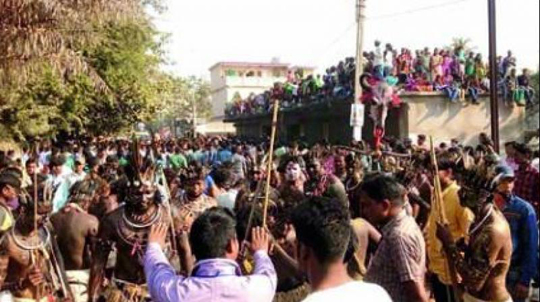
Bhawanipatna, Oct 12: In spite of public awareness campaigns and ban imposed by the Odisha government, people belonging to Hindu community have mercilessly butchered over 50,000 animals and birds to “appease” goddess Manikeswari during the annual “Chhattar Yatra” near the Manikeswari temple, here like previous years.
goddess

The district administration had also made fervent appeals to the people to refrain from killing animals and birds. However, the slaughtering continued tillSunday afternoon despite 15 CCTV and drone cameras being installed.

The huge deployment of police personnel also failed to check the slaughter, as most of the locals extended their patronage to the act, arguing that animal sacrifice was a long-practiced religious tradition during Chhattar Yatra, and the government's ban is an infringement of their right to religion.

Since no political parties want to earn the displeasure of the locals, they also don't raise their voice against the practice, nor do they cooperate with the administration's effort to enforce the law.

According to reports, over 1.5 lakh people took part in the annual festival, and had a glimpse of the presiding deity while it was taken out in a procession.

As many as 11 platoons of police personnel were deployed to maintain law and order. Besides, 41 sub-inspectors, 15 inspectors, five deputy superintendents of police and one additional SP, were deployed at the festival.

“We had initiated awareness campaigns to prevent animal sacrifice. I believe it will be on the wane due to massive awareness programmest,” Kalahandi SP Brijesh Kumar Rai was quoted as saying.

During the Chhattar Yatra, the goddess is taken in a procession from Jenakhal after Sandhi Puja to Bhawanipatna town, the permanent abode of the deity.

On Sunday, the Chhattar procession took off at around 5.20 am with people making beeline to have a glimpse of the presiding deity. The town reverberated amid the rhythmic beats of Jenabadya, Nisan and Ghanta (traditional musical instruments) and dancers performing Ghumura' and martial art forms.

“We eagerly wait for the festival to participate in it. The people of Kalahandi have immense faith in Maa Manikeswari. We offer sacrifices on fulfillment of our wishes in which people across caste and religion participate in it,” Sudharam Sarap, a devotee.

Before the start of the sacrifice ritual on Asthami tithi of the Hindu month of Ashwina every year, two swords belonging to the goddess are washed in the pond located behind the palace. The swords are then worshipped and brought back to the temple in a procession. Then a buffalo is sacrificed at the Budharaja or Vairab temple, a satellite shrine of the Manikeswari temple.

Following this ritual, the Chhattar or umbrella of the goddess, along with two swords of the deity, are taken out for the procession.

Comments

Satyameva jayate
 - 
Thursday, 13 Oct 2016

Where our beloved maa lovers and nationalists......
Muslims sacrifice animals In the name of the world's creator and consume it as food with respect.....these people sacrifice in the names of story book characters and dump them as waste....so which is cruel......

Raj
 - 
Wednesday, 12 Oct 2016

This is not hinduism. If this is hinduism then i think. Islam is better religion. They don't sacrifice to please god. As per true indian. What he said is true. I gone through quran app just now. And god says he only feed and he is not fed.

Many hindus including my self eat kfc. It DOESN'T please God.

If they continue like this. Then many hindus will convert to Muslim.

Every year hindu population is decreasing and muslim population is increasing. May be this is the reason.

suresh
 - 
Wednesday, 12 Oct 2016

VERY BAD.
god does not need anything from us.
Love, live and let live.

In Nepal, infamous Gadhimai temple sacrifice has banned completely by people. Now we have to be caring for all the living beings on earth.

H A Dsouza
 - 
Wednesday, 12 Oct 2016

Where is gavrakshakas their aim is to target minorities

TRUE INDIAN
 - 
Wednesday, 12 Oct 2016

WHY GOD NEEDS BLOOD. THEY EVEN KILL YOUNG KIDS TO PLEASE GOD. DISGUSTING.

Quran 6:14 He who feeds and is not fed?

Best way of life Islam.

SHABEER AHAMME…
 - 
Wednesday, 12 Oct 2016

OH my god..Bajarangdal / RSS / VHP / RAMASENE / & 100 many more Hindu wrong wings sleeping or RIP. Oh yeah political game. maneka gandhi / and many more on vacation it seems.
OH What about Arnab Cow Swamy. Still at large

Rikaz
 - 
Wednesday, 12 Oct 2016

Where is Maneka Gandhi, is she sleeping.....

Add new comment

  • Coastaldigest.com reserves the right to delete or block any comments.
  • Coastaldigset.com is not responsible for its readers’ comments.
  • Comments that are abusive, incendiary or irrelevant are strictly prohibited.
  • Please use a genuine email ID and provide your name to avoid reject.
News Network
March 28,2020

Bengaluru, Mar 28: Sun Tsu, in 'The Art of War' speaks of a skilful general who can subdue his enemy without any fighting. This constitutes the ultimate triumph which is referred to as stratagem. Today, we would need one such when we are faced with the '21-day corona challenge' for India.
Nearly four weeks back, Dr Jyothsna Rao, Dr Gururaj Rao and I sat across the OPD in the afternoon at HCG Bengaluru discussing our ongoing cancer immunology research. While on this topic, we drifted into the discussion on the coronavirus. During this engaging discussion, we wondered the similarity of the enigma between the virus and cancer. I paused to ask Dr Jyothsna and Dr Guru - how we wish we could do something against this virus.
Dr Jyothsna is a PhD from NCBS and had worked under Dr Ralph Steinman, physician and researcher from Rockefeller University, who won the Nobel Prize for his discovery of the dendritic cell and its role in adaptive immunity in 2011. Dr Gururaj is a molecular and cell biologist who did his PhD at the Chapel Hill, University of North Carolina and is the Director of iCrest.
Jyothsna while hearing our perplexing conversation on the covid intervened, "Yes, surely. I think we should take a break from cancer and focus on the innate and adaptive immunity role in COVID-19."
Thus began this sincere attempt to relook the human immune system from the eyes of the COVID-19.
We have 10 types of immune cells at the least which are widely dispersed in millions across the body. When our body is invaded by a foreign organism (bacteria, fungi or virus), these cells work with each other to destroy the invader.
Now, the question is - how do the immune cells talk to each other? They use small-molecule substances called cytokines (cyto means cells; kine means movement). There are many cytokines that are involved in work on the immune system. The most relevant for viruses are interferons.
Interferons (IFN) as the name reflects have an ability to interfere with the viral activity and stop their multiplication. These specialised signal proteins are released by our cells in response to a viral attack to forewarn other cells. They help build the antiviral proteins within the cells to kill the virus as it tries to invade the new cells.
Historically, interferons are a group of cytokines known to be potent antiviral agents against viruses and a hallmark cytokine induced by the host upon viral infections. Interferons possess unique immunoregulatory activities and are signature cytokines released by (TH1) T immune cells, which are crucial in viral infections.
As the outbreak of COVID-19 grapples us, an urgent need for finding strategies to combat the virus is growing. Coronaviruses (CoVs) are a group of RNA viruses. In patients infected with coronavirus, it was indicated that the activation of the IFN does not occur until 48 hours post-infection. Thus the delayed IFN-related antiviral response by the healthy cells leads to coronavirus evade the immune response.
Numerous studies have presented the success in defeating CoVs by the direct administration of IFNs. In a combination as a concoction, it was shown to synergistically inhibit the virus replication in vitro.
Moreover, it is understood that the earlier induction of IFNs in children although they have a less developed immune system could be the reason behind the children being least affected.
The key to success in reducing the disease fatality might be the stimulation of the immune responses to trigger IFN production at the very early stages of the disease, which might be done through the administration of IFN. Despite the evidence for the efficacy of IFNs in treating CoV-induced infections, the proper dosing and ideal timing for such interventions needs to be verified in clinical trials.
For the later stages of the diseases in advance stages where patients are on ventilator and have developed respiratory distress, we propose to utilise the mesenchymal cells derived from donor bone marrow that have been known to treat acute respiratory syndrome. Mesenchymal cells are known to possess anti-inflammatory activity and thus used often in autoimmune diseases.
With this scientific background, we have activated T cells from healthy donors, in a cGMP facility at iCrest - HCG hospital with an enriched cocktail of cytokines rich in Interferons. Injections of this cocktail we believe will result in a surge of cytokines in the body of the infected person and will boost his ability to fight the virus in the early phases. We are in the initial phases of this study and hope to be ready in the coming weeks with meaningful data on its potential utility.
Currently, it awaits government approvals (Union and state) and we have applied to central drugs authority for their initial evaluation and further directions.
As my Guru often expounded the philosophy of 'Seva' - the goal of education is knowledge, the end goal of knowledge is service. In this attempt to serve our fellow humans at this brink of unprecedented crisis, medical fraternity stands with you and promises to do our best for your safety.
We assure to exhaust every bit of our spirit in this fight against coronavirus. We have lost the sight of shores and travelled thus far, but that is the mandatory first step to cross the ocean. Are we going to succeed in this battle, is something only time will answer. 

Comments

Add new comment

  • Coastaldigest.com reserves the right to delete or block any comments.
  • Coastaldigset.com is not responsible for its readers’ comments.
  • Comments that are abusive, incendiary or irrelevant are strictly prohibited.
  • Please use a genuine email ID and provide your name to avoid reject.
News Network
March 30,2020

Mangaluru, Mar 30: In continuing cases of tipplers in the southern states ending their lives due to non-availability of liquor during the lockdown, two men committed suicide in Karnataka's Dakshina Kannada district.

The two suicides were reported in Kadaba taluk on Saturday, police said.

Tomy Thomas (50), a rubber tapping labourer in an estate at Kutrupadi village of the taluk, was found hanging at his rented house on Saturday. Thomas, a native of Kottayam in Kerala, had joined at the estate here a month ago.

Local people said he was desperately moving around in the last few days asking about places where he can get liquor. He had also not reported to work in these days. The body has been kept at the mortuary of a hospital at Deralakatte.

In another incident, a 70-year old man, belonging to Kodimbala village in the taluk, allegedly hanged himself from the branch of a tree near his house at Nakur.

The deceased has been identified as Thomas, who had left his family here 30 years ago and had been working in Kerala. He had returned here only a few years back.

Sources said Thomas, an alcohol addict, was having health problems related to withdrawal. He has been living on pavements at Kadaba without going home.

Kadaba police has registered cases in connection with the two incidents.

Incidents of tipplers committing suicide have been reported in Kerala and Telangana in the past few days. Two men ended their lives in Kerala today while a 50-year old daily wage worker jumped to death from a building in Hyderabad on Friday.

Comments

Add new comment

  • Coastaldigest.com reserves the right to delete or block any comments.
  • Coastaldigset.com is not responsible for its readers’ comments.
  • Comments that are abusive, incendiary or irrelevant are strictly prohibited.
  • Please use a genuine email ID and provide your name to avoid reject.
News Network
April 6,2020

Bengaluru, Apr 6: Karnataka State Board for Auqaf on Monday suspended mass prayers and visit to the Qabrasthans (graveyards) and dargahs on the occasion of Shab-e-Barat on April 9 due to the coronavirus pandemic.

"It is hereby directed to all not to hold congregational prayer in the Masjid and the management of the Qabrasthans/Dargahs throughout the State should suspend the visit of public on the occasion of Shab-e-Barat on Thursday, April 9," according to a statement here on Monday.

It said, no public shall be allowed to perform religious rituals in the Qabrasthans/Dargahs and all the gates shall be kept closed.

Comments

Add new comment

  • Coastaldigest.com reserves the right to delete or block any comments.
  • Coastaldigset.com is not responsible for its readers’ comments.
  • Comments that are abusive, incendiary or irrelevant are strictly prohibited.
  • Please use a genuine email ID and provide your name to avoid reject.