No end to blood and gore in Kannur: SDPI activist brutally murdered

[email protected] (CD Network)
October 13, 2016

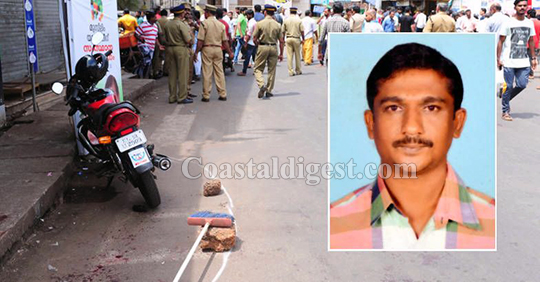
Kannur, Oct 13: Considered to be a hotbed of political violence, Kerala's Kannur district witnessed yet another murder on Thursday. This time the victim is an activist of Social Democratic Party of India.

sdpi

45-year-old Farooq, the president of SDPI Neerchal unit in Kannur was hacked to death near a hotel in the city around 11 am. He was rushed to hospital, but his life could not be saved.

SDPI alleged that Indian Union Muslim League (IUML) activists were behind the murder. Police have taken Abdul Rauf, a native of Kannur, into custody in connection with the murder.

Farooq is the third person to be murdered in last four days in Kannuru district which witnessed seven murders and a death due to bomb explosion after the LDF came to power in May this year.

Out of this, five murders were spread over a period of three months. The latest three were committed in four days that too in the assembly constituency represented by chief minister Pinarayi Vijayan, who also handles the home portfolio.

This year's wave of gory politics began on May 19, with the murder of Cherikandath Raveendran (55), a CPM worker and native of Pinarayi Puthankandam, during a victory procession after the LDF wrested the seat.

Though the CPM said that he was killed by the BJP workers, who first hurled bombs at the procession and then ran a vehicle over him, the latter refuted the allegations. BJP maintained that he was killed after suffering a fall from the vehicle, which then accidentally ran over him. However, as per police records it is a murder case.

Also Read:

BJP holds state-wide hartal protesting killing of party activist

Bloody revenge: BJP activist hacked to death in Kannur

Comments

Mohammed Rafique
 - 
Thursday, 13 Oct 2016

Viren...stop barking and we know which community kills more of its own brethren

Viren Kotian
 - 
Thursday, 13 Oct 2016

hahaha. Both IUML and SDPI call for Muslim unity and blame \Sickular\" parties like Congress for victory of nationalists. Funny part is that they kill each other."

Rikaz
 - 
Thursday, 13 Oct 2016

Blood thirsty people! its utter nonsense...

Add new comment

  • Coastaldigest.com reserves the right to delete or block any comments.
  • Coastaldigset.com is not responsible for its readers’ comments.
  • Comments that are abusive, incendiary or irrelevant are strictly prohibited.
  • Please use a genuine email ID and provide your name to avoid reject.
Ram Puniyani
February 10,2020

Noam Chomsky is one of the leading peace workers in the world. In the wake of America’s attack on Vietnam, he brought out his classic formulation, ‘manufacturing consent’. The phrase explains the state manipulating public opinion to have the public approve of it policies—in this case, the attack of the American state on Vietnam, which was then struggling to free itself from French colonial rule.

In India, we are witness to manufactured hate against religious minorities. This hatred serves to enhance polarisation in society, which undermines India’s democracy and Constitution and promotes support for a Hindu nation. Hate is being manufactured through multiple mechanisms. For example, it manifests in violence against religious minorities. Some recent ghastly expressions of this manufactured hate was the massive communal violence witnessed in Mumbai (1992-93), Gujarat (2002), Kandhamal (2008) and Muzaffarnagar (2013). Its other manifestation was in the form of lynching of those accused of having killed a cow or consumed beef. A parallel phenomenon is the brutal flogging, often to death, of Dalits who deal with animal carcasses or leather.

Yet another form of this was seen when Shambhulal Regar, indoctrinated by the propaganda of Hindu nationalists, burned alive Afrazul Khan and shot the video of the heinous act. For his brutality, he was praised by many. Regar was incited into the act by the propaganda around love jihad. Lately, we have the same phenomenon of manufactured hate taking on even more dastardly proportions as youth related to Hindu nationalist organisations have been caught using pistols, while police authorities look on.

Anurag Thakur, a BJP minster in the central government recently incited a crowd in Delhi to complete his chant of what should happen to ‘traitors of the country...” with a “they should be shot”. Just two days later, a youth brought a pistol to the site of a protest at Jamia Millia Islamia university and shouted “take Azaadi!” and fired it. One bullet hit a student of Jamia. This happened on 30 January, the day Nathuram Godse had shot Mahatma Gandhi in 1948. A few days later, another youth fired near the site of protests against the CAA and NRC at Shaheen Bagh. Soon after, he said that in India, “only Hindus will rule”.

What is very obvious is that the shootings by those associated with Hindu nationalist organisations are the culmination of a long campaign of spreading hate against religious minorities in India in general and against Muslims in particular. The present phase is the outcome of a long and sustained hate campaign, the beginning of which lies in nationalism in the name of religion; Muslim nationalism and Hindu nationalism. This sectarian nationalism picked up the communal view of history and the communal historiography which the British introduced in order to pursue their ‘divide and rule’ policy.

In India what became part of “social common sense” was that Muslim kings had destroyed Hindu temples, that Islam was spread by force, and that it is a foreign religion, and so on. Campaigns, such as the one for a temple dedicated to the Hindu god Rama to be built at the site where the Babri masjid once stood, further deepened the idea of a Muslim as a “temple-destroyer”. Aurangzeb, Tipu Sultan and other Muslim kings were tarnished as the ones who spread Islam by force in the subcontinent. The tragic Partition, which was primarily due to British policies, and was well-supported by communal streams also, was entirely attributed to Muslims. The Kashmir conflict, which is the outcome of regional, ethnic and other historical issues, coupled with the American policy of supporting Pakistan’s ambitions of regional hegemony, (which also fostered the birth of Al-Qaeda), was also attributed to the Muslims.

With recurring incidents of communal violence, these falsehoods went on going deeper into the social thinking. Violence itself led to ghettoisation of Muslims and further broke inter-community social bonds. On the one hand, a ghettoised community is cut off from others and on the other hand the victims come to be presented as culprits. The percolation of this hate through word-of-mouth propaganda, media and re-writing of school curricula, had a strong impact on social attitudes towards the minorities.

In the last couple of decades, the process of manufacturing hate has been intensified by the social media platforms which are being cleverly used by the communal forces. Swati Chaturvedi’s book, I Am a Troll: Inside the Secret World of the BJP’s Digital Army, tells us how the BJP used social media to spread hate. Whatapp University became the source of understanding for large sections of society and hate for the ‘Other’, went up by leaps and bounds. To add on to this process, the phenomenon of fake news was shrewdly deployed to intensify divisiveness.

Currently, the Shaheen Bagh movement is a big uniting force for the country; but it is being demonised as a gathering of ‘anti-nationals’. Another BJP leader has said that these protesters will indulge in crimes like rape. This has intensified the prevalent hate.

While there is a general dominance of hate, the likes of Shambhulal Regar and the Jamia shooter do get taken in by the incitement and act out the violence that is constantly hinted at. The deeper issue involved is the prevalence of hate, misconceptions and biases, which have become the part of social thinking.

These misconceptions are undoing the amity between different religious communities which was built during the freedom movement. They are undoing the fraternity which emerged with the process of India as a nation in the making. The processes which brought these communities together broadly drew from Gandhi, Bhagat Singh and Ambedkar. It is these values which need to be rooted again in the society. The communal forces have resorted to false propaganda against the minorities, and that needs to be undone with sincerity.

Combating those foundational misconceptions which create hatred is a massive task which needs to be taken up by the social organisations and political parties which have faith in the Indian Constitution and values of freedom movement. It needs to be done right away as a priority issue in with a focus on cultivating Indian fraternity yet again.

Comments

Add new comment

  • Coastaldigest.com reserves the right to delete or block any comments.
  • Coastaldigset.com is not responsible for its readers’ comments.
  • Comments that are abusive, incendiary or irrelevant are strictly prohibited.
  • Please use a genuine email ID and provide your name to avoid reject.
coastaldigest.com news network
May 14,2020

Kuwait: The COVID-19 pandemic has affected all sections of the community in Kuwait, hundreds of NRIs are stranded due to unavailability of flights to fly back home. Leaders of associations belonging to Karnataka state in Kuwait and other part of Gulf countries have initiated a collective effort to discuss the challenges and issues faced by Kannadigas in Gulf Countries during COVID-19 pandemic.    

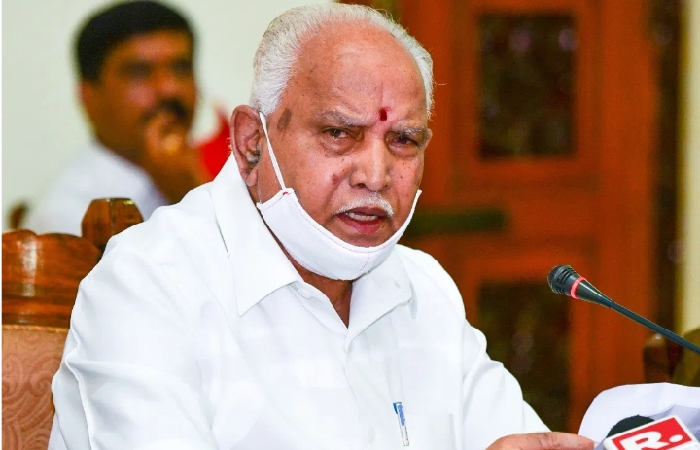
Mr. Ramesh S Bhandary – President of Tulu Koota Kuwait and Mr. Rajesh Vittal KKK president along with Other Gulf Karnataka Association leaders held video conference meeting arranged by GULF NRI Forum with Hon. Chief Minister of Karnataka Sri B.S. Yediyurappa to discuss the issue of COVID19 in Kuwait.

During this video conference, association leaders briefly explained various issues, statistics of emergency cases which include pregnant women, Senior citizens, visit visa expired cases and urgent medical treatment requirement cases who wish to travel back to Karnataka.

Evacuation flights to Bengaluru and Mangalore from Kuwait and other Gulf countries, request for free airline tickets or free quarantine facility at Bengaluru and Mangaluru also requested during this video call.

Dedicated Covid - 19 Helpline number for Karanataka NRIs- Nominate One line Contact person in Karnataka to co-ordinates all Covid related issues of NRI.

Responding to leaders requests, B.S Yediyurappa promised to address GCC Kannadigas concerns during this humanitarian crisis.

On Behalf of Kannadigaru Dubai & KNRI Forum , Gulf Kannadigas & Gulf Karantaka associations leaders expressed the happiness with BS Yadiyurappa - Hon Chief Minister of Karnataka, Raghavendra Yadiyurappa - Member of Parliament - Shivamogga constituency, for hearing problems of NRI and giving assurance of immediate action plan to repatriate needy Kannadigas from Gulf region to Karnataka.

Video conference was attended by Karnataka association leaders of Gulf Countries.

Karnataka NRI  Forum Kuwait committee comprising  representatives of leading associations of Karnataka in Kuwait such as Tulu Koota Kuwait (TKK), Kuwait Canara Welfare Association (KCWA), Kuwait Kannada Koota (KKK), Buntara Sangha Kuwait (BSK), Billava Sangha Kuwait (BSK), KKMA Karnataka Branch , Indian Doctors Forum and Karnataka Muslim Welfare Association Kuwait (KMWA).

Comments

Add new comment

  • Coastaldigest.com reserves the right to delete or block any comments.
  • Coastaldigset.com is not responsible for its readers’ comments.
  • Comments that are abusive, incendiary or irrelevant are strictly prohibited.
  • Please use a genuine email ID and provide your name to avoid reject.
News Network
August 2,2020

Bengaluru, Aug 2: Within a year of returning to power for the fourth time as Chief Minister in Karnataka, septuagenarian B.S. Yediyurappa has consolidated his position in the ruling BJP to stay the course till the next Assembly elections in mid-2023.

"A combination of factors helped Yediyurappa to consolidate and stay the course for the remaining term of his office to ensure the saffron party retains power in the state though he is unlikely to stake claim for the chief minister's post again as he would be 80 years old by 2023," a party source told news agency here.

Since the 77-year-old seasoned politician assumed office on July 26, 2019, the first year has been tumultuous for him, as he had go through a "trial by fire" what with the party's mighty high command and detractors testing his patience in the face of natural calamities like drought, floods and the Covid pandemic.

The first 7-8 months of the term were spent in tackling drought and floods, winning 12 of the 15 by-elections in December to secure a majority for the ruling party in the lower house and expanding the cabinet in February.

Even as Yediyurappa was settling down to seriously govern after presenting the state budget for fiscal 2020-21 in early March, the coronavirus outbreak overwhelmed him, as the pandemic spread and wreaked havoc, disrupting life, livelihood, economic growth and development.

"While the emphatic victory in the by-elections ensured the government's stability till the assembly term up to mid-2023, the second cabinet expansion on February 6 posed a challenge to Yediyurappa, as he could induct only 10 of the 12 MLAs who defected from the Congress and the Janata Dal-Secular (JD-S) and won the by-elections, triggering a revolt in the party by the loyalists left out of the ministry," the source recalled.

Though Yeddiyurappa has been leading the battle against the virus from day 1 and initially succeeded in controlling it from spreading during the extended lockdown till May 31, reopening the state under Unlock since June has undone the gains, as positive cases shot up to 1,29,287 so far, including 73,219 in Bengaluru after 53,648 recovered from across the state till date, while 2,412 succumbed to the deadly disease since March 9.

"For a state of 7 crore population, the data reveals that the pandemic has been fought on war-footing to contain it from spreading in all the 30 districts, although there are no signs of it going away till a vaccine is found. The chief minister has been trying to balance unlocking the state and containing the infection," a member of the health task force told IANS.

With six cabinet posts in the 34-member ministry being vacant, filling them will be a daunting task for Yediyurappa, as at least 20 legislators, including 5-6 newly elected turncoats and party's veterans are lobbying to become ministers at any cost.

By appointing 20 party legislators as heads of state-run board and corporations, nominating 5 as members of the state legislative council, including JD-S defector A.H. Vishwanath in July and getting 2 Congress defectors R. Shankar and M.T.B. Nagaraj elected as MLCs in June with 2 others, Yediyurappa ensured that these lawmakers would not be in the reckoning for the 6 cabinet posts, as dozen MLAs are already pitching for them.

Nagaraj and Vishwanath lost in the December 5 by-elections, while Shankar was not given a ticket to contest in the by-poll but was assured of making him an MLC with another disgruntled member C.P. Yogeshwar, who lost in the 2018 May assembly polls to JD-S leader and former chief minister H.D. Kumaraswamy of the 14-month-old JD-S and Congress coalition government from May 23, 2018 to July 23, 2019.

Resignations of 17 rebels, including 14 from the Congress and 3 from the JD-S led to the fall of the coalition government, as Kumaraswamy lost the majority in the 225-member assembly on July 23, 2019 in their absence.

Though Yediyurappa led the party to win 105 seats in the 2018 assembly elections and formed a government on May 17, 2018, he resigned 3 days later on May 19, 2018, as he fell 8-9 seats short of the halfway mark (113) for a simple majority in the lower house.

In a post-poll alliance, the JD-S and the Congress formed the coalition government to keep the BJP out of power in May 2018, after the assembly elections gave split verdict and the Congress lost power then.

"The record victory of the ruling party in the May 2019 general elections, when 25 of its 27 contestants won out of 28 Lok Sabha seats from the state, reinforced the popular belief that Yediyurappa is the party's mascot in winning elections and an unquestionable leader of the politically dominant Lingayats in the state," the source pointed out.

When Yediyurappa left the BJP and floated a regional outfit (Karnataka Janata Party) in January 2013, he delivered a body blow to the BJP in the May 2013 state assembly polls, as the votes got split and was defeated by then Congress.

"Besides the party's high command, everyone in the party's state unit, including leaders and cadres are aware of Yediyurappa's popularity across the state, as has the wherewithal to connect with masses and win elections," the source added.


Comments

Add new comment

  • Coastaldigest.com reserves the right to delete or block any comments.
  • Coastaldigset.com is not responsible for its readers’ comments.
  • Comments that are abusive, incendiary or irrelevant are strictly prohibited.
  • Please use a genuine email ID and provide your name to avoid reject.