Protests intensify in Bengaluru over RSS worker's murder

October 17, 2016

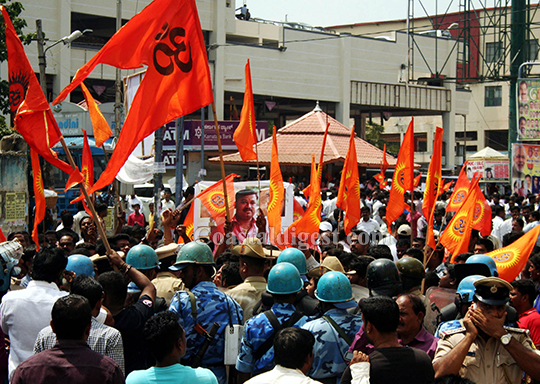
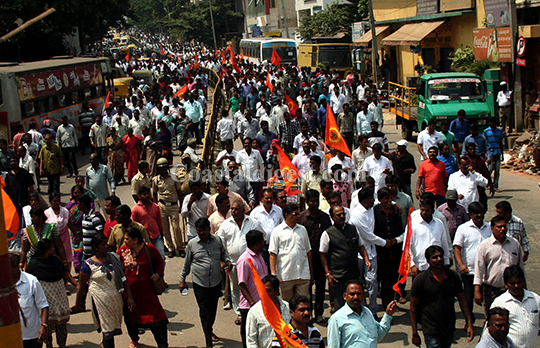
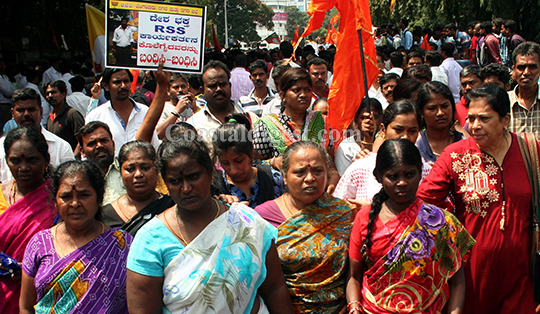
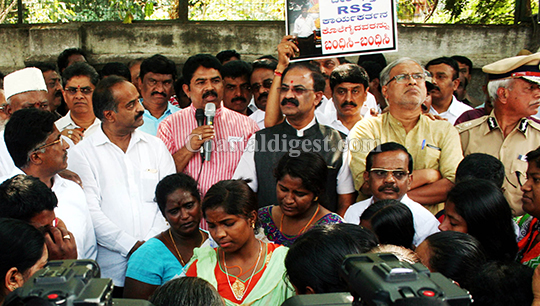
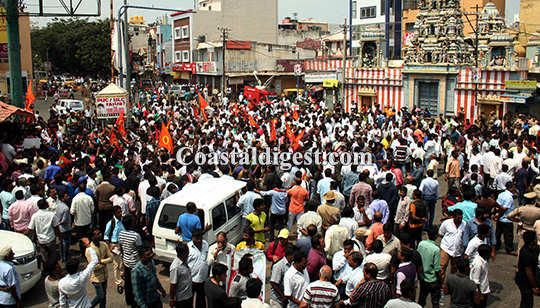
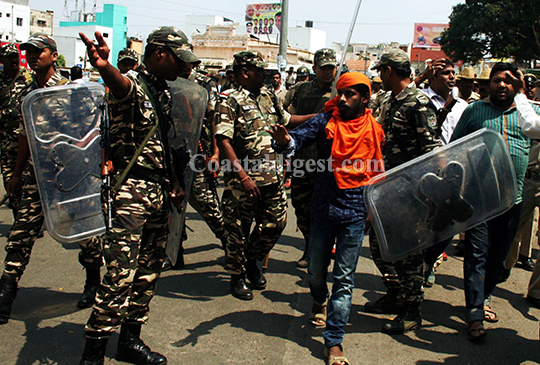
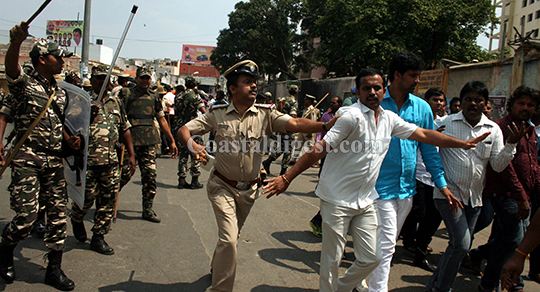
Bengaluru, Oct 17: BJP and RSS workers today staged a protest here against the gruesome murder of a local RSS functionary and demanded a fair probe into the case and immediate arrest of the culprits.

Bprtst 9

Rudresh, a 35-year old RSS worker, was hacked to death by two motorcycle-borne men who struck him with machete on Kamaraja Road here yesterday, when he was returning home on a bike after attending an RSS event.

RSS has called for a bandh today in Shivajinagar area, where the murder took place following which prohibitory orders have been clamped in four police station limits of the eastern zone of the city Commissionerate limits till midnight.

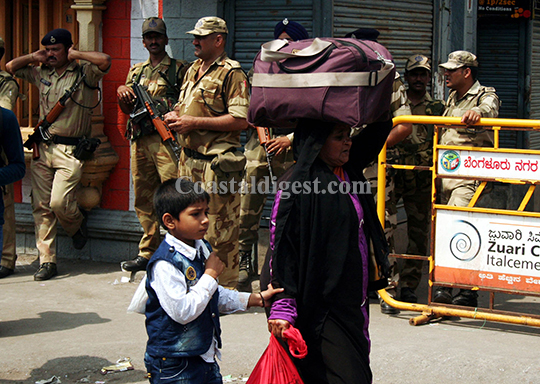
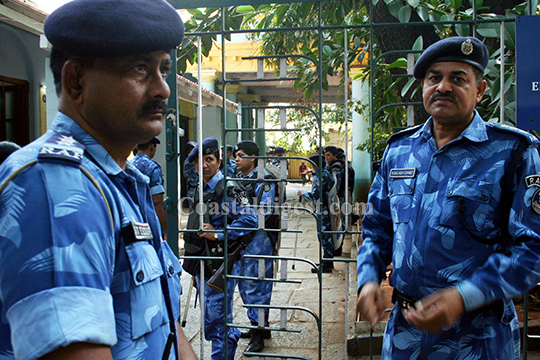
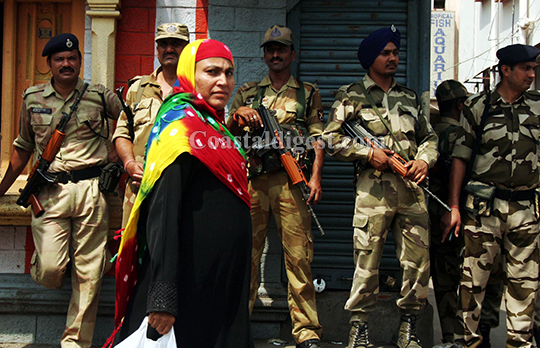
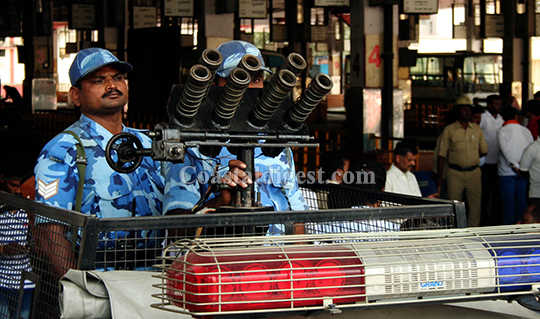
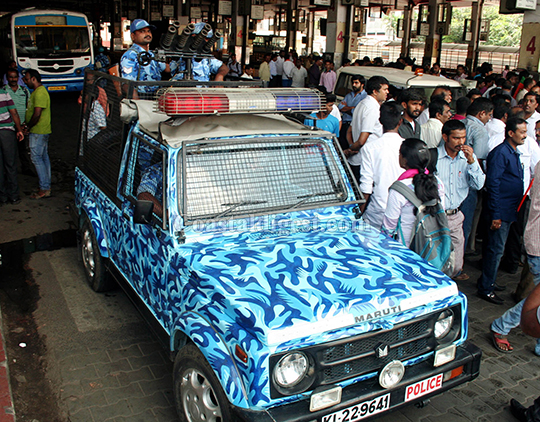
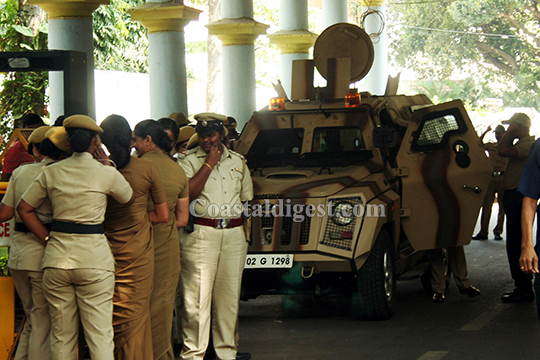
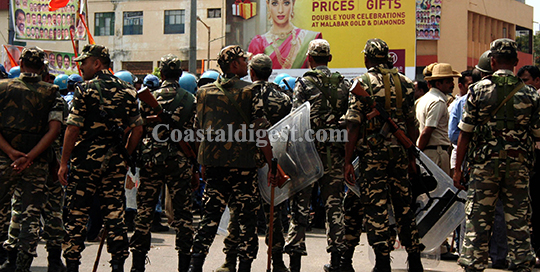
Police said elaborate security arrangements had been made all over the city as a precautionary measure, adding that central forces have also been deployed.

Platoons of Karnataka State Reserve Police, City Armed Reserve, Rapid Action Force and Central Industrial security Force have been deployed, police said.

BJP and RSS workers led by former Deputy Chief Minister R Ashoka and Members of Parliament Shobha Karandlaje and P C Mohan and others, marched from Shivajinagar towards Police Commissioner's office, but were stopped midway.

Linking Rudresh's murder to killing of BJP and RSS functionaries in different part of the country, Karandlaje said "there is a feeling that these killings are part of a planned conspiracy."

Ashoka said the culprits should be nabbed first before they fled out of the city or state.
Home Minister G Parameshwara said, "Four to five teams have been formed to investigate. Police will do their job. A few persons have already been taken into the custody, inquiry is on."

He said "Rudres happens to be an RSS worker, other than that, we are not aware of anything about him. We will get to know the exact reasons for his killing only after the investigation."

Assuring BJP and RSS workers that police will conduct a fair investigation into the case, city Police Commissioner N S Megharikh said, "We will nab the culprits soon."

Bprtst 2

Bprtst 1

Bprtst 3

Bprtst 4

Bprtst 5

Bprtst 6

Bprtst 7

Bprtst 8

Bprtst 10

Bprtst 11

Bprtst 12

Bprtst 13

Bprtst 14

Comments

shaji
 - 
Tuesday, 18 Oct 2016

These hate mongers and trouble makers should not be allowed to disturb the peace.

Add new comment

  • Coastaldigest.com reserves the right to delete or block any comments.
  • Coastaldigset.com is not responsible for its readers’ comments.
  • Comments that are abusive, incendiary or irrelevant are strictly prohibited.
  • Please use a genuine email ID and provide your name to avoid reject.
News Network
May 9,2020

Bengaluru, May 9: The bar owners in Karnataka, while welcoming the state government's decision to allow takeaway sales of liquor, said that the move is not going to benefit them much.

Venkatesh Babu, a Bengaluru-based bar owner said, "We welcome this move, our bar was closed for two months due to coronavirus crisis. We have been facing losses since then."

"The state government has told us to sell our stocks at maximum retail price (MRP). It is difficult for us to manage as the rent is high and we also have to pay salaries," he added.

The owner of Pingara Bar and Restaurant, Shivamogga said, "The government has said that is for parcel only and that too at MRP. There is no benefit to our business. We are only clearing the existing stock. They have given us time till May 17 and are not even giving us fresh stock. We are only allowed to sell what we have already."

Karnataka government in its Friday order allowed restaurants, pubs and bars to sell liquor at retail prices from May 9 till May 17, the day the third phase of lockdown is slated to end.

Earlier, the government had allowed the opening of liquor shops in order to mobilise revenue.

However, bars, pubs, restaurants were ordered to remain closed amid the COVID-19 lockdown.

Comments

Add new comment

  • Coastaldigest.com reserves the right to delete or block any comments.
  • Coastaldigset.com is not responsible for its readers’ comments.
  • Comments that are abusive, incendiary or irrelevant are strictly prohibited.
  • Please use a genuine email ID and provide your name to avoid reject.
Ram Puniyani
February 4,2020

As democracy is seeping in slowly all over the world, there is an organization which is monitoring the degree of democracy in the individual countries, The Economist Intelligence Unit. As such in each country there are diverse factors which on one hand work to deepen it, while others weaken it. Overall there is a march from theoretical democracy to substantive one. The substantive democracy will herald not just the formal equality, freedom and community feeling in the country but will be founded on the substantive quality of these values. In India while the introduction of modern education, transport, communication laid the backdrop of beginning of the process, the direction towards deepening of the process begins with Mahatma Gandhi when he led the non-cooperation movement in 1920, in which average people participated. The movement of freedom for India went on to become the ‘greatest ever mass movement’ in the World.

The approval and standards for democracy were enshrined in Indian Constitution, which begins ‘We the people of India’, and was adopted on 26th January 1950. With this Constitution and the policies adopted by Nehru the process of democratization started seeping further, the dreaded Emergency in 1975, which was lifted later restored democratic freedoms in some degree. This process of democratisation is facing an opposition since the decade of 1990s after the launch of Ram Temple agitation, and has seen the further erosion with BJP led Government coming to power in 2014. The state has been proactively attacking civil liberties, pluralism and participative political culture with democracy becoming flawed in a serious way. And this is what got reflected in the slipping of India by ten places, to 51st, in 2019. On the index of democracy India slipped down from the score of 7.23 to 6.90. The impact of sectarian BJP politics is writ on the state of the nation, country.

Ironically this lowering of score has come at a time when the popular protests, the deepening of democracy has been given a boost and is picking up with the Shaheen Bagh protests. The protest which began in Shaheen Bagh, Delhi in the backdrop of this Government getting the Citizenship amendment Bill getting converted into an act and mercilessly attacking the students of Jamia Milia Islamia, Aligarh Muslim University along with high handed approach in Jamia Nagar and neighbouring areas.  From 15th December 2019, the laudable protest is on.

It is interesting to note that the lead in this protest has been taken by the Muslim women, from the Burqa-Hijab clad to ‘not looking Muslim’ women and was joined by students and youth from all the communities, and later by the people from all the communities. Interestingly this time around this Muslim women initiated protest has contrast from all the protests which earlier had begun by Muslims. The protests opposing Shah Bano Judgment, the protests opposing entry of women in Haji Ali, the protests opposing the Government move to abolish triple Talaq. So far the maulanas from top were initiating the protests, with beard and skull cap dominating the marches and protests. The protests were by and large for protecting Sharia, Islam and were restricted to Muslim community participating.

This time around while Narendra Modi pronounced that ‘protesters can be identified by their clothes’, those who can be identified by their external appearance are greatly outnumbered by all those identified or not identified by their appearance.

The protests are not to save Islam or any other religion but to protect Indian Constitution. The slogans are structured around ‘Defence of democracy and Indian Constitution’. The theme slogans are not Allahu Akbar’ or Nara-E-Tadbeer’ but around preamble of Indian Constitution. The lead songs have come to be Faiz Ahmad Faiz’s ‘Hum Dekhenge’, a protest against Zia Ul Haq’s attempts to crush democracy in the name of religion. Another leading protest song is from Varun Grover, ‘Tanashah Aayenge…Hum Kagaz nahin Dikhayenge’, a call to civil disobedience against the CAA-NRC exercise and characterising the dictatorial nature of the current ruling regime.

While BJP was telling us that primary problem of Muslim women is Triple talaq, the Muslim women led movements has articulated that primary problem is the very threat to Muslim community. All other communities, cutting across religious lines, those below poverty line, those landless and shelter less people also see that if the citizenship of Muslims can be threatened because of lack of some papers, they will be not far behind in the victimization process being unleashed by this Government.

While CAA-NRC has acted as the precipitating factor, the policies of Modi regime, starting from failure to fulfil the tall promises of bringing back black money, the cruel impact of demonetisation, the rising process of commodities, the rising unemployment, the divisive policies of the ruling dispensation are the base on which these protest movements are standing. The spread of the protest movement, spontaneous but having similar message is remarkable. Shaheen Bagh is no more just a physical space; it’s a symbol of resistance against the divisive policies, against the policies which are increasing the sufferings of poor workers, the farmers and the average sections of society.

What is clear is that as identity issues, emotive issues like Ram Temple, Cow Beef, Love Jihad and Ghar Wapasi aimed to divide the society, Shaheen Bagh is uniting the society like never before. The democratisation process which faced erosion is getting a boost through people coming together around the Preamble of Indian Constitution, singing of Jan Gan Man, waving of tricolour and upholding the national icons like Gandhi, Bhagat Singh, Ambedkar and Maulana Azad. One can feel the sentiments which built India; one can see the courage of people to protect what India’s freedom movement and Indian Constitution gave them.

Surely the communal forces are spreading canards and falsehood against the protests. As such these protests which is a solid foundation of our democracy. The spontaneity of the movement is a strength which needs to be channelized to uphold Indian Constitution and democratic ethos of our beloved country.


Comments

Add new comment

  • Coastaldigest.com reserves the right to delete or block any comments.
  • Coastaldigset.com is not responsible for its readers’ comments.
  • Comments that are abusive, incendiary or irrelevant are strictly prohibited.
  • Please use a genuine email ID and provide your name to avoid reject.
coastaldigest.com news network
May 17,2020

Benglauru, May 17: A garment company manager jumped to death from his third-floor house on Saturday, four days after having killed his wife and wrapping her body in a blanket. 

Manish Kumar, 42, gave a relative and neighbours frightening moments before committing suicide at AECS Layout, Kudlu Gate, Southeast Bengaluru. The relative had come over after Kumar’s brother called him from Delhi, saying he had stopped responding to phone calls. 

The relative, who lives in Hongasandra, arrived at Kumar’s house around noon. He knocked on the door which was bolted from the inside but didn’t get a response. When he asked the neighbours, they said they didn’t have a clue. The relative and the neighbours decided to break the door open. 

But as they entered the house, they got the shock of their lives. Kumar was slitting his wrist with a blade. He then ran into the bathroom and locked himself in. They followed him and asked him to open the door. But he ignored them. They had to break open the bathroom door, too. By this time, Kumar had slashed his hands, chest and other parts of the body. Waving the blade at them, he asked them to stay away. 

Even the relative and the neighbours pleaded with him to drop the blade, he ran out and jumped off the building. He was taken to a hospital but it was too late. 

A bigger shock awaited them. They felt a foul smell emanating from the house. When they went in, they found the decomposed body of Kumar’s wife, Sandhya, 35, wrapped in a blanket. They called the cops. 

Police found a death note purportedly written by Kumar on May 12. “We suspect he killed her on that day,” said a police officer investigating the case. 

Police said the death note specifies what made Kumar kill his wife and commit suicide. Sandhya suspected him of having an affair since he regularly chatted up some bar dancers he had met in Gurgaon and Delhi. She accessed his phone and saw the calls and the WhatsApp messages he had sent them. The issue rocked their marital life and they often fought over it. He then decided to kill his wife and commit suicide, as per the death note. 

Police said Kumar appeared to have spent the last four days at home, with his wife’s body wrapped in the blanket. “We don’t know whether he tried to dispose of the body or didn’t want to see it,” the officer said. Police couldn’t determine how he killed her and are waiting for the post-mortem report. 

Joshi Srinath Mahadev, DCP (Southeast), said the couple hailed from Bihar. “We are waiting for Sandhya’s relatives to arrive in Bengaluru. A case of murder and suicide has been registered at the Parappana Agrahara police station.” Another officer said the couple had a love marriage.

Comments

Add new comment

  • Coastaldigest.com reserves the right to delete or block any comments.
  • Coastaldigset.com is not responsible for its readers’ comments.
  • Comments that are abusive, incendiary or irrelevant are strictly prohibited.
  • Please use a genuine email ID and provide your name to avoid reject.