



Now, PM Modi likens army's surgical strike to Israel's exploits

October 18, 2016

Mandi, Oct 18: Prime Minister Narendra Modi today likened the army's anti-terror surgical strikes to Israel's exploits and said the Indian forces have shown they are no less than anybody.
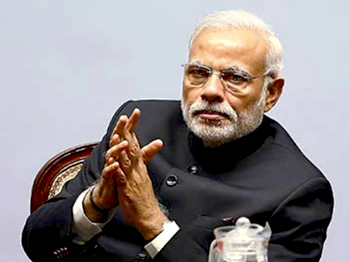
modi"Our army's valour is being discussed across the country these days. We used to hear earlier that Israel has done this. The nation has seen that Indian army is no less than anybody," he said.

Israel is known for its targeted military strikes against enemy countries and militant outfits.

Modi was speaking at a rally in Himachal Pradesh where he inaugurated three hydro-power projects.

The issue of surgical strikes has snowballed into a political row with the opposition accusing the BJP and its government of "milking" it for political benefits. The charge has been rejected by BJP which has insisted that it is taking the issue to the masses to boost the army's morale and highlight the strong political will of the Prime Minister.

Underscoring his commitment to the welfare of armed forces, Modi today said his government had fulfilled its promise of 'One-Rank, One-Pension' for ex-servicemen, an issue which he said had been hanging fire for over 40 years.

Previous governments, he said, duped the people by making tall claims and some of them even allocated Rs 200 crore-500 crore in this regard but never did an analysis of cost burden and how it could be executed.

"I did it and was puzzled to find that the economic burden kept rising. It worked to be more than Rs 10,000 crore," he said, adding that it was difficult for any government to make such a big allocation in one go.

Modi said he spoke to armed forces and offered to release the money in four installments to which they agreed.

"Over Rs 5,500 crore in first installment has been given. The rest will be to. A promise hanging fire for the last 40 years has been fulfilled," he said.

At the 'Parivartan Rally', Modi also targeted Virbhadra Singh, the Chief Minister of Himachal Pradesh where elections are due late next year, saying BJP chief ministers dedicated themselves to causes like drinking water and roads while the Congress leader was concerned about his own welfare.

"Do I need to explain what the current chief minister is known for?" he said and then added, "When BJP gave chief ministers, somebody dedicated himself to water, somebody to roads but when others came they dedicated so many things for their personal welfare," he said.

BJP has accused Singh of being involved in corruption but the Congress leader has rejected the charges and claimed that he was a victim of "political vendetta".

Comments

Naren kotian
 - 
Tuesday, 18 Oct 2016

Pakistani or rashtra drohi spotted. . haha ...why shud we strike china? Nimma maavana mane taraha gadda bitkondiro handicapped 6th century stinky people na China terrorism madsilikke kalihisolla ...we will strike Pakistan like our superb role model Israel. . we love the art of killing used by Israelis ...long live Israel. . we must strike mini Pakistanis also in this sane way ...

Honesty
 - 
Tuesday, 18 Oct 2016

Its been discussed thru modi bhakts and only in the cheddi media...
Please lets do it with CHINA also...

Add new comment

  • Coastaldigest.com reserves the right to delete or block any comments.
  • Coastaldigset.com is not responsible for its readers’ comments.
  • Comments that are abusive, incendiary or irrelevant are strictly prohibited.
  • Please use a genuine email ID and provide your name to avoid reject.
Agencies
May 14,2020

New Delhi, May 14: India may witness the death of additional 1.2-6 lakh children over the next one year from preventable causes as a consequence to the disruption in regular health services due to the COVID-19 pandemic, UNICEF has warned.

The warning comes from a new study that brackets India with nine other nations from Asia and Africa that could potentially have the largest number of additional child deaths as a consequence to the pandemic.

These potential child deaths will be in addition to the 2.5 million children who already die before their fifth birthday every six months in the 118 countries included in the study.

The estimate is based on an analysis by researchers from the Johns Hopkins Bloomberg School of Public Health published in the Lancet.  

This means the global mortality rate of children dying before their fifth birthday, one of the key progress indicators in all of the global development, could potentially increase for the first time since 1960 when the data was first collected.

There were 1.04 million under-5 deaths in India in 2017, of which nearly 50% (0.57 million) were neonatal deaths. The highest number of under-5 deaths was in Uttar Pradesh (312,800 which included 165,800 neonatal deaths) and Bihar (141,500 which included 75,300 neonatal deaths).

The researchers looked at three scenarios, factoring in parameters like reduction in workforce, supplies and access to healthcare for services like family planning, antenatal care, childbirth care, postnatal care, vaccination and preventive care for early childhood. The effects are modelled for a period of three months, six months and 12 months.  

In scenario-1 marked by 10-18% reduction of coverage of all the services, the number of additional children deaths could be in the range of 30,000 plus over three months, more than 60,000 over six months and above 120,000 over the next 12 months.

Coronavirus India update: State-wise total number of confirmed cases, deaths on May 13

The numbers sharply rose to nearly 55,000; 109,000 and 219,000 respectively for scenario-2, which was associated with an 18-28% drop in all the regular services.

But in the worst-case scenario in which 40-50% of the services are not available, the number of additional deaths ballooned to 1.5 lakhs in the three months in the short-range to nearly six lakhs over a year.

The ten countries that could potentially have the largest number of additional child deaths are Bangladesh, Brazil, Congo, Ethiopia, India, Indonesia, Nigeria, Pakistan, Uganda and Tanzania.

In countries with already weak health systems, COVID-19 is causing disruptions in medical supply chains and straining financial and human resources.

Visits to health care centres are declining due to lockdowns, curfews and transport disruptions, and due to the fear of infection among the communities. Such disruptions could result in potentially devastating increases in maternal and child deaths, the UN agency warned.

Comments

Add new comment

  • Coastaldigest.com reserves the right to delete or block any comments.
  • Coastaldigset.com is not responsible for its readers’ comments.
  • Comments that are abusive, incendiary or irrelevant are strictly prohibited.
  • Please use a genuine email ID and provide your name to avoid reject.
Agencies
July 30,2020

Mumbai, Jul 30: Counterfeiting incidents have increased 24 per cent in the country in 2019 over the previous year, creating an over Rs 1 lakh crore hole in the economy, according to a report.

The report also said counterfeiters are having a free run due to the pandemic-driven disruptions to organised supply chains and the resultant spike in consumer demand.

According to the report by ASPA, a self-regulated industry body of anti-counterfeiting and traceability solutions providers, counterfeiting has risen steadily in the last few years, and exploiting the pandemic as a cover for their activities.

Between February and April 2020, over 150 incidents of counterfeiting cases were reported, mostly about fake PPE kits, sanitisers and masks taking advantage of the high demand for these products, it noted.

"There was a 24 per cent increase in counterfeiting in 2019 over 2018, leading to the loss of more than Rs 1 lakh crore to the overall economy," said Nakul Pasricha, president of Authentication Solution Providers Association.

The association works with global authorities like the International Hologram Manufacturers Association, Counterfeit Intelligence Bureau of the Interpol, and domestic industry lobbies like Ficci, he said.

Counterfeiting is a universal issue and is 3.3 per cent of global trade, according to the OECD data, impacting social and economic development across the world.

The report lists the currency, FMCG, alcohol, pharma, documents, agriculture, infrastructure, automotive, tobacco, lifestyle and apparel, as the 10 sectors impacted most by counterfeiting.

Among these, currency, alcohol and FMCG continue to be the top three sectors with the highest counterfeiting in the last two years. The FMCG sector is most vulnerable, as counterfeit incidents rose 63 per cent between 2018 (79) and 2019 when the reported cases jumped to 129.

Within the states, the fakers have a free run in Uttar Pradesh, Bihar, Rajasthan, Madhya Pradesh, Bengal, Punjab, Jharkhand, Delhi, Gujarat, and Uttarakhand, calling for urgent actions to frame anti-counterfeiting policy measures.

According to the report, UP continues to be on top followed by Bihar, Rajasthan, and together these three states represent almost 45 per cent of all counterfeiting reported in the last two years.

What is more alarming is that counterfeiting is not limited to high-end luxury items today, as common everyday items as fake cumin seeds, mustard cooking oil, ghee, hair oils, soaps, baby care vaccines and medicines are aplenty in the markets.

"There is an urgent need for building and nurturing authentication ecosystems in the country with the active involvement and active participation of all stakeholders," said Pasricha.

Comments

Add new comment

  • Coastaldigest.com reserves the right to delete or block any comments.
  • Coastaldigset.com is not responsible for its readers’ comments.
  • Comments that are abusive, incendiary or irrelevant are strictly prohibited.
  • Please use a genuine email ID and provide your name to avoid reject.
News Network
May 9,2020

May 9: Union Home Minister Amit Shah has said the West Bengal government is not allowing trains with migrant workers to reach the state that may further create hardship for the labourers.

In a letter to West Bengal Chief Minister Mamata Banerjee, Shah said not allowing trains to reach West Bengal is "injustice" to the migrant workers from the state.

Referring to the 'Shramik Special' trains being run by the central government to facilitate transport of migrant workers from different parts of the country to various destinations, the home minister said in the letter that the Centre has facilitated more than two lakh migrants workers to reach home.

Shah said migrant workers from West Bengal are also eager to reach home and the central government is also facilitating the train services.

"But we are not getting expected support from the West Bengal. The state government of West Bengal is not allowing the trains reaching to West Bengal. This is injustice with West Bengal migrant labourers. This will create further hardship for them," Shah wrote.

Comments

Add new comment

  • Coastaldigest.com reserves the right to delete or block any comments.
  • Coastaldigset.com is not responsible for its readers’ comments.
  • Comments that are abusive, incendiary or irrelevant are strictly prohibited.
  • Please use a genuine email ID and provide your name to avoid reject.