Uniform Civil Code: Khader asks union govt to discuss with Ulema

[email protected] (CD Network | Chakravarthi)
October 21, 2016

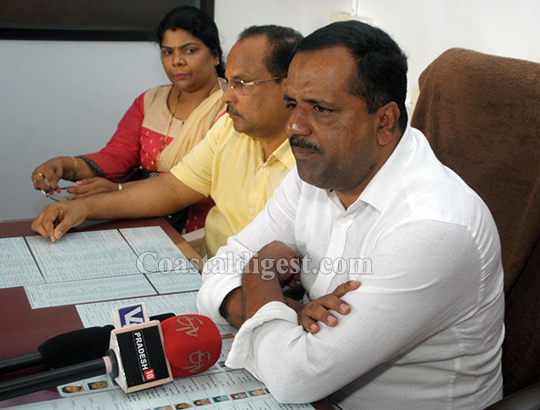
Mangaluru, Oct 21: Expressing his strong opposition to the implementation of Uniform Civil Code against the will of crores of Muslims in India, Congress leader and minister for food, civil supplies and consumer affairs U T Khader has urged the union government to hold talks with Islamic scholars and experts of Shariah before taking any decision.

utk 1

Speaking to media persons here, the minister said that the Constitution of India has granted Right to practice the Religion.

“Let those who discuss about triple talaq understand Shariat properly. Let the government discuss the issue with Ulema, scholars and other Islamic leaders before bringing laws against triple talaq,” he said adding that most of the people have misunderstood the concept of talaq in Islam.

There are several procedures under for talaq and three talaqs are not uttered at a stretch on a single day. Hence, let them discuss it properly before bringing law, Khader said.

Fake Aadhaar numbers

On the issue of seeding fake Aadhaar card numbers with ration cards, Mr. Khader said they have found as many as 1.6 lakh cards with fake Aadhaar numbers.

Following seeding of Aadhaar numbers, these card holders have obtained coupons for food grains at the ration shop. Mr. Khader said criminal cases will be filed against the accused, he said.

Subsidised kerosene for fishermen

Mr Khader said that an all-party delegation will be taken to the Union Petroleum Ministry demanding allocation of subsidised kerosene for fishermen using country boats.

He said that presently the State government had been giving fishermen a part of kerosene allocated by the Union government for distribution at the fair price shops in the State.

Each of the 915 registered country boat operators in Dakshina Kannada, Udupi and Uttara Kannada are getting 300 litres of kerosene at a subsidised rate per month.

“We have been doing it for many years. There have been instances when the supply from Centre got disrupted and thus causing problems for fishermen. Fishermen had difficulty in operating their boats for nearly a month and it was resolved on Wednesday,” he said.

Mr. Khader said that they planned to take an all-party delegation to Union Minister of State for Petroleum Dharmendra Pradhan and request a separate allocation of subsidised kerosene for fishermen in the three coastal districts.

Mr. Khader said they are waiting for the appointment of Mr. Pradhan.

Comments

TRUE INDIAN
 - 
Friday, 21 Oct 2016

Triple talaq in one go is the man made law. Which is not valid.

Quran says different. Read my last comment. Scroll down

TRUE INDIAN
 - 
Friday, 21 Oct 2016

@Venki

Rightly because of INDIAN govt law, many rapes, murders takes place, just apply sharia law and see the difference.

Even raj tackrey also agrees that sharia law should apply for rapists

Naren kotian
 - 
Friday, 21 Oct 2016

Who is that ulema counci ....govt should go ahead ...if u have itching problem goto supreme court. .ucc is the need of the hour to bring down criminal activities and anti India works, sexual abuse on women .4th standard passed Ibrahim says ..to avoid women getting into prostitution ...polygamy is must ...hahaha ...what a immature statement and inno Muslim women porke togondu jihadi galige hoditha ilvalla Ade sojiga ...

True indian
 - 
Friday, 21 Oct 2016

According to islam.

Groom has to give dowry and not the bride. But in india it is opposite.

All groom sides are taking advantages.

Triple talaq in one go is not allowed in Islam...

Add new comment

  • Coastaldigest.com reserves the right to delete or block any comments.
  • Coastaldigset.com is not responsible for its readers’ comments.
  • Comments that are abusive, incendiary or irrelevant are strictly prohibited.
  • Please use a genuine email ID and provide your name to avoid reject.
News Network
February 22,2020

Bengaluru, Feb 22: Thanks to joint efforts by the Protector of Emigrants in Bengaluru and Indian Embassy in Qatar, a 26-year-old woman from Karnataka who had been kept in confinement in Qatar has been rescued and brought back to India.

Anupama (name changed) from Holenarasipura in Hassan district arrived in Bengaluru on Thursday night. She was allegedly locked up in a house for 14 days, restrained from using a mobile and wasn't fed. There were three other women with her. On the midnight of February 12, they broke the window panes and fled before contacting local police.

Anupama, a diploma graduate in computer science, was jobless and her friend working in Kuwait suggested she try for a job abroad. She contacted an agency based in Chikkamagaluru which offered her a nanny's job in Qatar. After document verification, the agency demanded she pay Rs 2 lakh but she said she didn't have that kind of money.

The agency sent Anupama on a visitor visa but told her if questioned by immigration officials, she must claim she was visiting her sister. They also gave her a return ticket.

As Anupama was travelling abroad for the first time, she said she was ignorant about several things.

On January 12, Anupama left Bengaluru. But as she reached Qatar, all her documents, including passport, were confiscated by the agency. Her return ticket was cancelled and she was sent to a house to work as babysitter-cum-cook for Rs 30,000. She lived with four other maids in the same house, where they were made to work for 16-18 hours a day.

"I used to wake up around 5.30am every day and had to prepare breakfast for the employers by 6.30am. My work would end around 11pm every day. We never even got time to eat," Anupama told media on Friday. Four days into work, Anupama's nose started bleeding. However, the employers cared little and insisted she continue to work. After 18 days, she requested her employers that she be relieved.

The agency sent her to a house where three women were already present and locked her up with them. "They used to give us a glass of raw rice, an onion, tomato and potato to cook for ourselves. While we got rice every day, we had to use the vegetables for three days. We were not supposed to use mobiles or go out. Two people were monitoring us," she recalled.

Anupama and the others decided to approach police but for that they needed to escape. Around 1.30am on February 12, the four women managed to break window panes and jumped out. They ran for more than a kilometre and managed to approach police, who summoned the agency and got the women to speak to their families.

Anupama called her brother-in-law, who approached the Protector of Emigrants office in Koramangala, Bengaluru. Shubham Singh, PoE in Bengaluru, said they took up the issue with the Indian Embassy in Qatar, which immediately got in touch with Qatar police. Anupama said, "We were kept in prison for a couple of days and were sent to the deportation centre later."

Meanwhile, the Indian embassy got the agency to return the women's documents. However, the agents did not pay their salaries. Two of the women were sent to Hyderabad and the third to Kerala. On Friday, Anupama met Singh at his office, where her statement was recorded. "We have started the process of initiating action against the agency in India," he said.

Comments

Add new comment

  • Coastaldigest.com reserves the right to delete or block any comments.
  • Coastaldigset.com is not responsible for its readers’ comments.
  • Comments that are abusive, incendiary or irrelevant are strictly prohibited.
  • Please use a genuine email ID and provide your name to avoid reject.
coastaldigest.com news network
July 15,2020

Mangaluru, Jul 15: Amidst mounting coronavirus cases, the district administration has finalised 80 covid care centres (CCC) in Dakshina Kannada.

Sindhu B Rupesh, deputy commissioner of DK, said that as many as 80 premises that were functioning as quarantine centres have now been identified as CCCs in the district.

People in the district have been demanding that CCCs should be opened for asymptomatic cases in the district too. 

A majority of around 1,500 active cases in Dakshina Kannada are asymptomatic, and the CCCs will help those planning to go to private hospitals to reduce their treatment costs.

Additional deputy commissioner M J Roopa said that the 80 CCCs identified throughout the district will work as care centres for asymptomatic Covid-19 patients.

A medical team will attend to the centres, and supply of food and water will be taken care of by the government. In case of any health issues, the patient will be shifted to the Covid hospital, she said.

“All asymptotic Covid-19 patients, who are unable to opt for home isolation, are being kept in CCCs. A designated health team will monitor each CCC in the district. Meanwhile, the nearest public health centre (PHC) will have an ambulance on standby in case of an emergency,” she added.

Comments

Add new comment

  • Coastaldigest.com reserves the right to delete or block any comments.
  • Coastaldigset.com is not responsible for its readers’ comments.
  • Comments that are abusive, incendiary or irrelevant are strictly prohibited.
  • Please use a genuine email ID and provide your name to avoid reject.
Ram Puniyani
February 10,2020

Noam Chomsky is one of the leading peace workers in the world. In the wake of America’s attack on Vietnam, he brought out his classic formulation, ‘manufacturing consent’. The phrase explains the state manipulating public opinion to have the public approve of it policies—in this case, the attack of the American state on Vietnam, which was then struggling to free itself from French colonial rule.

In India, we are witness to manufactured hate against religious minorities. This hatred serves to enhance polarisation in society, which undermines India’s democracy and Constitution and promotes support for a Hindu nation. Hate is being manufactured through multiple mechanisms. For example, it manifests in violence against religious minorities. Some recent ghastly expressions of this manufactured hate was the massive communal violence witnessed in Mumbai (1992-93), Gujarat (2002), Kandhamal (2008) and Muzaffarnagar (2013). Its other manifestation was in the form of lynching of those accused of having killed a cow or consumed beef. A parallel phenomenon is the brutal flogging, often to death, of Dalits who deal with animal carcasses or leather.

Yet another form of this was seen when Shambhulal Regar, indoctrinated by the propaganda of Hindu nationalists, burned alive Afrazul Khan and shot the video of the heinous act. For his brutality, he was praised by many. Regar was incited into the act by the propaganda around love jihad. Lately, we have the same phenomenon of manufactured hate taking on even more dastardly proportions as youth related to Hindu nationalist organisations have been caught using pistols, while police authorities look on.

Anurag Thakur, a BJP minster in the central government recently incited a crowd in Delhi to complete his chant of what should happen to ‘traitors of the country...” with a “they should be shot”. Just two days later, a youth brought a pistol to the site of a protest at Jamia Millia Islamia university and shouted “take Azaadi!” and fired it. One bullet hit a student of Jamia. This happened on 30 January, the day Nathuram Godse had shot Mahatma Gandhi in 1948. A few days later, another youth fired near the site of protests against the CAA and NRC at Shaheen Bagh. Soon after, he said that in India, “only Hindus will rule”.

What is very obvious is that the shootings by those associated with Hindu nationalist organisations are the culmination of a long campaign of spreading hate against religious minorities in India in general and against Muslims in particular. The present phase is the outcome of a long and sustained hate campaign, the beginning of which lies in nationalism in the name of religion; Muslim nationalism and Hindu nationalism. This sectarian nationalism picked up the communal view of history and the communal historiography which the British introduced in order to pursue their ‘divide and rule’ policy.

In India what became part of “social common sense” was that Muslim kings had destroyed Hindu temples, that Islam was spread by force, and that it is a foreign religion, and so on. Campaigns, such as the one for a temple dedicated to the Hindu god Rama to be built at the site where the Babri masjid once stood, further deepened the idea of a Muslim as a “temple-destroyer”. Aurangzeb, Tipu Sultan and other Muslim kings were tarnished as the ones who spread Islam by force in the subcontinent. The tragic Partition, which was primarily due to British policies, and was well-supported by communal streams also, was entirely attributed to Muslims. The Kashmir conflict, which is the outcome of regional, ethnic and other historical issues, coupled with the American policy of supporting Pakistan’s ambitions of regional hegemony, (which also fostered the birth of Al-Qaeda), was also attributed to the Muslims.

With recurring incidents of communal violence, these falsehoods went on going deeper into the social thinking. Violence itself led to ghettoisation of Muslims and further broke inter-community social bonds. On the one hand, a ghettoised community is cut off from others and on the other hand the victims come to be presented as culprits. The percolation of this hate through word-of-mouth propaganda, media and re-writing of school curricula, had a strong impact on social attitudes towards the minorities.

In the last couple of decades, the process of manufacturing hate has been intensified by the social media platforms which are being cleverly used by the communal forces. Swati Chaturvedi’s book, I Am a Troll: Inside the Secret World of the BJP’s Digital Army, tells us how the BJP used social media to spread hate. Whatapp University became the source of understanding for large sections of society and hate for the ‘Other’, went up by leaps and bounds. To add on to this process, the phenomenon of fake news was shrewdly deployed to intensify divisiveness.

Currently, the Shaheen Bagh movement is a big uniting force for the country; but it is being demonised as a gathering of ‘anti-nationals’. Another BJP leader has said that these protesters will indulge in crimes like rape. This has intensified the prevalent hate.

While there is a general dominance of hate, the likes of Shambhulal Regar and the Jamia shooter do get taken in by the incitement and act out the violence that is constantly hinted at. The deeper issue involved is the prevalence of hate, misconceptions and biases, which have become the part of social thinking.

These misconceptions are undoing the amity between different religious communities which was built during the freedom movement. They are undoing the fraternity which emerged with the process of India as a nation in the making. The processes which brought these communities together broadly drew from Gandhi, Bhagat Singh and Ambedkar. It is these values which need to be rooted again in the society. The communal forces have resorted to false propaganda against the minorities, and that needs to be undone with sincerity.

Combating those foundational misconceptions which create hatred is a massive task which needs to be taken up by the social organisations and political parties which have faith in the Indian Constitution and values of freedom movement. It needs to be done right away as a priority issue in with a focus on cultivating Indian fraternity yet again.


Comments

Add new comment

  • Coastaldigest.com reserves the right to delete or block any comments.
  • Coastaldigset.com is not responsible for its readers’ comments.
  • Comments that are abusive, incendiary or irrelevant are strictly prohibited.
  • Please use a genuine email ID and provide your name to avoid reject.