


Haji Ali Dargah decides to grant access to women, finally

October 24, 2016

New Delhi, Oct 24: Women will be granted access to the sanctum sanctorum of the Haji Ali shrine in Mumbai on par with men, the Dargah Trust told the Supreme Court today and sought four weeks to make the requisite infrastructural changes.
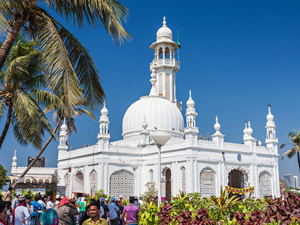
haji aliA bench comprising Chief Justice T S Thakur and Justices D Y Chandrachud and L Nageswara Rao granted time to the trust and disposed off its appeal against the Bombay High Court order asking it to give equal access to women also.

Senior advocate Gopal Subramanium, appearing for the trust, said an additional affidavit has been filed on behalf of the Dargah trust saying it is willing to allow women inside the shrine.

The apex court, on October 17, had extended the stay granted by Bombay High Court to facilitate an appeal against its decision to lift the ban on entry of women near the sanctum sanctorum of the Dargah in Mumbai.

Earlier, the Supreme Court had expressed hope that the Trust, which had challenged the high court judgement, "will take a stand which is progressive".

Subramanium, had also assured the bench that he was on a "progressive mission" and said all holy books and scriptures promoted equality and nothing which is regressive in character should be suggested.

The bench had also remarked that "if you are not allowing both men and women to go beyond a point, there is no problem. But if you are allowing some to go beyond a point while others are not, it is a problem."

The counsel, appearing for a women's group which has challenged the practice of the Trust not to allow women near the sanctum sanctorum, had submitted that the position was different before 2011 than what it is today.

The Trust moved the apex court challenging the Bombay High Court order lifting the ban on women from entering the sanctum sanctorum of the renowned Muslim shrine in South Mumbai.

The High Court on August 26 had held that the ban imposed by the Trust on women from entering the sanctum sanctorum of the Haji Ali Dargah, contravened Articles 14, 15 and 25 of the Constitution and said women should be permitted to enter the sanctum sanctorum like men.

The High Court had allowed a PIL filed by two women, Zakia Soman and Noorjehan Niaz, from NGO Bharatiya Muslim Mahila Andolan, challenging the ban on women's entry into the sanctum sanctorum of the dargah from 2012.

It had granted a six-week stay on the order on a request by the Dargah Trust to enable it to appeal before the Supreme Court.

The high court had held that the Trust had no power to alter or modify the mode or manner of religious practices of any individual or any group.

The High Court in its 56-page judgement had also noted that the "right to manage the Trust cannot override the right to practice religion itself".

It had said the trust has not been able to justify the ban legally or otherwise. Hence it cannot be said that the prohibition was an essential and integral part of Islam and whether taking away that part of the practice would result in a fundamental change in the character of the religion or belief.

It had also refused to accept the Trust's justification that the ban was imposed for safety and security of women, in particular, to prevent sexual harassment at places of worship.

The Trust had claimed that the ban was in keeping with an order of the Supreme Court wherein stringent directions have been issued to ensure that there is no sexual harassment to women at places of worship.

The court had noted that the aims, objectives and activities of the Haji Ali Dargah Trust were not governed by any custom or tradition and held that it was a public charitable trust and hence, open to people all over the world, irrespective of their caste, creed or gender.

The Maharashtra government had earlier told the court that women should be barred from entering the inner sanctorum of Haji Ali Dargah only if it is so enshrined in the Quran.

Comments

Syed
 - 
Monday, 24 Oct 2016

Performing Dargah Pooja is unpardonable sin in Islam.

Rashid
 - 
Monday, 24 Oct 2016

visiting these graves (darghas) either by men or women is against islamic belief ... whatever the decision , won't make any difference to community

Abdul
 - 
Monday, 24 Oct 2016

Wrong Number!..
Worship creator, not his creation.

Rikaz
 - 
Monday, 24 Oct 2016

Abbiya, you misunderstood about the concept of performing umrah and Haj....visiting grave of anyone is not allowed and which is prohibited for ladies....performing umrah or haj is religious duty....once in a life time if a Muslim financially strong enough is bound to perform these religious obligations.,,,,

Well Wisher
 - 
Monday, 24 Oct 2016

The last paragraph is so funny. Maharashtra Govt. was right. \Aaneye illaandmyake Ambaari ellind bantu kanawwa?\" There is nothing mentioned in the Qur'an about Dargah. In fact, Dargah & Durgah are the 2 faces of the same coin. Idol worship is major sin (Shirk) in Islam. Prophet also denied women's entry to the grave yard. I request MH govt to completely shut the dargah. It is just a money making, sexual harassment center. No relation with Islam. It is nothing but a Mafia."

Add new comment

  • Coastaldigest.com reserves the right to delete or block any comments.
  • Coastaldigset.com is not responsible for its readers’ comments.
  • Comments that are abusive, incendiary or irrelevant are strictly prohibited.
  • Please use a genuine email ID and provide your name to avoid reject.
Ram Puniyani
February 10,2020

Noam Chomsky is one of the leading peace workers in the world. In the wake of America’s attack on Vietnam, he brought out his classic formulation, ‘manufacturing consent’. The phrase explains the state manipulating public opinion to have the public approve of it policies—in this case, the attack of the American state on Vietnam, which was then struggling to free itself from French colonial rule.

In India, we are witness to manufactured hate against religious minorities. This hatred serves to enhance polarisation in society, which undermines India’s democracy and Constitution and promotes support for a Hindu nation. Hate is being manufactured through multiple mechanisms. For example, it manifests in violence against religious minorities. Some recent ghastly expressions of this manufactured hate was the massive communal violence witnessed in Mumbai (1992-93), Gujarat (2002), Kandhamal (2008) and Muzaffarnagar (2013). Its other manifestation was in the form of lynching of those accused of having killed a cow or consumed beef. A parallel phenomenon is the brutal flogging, often to death, of Dalits who deal with animal carcasses or leather.

Yet another form of this was seen when Shambhulal Regar, indoctrinated by the propaganda of Hindu nationalists, burned alive Afrazul Khan and shot the video of the heinous act. For his brutality, he was praised by many. Regar was incited into the act by the propaganda around love jihad. Lately, we have the same phenomenon of manufactured hate taking on even more dastardly proportions as youth related to Hindu nationalist organisations have been caught using pistols, while police authorities look on.

Anurag Thakur, a BJP minster in the central government recently incited a crowd in Delhi to complete his chant of what should happen to ‘traitors of the country...” with a “they should be shot”. Just two days later, a youth brought a pistol to the site of a protest at Jamia Millia Islamia university and shouted “take Azaadi!” and fired it. One bullet hit a student of Jamia. This happened on 30 January, the day Nathuram Godse had shot Mahatma Gandhi in 1948. A few days later, another youth fired near the site of protests against the CAA and NRC at Shaheen Bagh. Soon after, he said that in India, “only Hindus will rule”.

What is very obvious is that the shootings by those associated with Hindu nationalist organisations are the culmination of a long campaign of spreading hate against religious minorities in India in general and against Muslims in particular. The present phase is the outcome of a long and sustained hate campaign, the beginning of which lies in nationalism in the name of religion; Muslim nationalism and Hindu nationalism. This sectarian nationalism picked up the communal view of history and the communal historiography which the British introduced in order to pursue their ‘divide and rule’ policy.

In India what became part of “social common sense” was that Muslim kings had destroyed Hindu temples, that Islam was spread by force, and that it is a foreign religion, and so on. Campaigns, such as the one for a temple dedicated to the Hindu god Rama to be built at the site where the Babri masjid once stood, further deepened the idea of a Muslim as a “temple-destroyer”. Aurangzeb, Tipu Sultan and other Muslim kings were tarnished as the ones who spread Islam by force in the subcontinent. The tragic Partition, which was primarily due to British policies, and was well-supported by communal streams also, was entirely attributed to Muslims. The Kashmir conflict, which is the outcome of regional, ethnic and other historical issues, coupled with the American policy of supporting Pakistan’s ambitions of regional hegemony, (which also fostered the birth of Al-Qaeda), was also attributed to the Muslims.

With recurring incidents of communal violence, these falsehoods went on going deeper into the social thinking. Violence itself led to ghettoisation of Muslims and further broke inter-community social bonds. On the one hand, a ghettoised community is cut off from others and on the other hand the victims come to be presented as culprits. The percolation of this hate through word-of-mouth propaganda, media and re-writing of school curricula, had a strong impact on social attitudes towards the minorities.

In the last couple of decades, the process of manufacturing hate has been intensified by the social media platforms which are being cleverly used by the communal forces. Swati Chaturvedi’s book, I Am a Troll: Inside the Secret World of the BJP’s Digital Army, tells us how the BJP used social media to spread hate. Whatapp University became the source of understanding for large sections of society and hate for the ‘Other’, went up by leaps and bounds. To add on to this process, the phenomenon of fake news was shrewdly deployed to intensify divisiveness.

Currently, the Shaheen Bagh movement is a big uniting force for the country; but it is being demonised as a gathering of ‘anti-nationals’. Another BJP leader has said that these protesters will indulge in crimes like rape. This has intensified the prevalent hate.

While there is a general dominance of hate, the likes of Shambhulal Regar and the Jamia shooter do get taken in by the incitement and act out the violence that is constantly hinted at. The deeper issue involved is the prevalence of hate, misconceptions and biases, which have become the part of social thinking.

These misconceptions are undoing the amity between different religious communities which was built during the freedom movement. They are undoing the fraternity which emerged with the process of India as a nation in the making. The processes which brought these communities together broadly drew from Gandhi, Bhagat Singh and Ambedkar. It is these values which need to be rooted again in the society. The communal forces have resorted to false propaganda against the minorities, and that needs to be undone with sincerity.

Combating those foundational misconceptions which create hatred is a massive task which needs to be taken up by the social organisations and political parties which have faith in the Indian Constitution and values of freedom movement. It needs to be done right away as a priority issue in with a focus on cultivating Indian fraternity yet again.

Comments

Add new comment

  • Coastaldigest.com reserves the right to delete or block any comments.
  • Coastaldigset.com is not responsible for its readers’ comments.
  • Comments that are abusive, incendiary or irrelevant are strictly prohibited.
  • Please use a genuine email ID and provide your name to avoid reject.
News Network
March 8,2020

Bengaluru, Mar 8: The Indian Council of Medical Research (ICMR) has identified three more locations to open Viral Research Diagnostic Laboratories (VRDL) including in Mysuru, Hassan, and Shivamogga in Karnataka.

According to a statement issued here on Sunday, these laboratories will start functioning shortly in Mysuru Medical College and Research Institute, Hassan Institute of Medical Sciences, and Shivamogga Institute of Medical Sciences. Besides, the ICMR has also identified sample collection centres in Vijayanagar Institute of Medical Science in Ballari and Kalaburgi Institute of Medical Sciences.

B G Prakash, State Joint Director (Communicable Diseases), said that the new Laboratories will help to ease the load on the two designated laboratories in Bengaluru. Currently, the virology laboratory in Bangalore Medical College and Research Institute and the NIV branch in Rajiv Gandhi Institute of Chest Diseases are doing COVID-19 tests in Karnataka.

Comments

Add new comment

  • Coastaldigest.com reserves the right to delete or block any comments.
  • Coastaldigset.com is not responsible for its readers’ comments.
  • Comments that are abusive, incendiary or irrelevant are strictly prohibited.
  • Please use a genuine email ID and provide your name to avoid reject.
News Network
February 14,2020

Bengaluru, Feb 14: BJP leader and Karnataka Revenue Minister R Ashok refused to comment on the Bellary car accident case, allegedly involving his son, saying that the matter was still under investigation and that they did not have anything to do with the said car.

The car crash took place on February 10, when a speeding red Mercedes Benz allegedly driven by Ashok's son rammed into a tea stall by the roadside killing two people. While a 16-year-old boy Ravi died on the spot, one of the car's passengers was also killed in the accident.

"I came to know about the incident and also heard that two people have died and a few others have sustained injuries. Everybody is equal under the law. It is not fair to comment as a minister when the case is being investigated," Ashok told reporters here on Thursday.

However, the minister avoided answering questions about his son's presence in the car and said that they had "no connection" with the car.

"The case is in the investigation stage, I don't want to comment on anything. My son's name is not present in the FIR. We have no connection with the car," he said.

Superintendent of Police CK Baba told reporters that Ashok's son was not present in the car.

"There was no senior BJP leader and Revenue Ministers's son in the car. We will not hide anything and the case will be investigated," Baba said.

Comments

Add new comment

  • Coastaldigest.com reserves the right to delete or block any comments.
  • Coastaldigset.com is not responsible for its readers’ comments.
  • Comments that are abusive, incendiary or irrelevant are strictly prohibited.
  • Please use a genuine email ID and provide your name to avoid reject.