


Haji Ali Dargah decides to grant access to women, finally

October 24, 2016

New Delhi, Oct 24: Women will be granted access to the sanctum sanctorum of the Haji Ali shrine in Mumbai on par with men, the Dargah Trust told the Supreme Court today and sought four weeks to make the requisite infrastructural changes.
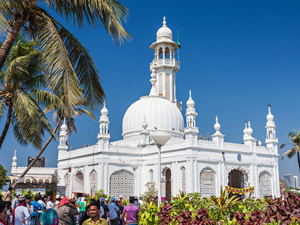
haji aliA bench comprising Chief Justice T S Thakur and Justices D Y Chandrachud and L Nageswara Rao granted time to the trust and disposed off its appeal against the Bombay High Court order asking it to give equal access to women also.

Senior advocate Gopal Subramanium, appearing for the trust, said an additional affidavit has been filed on behalf of the Dargah trust saying it is willing to allow women inside the shrine.

The apex court, on October 17, had extended the stay granted by Bombay High Court to facilitate an appeal against its decision to lift the ban on entry of women near the sanctum sanctorum of the Dargah in Mumbai.

Earlier, the Supreme Court had expressed hope that the Trust, which had challenged the high court judgement, "will take a stand which is progressive".

Subramanium, had also assured the bench that he was on a "progressive mission" and said all holy books and scriptures promoted equality and nothing which is regressive in character should be suggested.

The bench had also remarked that "if you are not allowing both men and women to go beyond a point, there is no problem. But if you are allowing some to go beyond a point while others are not, it is a problem."

The counsel, appearing for a women's group which has challenged the practice of the Trust not to allow women near the sanctum sanctorum, had submitted that the position was different before 2011 than what it is today.

The Trust moved the apex court challenging the Bombay High Court order lifting the ban on women from entering the sanctum sanctorum of the renowned Muslim shrine in South Mumbai.

The High Court on August 26 had held that the ban imposed by the Trust on women from entering the sanctum sanctorum of the Haji Ali Dargah, contravened Articles 14, 15 and 25 of the Constitution and said women should be permitted to enter the sanctum sanctorum like men.

The High Court had allowed a PIL filed by two women, Zakia Soman and Noorjehan Niaz, from NGO Bharatiya Muslim Mahila Andolan, challenging the ban on women's entry into the sanctum sanctorum of the dargah from 2012.

It had granted a six-week stay on the order on a request by the Dargah Trust to enable it to appeal before the Supreme Court.

The high court had held that the Trust had no power to alter or modify the mode or manner of religious practices of any individual or any group.

The High Court in its 56-page judgement had also noted that the "right to manage the Trust cannot override the right to practice religion itself".

It had said the trust has not been able to justify the ban legally or otherwise. Hence it cannot be said that the prohibition was an essential and integral part of Islam and whether taking away that part of the practice would result in a fundamental change in the character of the religion or belief.

It had also refused to accept the Trust's justification that the ban was imposed for safety and security of women, in particular, to prevent sexual harassment at places of worship.

The Trust had claimed that the ban was in keeping with an order of the Supreme Court wherein stringent directions have been issued to ensure that there is no sexual harassment to women at places of worship.

The court had noted that the aims, objectives and activities of the Haji Ali Dargah Trust were not governed by any custom or tradition and held that it was a public charitable trust and hence, open to people all over the world, irrespective of their caste, creed or gender.

The Maharashtra government had earlier told the court that women should be barred from entering the inner sanctorum of Haji Ali Dargah only if it is so enshrined in the Quran.

Comments

Syed
 - 
Monday, 24 Oct 2016

Performing Dargah Pooja is unpardonable sin in Islam.

Rashid
 - 
Monday, 24 Oct 2016

visiting these graves (darghas) either by men or women is against islamic belief ... whatever the decision , won't make any difference to community

Abdul
 - 
Monday, 24 Oct 2016

Wrong Number!..
Worship creator, not his creation.

Rikaz
 - 
Monday, 24 Oct 2016

Abbiya, you misunderstood about the concept of performing umrah and Haj....visiting grave of anyone is not allowed and which is prohibited for ladies....performing umrah or haj is religious duty....once in a life time if a Muslim financially strong enough is bound to perform these religious obligations.,,,,

Well Wisher
 - 
Monday, 24 Oct 2016

The last paragraph is so funny. Maharashtra Govt. was right. \Aaneye illaandmyake Ambaari ellind bantu kanawwa?\" There is nothing mentioned in the Qur'an about Dargah. In fact, Dargah & Durgah are the 2 faces of the same coin. Idol worship is major sin (Shirk) in Islam. Prophet also denied women's entry to the grave yard. I request MH govt to completely shut the dargah. It is just a money making, sexual harassment center. No relation with Islam. It is nothing but a Mafia."

Add new comment

  • Coastaldigest.com reserves the right to delete or block any comments.
  • Coastaldigset.com is not responsible for its readers’ comments.
  • Comments that are abusive, incendiary or irrelevant are strictly prohibited.
  • Please use a genuine email ID and provide your name to avoid reject.
coastaldigest.com news network
May 6,2020

Mangaluru, May 6: Amidst preparation for the paid evacuation of Indians stuck in Gulf countries amidst coronavirus lockdown, the central government has announced that it would only do a medical screening of the passengers before the flight and only asymptomatic persons would be allowed to travel.

Each passenger will have to fill a self-reporting form to be presented at the health and immigration counter at their destination.

The passengers are required to state whether they are suffering from fever, cough, diabetes or any respiratory disease. This form is similar to the one filled by passengers landing in India during the early days of the COVID-19 outbreak.

As per the announcement by the government, returnees would undergo COVID-19 once they complete 14-day quarantine in a hospital or government –arranged institution on a payment basis.

However, the form asks the applicants to keep themselves isolated at home for 28 days unless they develop any symptoms such as fever and cough.

During the journey, they will have to follow the protocols such as those issued by the Health Ministry and the Civil Aviation Ministry. Applicants from the UAE are yet to receive instructions on these.

On reaching the destination, passengers will have to register on the Arogya Setu app, India’s mobile application for COVID-19 surveillance.

No physical distancing!

Air India Express (AIE) which is set to operate the first two flights to Kerala on Thursday will operate its Boeing 737-800 flights, with a seating capacity of 186 economy class seats.

With nine seats reserved for isolation, only 177 passengers would be flown, sources said.

While most of the UAE flights in the first week will be operated by the AIE, Air India will operate two of its Dreamliner aircraft with a seating capacity of 256 seats. These flights would also reserve some seats for isolation.

However, the plan has made it clear that the Indian government will not be following the rules of physical distancing to prevent the spread of coronavirus in the repatriation flights.

Several people, including the Chief Minister of Kerala Pinarayi Vijayan, expressed concern over flying passengers, who will not be tested for COVID-19, without observing physical distancing.

Comments

Add new comment

  • Coastaldigest.com reserves the right to delete or block any comments.
  • Coastaldigset.com is not responsible for its readers’ comments.
  • Comments that are abusive, incendiary or irrelevant are strictly prohibited.
  • Please use a genuine email ID and provide your name to avoid reject.
News Network
February 27,2020

Bengaluru, Feb 26: Karnataka Minister CT Ravi on Wednesday said that time is ripe to bring in Uniform Civil Code in the country as there was a demand for "equality".

"Everyone talks about equality. Those who desired inequality in the past are now seeking equality. The time is ripe to bring Uniform Civil Code," he said.

The Minister said that the Uniform Civil Code (UCC) has been a part of the party's agenda since the time when BJP was formed in 1980.

"We spoke about article 370, we have done it, on Ayodhya issue, the Supreme Court has given its verdict. As the time comes we will do it," he said.

Comments

Add new comment

  • Coastaldigest.com reserves the right to delete or block any comments.
  • Coastaldigset.com is not responsible for its readers’ comments.
  • Comments that are abusive, incendiary or irrelevant are strictly prohibited.
  • Please use a genuine email ID and provide your name to avoid reject.
News Network
March 4,2020

Bengaluru, Mar 4: The Karnataka High Court has issued a notice to the state government in connection with the denial of retirement benefits to a retired deputy commissioner of commercial taxes who had fought against the illegal iron ore lobby.

Justice G Narendra also directed the state to respond to the notice before March 9, stating the reasons for withholding the officer’s retirement benefits.

Advocate Ramananda, appearing for the retired officer Josephat Andrews, explained that the single-judge bench also warned the government of stringent action.

Petitioner Josephat Andrews said his retirement benefits amounting to Rs 25.88 lakh were being withheld since 2014.

In 2009, Andrews detected a huge scam involving Vijaya Leasing, a company associated with former minister Gali Janardhan Reddy. Immediately he wrote to his higher officials explaining to them how the department was owed Rs 1,400 crore in taxes by the company. Immediately after that, Andrews was transferred to Bengaluru.

The media exposed the scam in 2012. Thereafter, to harass the officer, Andrews was served notice for allegedly not conducting an inspection of M/s Vijaya Leasing, which was controlled by the family of then tourism minister Gali Janardhana Reddy, on July 11, 2012.  He was discharged by a full departmental enquiry.

The petitioner was issued a second show cause notice on Jan 29, 2014 on the same charges. Before his retirement, he was docked two increments, denied promotional benefits and his pension was reduced without following due process.

He was served yet another notice with charges that he did not inspect goods vehicles, and an order was passed on April 30, 2019 reducing his pension by 5 per cent, an unprecedented punitive action.

This order was quashed by the Karnataka Administrative Tribunal (KAT), which also ordered payment of retirement benefits to Andrews within five months. However, the benefits were not released to him.  

“Rule 214 of the Karnataka Civil Services Rules (KCSR) make it clear that no enquiry can be held four years after an officer’s retirement.  Belying all statutory rules and precedents of the Supreme Court, Josephat Andrews’ retirement benefits were withheld for five years. Andrews therefore approached the High Court,” advocate Ramananda explained.

Josephat Andrews recalled to Deccan Chronicle that although mining activity was in full swing in 2008, the commercial tax department maintained that it had nothing to do with mining. “I travelled to Gujarat, Maharashtra and Bellary to investigate. I found tax evasion of thousands of crores. When I visited M/s the Vijaya Leasing facility – it was operating from an old oil mill premises–within 20 minutes I got calls from Ali, a person claiming to be the personal assistant of Gali Janardhan Reddy. He told me to get out of the premises as it belonged to his boss. Then calls came from minister Sreeramulu and MLA Nagendra. 

Within minutes 200-300 rowdies gathered around the building and my superior asked me to come back. Instead of filing a police complaint and forming a special team to deal with the situation, the department transferred me to Bengaluru,” he explained.

Talking about the High Court directive, Josephat Andrews said, “I have suffered a lot. Instead of getting a reward for increasing revenues by Rs 2,000 crore, I was punished.”

Comments

Add new comment

  • Coastaldigest.com reserves the right to delete or block any comments.
  • Coastaldigset.com is not responsible for its readers’ comments.
  • Comments that are abusive, incendiary or irrelevant are strictly prohibited.
  • Please use a genuine email ID and provide your name to avoid reject.