Muslim organisations in Mangaluru unite against Uniform Civil Code

[email protected] (CD Network | Chakravarthi)
October 27, 2016

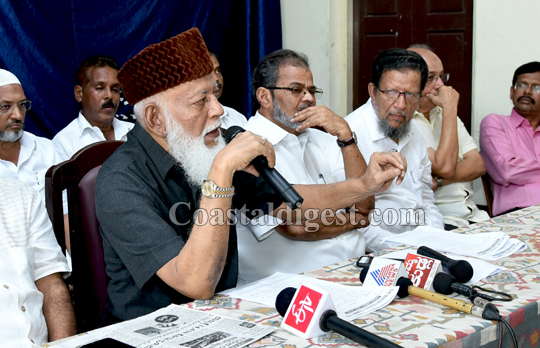
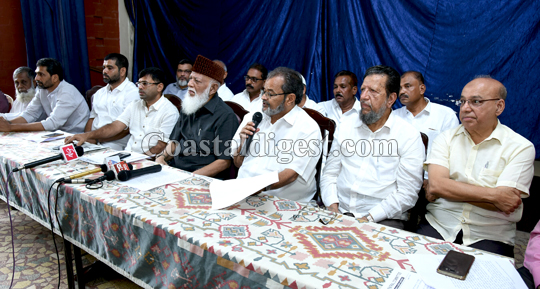
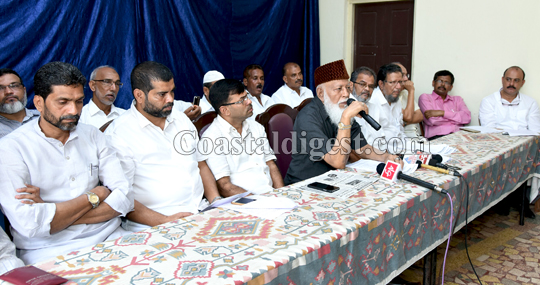
Mangaluru, Oct 27: The Muslim Central Committee of Dakshina Kannada and Udupi, along with several other organisations associated with the Muslim community, has joined the nationwide campaign against the union government's attempt to impalement a Uniform Civil Code (UCC).

muslimcnt 5

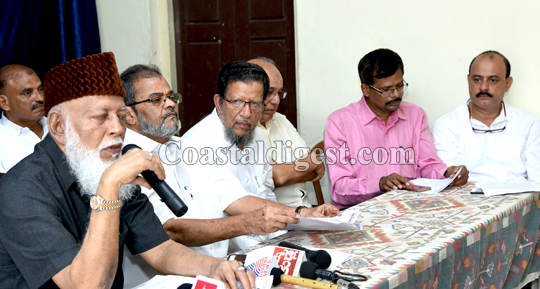
Addressing media persons in the city on Thursday, Committee president K S Mohammed Masood said that all the Muslim organisations in coastal Karnataka endorse All India Muslim Personal Law Board's decision to reject Law Commission's questionnaire on the possibility of a UCC.

He said that under the pretext of giving justice to Muslim women by ending controversial triple talaq, Prime Minister Narendra Modi led NDA government trying to interfere in Muslim personal law and make changes in Islamic Shariah.

Mr Masood said that if there were “flaws” in the personal laws governing Muslims, the scholars and religious heads of the community are capable of addressing them from time-to-time. “There is a long procedure for three talaqs in Islam. If anyone violates the rules of talaq and ignores rights of woman, the victims can approach local Ulema or Khazi who will solve the problem,” he said.

He said that his committee will join the nationwide signature campaign launched by the Personal Law Board against the UCC. He urged all Muslims in the twin districts to strive to make the campaign success. Signatures of men and women from the community will be sent to Personal Law Board through All India Milli Council, he added.

“People of different cultures live in this country. If the UCC is implemented, attempts will be made to paint all in one colour, which is not in the interest of the country. There are more divorces in other communities. Rather the highest rate, which is double that of Muslims, is among Hindus," said a cleric.

Terming UCC a pure political stunt, Uniwef president Rafeeuddin Kudroli said that in order to conceal its failure and diver the attention of people from core issues, the anti-people government is raking up such issues. Representatives of various Muslim organisations and associations were present at the press meet.

muslimcnt 3

muslimcnt 4

muslimcnt 1

Comments

Shahul
 - 
Saturday, 29 Oct 2016

Dear Ahmed

Learn the beauty of islam and its sharia law before commenting on islam. I think you are a name sake Muslim.

Mohammed
 - 
Friday, 28 Oct 2016

I read all negative comments id another news portal. Wo... where are comments are from non-muslims who do not know sharia law and just want to comment for the heck of it and put muslims in bad face by not writing the full facts as Mr. Masood mentioned that the girls can approach the kazi or ulemas. 95% of the comments are from non-muslims who should not interfere in our religion rights and try to amend theirs.

Bopanna
 - 
Thursday, 27 Oct 2016

Ahmed, finally a sane voice from Muslim side ref UCC

Ahmed
 - 
Thursday, 27 Oct 2016

I strongly feel ucc is the need of the hour. We are not supporters of bjp but somewhere we feel it is must .I met many Indians including Christians and Sikhs. Absolutely no opposition from their side .if we want our own laws then better to migrate for sharia backed country. If we have firm faith in sharia then even in criminal laws we must ask sharia laws .where as we want secular and general laws.we Muslims have lot of priorities. . concentrate on education ,quality employement and we must encourage young entrepreneurs ,we should bring down illiteracy rates ...our gals and boys must enter civil services in large no and our people must be in isro as scientists .. Dream in that way guys. Let us respect women feeling ....I can challenge non of the above are 100% true Muslims.... We Muslims must join mainstream .if not days are really going to be tough in India .whether we accept it or not RSS power quadrappled in past few years and pm has firm grip .we must accept the fact that bjp simply don't care for our votes. When we deal with bjp we cannot behave like the way we dealt with congress .we were vote bank for congress.they listen to us .we must also take a note on diminishing power of congress ....let us respect the rule of land. Jai hind ...proud Muslim from surathkal

Rikaz
 - 
Thursday, 27 Oct 2016

The person who is not respecting his own wife (Modi) is talking about women's protection, what a shit....these are all hidden agenda of panties....so called chaddies....now panties...

Shahul
 - 
Thursday, 27 Oct 2016

Rightly said it is need of the hour.

Add new comment

  • Coastaldigest.com reserves the right to delete or block any comments.
  • Coastaldigset.com is not responsible for its readers’ comments.
  • Comments that are abusive, incendiary or irrelevant are strictly prohibited.
  • Please use a genuine email ID and provide your name to avoid reject.
News Network
January 10,2020

Davanagere, Jan 9: Residents of SVR colony of Channagiri Taluq here on Thursday built a temple in the memory of a male monkey, who died here 'unexpectedly'.

A group of monkeys entered the SVR colony around three months back. The monkeys have never disturbed anybody in the area and they used to play with children living in the colony.

Locals said that the monkeys are very obedient to them.

Unfortunately, one of the monkeys died suddenly on Wednesday, causing distress among people who were very fond of him.

Showing their love for the deceased monkey, locals performed his final rite according to Hindu tradition.

Later, the residents approached the president of the village Panchayat to allot funds to build a temple in the monkey's memory.

The construction of the temple has already begun in the area at the same place where the monkey's funeral was conducted.

Comments

Add new comment

  • Coastaldigest.com reserves the right to delete or block any comments.
  • Coastaldigset.com is not responsible for its readers’ comments.
  • Comments that are abusive, incendiary or irrelevant are strictly prohibited.
  • Please use a genuine email ID and provide your name to avoid reject.
DHNS
January 2,2020

Jan 2: A year after 12,000 acres of forests in Bandipur went up in smoke, the Karnataka Forest Department is gearing up for the summer even as the Forest Survey of India (FSI) has cautioned that 22.78 lakh acres (9,222 sq km) or about 20% of the green cover spread across three districts in the central part of the state is fire-prone.

The FSI studied forest fire incidents across the country between 2004-05 and 2017 before coming up with state-specific inputs.

According to the 13-year observation, Karnataka has 7,352 “fire points” or areas measuring 5 km X 5 km with frequent fire incidents.

Though the number is lower compared to states like Maharashtra, Madhya Pradesh and Odisha with over 20,000 points, the sheer spread of the fire-prone area itself is a challenge for the Karnataka Forest Department.

According to data, about three lakh acres (1,199.9 sq km) of forest area is very highly fire prone with 26 to 52 fire incidents in 13 years. This is followed by 7.6 lakh acres (3,067 sq km) of “highly fire prone” areas with an average of one to two incidents every year.

Almost all of the “red alert” areas are concentrated in Uttara Kannada, Chikkmagaluru, Shivamogga and Chamarajanagar districts. As temperature rises at the end of January, so does the risk of forest fires, requiring officials to be on vigil till the end of summer.

After an investigation into the Bandipur blaze revealed that faulty fire lines and poor supervision were the reason for the spread of the fire, the department has come up with a multi-pronged approach to prevent similar incidents this year.

“After the Bandipur incident, we have created a fire cell and a standard operating procedure (SOP) which everyone has to follow. Firstly, a fire management plan is prepared and approved by a competent authority.

The SOP has well defined firelines which have to be executed by December-end and burning must be completed by January 15,”  Principal Chief Conservator of Forests (Head of Forest Force) Punati Sridhar told DH.

He said that to ensure its strict implementation, GPS readings of firelines are to be submitted for random verification.

“All the required equipment from fire jackets to shoes, gloves, backpack sprayers and tractors mounted with 2,000-5,000 litre tanks with high pressure pumps will be deployed at vantage points,” he said.

In addition, the department’s fire cell works in collaboration with the Karnataka State Remote Sensing Applications Centre (KSRSAC) to give fire alerts within half and hour of an area catching fire and detected by satellites.

“Earlier, the gap used to be four hours by when the fire would have spread beyond control. Now, with reduced time gap, it would be easier to control fire early,” he added.

Comments

Add new comment

  • Coastaldigest.com reserves the right to delete or block any comments.
  • Coastaldigset.com is not responsible for its readers’ comments.
  • Comments that are abusive, incendiary or irrelevant are strictly prohibited.
  • Please use a genuine email ID and provide your name to avoid reject.
Media Release
February 14,2020

Veteran journalist P. Sainath has said that the nation is in a crisis. And this crisis is not limited to just the rural area. It has become a national crisis at various areas such as agriculture, education, economy, job creation etc.

He was delivering the endowment lecture on the topic ‘Indian democracy at the post-liberalization and post-truth era’ at Media Manthan 2020 organized by the PG department of journalism and mass communication at St Aloysius College (Autonomous). 

Mr Sainath said that the many policies adopted in the 90s led to India becoming unusually unequal. Referring to the speech Ambedkar had made at the Constituent Assembly while handing over the draft of the Constitution, Mr Sainath said, “Ambedkar had warned about the weakness of Indian democracy that liberty without equality allows the supremacy of a few over the multitude. Liberty, equality and fraternity must be kept together as we cannot have one without the other.” 

Mr Sainath stated that the agrarian crisis was no longer about the loss of productivity, employment or about farmer suicide; it was a societal, civilizational crisis. Commenting on the lopsided policies such as cow-slaughter ban, he explained how cow slaughter ban had adversely affected many industries due to their interdependency. While Muslims who slaughtered cows were rendered helpless, the cattle traders who were mostly OBCs lost their earnings as the cattle prices crashed. An important industry like Kolhapur sandals industry in Maharashtra went bankrupt as a result of the cow slaughter ban in Maharashtra. He said the policymakers had no idea how the rural industries were interconnected. Demonetisation too devastated the rural economy as 98 percent of rural transactions happen through cash. 

Mr Sainath also spoke about the crisis of inequality which affects the Dalits and the Adivasis far more than anyone else as 90 percent of the rural households take home less than Rs 10,000/- per month. “Women are yet another group whose labour is never counted in the gross domestic product. Women and girls globally do unpaid work which amounts to about 12.5 billion working hours per year. Monetarily speaking, this is worth 10.8 trillion dollars,” Mr Sainath added. 

Speaking about the crisis of jobs Mr Sainath said that major companies were laying off employees just to create more profits for the investors and the adoption of artificial intelligence in the industry would further destroy millions of jobs.

Rector of St Aloysius College Institutions Fr Dionysius Vaz SJ, Principal Dr (Fr) Praveen Martis SJ, HOD of Journalism and Mass Communication department Dr (Fr) Melwyn Pinto SJ were present.

‘Veerappan and Vijay Mallya’s business models are interesting!’

Addressing the gathering during his endowment lecture on Friday, Mr Sainath made an interesting comment on the so called ‘revenue model’. “Whenever I visit IIMs and IITs for lectures on my PARI project, the students there ask me what my revenue model for my project is. I tell them that I do not have a revenue model. In fact, journalism does not begin with a revenue model. Gandhiji, Ambedkar, Bhagat Singh were all great journalists. But they did not have a revenue model,” Mr Sainath said.

On a lighter note, he said that the best revenue model that he liked was that of forest brigand Veerappan and liquor baron Vijay Mallya. “Veerappan ruled the forest for forty years and from the top ministers to the villagers he could dictate terms and liver royally. Similarly, Mallya’s revenue model was to steal the banks and run away abroad and live like a king,” Mr Sainath added.

Journalism is not and can never be a business. It is a calling, he opined. While newspaper can be a business, television can be a business, journalism per se cannot be reduced to a business. “Unfortunately today, journalists are recruited on a contract basis and they have no bargaining power; and there are no unions to fight for their cause. Hence, they are at the mercy of the corporate media houses for their survival and are made to write stories that cannot be called journalism,” Mr Sainath said.

Answering a question as to the pressures he faced as a journalist, he said that external pressures from the government or others could be very well handled. It is the internal pressures from once own media house that journalists find it difficult to manage.


 

Comments

Add new comment

  • Coastaldigest.com reserves the right to delete or block any comments.
  • Coastaldigset.com is not responsible for its readers’ comments.
  • Comments that are abusive, incendiary or irrelevant are strictly prohibited.
  • Please use a genuine email ID and provide your name to avoid reject.