


Election Season and Return of Lord Ram

[email protected] (Ram Puniyani)
November 1, 2016

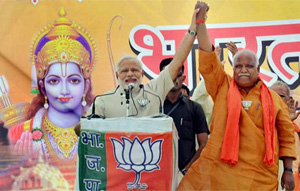
Lord Ram has served the BJP very well so far. It was the Ram temple issue around which seeds of the divisive politics were sown all over the country. The Rath yatra of Lal Krishna Advani precipitated deeper polarization and was followed by the trail of violence.
Untitled-1 copy copyThe well planned Babri demolition further intensified the communal violence and the politics in the name of religion in the country.

The reward of this was the strengthening of the electoral base of BJP, due to which the party gradually came to the fore, and from a marginal party in the national scheme of things it emerged as the single largest party in 1996.

With the 2014 elections it managed to get the simple majority (282 Lok Sabha seats, with 31% of votes). The promise of building the temple has been constantly on the agenda of the BJP but that has been a carrot which cannot materialize as a construction; but can keep serving BJP’s purpose of deceiving and polarizing the people.

This promise of Ram Temple is an allurement for sections of society. This promise has been made despite knowing well that the issue is pending in the Supreme Court and it cannot be built legally. The RSS combine also knows that demolitions can be incited illegally while constructions cannot be done illegally, still the propaganda can serve as an important electoral tool.

As UP elections (2017) are approaching, the issue of Ram Temple is being invoked yet again. In the Dussehra rally in Lucknow Prime Minister Narendra Modi invoked the slogan of Jai Shree Ram (October 2016).

This was the battle cry of the RSS combine as a build up to the Babri demolition in 1992.

A few days later, while inaugurating the power plant PM Modi was greeted with the same war cry symbolic of Hindu nationalism which has been the agenda of the BJP-RSS.

To supplement the efforts in the communal direction the BJP declared the project of a Ram Museum in Ayodha, and not to be left behind the Uttar Pradesh Government of Akhilesh Yadav decided to declare a Ram Leela theme park around the same time.

As such the Ram temple is the trade mark of BJP politics but seeing the electoral dividends which it has yielded for the ruling party, other political parties are also trying to jump in to this fray. Even Congress scion Rahul Gandhi during his Kisan Yatra paid a visit to the Hanuman Gadhi temple in Ayodhya.

To keep the pot boiling Vinay Katiyar of the BJP, who was part of the demolition squad in 1992, said that the museum-theme park is not the real thing, they are mere lolly-pops, real thing i.e. temple has to be built.

While RSS supremo Mohan Bhagwat has been declaring that the temple will be built in his life time, other worthies from the RSS combine have been more exactl saying the temple will be constructed during the regime of the current Modi Government.

As per the Allahabad high court judgment; the land of the Babri mosque should be divided into three parts. As per this ruling, one third of the land has gone to the Babri Masjid Action committee, another one third to Ram Shila Nyas and another third to Ram lalla.

This judgment used people’s faith as the foundation. This must have been a rare case where prevalent faith of people has been made the ground for a judgment. History has been mixed up with faith.

Lord Ram has been a strong cultural, religious and mythological entity in this part of South Asia. While giving the affidavit about the Ram Setu issue the UPA Government did say that Lord is a mythological figure. This statement is being heavily criticized by spokespersons of RSS, forgetting the clear cut distinction between history and mythology. One can’t deny the existence of Lord Rama at cultural and mythological levels, still to say that it is history is altogether a different matter.

With the rise of communal politics, on the one hand Lord Ram is being presented as a historical figure, that’s how communalists wanted to claim the Babri Masjid land on the ground that this was his place of birth.

On the other hand the cultural existence of Ram is being reduced to a mere religious one. One recalls that Dr. M. M. Basheer an important scholar of Ramayana from Kerala was forced to stop his column on Ramayana in the newspapers for being a Muslim.

Similarly famous actor Nawajuddin Siddiqui was stopped from playing the role of Ramayan character Marich in his village RamLila for his being a Muslim. The communalization of Lord Ram is a sad part of the story.

As such during the last few years, BJP’s assault on democratic values by playing communal games has been shifting the centre of gravity of Indian politics towards politics in the name of religion.

That’s why Rahul Gandhi has to visit a temple in Ayodhya as a public event. That’s how the Samajwadi party on the one hand is promoting theme parks like Ram Lila and on the other has been letting the communal violence continue in UP.

Starting from Muzaffarnagar (2013) the SP has played a dubious role due to which the BJP agenda of polarization has got a boost.

The calculation of the BJP is that low intensity communal violence will get it Hindu votes and on parallel lines the Samajwadi party feels this violence will make Muslims vulnerable and they will gravitate to it for protection.

As such the BJP now has equipped itself with many more emotive issues. It is out to politicize the surgical strikes in its favor by claiming ‘it is for the first time such a brave act has taken place’.

It is the leadership of PM Modi due to his training by RSS that such decisions are possible now. Falsehood and chest thumping are dominating sections of the media. BJP also has the issue of beef to boost its electoral campaign. So the grounds of democracy, issues related to material existence, rights and justice are being substituted by emotive issues. There is urgent need to restore the democratic order.

Comments

ali
 - 
Thursday, 3 Nov 2016

BJP will not win because ram has gone to vanavaas permanently.

Add new comment

  • Coastaldigest.com reserves the right to delete or block any comments.
  • Coastaldigset.com is not responsible for its readers’ comments.
  • Comments that are abusive, incendiary or irrelevant are strictly prohibited.
  • Please use a genuine email ID and provide your name to avoid reject.
Ram Puniyani
January 26,2020

During last couple of decades we have been witnessing the coming up of various statues in different parts of the country. There is diverse political logic and different set of political tendencies for erecting these statues. When Mayawati was UP CM, she got multiple of her own statues made, in addition to many statues of major dalit icons, irrespective of the criticism against that act. As per her strategy it was a symbol of identity of dalit assertion. The biggest statue to come up was that of Sardar Vallabh Bhai Patel, a lifelong Congressman, whom RSS combine is trying to appropriate. This statue of Unity was ‘Made in China’. The clever trick was that the same forces were behind this statue, which was banned by Patel in the aftermath of Gandhi murder. Interestingly while currently BJP is blaming Congress for Partition of India, ironically it was Sardar Patel who was in the committee which gave final stamp of approval for the partition of India.

There is also a talk in UP, where the Ram temple campaign yielded rich electoral dividends for BJP, to have tallest statue of Lord Ram in Ayodhya. In a state where children are dying in hospitals due to lack of Oxygen cylinders, a huge budgetary allocation will be required for such project. While on statues one should also remember that in Maharashtra a tall statue of Chatrapati Shivaji Maharaj is underway in Arabian Sea, near Mumbai. Only few voices of protest against it came up, e.g. that of renowned journalist, now, MP, Kumar Ketkar, whose house was vandalised for his opposing the move on the grounds that same massive amount can be utilized for welfare-development activities in the state.

On the back of this comes a comparatively low budget 114 feet tall statue of Jesus Christ in Karnataka, in Kappala hills Harobele village, where Christian pilgrims have been thronging from last several centuries. The land for this has been donated by Congress leader Shivaprasad and his brother, a Congress MP. It is planned to be carved out from a single rock. The plan of this statue is being opposed by those who have been behind most of the statue projects so far. Hindu Jagran Vedike, VHP, RSS are up in arms saying that they will not let this come up. There are various arguments cited for this opposition. It is being said that this was a place of worship of Lord Munnieshwara (a form of Lord Shiva).

More than this it is being argued that Shivakumar is trying to please his Italian boss in the party. Also that this will bring back the period of slavery of foreign rule, the colonial rule of British. As such this opposition is more in tune with the ideology of RSS combine, which has been for a statue here and a statue there. Their politics regards Christianity as a ‘foreign religion’! It is true that in Citizenship Amendment Act, they have not excluded Christianity while other religion, which they regard as ‘Foreign’ i.e. Islam. Here they are using a different logic, that the countries from where persecuted minorities are coming, are Muslim countries, Pakistan, Afghanistan and Bangla Desh.

In India the major targeting by RSS combine has been against Muslims, but Christians are also not spared. Starting in the decade of 1980, an intense propaganda has been going on that Christian Missionaries are converting. As RSS affiliate Vanvasi Kalyan Ashram became active in Adivasi areas, the likes of Swami Aseemanand, Swami Laxmanand and followers of Aasaram bapu spread out in Tribal areas. They started their programs to popularise Shabri and Hanuman, with congregations like Shabri Kumbh being regularly organized in these areas. The aim was to Hinduize the people in those areas.

The first major anti Christian violence came up in the ghastly form of burning alive of Pastor Graham Steward Stains along with his two minor sons Timothy and Philip. RSS affiliate Bajrang Dal's Dara Siingh aka Rajendra Pal was behind this and he is serving the life term for that. At the same time Wadhva Commission was appointed to investigate this crime which shook the country and President K.R. Narayan termed it as the one belonging to the inventory of the black deeds of human history.

The Wadhva commission report pointed out that there was no statistical significant change in the region where the pastor was working. Similarly the national figures tell us that the Christian population, if at all, has marginally declined in last five decades as per the census figures. They stand like this, percentage of Christians in population, 1971-2.60, 1981- 2.44, 1991-2.34, 2001-2.30 and 2011-2.30. There are arguments that some people are converting to Christianity but are not revealing their religion. This may be true in case of miniscule percentage of dalits, who may not reveal there conversion, as they stand to loose reservation provisions if they convert.

The anti Christian violence is scattered and is below the radar most of the places. There was massive valence in Kandhamal, Orissa, when on the pretext that Christians have murdered Swami Laxmananand, a massive violence was unleashed in 2008. On regular basis prayer meetings of Christians are attacked on the pretext that these are attempts at conversion. While there is a huge demand for the schools and colleges run by Christian groups, in Adivasis areas and remote areas the work of Swamis is on.

Now the trend is to dump Christian traditions. Since Ramnath Kovind became President, the usual practice of Carol Singers visiting Rashtrapati Bhavan has been stopped. In the army retreat so far ‘Abide with me’ by Scottish poet, Henri Francis Lyte, a Christian song, a favourite of Gandhi, has been dropped. The Christian minorities have perceived the threat in various forms. Currently they are as much part of the protests against CAA, NPR and NRIC as any other community.

While statues and identity issues cannot have primacy over the social development issues, it cannot be selective. To oppose Jesus Christ statue while spending fortunes for other statues is a part of the agenda of RSS combine, which is unfolding itself in various forms. opposition to Jesus Christ statue being yet another step in the direction.

Comments

Add new comment

  • Coastaldigest.com reserves the right to delete or block any comments.
  • Coastaldigset.com is not responsible for its readers’ comments.
  • Comments that are abusive, incendiary or irrelevant are strictly prohibited.
  • Please use a genuine email ID and provide your name to avoid reject.
Ram Puniyani
February 10,2020

Noam Chomsky is one of the leading peace workers in the world. In the wake of America’s attack on Vietnam, he brought out his classic formulation, ‘manufacturing consent’. The phrase explains the state manipulating public opinion to have the public approve of it policies—in this case, the attack of the American state on Vietnam, which was then struggling to free itself from French colonial rule.

In India, we are witness to manufactured hate against religious minorities. This hatred serves to enhance polarisation in society, which undermines India’s democracy and Constitution and promotes support for a Hindu nation. Hate is being manufactured through multiple mechanisms. For example, it manifests in violence against religious minorities. Some recent ghastly expressions of this manufactured hate was the massive communal violence witnessed in Mumbai (1992-93), Gujarat (2002), Kandhamal (2008) and Muzaffarnagar (2013). Its other manifestation was in the form of lynching of those accused of having killed a cow or consumed beef. A parallel phenomenon is the brutal flogging, often to death, of Dalits who deal with animal carcasses or leather.

Yet another form of this was seen when Shambhulal Regar, indoctrinated by the propaganda of Hindu nationalists, burned alive Afrazul Khan and shot the video of the heinous act. For his brutality, he was praised by many. Regar was incited into the act by the propaganda around love jihad. Lately, we have the same phenomenon of manufactured hate taking on even more dastardly proportions as youth related to Hindu nationalist organisations have been caught using pistols, while police authorities look on.

Anurag Thakur, a BJP minster in the central government recently incited a crowd in Delhi to complete his chant of what should happen to ‘traitors of the country...” with a “they should be shot”. Just two days later, a youth brought a pistol to the site of a protest at Jamia Millia Islamia university and shouted “take Azaadi!” and fired it. One bullet hit a student of Jamia. This happened on 30 January, the day Nathuram Godse had shot Mahatma Gandhi in 1948. A few days later, another youth fired near the site of protests against the CAA and NRC at Shaheen Bagh. Soon after, he said that in India, “only Hindus will rule”.

What is very obvious is that the shootings by those associated with Hindu nationalist organisations are the culmination of a long campaign of spreading hate against religious minorities in India in general and against Muslims in particular. The present phase is the outcome of a long and sustained hate campaign, the beginning of which lies in nationalism in the name of religion; Muslim nationalism and Hindu nationalism. This sectarian nationalism picked up the communal view of history and the communal historiography which the British introduced in order to pursue their ‘divide and rule’ policy.

In India what became part of “social common sense” was that Muslim kings had destroyed Hindu temples, that Islam was spread by force, and that it is a foreign religion, and so on. Campaigns, such as the one for a temple dedicated to the Hindu god Rama to be built at the site where the Babri masjid once stood, further deepened the idea of a Muslim as a “temple-destroyer”. Aurangzeb, Tipu Sultan and other Muslim kings were tarnished as the ones who spread Islam by force in the subcontinent. The tragic Partition, which was primarily due to British policies, and was well-supported by communal streams also, was entirely attributed to Muslims. The Kashmir conflict, which is the outcome of regional, ethnic and other historical issues, coupled with the American policy of supporting Pakistan’s ambitions of regional hegemony, (which also fostered the birth of Al-Qaeda), was also attributed to the Muslims.

With recurring incidents of communal violence, these falsehoods went on going deeper into the social thinking. Violence itself led to ghettoisation of Muslims and further broke inter-community social bonds. On the one hand, a ghettoised community is cut off from others and on the other hand the victims come to be presented as culprits. The percolation of this hate through word-of-mouth propaganda, media and re-writing of school curricula, had a strong impact on social attitudes towards the minorities.

In the last couple of decades, the process of manufacturing hate has been intensified by the social media platforms which are being cleverly used by the communal forces. Swati Chaturvedi’s book, I Am a Troll: Inside the Secret World of the BJP’s Digital Army, tells us how the BJP used social media to spread hate. Whatapp University became the source of understanding for large sections of society and hate for the ‘Other’, went up by leaps and bounds. To add on to this process, the phenomenon of fake news was shrewdly deployed to intensify divisiveness.

Currently, the Shaheen Bagh movement is a big uniting force for the country; but it is being demonised as a gathering of ‘anti-nationals’. Another BJP leader has said that these protesters will indulge in crimes like rape. This has intensified the prevalent hate.

While there is a general dominance of hate, the likes of Shambhulal Regar and the Jamia shooter do get taken in by the incitement and act out the violence that is constantly hinted at. The deeper issue involved is the prevalence of hate, misconceptions and biases, which have become the part of social thinking.

These misconceptions are undoing the amity between different religious communities which was built during the freedom movement. They are undoing the fraternity which emerged with the process of India as a nation in the making. The processes which brought these communities together broadly drew from Gandhi, Bhagat Singh and Ambedkar. It is these values which need to be rooted again in the society. The communal forces have resorted to false propaganda against the minorities, and that needs to be undone with sincerity.

Combating those foundational misconceptions which create hatred is a massive task which needs to be taken up by the social organisations and political parties which have faith in the Indian Constitution and values of freedom movement. It needs to be done right away as a priority issue in with a focus on cultivating Indian fraternity yet again.

Comments

Add new comment

  • Coastaldigest.com reserves the right to delete or block any comments.
  • Coastaldigset.com is not responsible for its readers’ comments.
  • Comments that are abusive, incendiary or irrelevant are strictly prohibited.
  • Please use a genuine email ID and provide your name to avoid reject.
Wafa Sultana
April 4,2020

Over the last couple of days when the world was occupied with unifying efforts to fight the deadly Covid19 pandemic, sections of Indian media provided viewers a familiar scapegoat – the Indian Muslims – who are often stereotyped as a community being constantly at loggerheads with the citizenry and the State. Biased media channels were quick to resort to blaming the entire Muslim community for the spread of the disease in the country, thanks to an ill-timed Tablighi Jamaat gathering at its international headquarters in Delhi’s Nizamuddin. Unsurprisingly, the opprobrium was also marked by a sudden spike in WhatsApp forwards of videos with people wearing skullcaps licking spoons and performing Sufi breathing rituals, suggesting some sort of wild conspiracy on the part of the community to spread the virus.  Some media channels were quick to formulate, hypothesize and provide loose definitions of a newly discovered form of Jihad i.e. ‘Corona Jihad ’ thereby vilifying the Islamic faith and its followers.

While the investigation on the culpability of the organizers of the Nizamuddin event is still ongoing, there is enough information to suggest that the meeting was held before any lockdown was in force, and the problem began when there was no way of getting people out once the curfew was announced. Be that as it may, there is little doubt that organizing a meet of such a scale when there is a global pandemic smacks of gross misjudgment, and definitely the organizers should be held accountable if laws or public orders were defied. Attendees who attempt to defy quarantine measures must be dealt with strictly. However, what is alarming is that the focus and narrative have now shifted from the unfortunate event at Nizamuddin to the Tablighi Jamaat itself.

For those not familiar with the Tablighi Jamaat, the organization was founded in 1926 in Mewat by scholar Maulana Mohammad Ilyas. The Jamaat’s main objective was to get Muslim youth to learn and practice pristine Islam shorn of external influences. This is achieved through individuals dedicating time for moral and spiritual upliftment secluded from the rest of the world for a brief period of time. There is no formal membership process. More senior and experienced participants typically travel from one mosque to other delivering talks on religious topics, inviting local youth to attend and then volunteer for a spiritual retreat for a fixed number of days to a mosque in a nearby town or village to present the message to their co-religionists. Contrary to ongoing Islamophobic rhetoric, the movement does not actively proselytize. The focus is rather on getting Muslims to learn the teachings and practices of Islam.  This grassroots India-based movement has now grown to almost all countries with substantial Muslim populations. Its annual meets, or ‘ijtemas’ are among the largest Islamic congregations in the world after the annual Haj. One of the reasons for its popularity and wide network in the subcontinent and wordwide is the fact that it has eschewed the need for scholarly intervention, focusing on peer learning of fundamental beliefs and practice rather than high-falutin ideological debates. The Tablighi Jamaat also distinguishes itself from other Islamic movements through its strictly apolitical nature, with a focus on individual self-improvement rather than political mobilization. Hardships and difficulty in the world are expected to be face through ‘sabr’ (patience) and ‘dua’ (supplication),  than through quest for political power or influence. In terms of ideology, it is very much based on mainstream Sunni Islamic principles derived from the Deobandi school.

So, why is all this background important in the current context? While biased media entities have expectedly brought out their Islamophobic paraphernalia out for full display, more neutral commentators have tried to paint the Tablighi Jamaat as a fringe group and have tried to distance it from 'mainstream Muslims'. While the intent is no doubt innocent, this is a trap we must not fall into. This narrative, unfortunately, is also gaining ground due to apathy some Muslims have for the group, accusing it of being “disconnected from the realities of the world”. Unlike other Muslim organizations and movements, the Tablighi Jamat, by virtue of its political indifference, does not boast of high-profile advocates and savvy spokespersons who can defend it in mainstream or social media.  The use of adjectives such as 'outdated' and 'orthodox' by liberal columnists to describe the Jamaat feeds into the malignant attempt to change the narrative from the control of the spread of the pandemic due to the Nizamuddin gathering to 'raison d'etre' of the organization itself.

A large mainstream religious group like the Tablighi Jamaat with nearly a hundred-year history, normally considered to be peaceful, apolitical and minding its own business is now suddenly being villainized owing to unfortunate circumstances. Biased media reactions filled with disgust and hate seem to feed the Indian public conscience with a danngerous misconception - to be a nominal Muslim is okay but being a practicing one is not.  For those committed to the truth and fighting the spread of Islamophobia, the temptation to throw the entire Tablighi Jamaat under the bus must be resisted.

The writer is a lawyer and research scholar at Qatar University. Her research interests include Islamic law and politics.

Comments

zahoorahmed
 - 
Saturday, 4 Apr 2020

great article! provides a great perspective on tableeg jamat

Add new comment

  • Coastaldigest.com reserves the right to delete or block any comments.
  • Coastaldigset.com is not responsible for its readers’ comments.
  • Comments that are abusive, incendiary or irrelevant are strictly prohibited.
  • Please use a genuine email ID and provide your name to avoid reject.