



Donald Trump triumphs over Hilary Clinton in White House upset

November 9, 2016

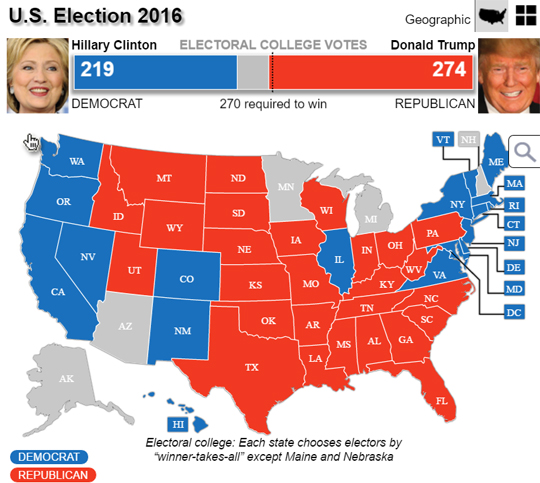
Washington, Nov 9: Republican Donald Trump stunned the world on Tuesday by defeating heavily favored Hillary Clinton in the race for the White House, ending eight years of Democratic rule and sending the United States on a new, uncertain path.
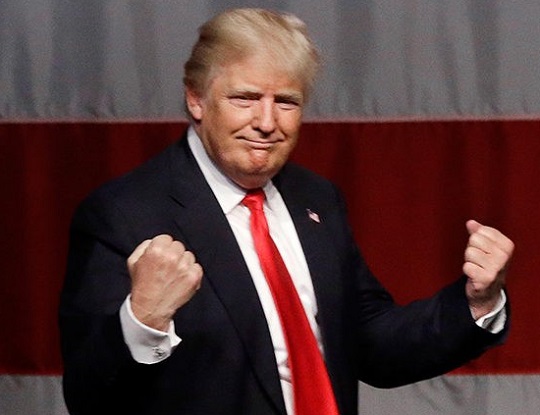
Donald-Trump

A wealthy real-estate developer and former reality TV host, Trump rode a wave of anger toward Washington insiders to defeat Clinton, whose gold-plated establishment resume includes stints as a first lady, U.S. senator and secretary of state.

Worried a Trump victory could cause economic and global uncertainty, investors were in full flight from risky assets such as stocks. In overnight trading, S&P 500 index futures fell 5 percent to hit their so-called limit down levels, indicating they would not be permitted to trade any lower until regular U.S. stock market hours on Wednesday.

The Associated Press and Fox News projected that Trump had collected just enough of the 270 state-by-state electoral votes needed to win a four-year term that starts on Jan. 20, taking battleground states where presidential elections are traditionally decided.

CNN reported Clinton had called Trump to concede concede the election. A short time earlier, Clinton campaign chairman John Podesta told supporters at her election rally in New York to go home. "Several states are too close to call so we're not going to have anything more to say tonight," he said.

Victorious in a cliffhanger race that opinion polls had forecast was Clinton's to win, Trump won avid support among a core base of white non-college educated workers with his promise to be the "greatest jobs president that God ever created."

His win raises a host of questions for the United States at home and abroad. He campaigned on a pledge to take the country on a more isolationist, protectionist "America First" path. He has vowed to impose a 35 percent tariff on goods exported to the United States by U.S. companies that went abroad.

Both candidates, albeit Trump more than Clinton, had historically low popularity ratings in an election that many voters characterized as a choice between two unpleasant alternatives.

Trump, who at 70 will be the oldest first-term U.S. president, came out on top after a bitter and divisive campaign that focused largely on the character of the candidates and whether they could be trusted to serve as the country's 45th president.

The presidency will be his first elected office, and it remains to be seen how he will work with Congress. During the campaign Trump was the target of sharp disapproval, not just from Democrats but from many in his own party.

Television networks projected Republicans would retain control of the U.S. House of Representatives, where all 435 seats were up for grabs. In the U.S. Senate, the party also put up an unexpectedly tough fight to protect its majority in the U.S. Senate.

Trump entered the race 17 months ago and survived a series of seemingly crippling blows, many of them self-inflicted, including the emergence in October of a 2005 video in which he boasted about making unwanted sexual advances on women. He apologized but within days, several women emerged to say he had groped them, allegations he denied. He was judged the loser of all three presidential debates with Clinton.

Touts His Business Acumen

During the campaign, Trump said he would make America great again through the force of his personality, negotiating skill and business acumen. He proposed refusing entry to the United States of people from war-torn Middle Eastern countries, a modified version of an earlier proposed ban on Muslims.

His volatile nature and unorthodox proposals led to campaign feuds with a long list of people, including Muslims, the disabled, Republican U.S. Senator John McCain, Fox News anchor Megyn Kelly, the family of a slain Muslim-American soldier, a Miss Universe winner and a federal judge of Mexican heritage.

Throughout his campaign - and especially in his acceptance speech at the Republican National Convention in July - Trump described a dark America that had been knocked to its knees by China, Mexico, Russia and Islamic State. The American dream was dead, he said, smothered by malevolent business interests and corrupt politicians, and he alone could revive it.

He offered vague plans to win economic concessions from China, to build a wall on the southern U.S. border with Mexico to keep out undocumented immigrants and to pay for it with tax money sent home by migrants.

The Mexican peso plunged to its lowest-ever levels. The peso had become a touchstone for sentiment on the election as Trump threatened to rip up a free trade agreement with Mexico.

His triumph was a rebuke to President Barack Obama, a Democrat who spent weeks flying around the country to campaign against him. Obama will hand over the office to Trump after serving the maximum eight years allowed by law.

Trump promises to push Congress to repeal Obama's troubled healthcare plan and to reverse his Clean Power Plan. He plans to create jobs by relying on U.S. fossil fuels such as oil and gas.

Clinton's Failed Second Bid

Trump's victory marked a frustrating end to the presidential aspirations of Clinton, 69, who for the second time failed in her drive to be elected the first woman U.S. president.

In a posting on Twitter, Clinton acknowledged a battle that was unexpectedly tight given her edge in opinion polls going into Election Day. "This team has so much to be proud of. Whatever happens tonight, thank you for everything," she tweeted.

The wife of former President Bill Clinton and herself a former U.S. senator, she held a steady lead in many opinion polls for months. Voters perceived in her a cautious and calculating candidate and an inability to personally connect with them.

Even though the FBI found no grounds for criminal charges after a probe into her use of a private email server rather than a government system while she was secretary of state, the issue allowed critics to raise doubts about her integrity.

Hacked emails also showed a cozy relationship between her State Department and donors to her family's Clinton Foundation charity.

usresultgraph

Comments

abdul khadar
 - 
Thursday, 10 Nov 2016

What a tragedy?

Hilary is Looser with 48% votes
Trump is winner with 47% votes

Modi is winner with less than 35% votes (more than 65% against)

What a great Democracy?

myb
 - 
Wednesday, 9 Nov 2016

@Bopanna/ Bernardo
You are trying to lie hundred times to prove one wrong which is nothing new for muslims. There are many such websites engage in defaming Islam which did nothing harm to Islam instead more people embracing across the world. Islam is

analyst
 - 
Wednesday, 9 Nov 2016

I think CD should either ignore the comments consist of religion sentiments or forward the emal ID to the concern heads of that respective country.

Sameer
 - 
Wednesday, 9 Nov 2016

Bopu is not in KSA.. he has a dream to visit KSA thats it guys. So he always mentioning KSA.. Bhakt log India se bahar jakey kya karengey? Hawan kya? Bhakt log tho fake hey tho fake hi naam likhengey na.. :D

Althaf
 - 
Wednesday, 9 Nov 2016

Oye Bopanna KSA
If child molesters are from desert then they might molest you also. Dont you have shame to work in desert?? Remember you are feeding your family from the wealth which is earned from the same desert where you work. Really shame on creatures like you.

Abu Muhammad
 - 
Wednesday, 9 Nov 2016

Trump long back declared that he has been a friend & ally of adulterous and fatherless religion of scums who worship human private parts. This day no female child is safe in their homes as the nation of drunkards celebrate victory, for them women are just for sex, use n throw

Sahil
 - 
Wednesday, 9 Nov 2016

Bopu.. and you forgot to write.. from the desert where you are earning ur bread and butter. Bhakts will have 1 peg extra today and will try to molest their own family members. Llol

aharkul
 - 
Wednesday, 9 Nov 2016

Congratulation Mr. Trump. Keep it up. Bring whole world into control and vanish terrorism all over the world. Keep smiling. God bless you..

A.Mangalore
 - 
Wednesday, 9 Nov 2016

Another 9/11 hit US

Pamela
 - 
Wednesday, 9 Nov 2016

I had this victory predicted two weeks ago under comment's column in CD

Rikaz
 - 
Wednesday, 9 Nov 2016

Congratulations Mr. Trump!

Add new comment

  • Coastaldigest.com reserves the right to delete or block any comments.
  • Coastaldigset.com is not responsible for its readers’ comments.
  • Comments that are abusive, incendiary or irrelevant are strictly prohibited.
  • Please use a genuine email ID and provide your name to avoid reject.
News Network
February 22,2020

Washington, Feb 22: US President Donald Trump will raise the issue of religious freedom with Prime Minister Narendra Modi during his visit to India next week, the White House said on Friday, noting that the US has great respect for India's democratic traditions and institutions.

"President Trump will talk about our shared tradition of democracy and religious freedom both in his public remarks and then certainly in private. He will raise these issues, particularly the religious freedom issue, which is extremely important to this administration," a senior official told reporters in a conference call.

The official was responding to a question on whether the president was planning to speak to Modi on the Citizenship (Amendment) Act or the National Register of Citizens.

"We do have this shared commitment to upholding our universal values, the rule of law. We have great respect for India's democratic traditions and institutions, and we will continue to encourage India to uphold those traditions," the official said, requesting anonymity.

"And we are concerned with some of the issues that you have raised," the senior administration official said, in response to the question on CAA and NRC.

"I think the President will talk about these issues in his meetings with Prime Minister Modi and note that the world is looking to India to continue to uphold its democratic traditions, respect for religious minorities," the official said.

"Of course, it's in the Indian constitution -- religious freedom, respect for religious minorities, and equal treatment of all religions. So this is something that is important to the president and I'm sure it will come up," said the official.

Pointing out that India has a strong democratic foundation, the official said India is a country rich in religious, linguistic, and cultural diversity.

"In fact, it's the birthplace of four major world religions," the official noted.

Comments

Add new comment

  • Coastaldigest.com reserves the right to delete or block any comments.
  • Coastaldigset.com is not responsible for its readers’ comments.
  • Comments that are abusive, incendiary or irrelevant are strictly prohibited.
  • Please use a genuine email ID and provide your name to avoid reject.
News Network
March 3,2020

Mar 3: Just hours after the ending of a week-long “reduction” in violence that was crucial for Donald Trump’s peace deal in Afghanistan, the Taliban struck again: On Monday, they killed three people and injured about a dozen at a football match in Khost province. This resumption of violence will not surprise anyone actually invested in peace for that troubled country. The point of the U.S.-Taliban deal was never peace. It was to try and cover up an ignominious exit for the U.S., driven by an election-bound president who feels no responsibility toward that country or to the broader region.

Seen from South Asia, every point we know about in the agreement is a concession by Trump to the Taliban. Most importantly, it completes a long-term effort by the U.S. to delegitimize the elected government in Kabul — and, by extension, Afghanistan’s constitution. Afghanistan’s president is already balking at releasing 5,000 Taliban prisoners before intra-Afghan talks can begin — a provision that his government did not approve.

One particularly cringe-worthy aspect: The agreement refers to the Taliban throughout  as “the Islamic Emirate of Afghanistan that is not recognized by the United States as a state and is known as the Taliban.” This unwieldy nomenclature validates the Taliban’s claim to be a government equivalent to the one in Kabul, just not the one recognised at the moment by the U.S. When read together with the second part of the agreement, which binds the U.S. to not “intervene in [Afghanistan’s] domestic affairs,” the point is obvious: The Taliban is not interested in peace, but in ensuring that support for its rivals is forbidden, and its path to Kabul is cleared.

All that the U.S. has effectively gotten in return is the Taliban’s assurance that it will not allow the soil of Afghanistan to be used against the “U.S. and its allies.” True, the U.S. under Trump has shown a disturbing willingness to trust solemn assurances from autocrats; but its apparent belief in promises made by a murderous theocratic movement is even more ridiculous. Especially as the Taliban made much the same promise to an Assistant Secretary of State about Osama bin Laden while he was in the country plotting 9/11.

Nobody in the region is pleased with this agreement except for the Taliban and their backers in the Pakistani military. India has consistently held that the legitimate government in Kabul must be the basic anchor of any peace plan. Ordinary Afghans, unsurprisingly, long for peace — but they are, by all accounts, deeply skeptical about how this deal will get them there. The brave activists of the Afghan Women’s Network are worried that intra-Afghan talks will take place without adequate representation of the country’s women — who have, after all, the most to lose from a return to Taliban rule.

But the Pakistani military establishment is not hiding its glee. One retired general tweeted: “Big victory for Afghan Taliban as historic accord signed… Forced Americans to negotiate an accord from the position of parity. Setback for India.” Pakistan’s army, the Taliban’s biggest backer, longs to re-install a friendly Islamist regime in Kabul — and it has correctly estimated that, after being abandoned by Trump, the Afghan government will have sharply reduced bargaining power in any intra-Afghan peace talks. A deal with the Taliban that fails also to include its backers in the Pakistani military is meaningless.

India, meanwhile, will not see this deal as a positive for regional peace or its relationship with the U.S. It comes barely a week after Trump’s India visit, which made it painfully clear that shared strategic concerns are the only thing keeping the countries together. New Delhi remembers that India is not, on paper, a U.S. “ally.” In that respect, an intensification of terrorism targeting India, as happened the last time the U.S. withdrew from the region, would not even be a violation of Trump’s agreement. One possible outcome: Over time the government in New Delhi, which has resolutely sought to keep its ties with Kabul primarily political, may have to step up security cooperation. Nobody knows where that would lead.

The irresponsible concessions made by the U.S. in this agreement will likely disrupt South Asia for years to come, and endanger its own relationship with India going forward. But worst of all, this deal abandons those in Afghanistan who, under the shadow of war, tried to develop, for the first time, institutions that work for all Afghans. No amount of sanctimony about “ending America’s longest war” should obscure the danger and immorality of this sort of exit.

Comments

Add new comment

  • Coastaldigest.com reserves the right to delete or block any comments.
  • Coastaldigset.com is not responsible for its readers’ comments.
  • Comments that are abusive, incendiary or irrelevant are strictly prohibited.
  • Please use a genuine email ID and provide your name to avoid reject.
Agencies
July 15,2020

Huawei will be completely removed from the UK's 5G networks by the end of 2027, the UK government announced on Tuesday after a review by the country's National Cyber Security Centre (NCSC) on the impact of US sanctions against the Chinese telecommunications giant.

In the lead up to this complete removal of all Huawei kit from UK networks, there will be a total ban on the purchase of any new 5G kit after December 31, 2020.

The decision was taken at a meeting of the UK's National Security Council (NSC) chaired by Prime Minister Boris Johnson, in response to new US sanctions against the telecom major imposed in May which removed the firm's access to products which have been built based on US semiconductor technology.

5G will be transformative for our country, but only if we have confidence in the security and resilience of the infrastructure it is built upon, said Oliver Dowden, UK Secretary of State for Digital, Culture, Media and Sport (DCMS).

Following US sanctions against Huawei and updated technical advice from our cyber experts, the government has decided it necessary to ban Huawei from our 5G networks. No new kit is to be added from January 2021, and UK 5G networks will be Huawei free by the end of 2027. This decisive move provides the industry with the clarity and certainty it needs to get on with delivering 5G across the UK, he said.

The minister, who laid out the details of the UK's ban on Huawei in the House of Commons, said the government will now seek to legislate with a new Telecoms Security Bill to put in place the powers necessary to implement the tough new telecoms security framework.

By the time of the next election (2024) we will have implemented in law an irreversible path for the complete removal of Huawei equipment from our 5G networks, said Dowden.

The new law will give the government the national security powers to impose these new controls on high risk vendors and create extensive security duties on network operators to drive up standards, DCMS said.

Technical experts at the NCSC reviewed the consequences of the US sanctions and concluded that Huawei will need to do a major reconfiguration of its supply chain as it will no longer have access to the technology on which it currently relies and there are no alternatives which we have sufficient confidence in.

They found the new restrictions make it impossible to continue to guarantee the security of Huawei equipment in the future.

After a ban on the purchase of new Huawei kit for 5G from next year, the aim is to completely remove the Chinese vendor's influence on 5G networks across the UK by the end of 2027.

The DCMS said Tuesday's decision takes into account the UK's specific national circumstances and how the risks from these sanctions are manifested in the country.

The existing restrictions on Huawei in sensitive and critical parts of the network remain in place, it highlighted.

The DCMS said the US action also affects Huawei products used in the UK's full fibre broadband networks. However, the UK has managed Huawei's presence in the UK's fixed access networks since 2005 and we also need to avoid a situation where broadband operators are reliant on a single supplier for their equipment.

As a result, following security advice from experts, DCMS is advising full fibre operators to transition away from purchasing new Huawei equipment. A technical consultation will determine the transition timetable, but it is expect this period to last no longer than two years.

The government said its new approach strikes the right balance by recognising full fibre's established presence and supporting the connections that the public relies on, while fully addressing the security concerns.

It stressed that its new policy in relation to high risk vendors has not been designed around one company, one country or one threat but as an enduring and flexible policy that will enable the UK to manage the risks to the network, now and in the future.

Comments

Add new comment

  • Coastaldigest.com reserves the right to delete or block any comments.
  • Coastaldigset.com is not responsible for its readers’ comments.
  • Comments that are abusive, incendiary or irrelevant are strictly prohibited.
  • Please use a genuine email ID and provide your name to avoid reject.