


Donald Trump triumphs over Hilary Clinton in White House upset

November 9, 2016

Washington, Nov 9: Republican Donald Trump stunned the world on Tuesday by defeating heavily favored Hillary Clinton in the race for the White House, ending eight years of Democratic rule and sending the United States on a new, uncertain path.
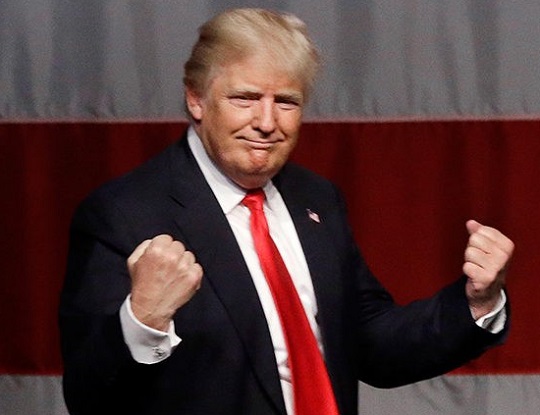
Donald-Trump

A wealthy real-estate developer and former reality TV host, Trump rode a wave of anger toward Washington insiders to defeat Clinton, whose gold-plated establishment resume includes stints as a first lady, U.S. senator and secretary of state.

Worried a Trump victory could cause economic and global uncertainty, investors were in full flight from risky assets such as stocks. In overnight trading, S&P 500 index futures fell 5 percent to hit their so-called limit down levels, indicating they would not be permitted to trade any lower until regular U.S. stock market hours on Wednesday.

The Associated Press and Fox News projected that Trump had collected just enough of the 270 state-by-state electoral votes needed to win a four-year term that starts on Jan. 20, taking battleground states where presidential elections are traditionally decided.

CNN reported Clinton had called Trump to concede concede the election. A short time earlier, Clinton campaign chairman John Podesta told supporters at her election rally in New York to go home. "Several states are too close to call so we're not going to have anything more to say tonight," he said.

Victorious in a cliffhanger race that opinion polls had forecast was Clinton's to win, Trump won avid support among a core base of white non-college educated workers with his promise to be the "greatest jobs president that God ever created."

His win raises a host of questions for the United States at home and abroad. He campaigned on a pledge to take the country on a more isolationist, protectionist "America First" path. He has vowed to impose a 35 percent tariff on goods exported to the United States by U.S. companies that went abroad.

Both candidates, albeit Trump more than Clinton, had historically low popularity ratings in an election that many voters characterized as a choice between two unpleasant alternatives.

Trump, who at 70 will be the oldest first-term U.S. president, came out on top after a bitter and divisive campaign that focused largely on the character of the candidates and whether they could be trusted to serve as the country's 45th president.

The presidency will be his first elected office, and it remains to be seen how he will work with Congress. During the campaign Trump was the target of sharp disapproval, not just from Democrats but from many in his own party.

Television networks projected Republicans would retain control of the U.S. House of Representatives, where all 435 seats were up for grabs. In the U.S. Senate, the party also put up an unexpectedly tough fight to protect its majority in the U.S. Senate.

Trump entered the race 17 months ago and survived a series of seemingly crippling blows, many of them self-inflicted, including the emergence in October of a 2005 video in which he boasted about making unwanted sexual advances on women. He apologized but within days, several women emerged to say he had groped them, allegations he denied. He was judged the loser of all three presidential debates with Clinton.

Touts His Business Acumen

During the campaign, Trump said he would make America great again through the force of his personality, negotiating skill and business acumen. He proposed refusing entry to the United States of people from war-torn Middle Eastern countries, a modified version of an earlier proposed ban on Muslims.

His volatile nature and unorthodox proposals led to campaign feuds with a long list of people, including Muslims, the disabled, Republican U.S. Senator John McCain, Fox News anchor Megyn Kelly, the family of a slain Muslim-American soldier, a Miss Universe winner and a federal judge of Mexican heritage.

Throughout his campaign - and especially in his acceptance speech at the Republican National Convention in July - Trump described a dark America that had been knocked to its knees by China, Mexico, Russia and Islamic State. The American dream was dead, he said, smothered by malevolent business interests and corrupt politicians, and he alone could revive it.

He offered vague plans to win economic concessions from China, to build a wall on the southern U.S. border with Mexico to keep out undocumented immigrants and to pay for it with tax money sent home by migrants.

The Mexican peso plunged to its lowest-ever levels. The peso had become a touchstone for sentiment on the election as Trump threatened to rip up a free trade agreement with Mexico.

His triumph was a rebuke to President Barack Obama, a Democrat who spent weeks flying around the country to campaign against him. Obama will hand over the office to Trump after serving the maximum eight years allowed by law.

Trump promises to push Congress to repeal Obama's troubled healthcare plan and to reverse his Clean Power Plan. He plans to create jobs by relying on U.S. fossil fuels such as oil and gas.

Clinton's Failed Second Bid

Trump's victory marked a frustrating end to the presidential aspirations of Clinton, 69, who for the second time failed in her drive to be elected the first woman U.S. president.

In a posting on Twitter, Clinton acknowledged a battle that was unexpectedly tight given her edge in opinion polls going into Election Day. "This team has so much to be proud of. Whatever happens tonight, thank you for everything," she tweeted.

The wife of former President Bill Clinton and herself a former U.S. senator, she held a steady lead in many opinion polls for months. Voters perceived in her a cautious and calculating candidate and an inability to personally connect with them.

Even though the FBI found no grounds for criminal charges after a probe into her use of a private email server rather than a government system while she was secretary of state, the issue allowed critics to raise doubts about her integrity.

Hacked emails also showed a cozy relationship between her State Department and donors to her family's Clinton Foundation charity.
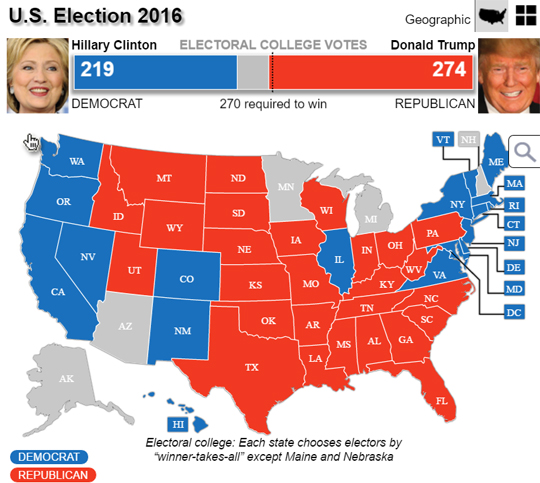

usresultgraph

Comments

abdul khadar
 - 
Thursday, 10 Nov 2016

What a tragedy?

Hilary is Looser with 48% votes
Trump is winner with 47% votes

Modi is winner with less than 35% votes (more than 65% against)

What a great Democracy?

myb
 - 
Wednesday, 9 Nov 2016

@Bopanna/ Bernardo
You are trying to lie hundred times to prove one wrong which is nothing new for muslims. There are many such websites engage in defaming Islam which did nothing harm to Islam instead more people embracing across the world. Islam is

analyst
 - 
Wednesday, 9 Nov 2016

I think CD should either ignore the comments consist of religion sentiments or forward the emal ID to the concern heads of that respective country.

Sameer
 - 
Wednesday, 9 Nov 2016

Bopu is not in KSA.. he has a dream to visit KSA thats it guys. So he always mentioning KSA.. Bhakt log India se bahar jakey kya karengey? Hawan kya? Bhakt log tho fake hey tho fake hi naam likhengey na.. :D

Althaf
 - 
Wednesday, 9 Nov 2016

Oye Bopanna KSA
If child molesters are from desert then they might molest you also. Dont you have shame to work in desert?? Remember you are feeding your family from the wealth which is earned from the same desert where you work. Really shame on creatures like you.

Abu Muhammad
 - 
Wednesday, 9 Nov 2016

Trump long back declared that he has been a friend & ally of adulterous and fatherless religion of scums who worship human private parts. This day no female child is safe in their homes as the nation of drunkards celebrate victory, for them women are just for sex, use n throw

Sahil
 - 
Wednesday, 9 Nov 2016

Bopu.. and you forgot to write.. from the desert where you are earning ur bread and butter. Bhakts will have 1 peg extra today and will try to molest their own family members. Llol

aharkul
 - 
Wednesday, 9 Nov 2016

Congratulation Mr. Trump. Keep it up. Bring whole world into control and vanish terrorism all over the world. Keep smiling. God bless you..

A.Mangalore
 - 
Wednesday, 9 Nov 2016

Another 9/11 hit US

Pamela
 - 
Wednesday, 9 Nov 2016

I had this victory predicted two weeks ago under comment's column in CD

Rikaz
 - 
Wednesday, 9 Nov 2016

Congratulations Mr. Trump!

Add new comment

  • Coastaldigest.com reserves the right to delete or block any comments.
  • Coastaldigset.com is not responsible for its readers’ comments.
  • Comments that are abusive, incendiary or irrelevant are strictly prohibited.
  • Please use a genuine email ID and provide your name to avoid reject.
News Network
March 28,2020

Washington, Mar 28: The world is in the face of a devastating impact due to the coronavirus pandemic and has clearly entered a recession, the International Monetary Fund said on Friday, but projected a recovery next year.

"We have reassessed the prospects for growth for 2020 and 2021. It is now clear that we have entered a recession as bad or worse than in 2009. We do project recovery in 2021," IMF Managing Director Kristalina Georgieva told reporters at a news conference.

Georgieva was addressing the press after a meeting of governing body of the IMF, the International Monetary and Financial Committee. Representing 189 members, the body met virtually to discuss the unprecedented challenge posed to the world by COVID-19.

The key to recovery in 2021, she said, is only if the international community succeeds in containing the virus everywhere and prevent liquidity problems from becoming a solvency issue.

"The US is in recession, as is the rest of the advanced economies of the world. And in a big chunk of developed and emerging markets in developing economies. How severe? We are working now on our projections for 2020, Georgieva said in response to a question.

The new projections are expected in the next few weeks.

Stressing that while containment is the main reason for the economy to stand still and get into a recession, she said containment is very necessary to come out of this period and step in to recovery. "Until the virus is not contained, it would be very difficult to go to the lives we love."

"A key concern about a long-lasting impact of the sudden stop of the world economy is the risk of a wave of bankruptcies and layoffs that not only can undermine the recovery. But can erode the fabric of our societies," the IMF chief said.

To avoid this from happening, many countries have taken far-reaching measures to address the health crisis and to cushion its impact on the economy, both on the monetary and on the fiscal side, she said.

The IMF chief said 81 emergency financing requests, including 50 from lower-income countries, have been received. She said current estimate for the overall financial needs of emerging markets is 2.5 trillion dollars.

"We believe this is on the lower end. We do know that their own reserves and domestic resources will not be sufficient," she added.

The G-20, a day earlier, reported fiscal measures totalling some 5 trillion dollars or over 6 per cent of the global GDP.

Responding to another question, Georgieva said the IMF is projecting recession for 2020.

"We do expect it to be quite deep and we are very much urging countries to step up containment measures aggressively so we can shorten the duration of this period of time when the economy is in standstill," she said.

"And also to apply well-targeted measures, primarily focusing on the health system to absorb that enormous stress that comes from coronavirus. And on people, businesses and the financial system, I am very pleased to say that when we went through countries' responses, that sense of targeted fiscal measures is there and are also very impressive to see the size of these measures," she added.

"Countries are doing all they can on the fiscal and on the monetary front. We have heard from our members' very impressive decisions taken over the last days," the IMF chief said.

"We also want to caution that as we are responding now, we want to make the recession as possibly short and not too deep. We also want to think about what is going to follow the recovery and make sure that we are putting forward measures that can be supportive in this regard," she said.

Comments

Add new comment

  • Coastaldigest.com reserves the right to delete or block any comments.
  • Coastaldigset.com is not responsible for its readers’ comments.
  • Comments that are abusive, incendiary or irrelevant are strictly prohibited.
  • Please use a genuine email ID and provide your name to avoid reject.
Agencies
January 20,2020

For the first time in the 15 years of the Global Risks Report, the climate change and environment risk has occupied all the top five slots.

According to the 15th edition of the World Economic Forum's (WEF) Global Risks Report, the top five risks in terms of likelihood are extreme weather, climate action failure, natural disasters, biodiversity loss and human-made environmental disasters. They all fall in the one category of climate change and related environmental disasters.

WEF President Borge Brende said the world was feeling long-mounting and interconnected risks.

The report also points to how citizens are protesting across the world as discontent rises with failed systems that are creating inequality. The citizens' discontent had hardened with systems that had failed to promote advancement, it said.

"Disapproval of how governments are addressing profound economic and social issues has sparked protests throughout the world, potentially weakening the ability of governments to take decisive action should a downturn occur. Without economic and social stability, countries could lack the financial resources, fiscal margin, political capital or social support needed to confront key global risks," it said.

Listing the grim scenario, Borge said the global economy was faced with "synchronised slowdown", the past five years had been the warmest on record and cyber attacks were expected to increase this year.

The report warns that while the myriad risks were rising, time was running out on how to prevent them.

Borge said the growing palpability of shared economic, environmental and societal risks indicated that the horizon had shortened for preventing "or even mitigating" some of the direst consequences of global risks.

"It's sobering that in the face of this development, when the challenges before us demand immediate collective action, fractures within the global community appear to only be widening," he said.

The report points to grave concern about the consequences of continued environmental degradation, including the record pace of species decline.

Pointing to an unsettled geopolitical environment, the report said today's risk landscape was one in which new centres of power and influence were forming and old alliance structures and global institutions were being tested.

"While these changes can create openings for new partnership structures in the immediate term, they are putting stress on systems of coordination and challenging norms around shared responsibility. Unless stakeholders adapt multilateral mechanisms for this turbulent period, the risks that were once on the horizon will continue to arrive," it said.

Calling it a "an unsettled world", the WEF report notes that powerful economic, demographic and technological forces were shaping a new balance of power. "The result is an unsettled geopolitical landscape in which states are increasingly viewing opportunities and challenges through unilateral lenses," it said.

"What were once givens regarding alliance structures and multilateral systems no longer hold as states question the value of long-standing frameworks, adopt more nationalist postures in pursuit of individual agendas and weigh the potential geopolitical consequences of economic decoupling. Beyond the risk of conflict, if stakeholders concentrate on immediate geo-strategic advantage and fail to re-imagine or adapt mechanisms for coordination during this unsettled period, opportunities for action on key priorities may slip away," the WEF said.

In a chapter on risks to economic stability and social cohesion, it said a challenging economic climate might persist this year and members of the multi-stakeholder community saw "economic confrontations" and "domestic political polarisation" as the top risks in 2020.

The report also warned of downward pressure on the global economy from macroeconomic fragilities and financial inequality. These pressures continued to intensify in 2019, increasing the risk of economic stagnation.

Low trade barriers, fiscal prudence and strong global investment, once seen as fundamentals for economic growth, are fraying as leaders advance nationalist policies. The margins for monetary and fiscal stimuli are also narrower than before the 2008-2009 financial crisis, creating uncertainty about how well countercyclical policies will work.

The strategic partners for the WEF report included Marsh & McLennan and Zurich Insurance Group. The academic advisers were National University of Singapore, Oxford Martin School, University of Oxford and Wharton Risk Management and Decision Processes Center, University of Pennsylvania.

Comments

Add new comment

  • Coastaldigest.com reserves the right to delete or block any comments.
  • Coastaldigset.com is not responsible for its readers’ comments.
  • Comments that are abusive, incendiary or irrelevant are strictly prohibited.
  • Please use a genuine email ID and provide your name to avoid reject.
News Network
January 2,2020

Washington, Jan 2: The number of people killed in large commercial airplane crashes fell by more than 50% in 2019 despite a high-profile Boeing 737 MAX crash in Ethiopia in March, a Dutch consulting firm said on Wednesday. Aviation consulting firm To70 said there were 86 accidents involving large commercial planes - including eight fatal incidents - resulting in 257 fatalities last year. In 2018, there were 160 accidents, including 13 fatal ones, resulting in 534 deaths, the firm said.

To70 said the fatal accident rate for large airplanes in commercial passenger air transport was just 0.18 fatal accident per million flights in 2019, or an average one fatal accident every 5.58 million flights, a significant improvement over 2018. The fatality numbers include passengers, air crew such as flight attendants and any people on the ground killed in a plane accident

Large passenger airplanes in the study are aircraft used by nearly all travelers on airlines worldwide but excludes small commuter airplanes in service, including the Cessna Caravan and some smaller turboprop airplanes, according to To70.

On Dec. 23, Boeing's board said it had fired Chief Executive Dennis Muilenburg after a pair of fatal crashes involving the 737 MAX forced it to announce it was halting output of its best-selling jetliner. The 737 MAX has been grounded since March after an October 2018 crash in Indonesia and the crash of a MAX in Ethiopia in March killed a total of 346 people.

To70 said the aviation industry spent significant effort in 2019 "focusing on so-called 'future threats' such as drones." But the MAX crashes "are a reminder that we need to retain our focus on the basics that make civil aviation so safe: well-designed and well-built aircraft flown by fully informed and well-trained crews."

The Aviation Safety Network said on Wednesday that, despite the MAX crash, 2019 "was one of the safest years ever for commercial aviation." The 157 people killed in March on Ethiopian Airlines Flight 302 accounted for more than half of all deaths last year worldwide in passenger airline crashes.

Over the last two decades, aviation deaths around the world have been falling dramatically even as travel has increased. As recently as 2005, there were 1,015 deaths aboard commercial passenger flights worldwide, the Aviation Safety Network said.

Last week, 12 people were killed when a Fokker 100 operated by Kazakh carrier Bek Air crashed near Almaty after takeoff. In May, a Russian Sukhoi Superjet 100 aircraft caught fire as it made an emergency landing at Moscow’s Sheremetyevo airport, killing 41 people.

The figures do not include accidents involving military flights, training flights, private flights, cargo operations and helicopters.

Comments

Add new comment

  • Coastaldigest.com reserves the right to delete or block any comments.
  • Coastaldigset.com is not responsible for its readers’ comments.
  • Comments that are abusive, incendiary or irrelevant are strictly prohibited.
  • Please use a genuine email ID and provide your name to avoid reject.