High security in Dakshina Kannada; drone cameras deployed in Mangaluru

[email protected] (CD Network | Chakravarthi)
November 10, 2016

Mangaluru, Nov 10: Massive precautionary measures by the Dakshina Kannada district administration and police department have thwarted the plans of trouble mongers to create tension during Tipu Jayanti celebration on Thursday.

tippuprotest 6

A high alert has been sounded in Mangaluru Police Commissionerate limits and 2,000 police personnel have been pressed into service. In addition to city police, CAR police from Kerala have also been deployed.

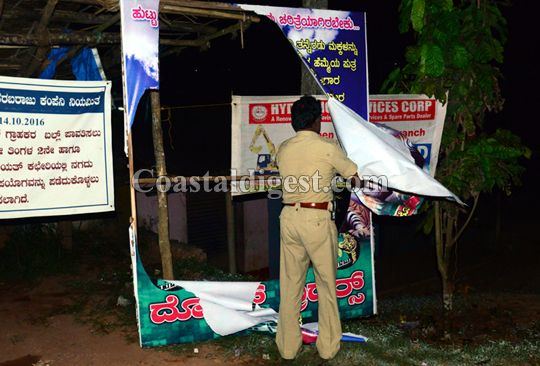
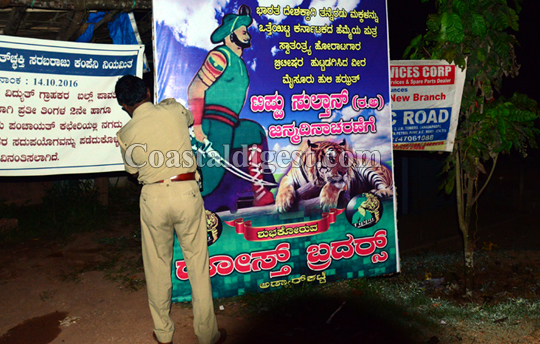
Early on Thursday Mangaluru city police removed illegal banners put up at Adyar by the supporters of Tipu Jayanti.

City Police Commissioner M Chandrasekhar said four high-resolution drone cameras have been deployed in the city to collect images from Wednesday night and added that the police are prepared to prevent any untoward incidents.

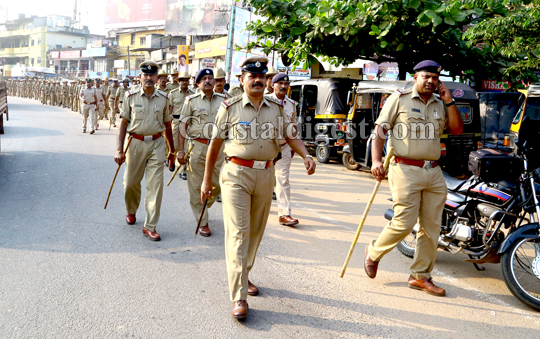
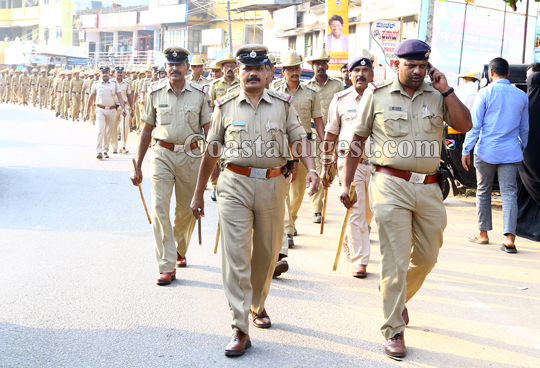
The police personnel carried out a route march to instill confidence in people while sending a warning to trouble mongers on Wednesday evening. A total of 12 check-posts have been opened, including six on border areas, in the Police Commissionerate jurisdiction. All vehicles from Kerala entering Karnataka are being monitored on Thursday.

Security has been stepped up in other parts of Dakshina Kannada too. As many as 4,000 personnel across Dakshina Kannada district.

SP Bhushan Gulabrao Borase said that 35 check-posts have been opened across Dakshina Kannada district. He said considering the sensitivity of the region, drone cameras have been deployed. Ahead of Tipu Jayanti, Borase said they have taken undertakings from trouble mongers in a bond of Rs 10 lakh. He said as many as 417 bonds had been collected from all over the district, including 112 in the jurisdiction of Police Commissionerate.

pwalk 2

tippuflex 2

tippuflex 6

pwalk 1

Comments

Chombu Kotyan
 - 
Thursday, 10 Nov 2016

Naren is hiding under my chombu.. haha good job siddu.. burnol is on high demand today..

mohammad.n
 - 
Thursday, 10 Nov 2016

Celebrating a Jayanti is not part of Islam. When we muslims will learn? May be this kind of things will add as islamic festival by our future generations. Stop this. These politicians and all the groups who are against it are just making this a political game and harm muslims. Think and understand the disaster this day will make. I pray to Allah that no one is harmed because of this useless, zero benefit celebration. Anybody who likes tipu and his achievements just pray for his magfirah at your home.

Peace
 - 
Thursday, 10 Nov 2016

Needless approach by the congress govt. why don't the govt ban saffron organization if they really care about the welfare of society? Dirty politics. Muslims should not trust this govt and join to celebrate this event though we all know for a fact that TIpu was a great secular ruler. congress is playing politics with muslims as usual. Brothers & sisters please open up your minds and don't get into any kind of mischievous to disturb the peace in society.

Althaf
 - 
Thursday, 10 Nov 2016

Chaddigalige Burnal Bhagya.. Naren is hiding due to High security.

Asim Ansari
 - 
Thursday, 10 Nov 2016

Well done Siddu

Sixer Siddu

Jai Hind

Bajrang dal Bandh

Rikaz
 - 
Thursday, 10 Nov 2016

Its better as a precautionary step police arrest all trouble mongers like bajrangies put behind bar....this will easy police job....

Add new comment

  • Coastaldigest.com reserves the right to delete or block any comments.
  • Coastaldigset.com is not responsible for its readers’ comments.
  • Comments that are abusive, incendiary or irrelevant are strictly prohibited.
  • Please use a genuine email ID and provide your name to avoid reject.
Ram Puniyani
February 10,2020

Noam Chomsky is one of the leading peace workers in the world. In the wake of America’s attack on Vietnam, he brought out his classic formulation, ‘manufacturing consent’. The phrase explains the state manipulating public opinion to have the public approve of it policies—in this case, the attack of the American state on Vietnam, which was then struggling to free itself from French colonial rule.

In India, we are witness to manufactured hate against religious minorities. This hatred serves to enhance polarisation in society, which undermines India’s democracy and Constitution and promotes support for a Hindu nation. Hate is being manufactured through multiple mechanisms. For example, it manifests in violence against religious minorities. Some recent ghastly expressions of this manufactured hate was the massive communal violence witnessed in Mumbai (1992-93), Gujarat (2002), Kandhamal (2008) and Muzaffarnagar (2013). Its other manifestation was in the form of lynching of those accused of having killed a cow or consumed beef. A parallel phenomenon is the brutal flogging, often to death, of Dalits who deal with animal carcasses or leather.

Yet another form of this was seen when Shambhulal Regar, indoctrinated by the propaganda of Hindu nationalists, burned alive Afrazul Khan and shot the video of the heinous act. For his brutality, he was praised by many. Regar was incited into the act by the propaganda around love jihad. Lately, we have the same phenomenon of manufactured hate taking on even more dastardly proportions as youth related to Hindu nationalist organisations have been caught using pistols, while police authorities look on.

Anurag Thakur, a BJP minster in the central government recently incited a crowd in Delhi to complete his chant of what should happen to ‘traitors of the country...” with a “they should be shot”. Just two days later, a youth brought a pistol to the site of a protest at Jamia Millia Islamia university and shouted “take Azaadi!” and fired it. One bullet hit a student of Jamia. This happened on 30 January, the day Nathuram Godse had shot Mahatma Gandhi in 1948. A few days later, another youth fired near the site of protests against the CAA and NRC at Shaheen Bagh. Soon after, he said that in India, “only Hindus will rule”.

What is very obvious is that the shootings by those associated with Hindu nationalist organisations are the culmination of a long campaign of spreading hate against religious minorities in India in general and against Muslims in particular. The present phase is the outcome of a long and sustained hate campaign, the beginning of which lies in nationalism in the name of religion; Muslim nationalism and Hindu nationalism. This sectarian nationalism picked up the communal view of history and the communal historiography which the British introduced in order to pursue their ‘divide and rule’ policy.

In India what became part of “social common sense” was that Muslim kings had destroyed Hindu temples, that Islam was spread by force, and that it is a foreign religion, and so on. Campaigns, such as the one for a temple dedicated to the Hindu god Rama to be built at the site where the Babri masjid once stood, further deepened the idea of a Muslim as a “temple-destroyer”. Aurangzeb, Tipu Sultan and other Muslim kings were tarnished as the ones who spread Islam by force in the subcontinent. The tragic Partition, which was primarily due to British policies, and was well-supported by communal streams also, was entirely attributed to Muslims. The Kashmir conflict, which is the outcome of regional, ethnic and other historical issues, coupled with the American policy of supporting Pakistan’s ambitions of regional hegemony, (which also fostered the birth of Al-Qaeda), was also attributed to the Muslims.

With recurring incidents of communal violence, these falsehoods went on going deeper into the social thinking. Violence itself led to ghettoisation of Muslims and further broke inter-community social bonds. On the one hand, a ghettoised community is cut off from others and on the other hand the victims come to be presented as culprits. The percolation of this hate through word-of-mouth propaganda, media and re-writing of school curricula, had a strong impact on social attitudes towards the minorities.

In the last couple of decades, the process of manufacturing hate has been intensified by the social media platforms which are being cleverly used by the communal forces. Swati Chaturvedi’s book, I Am a Troll: Inside the Secret World of the BJP’s Digital Army, tells us how the BJP used social media to spread hate. Whatapp University became the source of understanding for large sections of society and hate for the ‘Other’, went up by leaps and bounds. To add on to this process, the phenomenon of fake news was shrewdly deployed to intensify divisiveness.

Currently, the Shaheen Bagh movement is a big uniting force for the country; but it is being demonised as a gathering of ‘anti-nationals’. Another BJP leader has said that these protesters will indulge in crimes like rape. This has intensified the prevalent hate.

While there is a general dominance of hate, the likes of Shambhulal Regar and the Jamia shooter do get taken in by the incitement and act out the violence that is constantly hinted at. The deeper issue involved is the prevalence of hate, misconceptions and biases, which have become the part of social thinking.

These misconceptions are undoing the amity between different religious communities which was built during the freedom movement. They are undoing the fraternity which emerged with the process of India as a nation in the making. The processes which brought these communities together broadly drew from Gandhi, Bhagat Singh and Ambedkar. It is these values which need to be rooted again in the society. The communal forces have resorted to false propaganda against the minorities, and that needs to be undone with sincerity.

Combating those foundational misconceptions which create hatred is a massive task which needs to be taken up by the social organisations and political parties which have faith in the Indian Constitution and values of freedom movement. It needs to be done right away as a priority issue in with a focus on cultivating Indian fraternity yet again.

Comments

Add new comment

  • Coastaldigest.com reserves the right to delete or block any comments.
  • Coastaldigset.com is not responsible for its readers’ comments.
  • Comments that are abusive, incendiary or irrelevant are strictly prohibited.
  • Please use a genuine email ID and provide your name to avoid reject.
Agencies
January 1,2020

For many Indian tycoons, 2019 turned woeful as lenders -- empowered by the nation’s recent bankruptcy law and desperate to clean up soured debt from their books -- started seizing assets of delinquent firms or dragged them into insolvency.

Indian banks wrote off a record $39 billion of loans in the 18 months through September in a bid to repair their balance sheets as they battled the world’s worst bad debt pile. Making matters worse, a shadow banking crisis led to a funding squeeze, crushing debt-laden businesses that were critically dependent on rollover financing.

“Life has come a full circle for tycoons that had enjoyed debt-fueled growth,” said Nirmal Gangwal, founder of distress and debt restructuring advisory firm Brescon & Allied Partners LLP. “Many firms collapsed like a house of cards. The downfall was rather unprecedented.”
The government has also been cracking down on economic crime to assuage public anger over absconding businessmen. It’s even barred some from traveling overseas if they were deemed a flight risk.

Here are some of the country’s biggest and most-storied businessmen who saw their fortunes fade. Spokespersons for none of these tycoons, except Essar, immediately replied to emails and text messages seeking comments.

Anil Ambani

The chairman of Reliance Group, which makes movies to metro lines, had a close shave with jail time in March before his elder brother and Asia’s richest man, Mukesh Ambani, bailed him out at the last minute. The woes of the ex-billionaire came to the fore when India’s top court asked him to pay Ericsson AB’s India unit about $77 million of past dues or go to jail since Anil Ambani, 60, had given a personal guarantee. His telecom carrier slipped into insolvency this year, while unprofitable Reliance Naval & Engineering Ltd. faced a cash crunch. Reliance Capital Ltd. is selling assets to pare debt. Ambani is also fending off Chinese lenders in a London court.

Malvinder & Shivinder Singh

Karma caught up with ex-billionaires and brothers Malvinder Singh, 47, and Shivinder Singh, 44, and how. Scions of a prominent business family, they once helmed India’s top drug maker and second-largest hospital chain. In October, the two were arrested on charges of fraudulently diverting nearly $337 million from a lender they controlled. India’s market regulator found in 2018 that the brothers had defrauded their hospital company of about $56 million. The collapse of the $2 billion empire turned brother against brother, prompting their mother to broker a peace deal that was short-lived. In February, Malvinder accused Shivinder and their spiritual guru of fraud.

Shashikant & Ravikant Ruia

After a hard-fought battle to keep their flagship steel mill, the first-generation entrepreneurs finally saw the bankrupt Essar Steel India Ltd. pass on to ArcelorMittal last month. The $5.9 billion takeover was almost two years in the making with multiple legal wrangles. The group, controlled by Shashikant Ruia, 76, and Ravikant Ruia, 70, were also reprimanded by a U.K. judge in March this year for concealing documents. Started in 1969 as a construction firm, Essar Group diversified, investing about $18 billion between 2008 and 2012, and piled on debt. In 2017, the group had sold another prized asset, Essar Oil.

Selling an asset to pare a liability shouldn’t be seen as a “lost asset,” an Essar spokesman said, adding that the group remains a diversified conglomerate.

VG Siddhartha

Before jumping off a bridge into a river in July in an apparent suicide, the founder of India’s biggest coffee chain Cafe Coffee Day had penned a letter that spoke of pressure from lenders, a private equity firm and harassment by tax officials. He had spent much of the last two years pledging ever more of Coffee Day Enterprises Ltd. shares to refinance loans for ever shorter periods, at ever higher interest rates. “I would like to say I gave it my all,” V.G. Siddhartha, 60, wrote in the letter. “I fought for a long time but today I gave up.”

Naresh Goyal

The former ticketing agent who built India’s largest airline by value, stepped down as chairman of Jet Airways India Ltd. in March, caving in to pressure from banks who took over the company. Cut-throat price wars and surging costs pushed Jet deeper into loss. The airline stopped flying in April and went into bankruptcy two months later as lenders failed to find a buyer. In July, an Indian court barred Naresh Goyal from flying overseas after the government said it was investigating an alleged $2.6 billion fraud involving Jet Airways.

Rana Kapoor

The founder of Yes Bank Ltd., which became India’s fourth-largest non-state lender, tweeted in September 2018 that his shares were invaluable and requested his children never to sell them upon inheritance. But trouble was brewing. The nation’s banking regulator, which found the lender had repeatedly under-reported its bad loans, refused to extend his tenure as chief executive officer. This forced Rana Kapoor, 62, to step down by end-January. Kapoor, who has pledged some of his Yes Bank shares in July, sold almost his entire stake in the lender by October.

Subhash Chandra

The rice trader-turned-media mogul, 69, who brought cable television into Indian homes in the early 1990s with his ZEE TV, resigned as chairman of Zee Entertainment Enterprises Ltd. in November and lost control of his crown jewel. Subhash Chandra has been selling stake in Zee Entertainment in the past few months to repay group’s debt.

Gautam Thapar

A default by Gautam Thapar, founder of the paper mill-to-power transmission Avantha Group, on pledged shares made Yes Bank Ltd. the biggest shareholder in CG Power and Industrial Solutions Ltd. In August, the firm was hit by an accounting scandal forcing the board to remove Thapar, 59, from the chairman’s post. A month later, the market regulator ordered a forensic audit of the firm and barred Thapar from accessing securities market.


Comments

Add new comment

  • Coastaldigest.com reserves the right to delete or block any comments.
  • Coastaldigset.com is not responsible for its readers’ comments.
  • Comments that are abusive, incendiary or irrelevant are strictly prohibited.
  • Please use a genuine email ID and provide your name to avoid reject.
News Network
April 3,2020

Bengaluru, April 3: Thirteen people in Karnataka, who had attended the Tablighi Jamaat event in Delhi, have tested positive for coronavirus, said state education minister S Suresh Kumar.

"13 attendees of Delhi's Tablighi Jamaat event have tested COVID-19 positive and 187 were tested negative," said Kumar, who has been entrusted to look into queries related to COVID-19.

He added, "A total number of four COVID-19 positive cases have been confirmed today -- a 75-year-old man in Bagalkote, a 70-year-old in Belagavi, a 26-year-old in Belagavi and a 20-year-old in Belagavi."

"The three people from Belagavi had attended the Tablighi Jamaat event in Delhi," he said, adding that the total number of cases in the state increased to 128.

The reports of 88 other people who had attended the Tablighi Jamaat event are yet to be received, the minister said.

The total number of COVID-19 positive cases in India on Friday rose to 2,547 including 162 cured/discharged and 62 deaths, according to the Ministry of Health and Family Welfare.

Comments

Add new comment

  • Coastaldigest.com reserves the right to delete or block any comments.
  • Coastaldigset.com is not responsible for its readers’ comments.
  • Comments that are abusive, incendiary or irrelevant are strictly prohibited.
  • Please use a genuine email ID and provide your name to avoid reject.