


Mangaluru goes cashless; common man's struggles continue on 6th day

[email protected] (CD Network | Suresh)
November 14, 2016

Mangaluru, Nov 14: Even six days after the abolishment of Rs 500 and Rs 1,000 notes, the coastal city of Mangaluru has failed to recover from the unexpected shock.
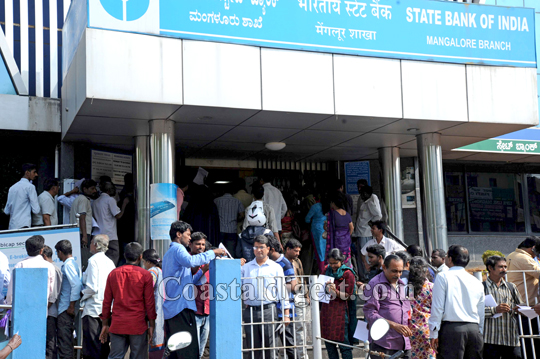
bankque 5

In fact, the demonetization move has affected pretty much every sphere of life — from getting provisions and eating out, to making routine payments such as rent and salaries to domestic help.

While making announcement of demonetization, the government has assured that banks would work on weekends too for exchange of notes. Ironically, on week days too the banks and ATMs are functioning partially thanks to scarcity of notes.

The government on Monday has extended the usage of existing Rs.500 and Rs.1,000 notes for select transactions till 24 November from the earlier deadline of 14 November.

This means that people can now use these notes at government hospitals, government-run cooperative shops, air-ticket counters, milk booths, petrol stations, international airports, to buy tickets at railway stations, to pay for medicines in government and private medical shops, to get cooking gas cylinders, and to pay court fees till 24 November. 

However, thanks to the scarcity of change, the government's relaxation has not improved the situation in the city.

No change in bunks

Petrol bunks are accepting old Rs 500 and Rs 1,000 notes, but you can only fill up for amounts in increments of Rs 500. The reason is that the bunk employees don't have Rs 100 notes to return as change. So if you want to fill fuel for, say, Rs 200, chances are you won't get Rs 300 back.

Market Woes

The future for hundreds of vegetable, fruits and other household merchants, who supply daily needs to entire city is in quandary. "From Sunday onwards I have stopped the purchasing of goods and will resume when everything turns to normalcy," says worried vegetable merchant Peter D'Souza.

Abdul Salam, wholesale fruit merchant at the market shares that they have given goods in credit to regular customers. "Since all are transactions are done in Rs 500 and Rs 1000 currency, we have no other way out. For some we have given credit and asked our suppliers to wait for some days to clear their dues," he maintains.

Other merchants complain that they don't have enough change to tender with customers. "All customers are giving us Rs 2000 note. If they make business of Rs 200 or Rs 300, we have to give them change in Rs 100 notes. How can it be possible when bank themselves don't have Rs 100 notes," adds another lemon merchant.

Comments

ibbu Saheb
 - 
Monday, 14 Nov 2016

ACCHE DIN AAGAYE... AUR BI ACCHE DIN ANE WALE HAI...
SO KEEP YOUR ENERGY FOR MORE AND MORE ACCHE DIN...

Rikaz
 - 
Monday, 14 Nov 2016

Be patient, Mr. Modi said it would take 50 days.....after 50 days they will withdrew 2,000 and re-initiate new 1,000 currency....wait and see....

Add new comment

  • Coastaldigest.com reserves the right to delete or block any comments.
  • Coastaldigset.com is not responsible for its readers’ comments.
  • Comments that are abusive, incendiary or irrelevant are strictly prohibited.
  • Please use a genuine email ID and provide your name to avoid reject.
News Network
March 27,2020

Mangaluru, Mar 27: In the wake of coronavirus, the Council of Mangalore City Corporation (MCC) has taken steps to prevent the spread of Covid-19 in the city as a task force has been formed to monitor home delivery of essentials and the situation prevailing in the city due to outbreak of the virus.

MCC commissioner Shanady Ajith Kumar Hegde held a meeting of wholesalers to plan the smooth supply of essentials to the people on Thursday.

Speaking on the occasion, he said, the wholesalers of the city have been directed to supply essential goods to apartments in the city. Each apartment should prepare purchase details and must hand it over to the wholesalers. This way residents will not have to go out to buy essentials. The purchasing time will be between 6 am to 12 pm.

Comments

Add new comment

  • Coastaldigest.com reserves the right to delete or block any comments.
  • Coastaldigset.com is not responsible for its readers’ comments.
  • Comments that are abusive, incendiary or irrelevant are strictly prohibited.
  • Please use a genuine email ID and provide your name to avoid reject.
News Network
June 26,2020

Bengaluru, Jun 26: The National Restaurant Association of India (NRAI) on Thursday came up with a Standard Operating Procedure (SOP) for restaurants whereby among other physical distancing norms, it has suggested a 2-metre gap between tables.

Formulated in partnership with Releski, a Bengaluru based skill-tech company, the SoP suggests that in case of back-to-back seating, people sitting with their backs towards each other will have their seats divided by 'Plexiglass' divider raised up to 2 meters from the ground.

"In a typical restaurant, the improvised seating plan should have a minimum distance of 2 metres between tables. The distance of 2 metres (6 feet) between tables should measure from one edge of the table to the other table's edge," it said.

In case of loose or free seating such as in banquet style or food court style seating, a minimum 2 meters of distance should be maintained between tables.

The guidelines noted that, to encourage physical distancing, restaurants have to sacrifice their seating capacity, to promote health and safety, and also to gain trust from their patrons.

"In order to perform this, divide your restaurants under different sectors. Pull out your restaurant's floor plan and colour code different sections red and yellow. Red sections are potential areas where maximum footfall or traffic is observed. Yellow sections are areas where the footfalls are average," it said.

All the red sections are encircled or bordered by placing barricades or Q manager and will open at specific points to access the yellow section and all the opening points will have hand sanitisers and sprays, and every guest who walks from red zones to yellow zones will sanitise himself/herself to reduce the chances of contamination.

For air conditioning, the guidelines of CPWD shall be followed which inter alia emphasises that the temperature setting of all air conditioning devices should be in the range of 24-30 degree Celsius, relative humidity should be in the range of 40- 65 per cent, intake of fresh air should be as much as possible and cross ventilation should be adequate, the guidelines suggested.

The industry body has also suggested appointment of a COVID-free Ambassador who would operate as the Chief Health Officer within the restaurant team, preferably from the management team in each shift.

The ambassador's would put the new daily work routines into practice, to monitor compliance with good practice and to lead the preventative measures, adapt to health & safety recommendations and requirements of the restaurant and oversee the implementation of the norms.

Anurag Katriar, President of NRAI and CEO & Executive Director of deGustibus Hospitality, said: "Every restaurant cutting across formats is facing the harsh reality of subdued to shut business volumes in the present and the uncertainty of business environment in the future. One thing is certain that hygiene and safety will be a key differentiator in the post-pandemic restaurant operations."

Comments

Add new comment

  • Coastaldigest.com reserves the right to delete or block any comments.
  • Coastaldigset.com is not responsible for its readers’ comments.
  • Comments that are abusive, incendiary or irrelevant are strictly prohibited.
  • Please use a genuine email ID and provide your name to avoid reject.
News Network
April 11,2020

Bengaluru, Apr 11: The coronavirus-driven lockdown will continue for another 15 days, but relaxations will be allowed in a graded manner, Karnataka Chief Minister B S Yediyurappa said after a four-hour-long video conference with Prime Minister Narendra Modi on Saturday.

“Agriculture and industrial sectors will be given relaxation. Government offices will be allowed to work with partial strength. But the PM said detailed guidelines will be issued in two days,” Yediyurappa said, briefing reporters. 

“Importantly, the lockdown for the next two weeks will be different than how it was in the past three weeks. The Centre, keeping in mind economic activities, especially agriculture, industry and employment of labourers, the Centre will tell us what needs to be done,” the CM said.
 
According to Yediyurappa, PM Modi told all chief ministers that the next 2-3 weeks will be critical. “The next few weeks will decide whether or not we have succeeded. If the situation worsens, we have to face the crisis,” Yediyurappa said, quoting Modi. 

Apparently, Modi sought details on the COVID-19 situation from 12-13 states where the situation is grave. “He did not take a report from Karnataka,” Yediyurappa said. “This morning, seven new cases were reported in the state, taking our tally to 214. Nationally, we were in the third place; we’re now 11th,” he said, hailing the efforts of officials involved in fighting the pandemic. 

The CM said it was “inevitable” to continue the lockdown for another 15 days. “But for citizens to get essential supplies, there’s no bar on them going by walk alone. Also, we will see to it that agricultural activities are not affected anywhere,” Yediyurappa said.

Comments

Add new comment

  • Coastaldigest.com reserves the right to delete or block any comments.
  • Coastaldigset.com is not responsible for its readers’ comments.
  • Comments that are abusive, incendiary or irrelevant are strictly prohibited.
  • Please use a genuine email ID and provide your name to avoid reject.