Mangaluru: Madrasa student stabbed by bike-borne miscreants near Konaje

[email protected] (CD Network)
November 14, 2016

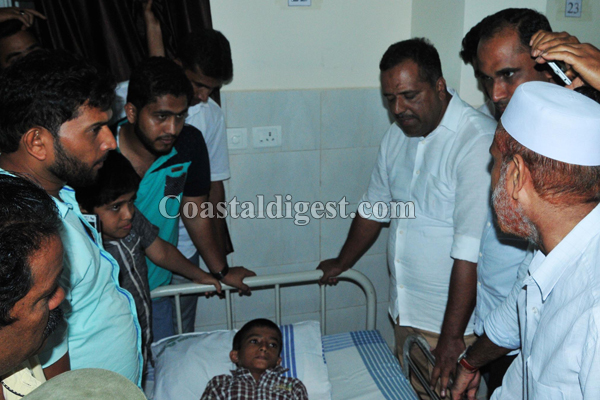
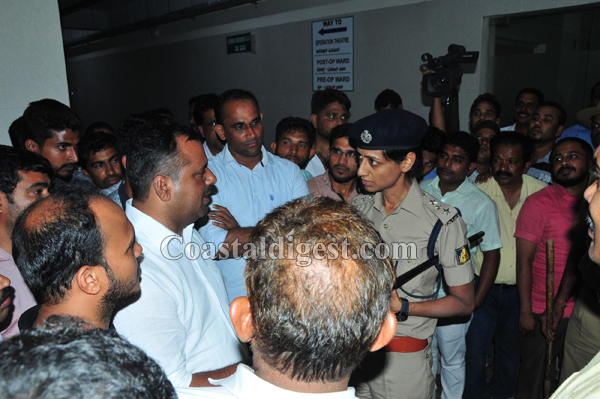
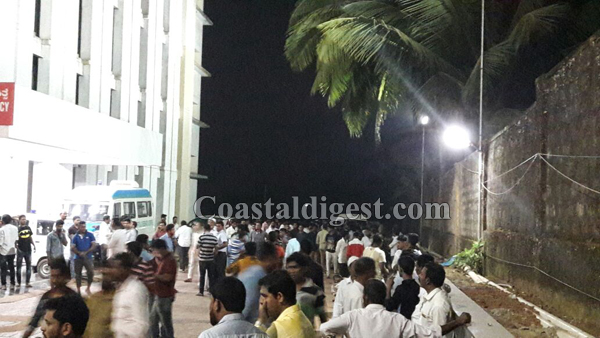
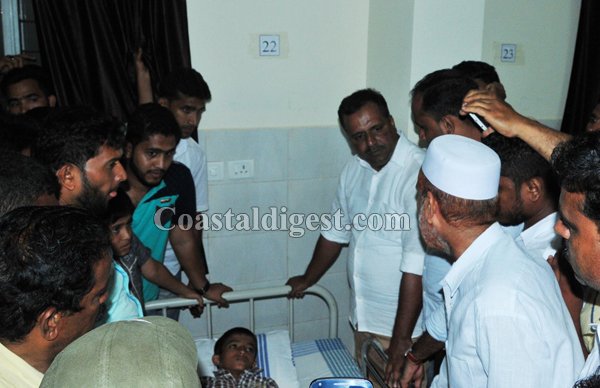
Manglauru, Nov 14: A madrasa student on Monday evening became the latest victim of the stabbing spree in Ullal-Konaje region in Dakshina Kannada.

madrasa 1

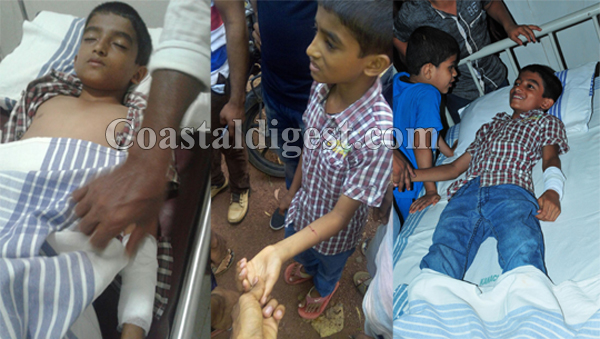
Razik, son of Mayyaddi, a resident of Kairangala village located on Mangaluru-Bantwal border, has been admitted to a private hospital in Deralakatte with severe injuries.

It is learnt that Razik was walking towards his madrasa from his home at Jalli Cross in Kairangala when motorbike-borne miscreants approached him seeking directions.

When Razik was showing them the direction the pillion rider stabbed him with a knife. The miscreants sped away when the Razik collapsed.

This is the fourth incident of stabbing in last four days in this communal sensitive region. On November 10 an RSS activists was stabbed by motorbike-borne miscreants near Kutthar under the limits of Ullal police station.

On November 12 two Muslim youths were stabbed by motorbike-borne miscreants in a similar way at Manjanady Kattemar and Ansar Nagar under the limits of Konaje police station.

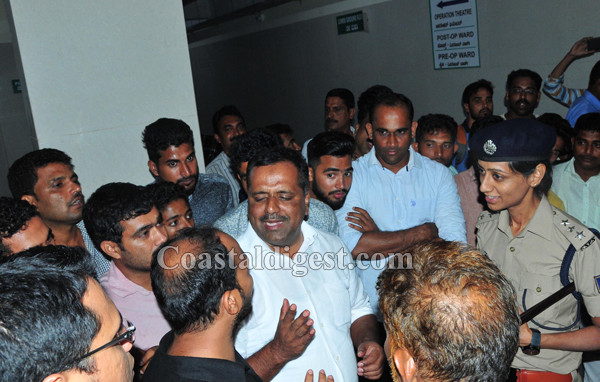
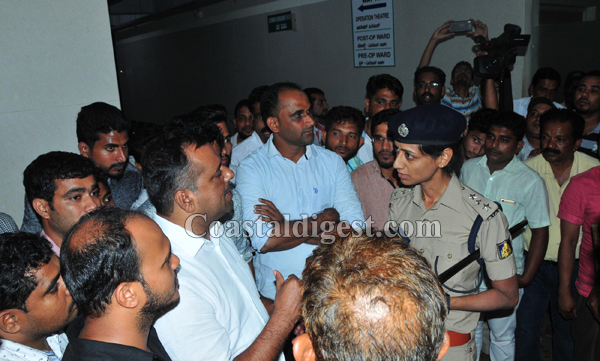
Food and Civil Supplies Minister U T Khader, who represents Mangaluru constituency, comprising the Ullal-Konaje region, at Karnataka Legislative Assembly, had recently alleged that some communal groups were trying to disrupt peace in the region for political reasons.

Also Read:

Section 144 clamped in Mangaluru; social media under scanner

Mangaluru: Bike-borne miscreants stab two Muslim youths near Konaje

Mangaluru: Murder attempt on RSS activist near Kuthar sparks tension

madrasa 2

madrasa 3

madrasa 4

madrasa 5

madrasa 6

madrasa 7

Comments

ajit kumar
 - 
Tuesday, 15 Nov 2016

shame on those mad people who attack small children, jelousy on the mind and heart, surely they are one who are loosers,

Peace lover
 - 
Monday, 14 Nov 2016

If the dept notable to drag out the culprits from the route then it will be difficult for the public to lead peace full life.
Now everything is with police dept hand.
Hope they will do their best to pull out the culprits.

Add new comment

  • Coastaldigest.com reserves the right to delete or block any comments.
  • Coastaldigset.com is not responsible for its readers’ comments.
  • Comments that are abusive, incendiary or irrelevant are strictly prohibited.
  • Please use a genuine email ID and provide your name to avoid reject.
News Network
May 31,2020

Bengaluru, May 31: Karnataka government on Sunday issued guidelines, which will come into force from June 1 and continue till June 30.

According to the new guidelines, religious places and places of worship for the public, hotels, restaurants and other hospitality services, and shopping malls will be permitted to open from June 8.

Union Ministry of Home Affairs (MHA) on Saturday announced new guidelines for phased re-opening of "all activities outside containment zones for the next one month beginning June 1.

In an order, Karnataka government said that phased re-opening of areas outside the containment zones, all activities will be permitted, except the following, which will be allowed, with the stipulation of following Standard Operating Procedures (SOPs) to be prescribed by the Ministry of Health and Family Welfare (MoHFW).

PHASE I

The activities will be allowed with effect from June 8 at religious places/places of worship for public, hotels, restaurants, and other hospitality services, shopping malls.

PHASE II

For the opening of schools, colleges, educational/training/ coaching institutions, the State government will hold consultations at the institution level with parents and other stakeholders. Based on the feedback, a decision on the re-opening of these institutions will be taken in the month of July.

PHASE III

Based on the assessment of the situation, dates for re-starting activities will be decided -- international air travel of passengers, except as permitted by MHA, Metro Rail, cinema halls, gymnasiums, swimming pools, entertainment parks, theatres, bars and auditoriums, assembly halls and similar places, social/political/spoils/ entertainment/academic/cultural/religious functions and other large congregations.

The State government said that it will follow the MHA's national directives for the coronavirus management, including compulsory use of face masks and social distancing norms.

"Face coverings are compulsory in public places, workplaces and during transport. Individuals must maintain a minimum distance of 6 feet in public places. Shops will ensure physical distancing among customers and will not allow more than 5 persons at a time," read the directives issued by the MHA.

In the order, State government has said that night curfew will continue to remain in force on the movement of individuals for all non-essential activities outside containment zones till June 30.

Lockdown limited to Containment Zones

* Lockdown shall continue to remain in force in the Containment Zones till June 30.

* Containment Zones will be demarcated by the district authorities after taking into consideration the guidelines of Department of Health and Family Welfare, Government of Karnataka.

* In the Containment Zones, only essential activities shall be allowed. There shall be strict perimeter control to ensure that there is no movement of people in or out of these zones, except for medical emergencies and for maintaining a supply of essential goods and services.

* In the Containment Zones, there shall be intensive contact tracing, house-to-house surveillance, and other clinical interventions, as required. Guidelines of the Department of Health and Family Welfare, Government of Karnataka shall be taken into consideration for the above purpose.

* District authorities/BBMP authorities may also identify buffer zones outside the Containment Zones, where new cases are more likely to occur. Within the buffer zones, restrictions, as considered necessary, may be put in place by the District authorities.

Movement of persons, goods

* There shall be no restriction on inter-State and intra-State movement of persons and goods. No separate permission/approval/e-permit will be required for such movements.

* Based on reasons of public health and assessment of the prevalence of Covid-19 in various States separate orders will be issued by the Health and Family Welfare Department regarding the inter-state movement of persons to Karnataka.

* Movement by passenger trains and Shramik special trains; domestic passenger air travel; movement of Indian Nationals stranded outside the country and of specified persons to travel abroad; evacuation of foreign nationals; and sign-on and sign-off of Indian seafarers will continue to be regulated as per SOPs issued.

The State Government in its guidelines advised persons above 65 years of age, persons with co-morbidities, pregnant women, and children below the age of 10 years, to stay at home, except for essential and health purposes.

Guidelines for Aarogya Setu App

* Aarogya Setu enables early identification of potential risk of infection, and thus acts as a shield for individuals and the community.

* With a view to ensuring safety in offices and workplaces, employers on best effort basis should ensure that Aarogya Sew is installed by all employees having compatible mobile phones.

* District authorities and BBMP Authorities may advise individuals to install the Aarogya Setu application on compatible mobile phones and regularly update their health status on the app. This will facilitate timely provision of medical attention to those individuals who are at risk.

Union Ministry of Home Affairs (MHA) on Saturday said that lockdown will continue in containment zones till June 30 and only essential activities will be allowed in those areas.

"Lockdown shall continue to remain in force in the containment zones till 30 June. In the containment zones, only essential activities shall be allowed. There shall be strict perimeter control to ensure that there is no movement of people in or out of these zones, except for medical emergencies and for maintaining the supply of essential goods and services. In the containment zones, there shall be intensive contact tracing, house-to-house surveillance, and other clinical interventions, as required," MHA said in its guidelines for #Unlock1.

It also issued new guidelines for phased re-opening of "all activities outside containment zones for the next one month beginning June 1."


Comments

Add new comment

  • Coastaldigest.com reserves the right to delete or block any comments.
  • Coastaldigset.com is not responsible for its readers’ comments.
  • Comments that are abusive, incendiary or irrelevant are strictly prohibited.
  • Please use a genuine email ID and provide your name to avoid reject.
Agencies
January 1,2020

For many Indian tycoons, 2019 turned woeful as lenders -- empowered by the nation’s recent bankruptcy law and desperate to clean up soured debt from their books -- started seizing assets of delinquent firms or dragged them into insolvency.

Indian banks wrote off a record $39 billion of loans in the 18 months through September in a bid to repair their balance sheets as they battled the world’s worst bad debt pile. Making matters worse, a shadow banking crisis led to a funding squeeze, crushing debt-laden businesses that were critically dependent on rollover financing.

“Life has come a full circle for tycoons that had enjoyed debt-fueled growth,” said Nirmal Gangwal, founder of distress and debt restructuring advisory firm Brescon & Allied Partners LLP. “Many firms collapsed like a house of cards. The downfall was rather unprecedented.”
The government has also been cracking down on economic crime to assuage public anger over absconding businessmen. It’s even barred some from traveling overseas if they were deemed a flight risk.

Here are some of the country’s biggest and most-storied businessmen who saw their fortunes fade. Spokespersons for none of these tycoons, except Essar, immediately replied to emails and text messages seeking comments.

Anil Ambani

The chairman of Reliance Group, which makes movies to metro lines, had a close shave with jail time in March before his elder brother and Asia’s richest man, Mukesh Ambani, bailed him out at the last minute. The woes of the ex-billionaire came to the fore when India’s top court asked him to pay Ericsson AB’s India unit about $77 million of past dues or go to jail since Anil Ambani, 60, had given a personal guarantee. His telecom carrier slipped into insolvency this year, while unprofitable Reliance Naval & Engineering Ltd. faced a cash crunch. Reliance Capital Ltd. is selling assets to pare debt. Ambani is also fending off Chinese lenders in a London court.

Malvinder & Shivinder Singh

Karma caught up with ex-billionaires and brothers Malvinder Singh, 47, and Shivinder Singh, 44, and how. Scions of a prominent business family, they once helmed India’s top drug maker and second-largest hospital chain. In October, the two were arrested on charges of fraudulently diverting nearly $337 million from a lender they controlled. India’s market regulator found in 2018 that the brothers had defrauded their hospital company of about $56 million. The collapse of the $2 billion empire turned brother against brother, prompting their mother to broker a peace deal that was short-lived. In February, Malvinder accused Shivinder and their spiritual guru of fraud.

Shashikant & Ravikant Ruia

After a hard-fought battle to keep their flagship steel mill, the first-generation entrepreneurs finally saw the bankrupt Essar Steel India Ltd. pass on to ArcelorMittal last month. The $5.9 billion takeover was almost two years in the making with multiple legal wrangles. The group, controlled by Shashikant Ruia, 76, and Ravikant Ruia, 70, were also reprimanded by a U.K. judge in March this year for concealing documents. Started in 1969 as a construction firm, Essar Group diversified, investing about $18 billion between 2008 and 2012, and piled on debt. In 2017, the group had sold another prized asset, Essar Oil.

Selling an asset to pare a liability shouldn’t be seen as a “lost asset,” an Essar spokesman said, adding that the group remains a diversified conglomerate.

VG Siddhartha

Before jumping off a bridge into a river in July in an apparent suicide, the founder of India’s biggest coffee chain Cafe Coffee Day had penned a letter that spoke of pressure from lenders, a private equity firm and harassment by tax officials. He had spent much of the last two years pledging ever more of Coffee Day Enterprises Ltd. shares to refinance loans for ever shorter periods, at ever higher interest rates. “I would like to say I gave it my all,” V.G. Siddhartha, 60, wrote in the letter. “I fought for a long time but today I gave up.”

Naresh Goyal

The former ticketing agent who built India’s largest airline by value, stepped down as chairman of Jet Airways India Ltd. in March, caving in to pressure from banks who took over the company. Cut-throat price wars and surging costs pushed Jet deeper into loss. The airline stopped flying in April and went into bankruptcy two months later as lenders failed to find a buyer. In July, an Indian court barred Naresh Goyal from flying overseas after the government said it was investigating an alleged $2.6 billion fraud involving Jet Airways.

Rana Kapoor

The founder of Yes Bank Ltd., which became India’s fourth-largest non-state lender, tweeted in September 2018 that his shares were invaluable and requested his children never to sell them upon inheritance. But trouble was brewing. The nation’s banking regulator, which found the lender had repeatedly under-reported its bad loans, refused to extend his tenure as chief executive officer. This forced Rana Kapoor, 62, to step down by end-January. Kapoor, who has pledged some of his Yes Bank shares in July, sold almost his entire stake in the lender by October.

Subhash Chandra

The rice trader-turned-media mogul, 69, who brought cable television into Indian homes in the early 1990s with his ZEE TV, resigned as chairman of Zee Entertainment Enterprises Ltd. in November and lost control of his crown jewel. Subhash Chandra has been selling stake in Zee Entertainment in the past few months to repay group’s debt.

Gautam Thapar

A default by Gautam Thapar, founder of the paper mill-to-power transmission Avantha Group, on pledged shares made Yes Bank Ltd. the biggest shareholder in CG Power and Industrial Solutions Ltd. In August, the firm was hit by an accounting scandal forcing the board to remove Thapar, 59, from the chairman’s post. A month later, the market regulator ordered a forensic audit of the firm and barred Thapar from accessing securities market.

Comments

Add new comment

  • Coastaldigest.com reserves the right to delete or block any comments.
  • Coastaldigset.com is not responsible for its readers’ comments.
  • Comments that are abusive, incendiary or irrelevant are strictly prohibited.
  • Please use a genuine email ID and provide your name to avoid reject.
coastaldigest.com news network
July 24,2020

Bengaluru, Jul 24: A government doctor who was turned away by three private hospitals because he could not produce a coronavirus test result passed away today in Bengaluru. Dr Manjunath, who was a frontline COVID-19 doctor, was allegedly turned away by hospitals when he was extremely ill and struggling to breathe.

Dr Manjunath worked in the state Health and Family Welfare department and was based in Ramanagara district, around 50 km from Bengaluru.

D Randeep, a Special Officer with the Bengaluru municipal body BBMP, said that the hospitals that had refused to admit Dr Manjunath would be reported to the health department.

In June-end, Dr Manjunath went to Rajashekhar Hospital in JP Nagar, BGS Global Hospital in Kengeri and Sagar hospital in Kumaraswamy Layout. All three demanded to see his COVID-19 test result but those were still not in at the time, according to his family. His brother-in-law Nagendra is also a doctor with BBMP and in charge of allotting hospital beds, yet he was completely helpless when it came to his own relative.

He was finally admitted to Sagar hospital on June 25 when his family sat in protest on the footpath outside the Dayananda Sagar campus. He was placed on ventilator and later shifted to the Bangalore Medical College and Research Institute, where he died earlier today. The hospital says Dr Manjunath was discharged on July 9 because he wanted plasma therapy.

Six members of his family, including a 14-year-old, tested COVID-19 positive. Most of them have recovered.

Bengaluru has seen several cases of patients being turned away from hospitals in the city. Hospitals say they need Covid test results to know whether to admit patients in the coronavirus ICU or in the general section and to understand treatment protocol.

Mr Randeep said hospitals have been instructed to admit patients even without such a certificate. Notices have been sent to hospitals that fail to comply. The OPD of two private hospitals was sealed for 48 hours when they refused to admit a patient.

Comments

Add new comment

  • Coastaldigest.com reserves the right to delete or block any comments.
  • Coastaldigset.com is not responsible for its readers’ comments.
  • Comments that are abusive, incendiary or irrelevant are strictly prohibited.
  • Please use a genuine email ID and provide your name to avoid reject.