


Demonetisation: Banks to use indelible ink while exchanging notes

November 15, 2016

New Delhi, Nov 15: A small mark of indelible ink, used mostly during elections to prevent multiple voting, will be put on the right hand finger of those exchanging banned 500 and 1,000 rupee notes for new ones from tomorrow to prevent crowding at banks by repeat exchangers.Untitled-1
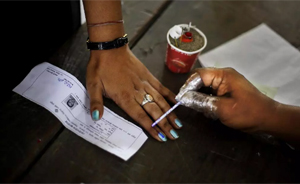
As per the assessment of Finance Ministry, bank counters are getting overcrowded due to same people turning up again and again to exchange old notes. "Ideally, the ink mark should have been put on the left hand as is done when a person casts his vote. But with by-elections due in some states, an ink mark for exchange or withdrawal of currency note on the left hand will lead to unnecessary difficulties. So it has been decided that the ink mark would be put on right hand," an official said.

The ink manufactured at the Mysore Paints and Varnish Ltd - the firm that has supplied indelible ink to the Election Commission since 1962 to mark voters, will be made available to banks and post offices from tonight.

Banks in major cities will start marking note exchangers with the ink, the official said.
Also, an expert committee comprising of officers from the Department of Economic Affairs and the Department of Financial Services are preparing standard operating procedure (SoPs) for ink marking as well as additional steps to be taken to manage the crowds.

The move comes amid long, unending queue at banks even after a week of Prime Minister Narendra Modi announcing withdrawal of old Rs 500/1000 notes in biggest crackdown on black money, corruption and counterfeit currency. The notes withdrawn accounted for 86 per cent of the cash circulating in the Asia's third-largest economy.

The source said the use of indelible ink would prevent "unscrupulous persons" from use conduits for exchanging notes. A persons, as per the revised guideline, is allowed to exchange old notes totalling up to 4,500 on a single day.

Earlier in the day, Economic Affairs Secretary Shaktikanta Das said it was noticed that the same people were coming back again and again to exchange notes, causing the long queues and creating hassles for genuine people to get their cash.

By-elections for four Lok Sabha seats - Cooch Behar and Tamluk in Purba Medinipur district in West Bengal, Shahdol in Madhya Pradesh and Lakhimpur in Assam will be held on November 19.

As many as 8 Assembly seats in Assam, Arunachal Pradesh, Madhya Pradesh, West Bengal, Tamil Nadu, Tripura and Puducherry will go to polls on the same day.

Comments

MARK
 - 
Tuesday, 15 Nov 2016

Dictatorship.... is in india... and that too its Worst ... Keeping the PUBLIC in trouble.

Instead of riding Ambani and adani .. cheddis are deceiving the people of india..

STILL bakhts did not understand this deception...

Add new comment

  • Coastaldigest.com reserves the right to delete or block any comments.
  • Coastaldigset.com is not responsible for its readers’ comments.
  • Comments that are abusive, incendiary or irrelevant are strictly prohibited.
  • Please use a genuine email ID and provide your name to avoid reject.
News Network
March 11,2020

Bengaluru, Mar 11: DK Shivakumar has been appointed as the new president of the party's Karnataka unit, an official said on Wednesday.

"Congress president (Sonia Gandhi) has appointed D.K. Shivakumar as the president of the Karnataka Pradesh Congress Committee (KPCC)," said party's general secretary K.C. Venugopal in a statement from New Delhi.

Party's state unit leaders Eshwar Khandre, Satish Jharkiholi and Saleem Ahammed are the working presidents in the southern state.

"Former chief minister Siddaramaiah will continue as the Congress Legislature Party (CLP) leader and opposition leader in the state legislative assembly.

MLC M. Narayanswamy and MLA Ajay Singh will be the party's chief whips in the state legislative council and assembly.

Congress appoints Anil Chaudhary as DPCC chief

The Congress on Wednesday appointed former MLA Anil Chaudhary as its Delhi unit chief, while also naming five vice-presidents for the DPCC.

Congress president Sonia Gandhi named Chaudhary president and Abhishek Dutt, Shivani Chopra, Jaikishan, Mudit Agarwal and Ali Hassan vice-presidents of the Delhi Pradesh Congress Committee (DPCC), a party statement said.

Subhash Chopra had resigned as the Delhi Congress chief in February, taking moral responsibility for the party's debacle in the Assembly polls.

The Congress drew a blank for the second time in a row in the Delhi Assembly polls and reduced its vote share from 9.7 per cent in 2015 to 4.27 per cent this time.

Comments

Add new comment

  • Coastaldigest.com reserves the right to delete or block any comments.
  • Coastaldigset.com is not responsible for its readers’ comments.
  • Comments that are abusive, incendiary or irrelevant are strictly prohibited.
  • Please use a genuine email ID and provide your name to avoid reject.
News Network
January 10,2020

Bengaluru, Jan 10: The National Commission for Scheduled Tribes (NCST), which met with officials of the Social Welfare Department Thursday, has urged the state government to increase the reservation provided to the ST community.

The Commission's suggestion comes even as a committee headed by Justice Nagamohan Das is currently studying a demand for increase of reservation for the community from the existing 3% to 7.5%.

Addressing mediapersons on Thursday, Commission Chairperson Nand Kumar Sai, said the Commission had discussed the issue with the Social Welfare Department, Karnataka, asking officials to expedite the process.

In response to this suggestion, Social Welfare Department Principal Secretary G Kumar Naik said the government would take a call based on the Nagamohan Das Committee's report.

A meeting was held between members of the National ST Commission and the Social Welfare Department Thursday with regard to various projects taken up by the department.

In June last year, the then Kumaraswamy-led coalition government constituted the Justice Nagamohan Das Committee, after protests from members of the Valmiki community for an increase in reservation to 7.5%. At present, Karnataka provides 15% reservation for SCs, 3% for STs and 32% for other backward classes (OBC).

The national commission also urged the state government to ensure permanent faculty in all the 824 residential institutions run by the department. At present, as much as 50% of the faculty in these institutions have been hired on a contractual basis. "We have assured that the recruitment will be done in a short time," Naik told mediapersons.

Comments

Add new comment

  • Coastaldigest.com reserves the right to delete or block any comments.
  • Coastaldigset.com is not responsible for its readers’ comments.
  • Comments that are abusive, incendiary or irrelevant are strictly prohibited.
  • Please use a genuine email ID and provide your name to avoid reject.
News Network
February 28,2020

Bengaluru, Feb 28: Historian S. Shettar, 85, breathed his last early on February 28 in Bengaluru. He was suffering from respiratory problems and was hospitalised for over a week.

Shettar was known for his multi-disciplinary work, encompassing linguistics, epigraphy, anthropology, the study of religions and art history. He had extensively worked on the Jain practice of ritual death in Karnataka and Asoka edicts. He had studied and compiled early edicts in Kannada and worked extensively on the growth of Kannada language down the ages.

Born in 1935 at Hampasagara, Ballari district, he went on to study at Cambridge University and started his career as a Professor of History at Karnatak University, Dharwad, his alma mater. He later headed the National Museum Institute of the History of Art, Conservation and Museology in 1978 and Indian Council for Historical Research in 1996. He was also a visiting professor at the National Institute of Advanced Studies, Bengaluru.

He was a bilingual historian who wrote in English for most of his career, but started writing in Kannada in later years. In the last two decades, he developed a keen interest in linguistics and wrote multiple books on classical Kannada and Prakrit. His 2007 book “Shangam Tamilagam” is considered a seminal work in the study of the early period of Dravidian languages. It won him Bhasha Samman from Central Sahitya Akademi. He later wrote two works on Halegannada, classical Kannada. His most recent work was “Prakrita Jagadvalaya” in 2018.

Comments

Add new comment

  • Coastaldigest.com reserves the right to delete or block any comments.
  • Coastaldigset.com is not responsible for its readers’ comments.
  • Comments that are abusive, incendiary or irrelevant are strictly prohibited.
  • Please use a genuine email ID and provide your name to avoid reject.