


Demonetisation: Banks to use indelible ink while exchanging notes

November 15, 2016

New Delhi, Nov 15: A small mark of indelible ink, used mostly during elections to prevent multiple voting, will be put on the right hand finger of those exchanging banned 500 and 1,000 rupee notes for new ones from tomorrow to prevent crowding at banks by repeat exchangers.Untitled-1
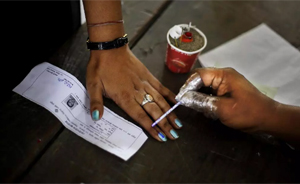
As per the assessment of Finance Ministry, bank counters are getting overcrowded due to same people turning up again and again to exchange old notes. "Ideally, the ink mark should have been put on the left hand as is done when a person casts his vote. But with by-elections due in some states, an ink mark for exchange or withdrawal of currency note on the left hand will lead to unnecessary difficulties. So it has been decided that the ink mark would be put on right hand," an official said.

The ink manufactured at the Mysore Paints and Varnish Ltd - the firm that has supplied indelible ink to the Election Commission since 1962 to mark voters, will be made available to banks and post offices from tonight.

Banks in major cities will start marking note exchangers with the ink, the official said.
Also, an expert committee comprising of officers from the Department of Economic Affairs and the Department of Financial Services are preparing standard operating procedure (SoPs) for ink marking as well as additional steps to be taken to manage the crowds.

The move comes amid long, unending queue at banks even after a week of Prime Minister Narendra Modi announcing withdrawal of old Rs 500/1000 notes in biggest crackdown on black money, corruption and counterfeit currency. The notes withdrawn accounted for 86 per cent of the cash circulating in the Asia's third-largest economy.

The source said the use of indelible ink would prevent "unscrupulous persons" from use conduits for exchanging notes. A persons, as per the revised guideline, is allowed to exchange old notes totalling up to 4,500 on a single day.

Earlier in the day, Economic Affairs Secretary Shaktikanta Das said it was noticed that the same people were coming back again and again to exchange notes, causing the long queues and creating hassles for genuine people to get their cash.

By-elections for four Lok Sabha seats - Cooch Behar and Tamluk in Purba Medinipur district in West Bengal, Shahdol in Madhya Pradesh and Lakhimpur in Assam will be held on November 19.

As many as 8 Assembly seats in Assam, Arunachal Pradesh, Madhya Pradesh, West Bengal, Tamil Nadu, Tripura and Puducherry will go to polls on the same day.

Comments

MARK
 - 
Tuesday, 15 Nov 2016

Dictatorship.... is in india... and that too its Worst ... Keeping the PUBLIC in trouble.

Instead of riding Ambani and adani .. cheddis are deceiving the people of india..

STILL bakhts did not understand this deception...

Add new comment

  • Coastaldigest.com reserves the right to delete or block any comments.
  • Coastaldigset.com is not responsible for its readers’ comments.
  • Comments that are abusive, incendiary or irrelevant are strictly prohibited.
  • Please use a genuine email ID and provide your name to avoid reject.
News Network
March 31,2020

Patna, Mar 31: In arguably the first of its kind incident in the country, a young man in Bihar was beaten to death precisely because he had informed the district control room about two corona suspects who had arrived here in the State from Mumbai.

The incident took place in Sitamarhi in North Bihar where a 20-year-old youth Bablu Kumar was allegedly killed by Sudhir Mahto and Munna Mahto.

The two Mahtos had arrived from Mumbai to Sitamarhi around ten days back. Bablu, in the meantime, informed the district control room about the arrival of two persons from a State where a large number of people were afflicted with coronavirus.

A team of doctors on March 24 reached Runnisaidpur in Sitamarhi to examine the two suspects. Three days later, these two persons from Maharashtra tested negative.

But the incident (of informing control room and subsequent medial test) created such enmity between the family of Mahtos and Babloo that on Sunday when they found the 20-year-old young man sitting alone, they thrashed him so mercilessly that he died on the spot.

Shocked and grief-struck, Babloo’s father Vinod Singh eventually lodged an FIR with the police and named Sudhir Mahto, Munna Mahto, and their family members as accused in the killing of his son.

The police on Monday raided the place and arrested the Mahtos.

But then, this is not an isolated case of violence. In another incident that took place in Bihar’s Jehanabad district, a BDO Ajay Kumar and a police officer Chandrashekhar Kumar were attacked by fellow villagers when the officials reached there to quarantine those migrants who had reached there from Delhi. So angry were the villagers with the officials’ move to isolate the migrants that they smashed the window-panes of the government vehicles and attacked the officials.

The officials had to beat a hasty retreat. But they soon returned with additional police team which used brutal force and took local leaders into custody before restoring normalcy in the area.

Comments

Add new comment

  • Coastaldigest.com reserves the right to delete or block any comments.
  • Coastaldigset.com is not responsible for its readers’ comments.
  • Comments that are abusive, incendiary or irrelevant are strictly prohibited.
  • Please use a genuine email ID and provide your name to avoid reject.
News Network
March 4,2020

Bengaluru, Mar 4: CM BS Yediyurappa may reconsider plans to hike taxes and curtail populist schemes in his budget on Thursday as the Centre released part of GST compensation it owes the state. Officials said the Centre released the first instalment of the bimonthly compensation for October-November amounting to Rs 2,013 crore.

"This is welcome relief as the government has been scrambling to mobilise funds," said BT Manohar, member of GST consultative committee, government of Karnataka. The second instalment of Rs 1,523 crore is also expected to be released soon.

The CM, in his seventh budget, is expected keep the focus firmly on farmers and give top priority to irrigation, agriculture and welfare schemes.

The irrigation sector is expected to land the lion's share with an allocation of at least Rs 25,000 crore, followed by agriculture. Former CM Kumaraswamy had allocated over Rs 17,000 crore for water resources.

The bulk of funds is likely to go to the Upper Krishna (UKP) and Upper Bhadra projects, as it will help backward Kalyana Karnataka and central Karnataka regions. The two are also significant political blocs. The government will also seek assistance from the Centre for the UKP project in the erstwhile Hyderabad-Karnataka region, which enjoys special status under the Constitution owing to its backwardness. P4

Yediyurappa is also expected to spell out populist schemes for the poor.

Former CM HD Kumaraswamy had allocated Rs 17,212 crore in the previous budget for water resources and Yediyurappa is likely to go well beyond that figure. "Priority will be given to irrigation and farmers," Yediyurappa had said recently. "I am making efforts to present a budget within the financial constraints."

he amounts are released once every two months, but the Centre had fallen behind on payments. PX

"There are indications that another payment will be made."

The state's optimism stems from the fact that the Centre's GST collection crossed the Rs 1 lakh crore-mark for four successive months till February.

However, the CM could still hike tax rates marginally. At a pre-budget meet on resource mobilisation where Yediyurappa is learnt to have expressed willingness to borrow funds, officials from the finance department advocated raising tax rates instead.

Comments

Add new comment

  • Coastaldigest.com reserves the right to delete or block any comments.
  • Coastaldigset.com is not responsible for its readers’ comments.
  • Comments that are abusive, incendiary or irrelevant are strictly prohibited.
  • Please use a genuine email ID and provide your name to avoid reject.
Agencies
June 13,2020

New Delhi, Jun 13: Loss of smell or taste has been added to the list of COVID-19 symptoms, according to the revised clinical management protocols released by the Union Health Ministry on Saturday.

The ministry said that coronavirus-infected patients reporting to various COVID-19 treatment facilities have been reporting symptoms like fever, cough, fatigue, shortness of breath, expectoration, myalgia, rhinorrhea, sore throat and diarrhea.

They have also complained of loss of smell (anosmia) or loss of taste (ageusia) preceding the onset of respiratory symptoms.

Older people and immune-suppressed patients in particular may present with atypical symptoms such as fatigue, reduced alertness, reduced mobility, diarrhoea, loss of appetite, delirium, and absence of fever, the ministry said.

Children might not have reported fever or cough as frequently as adults.

The US's national public health institute, the Centers for Disease Control and Prevention (CDC), had in early May incorporated "a new loss of taste or smell" in the list of COVID-19 symptoms.

According to the data from Integrated Health Information Platform and Integrated Disease Surveillance Programme, portal case investigation forms for COVID 19 (n=15,366), the details on the signs and symptoms reported are (as on June 11), fever (27 per cent), cough (21 pc), sore throat (10 pc), breathlessness (8 pc), Weakness (7 pc), running nose (3pc ) and others 24 pc.

According to the health ministry, people infected by the novel coronavirus are the main source of infection.

Direct person-to-person transmission occurs through close contact, mainly through respiratory droplets that are released when the infected person coughs, sneezes, or talks.

These droplets may also land on surfaces, where the virus remains viable. Infection can also occur if a person touches an infected surface and then touches his or her eyes, nose, or mouth.

The median incubation period is 5.1 days (range 2–14 days). The precise interval during which an individual with COVID-19 is infectious is uncertain.

As per the current evidence, the period of infectivity starts 2 days prior to onset of symptoms and lasts up to 8 days.

The extent and role played by pre-clinical/ asymptomatic infections in transmission still remain under investigation.

Comments

Add new comment

  • Coastaldigest.com reserves the right to delete or block any comments.
  • Coastaldigset.com is not responsible for its readers’ comments.
  • Comments that are abusive, incendiary or irrelevant are strictly prohibited.
  • Please use a genuine email ID and provide your name to avoid reject.