


Demonetisation: Banks to use indelible ink while exchanging notes

November 15, 2016

New Delhi, Nov 15: A small mark of indelible ink, used mostly during elections to prevent multiple voting, will be put on the right hand finger of those exchanging banned 500 and 1,000 rupee notes for new ones from tomorrow to prevent crowding at banks by repeat exchangers.Untitled-1
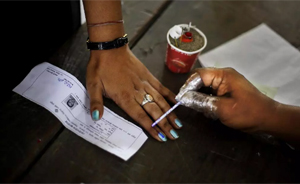
As per the assessment of Finance Ministry, bank counters are getting overcrowded due to same people turning up again and again to exchange old notes. "Ideally, the ink mark should have been put on the left hand as is done when a person casts his vote. But with by-elections due in some states, an ink mark for exchange or withdrawal of currency note on the left hand will lead to unnecessary difficulties. So it has been decided that the ink mark would be put on right hand," an official said.

The ink manufactured at the Mysore Paints and Varnish Ltd - the firm that has supplied indelible ink to the Election Commission since 1962 to mark voters, will be made available to banks and post offices from tonight.

Banks in major cities will start marking note exchangers with the ink, the official said.
Also, an expert committee comprising of officers from the Department of Economic Affairs and the Department of Financial Services are preparing standard operating procedure (SoPs) for ink marking as well as additional steps to be taken to manage the crowds.

The move comes amid long, unending queue at banks even after a week of Prime Minister Narendra Modi announcing withdrawal of old Rs 500/1000 notes in biggest crackdown on black money, corruption and counterfeit currency. The notes withdrawn accounted for 86 per cent of the cash circulating in the Asia's third-largest economy.

The source said the use of indelible ink would prevent "unscrupulous persons" from use conduits for exchanging notes. A persons, as per the revised guideline, is allowed to exchange old notes totalling up to 4,500 on a single day.

Earlier in the day, Economic Affairs Secretary Shaktikanta Das said it was noticed that the same people were coming back again and again to exchange notes, causing the long queues and creating hassles for genuine people to get their cash.

By-elections for four Lok Sabha seats - Cooch Behar and Tamluk in Purba Medinipur district in West Bengal, Shahdol in Madhya Pradesh and Lakhimpur in Assam will be held on November 19.

As many as 8 Assembly seats in Assam, Arunachal Pradesh, Madhya Pradesh, West Bengal, Tamil Nadu, Tripura and Puducherry will go to polls on the same day.

Comments

MARK
 - 
Tuesday, 15 Nov 2016

Dictatorship.... is in india... and that too its Worst ... Keeping the PUBLIC in trouble.

Instead of riding Ambani and adani .. cheddis are deceiving the people of india..

STILL bakhts did not understand this deception...

Add new comment

  • Coastaldigest.com reserves the right to delete or block any comments.
  • Coastaldigset.com is not responsible for its readers’ comments.
  • Comments that are abusive, incendiary or irrelevant are strictly prohibited.
  • Please use a genuine email ID and provide your name to avoid reject.
Agencies
March 6,2020

The rapid spread of COVID-19 across the globe has thrown movement of lakhs of travelers off gear. This has not only impacted pleasure trips of tourists but also business travel resulting in monetary losses worth millions.

In wake of numerous advisories against travel, the travel industry, particularly the aviation sector, has also get badly impacted. Not only traffic on their once popular routes have plummeted but several have to cancel flights to destinations in China and few other South and East Asian countries to prevent becoming carrier of the contagious virus.

According to MakeMyTrip flight bookings for Southeast Asian countries have been significantly impacted but sectors in But US and Europe are only seeing a marginal dip.

More than 95,000 people in 86 countries have been infected with the virus and more than 3,200 people have died. In India so far 31 persons have tested positive for the virus.

So the situation across the globe remains grim with only positives coming from China where fresh infections of COVID-19 has reduced. But does that make travel safer? And what if you still need to travel...are there enough flights available or whether the ticket you procured protects against any unforeseen cancellations?

Here is the situation as it exists :

International flights by domestic carriers:

*Air India and Indigo that run long haul flights have cancelled their flights to Hong Kong and Shanghai and the restrictions may well run into June

*SpicejJet has cancelled Delhi Hong Kong flights till March 28

*Vistara Airlines has cancelled around 54 flights to and from Bangkok and Singapore.

*GoAir suspends flight operations to Dammam, Saudi Arabia after an advisory issued by the Saudi government to not allow non-Saudi residents to enter. It has also suspended flights to Thailand

International flights by global airlines:

*Almost all major airlines operating out of India have suspended flights to China, Korea, Iran, Italy and some to Japan.

*European and American connections provide by airlines such as Lufthansa, KLM, United Airlines from India continues

*JAL is still operating its service to Japan from India

*United, Air Canada, JetBlue, Alaska, American Airlines, Delta, Brutus Airways have suspended flights to China and reduced operations in countries with high Coronavirus infections such as Italy

Domestic airlines:

There have been no restrictions on domestic travel, so far.

What advisories have been issued by authorities that can affect your travel plan :

*From March 9 midnight all air travellers having visited or arriving from Italy and South Korea will require to submit a certificate of having tested nagative from health authorities -designated lab in their countries for Coronavirus at the departure.

*India has also suspended most visas issued to nationals of Japan, South Korea, Italy, Iran and China, as well as suspending visas of any travellers who had been to those five countries since February.

*It has now been decided that all incoming international passengers must declare their travel history to health and immigrations officials at India's airports.

*Arrivals from DGCA list of 12 countries undergo thermal screening, passengers with high temperature taken to quantantine

*Screening to be carried out at 21 airports across the country

*Regular (sticker) visa/e-visa granted to nationals of People's Republic of China, issued on or before February 5, 2020 were suspended earlier. It shall remain in force.

*Those needing to travel to India under compelling circumstances may apply for fresh visa to the nearest Indian Embassy/Consulate," the advisory said.

*An advisory had also directed passengers arriving directly or indirectly from China, South Korea, Japan, Iran, Italy, Hong Kong, Macau, Vietnam, Malaysia, Indonesia, Nepal, Thailand, Singapore and Taiwan to undergo medical screening at the port of entry

Travel Insurance :

*All Indian carriers are offering full refund or bookings to alternate destinations for flights that were booked earlier but are getting cancelled due Coronavirus scare.

*GoAir stated that people have the option of availing a full refund or utilising the booking amount for any future travel with the airline.

*In a travel advisory, Emirates has stated that those wishing to travel to Saudi Arabia will have to contact the Emirates office or their travel agent for refunds.

*Others travellers having expensive insurance cover may get full refunds by the insurance companies if they have included everything under coverage.

*But a larger number of insurers do not provide travel insurance against any pandemics outright. Moreover, any travel plan made now may not get covered for can cancellations due to Coronavirus.

Comments

Add new comment

  • Coastaldigest.com reserves the right to delete or block any comments.
  • Coastaldigset.com is not responsible for its readers’ comments.
  • Comments that are abusive, incendiary or irrelevant are strictly prohibited.
  • Please use a genuine email ID and provide your name to avoid reject.
coastaldigest.com news network
July 30,2020

Mangaluru, July 30: Under the KKMA Dream House (Home for Homeless) project, the Karnataka Branch of Kuwait Kerala Muslim Association built two new houses at Nelyadi in Puttur taluk (house # 12 & 13) and handed over the keys on 29th July 2020 to the two widows as an Eid al-Adha gift for them.

Mr. S.M. Basha, president of Sea Food Buyers Association, Mangaluru, Mr. Sajid A.K, president of Highland Islamic Forum (HIF), Mangaluru, Mr. S.M. Farooq, president of KKMA Karnataka State Committee and Mr. Abubakker Thumbay, Vice President of Karnataka Branch Religious Affairs graced the occasion as Chief Guests.

Mr. S.M. Basha along with other dignitaries handed over the House # 12 key to a widow with three daughters at Bail house in Nelyadi and Mr. Sajid A.K. handed over the House # 13 key to another widow with two children at Alampadi in Nelyadi. 

Ustaad Haneef Saqafi, Qateeb Badriya Juma Masjid Nelyadi, Advocate Ismail, Ex-President and present committee member, Abdul Qader, Secretary of Jamaat, Taj Umar, Treasurer of Jamath, City Abbu, Ex-President of Jamath were present.  Ustaad Haneef Saqafi did the dua prayers. Mr. Abdul Rehman,  Contractor of the two houses was also present.

Kuwait Kerala Muslim Association being a leading Social Service Organization is an Extrordinary organization of ordinary people has successfully implemented several social development projects in Kerala and Karnataka states. KKMA Karnataka branch has previously handed over 11 houses for homeless at different places in Dakshina Kannada District.

Comments

Add new comment

  • Coastaldigest.com reserves the right to delete or block any comments.
  • Coastaldigset.com is not responsible for its readers’ comments.
  • Comments that are abusive, incendiary or irrelevant are strictly prohibited.
  • Please use a genuine email ID and provide your name to avoid reject.
News Network
April 29,2020

Washington, Apr 29: A US government panel on Tuesday called for India to be put on a religious freedom blacklist over a "drastic" downturn under Prime Minister Narendra Modi, triggering a sharp rebuttal from New Delhi.

The US Commission on International Religious Freedom recommends but does not set policy, and there is virtually no chance the State Department will follow its lead on India, an increasingly close US ally.

In an annual report, the bipartisan panel narrowly agreed that India should join the ranks of "countries of particular concern" that would be subject to sanctions if they do not improve their records.

"In 2019, religious freedom conditions in India experienced a drastic turn downward, with religious minorities under increasing assault," the report said.

It called on the United States to impose punitive measures, including visa bans, on Indian officials believed responsible and grant funding to civil society groups that monitor hate speech.

The commission said that Modi's Hindu nationalist government, which won a convincing election victory last year, "allowed violence against minorities and their houses of worship to continue with impunity, and also engaged in and tolerated hate speech and incitement to violence."

It pointed to comments by Home Minister Amit Shah, who notoriously referred to mostly Muslim migrants as "termites," and to a citizenship law that has triggered nationwide protests.

It also highlighted the revocation of the autonomy of Kashmir, which was India's only Muslim-majority state, and allegations that Delhi police turned a blind eye to mobs who attacked Muslim neighborhoods in February this year.

Coronavirus state-wise India update: Total number of confirmed cases, deaths on April 29

The Indian government, long irritated by the commission's comments, quickly rejected the report.

"Its biased and tendentious comments against India are not new. But on this occasion, its misrepresentation has reached new levels," foreign ministry spokesman Anurag Srivastava said.

"We regard it as an organization of particular concern and will treat it accordingly," he said in a statement.

The State Department designates nine "countries of particular concern" on religious freedom -- China, Eritrea, Iran, Myanmar, North Korea, Pakistan, Saudi Arabia, Tajikistan and Turkmenistan.

The commission asked that all nine countries remain on the list. In addition to India, it sought the inclusion of four more -- Nigeria, Russia, Syria and Vietnam.

Pakistan, India's historic rival, was added by the State Department in 2018 after years of appeals by the commission.

In its latest report, the commission said that Pakistan "continued to trend negatively," voicing alarm at forced conversions of Hindus and other minorities, abuse of blasphemy prosecutions and a ban on the Ahmadi sect calling itself Muslim.

India's citizenship law fast-tracks naturalization for minorities from neighbouring countries -- but not if they are Muslim.

Modi's government says it is not targeting Muslims but rather providing refuge to persecuted people and should be commended.

But critics consider it a watershed move by Modi to define the world's largest democracy as a Hindu nation and chip away at independent India's founding principle of secularism.

Tony Perkins, the commission's chair, called the law a "tipping point" and voiced concern about a registry in the northeastern state of Assam, under which 1.9 million people failed to produce documentation to prove that they were Indian citizens before 1971 when mostly Muslim migrants flowed in during Bangladesh's bloody war of independence.

"The intentions of the national leaders are to bring this about throughout the entire country," Perkins told an online news conference.

"You could potentially have 100 million people, mostly Muslims, left stateless because of their religion. That would be, obviously, an international issue," said Perkins, a Christian activist known for his opposition to gay rights who is close to President Donald Trump's administration.

Three of the nine commissioners dissented -- including another prominent Christian conservative, Gary Bauer, who voiced alarm about India's direction but said the ally could not be likened to non-democracies such as China.

"I am deeply concerned that this public denunciation risks exactly the opposite outcome than the one we all desire," Bauer said.

Trump, who called for a ban on Muslim immigration to the US when he ran for president, hailed Modi on a February visit to New Delhi.

Comments

Add new comment

  • Coastaldigest.com reserves the right to delete or block any comments.
  • Coastaldigset.com is not responsible for its readers’ comments.
  • Comments that are abusive, incendiary or irrelevant are strictly prohibited.
  • Please use a genuine email ID and provide your name to avoid reject.