


Demonetisation: Banks to use indelible ink while exchanging notes

November 15, 2016

New Delhi, Nov 15: A small mark of indelible ink, used mostly during elections to prevent multiple voting, will be put on the right hand finger of those exchanging banned 500 and 1,000 rupee notes for new ones from tomorrow to prevent crowding at banks by repeat exchangers.Untitled-1
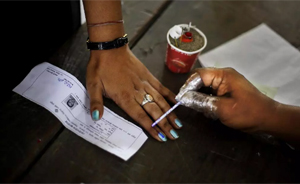
As per the assessment of Finance Ministry, bank counters are getting overcrowded due to same people turning up again and again to exchange old notes. "Ideally, the ink mark should have been put on the left hand as is done when a person casts his vote. But with by-elections due in some states, an ink mark for exchange or withdrawal of currency note on the left hand will lead to unnecessary difficulties. So it has been decided that the ink mark would be put on right hand," an official said.

The ink manufactured at the Mysore Paints and Varnish Ltd - the firm that has supplied indelible ink to the Election Commission since 1962 to mark voters, will be made available to banks and post offices from tonight.

Banks in major cities will start marking note exchangers with the ink, the official said.
Also, an expert committee comprising of officers from the Department of Economic Affairs and the Department of Financial Services are preparing standard operating procedure (SoPs) for ink marking as well as additional steps to be taken to manage the crowds.

The move comes amid long, unending queue at banks even after a week of Prime Minister Narendra Modi announcing withdrawal of old Rs 500/1000 notes in biggest crackdown on black money, corruption and counterfeit currency. The notes withdrawn accounted for 86 per cent of the cash circulating in the Asia's third-largest economy.

The source said the use of indelible ink would prevent "unscrupulous persons" from use conduits for exchanging notes. A persons, as per the revised guideline, is allowed to exchange old notes totalling up to 4,500 on a single day.

Earlier in the day, Economic Affairs Secretary Shaktikanta Das said it was noticed that the same people were coming back again and again to exchange notes, causing the long queues and creating hassles for genuine people to get their cash.

By-elections for four Lok Sabha seats - Cooch Behar and Tamluk in Purba Medinipur district in West Bengal, Shahdol in Madhya Pradesh and Lakhimpur in Assam will be held on November 19.

As many as 8 Assembly seats in Assam, Arunachal Pradesh, Madhya Pradesh, West Bengal, Tamil Nadu, Tripura and Puducherry will go to polls on the same day.

Comments

MARK
 - 
Tuesday, 15 Nov 2016

Dictatorship.... is in india... and that too its Worst ... Keeping the PUBLIC in trouble.

Instead of riding Ambani and adani .. cheddis are deceiving the people of india..

STILL bakhts did not understand this deception...

Add new comment

  • Coastaldigest.com reserves the right to delete or block any comments.
  • Coastaldigset.com is not responsible for its readers’ comments.
  • Comments that are abusive, incendiary or irrelevant are strictly prohibited.
  • Please use a genuine email ID and provide your name to avoid reject.
News Network
April 20,2020

Kalaburagi, Apr 20: With no COVID-19 case reported here on Sunday, the total number of virus-infected people in the district stood at 22.

While three persons have succumbed to the infection in the district so far, three others have been cured and discharged.

"No COVID-19 case was reported in Kalaburagi district today. Total 22 positive cases and 3 deaths have been reported in the district till date. Three persons have been cured," said District Magistrate B. Sharat.

Karnataka's total count of coronavirus patients has surged to 390, said the State Health Department on Sunday.

"Six new cases have been confirmed for COVID-19 in the State from 5 pm on Saturday till 5 pm on Sunday. Cumulatively, 390 COVID-19 positive cases have been confirmed in the state," it said.

Comments

Add new comment

  • Coastaldigest.com reserves the right to delete or block any comments.
  • Coastaldigset.com is not responsible for its readers’ comments.
  • Comments that are abusive, incendiary or irrelevant are strictly prohibited.
  • Please use a genuine email ID and provide your name to avoid reject.
Wafa Sultana
April 4,2020

Over the last couple of days when the world was occupied with unifying efforts to fight the deadly Covid19 pandemic, sections of Indian media provided viewers a familiar scapegoat – the Indian Muslims – who are often stereotyped as a community being constantly at loggerheads with the citizenry and the State. Biased media channels were quick to resort to blaming the entire Muslim community for the spread of the disease in the country, thanks to an ill-timed Tablighi Jamaat gathering at its international headquarters in Delhi’s Nizamuddin. Unsurprisingly, the opprobrium was also marked by a sudden spike in WhatsApp forwards of videos with people wearing skullcaps licking spoons and performing Sufi breathing rituals, suggesting some sort of wild conspiracy on the part of the community to spread the virus.  Some media channels were quick to formulate, hypothesize and provide loose definitions of a newly discovered form of Jihad i.e. ‘Corona Jihad ’ thereby vilifying the Islamic faith and its followers.

While the investigation on the culpability of the organizers of the Nizamuddin event is still ongoing, there is enough information to suggest that the meeting was held before any lockdown was in force, and the problem began when there was no way of getting people out once the curfew was announced. Be that as it may, there is little doubt that organizing a meet of such a scale when there is a global pandemic smacks of gross misjudgment, and definitely the organizers should be held accountable if laws or public orders were defied. Attendees who attempt to defy quarantine measures must be dealt with strictly. However, what is alarming is that the focus and narrative have now shifted from the unfortunate event at Nizamuddin to the Tablighi Jamaat itself.

For those not familiar with the Tablighi Jamaat, the organization was founded in 1926 in Mewat by scholar Maulana Mohammad Ilyas. The Jamaat’s main objective was to get Muslim youth to learn and practice pristine Islam shorn of external influences. This is achieved through individuals dedicating time for moral and spiritual upliftment secluded from the rest of the world for a brief period of time. There is no formal membership process. More senior and experienced participants typically travel from one mosque to other delivering talks on religious topics, inviting local youth to attend and then volunteer for a spiritual retreat for a fixed number of days to a mosque in a nearby town or village to present the message to their co-religionists. Contrary to ongoing Islamophobic rhetoric, the movement does not actively proselytize. The focus is rather on getting Muslims to learn the teachings and practices of Islam.  This grassroots India-based movement has now grown to almost all countries with substantial Muslim populations. Its annual meets, or ‘ijtemas’ are among the largest Islamic congregations in the world after the annual Haj. One of the reasons for its popularity and wide network in the subcontinent and wordwide is the fact that it has eschewed the need for scholarly intervention, focusing on peer learning of fundamental beliefs and practice rather than high-falutin ideological debates. The Tablighi Jamaat also distinguishes itself from other Islamic movements through its strictly apolitical nature, with a focus on individual self-improvement rather than political mobilization. Hardships and difficulty in the world are expected to be face through ‘sabr’ (patience) and ‘dua’ (supplication),  than through quest for political power or influence. In terms of ideology, it is very much based on mainstream Sunni Islamic principles derived from the Deobandi school.

So, why is all this background important in the current context? While biased media entities have expectedly brought out their Islamophobic paraphernalia out for full display, more neutral commentators have tried to paint the Tablighi Jamaat as a fringe group and have tried to distance it from 'mainstream Muslims'. While the intent is no doubt innocent, this is a trap we must not fall into. This narrative, unfortunately, is also gaining ground due to apathy some Muslims have for the group, accusing it of being “disconnected from the realities of the world”. Unlike other Muslim organizations and movements, the Tablighi Jamat, by virtue of its political indifference, does not boast of high-profile advocates and savvy spokespersons who can defend it in mainstream or social media.  The use of adjectives such as 'outdated' and 'orthodox' by liberal columnists to describe the Jamaat feeds into the malignant attempt to change the narrative from the control of the spread of the pandemic due to the Nizamuddin gathering to 'raison d'etre' of the organization itself.

A large mainstream religious group like the Tablighi Jamaat with nearly a hundred-year history, normally considered to be peaceful, apolitical and minding its own business is now suddenly being villainized owing to unfortunate circumstances. Biased media reactions filled with disgust and hate seem to feed the Indian public conscience with a danngerous misconception - to be a nominal Muslim is okay but being a practicing one is not.  For those committed to the truth and fighting the spread of Islamophobia, the temptation to throw the entire Tablighi Jamaat under the bus must be resisted.

The writer is a lawyer and research scholar at Qatar University. Her research interests include Islamic law and politics.

Comments

zahoorahmed
 - 
Saturday, 4 Apr 2020

great article! provides a great perspective on tableeg jamat

Add new comment

  • Coastaldigest.com reserves the right to delete or block any comments.
  • Coastaldigset.com is not responsible for its readers’ comments.
  • Comments that are abusive, incendiary or irrelevant are strictly prohibited.
  • Please use a genuine email ID and provide your name to avoid reject.
News Network
May 9,2020

Kota, May 9: Karnataka Yakshagana Academy has come to the rescue of artists in distress due to cancellation of all Yakshagana festivals following coronavirus outbreak and clamping of lock-down.

The academy spends lakh of rupees every year from the money sanctioned to it on training new artists, performances and documentation. However, no such activity was undertaken due to COVID-19. Hence, the academy is discussing to transfer a large amount of money to Yakshagana artists as emergency aid, Academy President Prof M A Hegde said here.

In a statement issued here on Saturday, he said that along with this aid the donations by the public and Yakshagana admirers too could be given to the artists.

Comments

Add new comment

  • Coastaldigest.com reserves the right to delete or block any comments.
  • Coastaldigset.com is not responsible for its readers’ comments.
  • Comments that are abusive, incendiary or irrelevant are strictly prohibited.
  • Please use a genuine email ID and provide your name to avoid reject.