



Govt rejects demand for PM's reply on demonetisation debate

November 17, 2016

New Delhi, Nov 17: Government today rejected the demand for Prime Minister Narendra Modi's response on the debate on demonetisation and accused the opposition of using it as an excuse to scuttle discussion on the issue in Parliament.
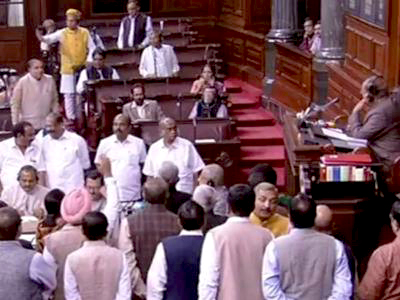
GovtInformation and Broadcasting Minister M Venkaiah Naidu told reporters after Parliament was adjourned for the day, amid protests by opposition demanding Modi's presence, that the reply to the debate would be given by the minister concerned or any other person on behalf of the government as per the rules of the House and precedents.

The opposition disrupted the Rajya Sabha, stalling midway the discussion on demonetisation that started yesterday.

A united opposition's relentless demand for a debate on demonetisation under a rule which entails voting forced the adjournment of the Lok Sabha also for the day as the government refused to accept it.

"Half way through, they realised that by raising such a debate it is going negative on them and boomeranging. Now I am afraid, are they trying to find a way out to come out of this and then stall the debate on one pretext or the other," Naidu said.

Dubbing the uproar by Congress and other opposition parties as an "excuse" to stall a debate, Naidu alleged that there is no rationale, whatsoever, behind it.

The Minister said things will happen as per the rules and procedures of the House and urged that the debate should go on.

"I feel that those who started the debate are now understanding that it is going negative, that is why they are finding excuse for not allowing the discussion.

"They are speaking in double tone and in different voices. They are not coming out openly either for or against. They are in dilemma and that dilemma will continue," he said.

Naidu said the entire country is watching as to who are with the hoarders and with the people with black money and who are with the government and the Prime Minister, who has "taken such a revolutionary step. They have to make a choice".

"Let the discussion take place. Then who will reply in the government. It could be the concerned Minister. The solution will come through the government as per traditions and rules," he said.

Naidu said government is addressing the problems faced by people on demonetisation and any suggestion, if worth considering, will be take up positively.

"Government is open to ideas to improve the system. But if somebody is trying to question this and attribute motives, then people are there to finally come to an assessment and decide. Let every party decide are they in favour of this move or against it, for which they have no answer directly," the minister said.

Comments

c.m bin
 - 
Thursday, 17 Nov 2016

cancel this PM. see korea and build the nation.

Add new comment

  • Coastaldigest.com reserves the right to delete or block any comments.
  • Coastaldigset.com is not responsible for its readers’ comments.
  • Comments that are abusive, incendiary or irrelevant are strictly prohibited.
  • Please use a genuine email ID and provide your name to avoid reject.
News Network
April 3,2020

Washington, Apr 3: The World Bank has approved USD 1 billion emergency funding for India to help it tackle the coronavirus pandemic, which has claimed 76 lives and infected 2,500 people in the country.

The World Bank's first set of aid projects, amounting to USD 1.9 billion, will assist 25 countries, and new operations are moving forward in over 40 nations using the fast-track process, the bank said on Thursday.

The largest chunk of the emergency financial assistance has gone to India USD 1 billion.

"In India, USD 1 billion emergency financing will support better screening, contact tracing, and laboratory diagnostics; procure personal protective equipment; and set up new isolation wards," the World Bank said after its Board of Executive Directors approved the first set of emergency support operations for developing countries around the world, using a dedicated, fast-track facility for COVID-19 response.

In South Asia, the World Bank also approved USD 200 million for Pakistan, USD 100 million for Afghanistan, USD 7.3 million for the Maldives and USD 128.6 million for Sri Lanka.

The World Bank said it was now working to grant up to USD 160 billion over the next 15 months to support measures to tackle the pandemic which will focus on the immediate health consequences and bolster economic recovery.

The broader economic program will aim to shorten the time to recovery, create conditions for growth, support small and medium enterprises, and help protect the poor and vulnerable.

"The World Bank Group is taking broad, fast action to reduce the spread of COVID-19 and we already have health response operations moving forward in over 65 countries," said World Bank Group President David Malpass.

"We are working to strengthen (the) developing nations' ability to respond to the COVID-19 pandemic and shorten the time to economic and social recovery," Malpass said.

According to the bank, USD 100 million will support Afghanistan to slow and limit the spread of COVID-19 through enhanced detection, surveillance, and laboratory systems, as well as strengthen essential health care delivery and intensive care.

In Pakistan, USD 200 million will support preparedness and emergency response in the health sector and include social protection and education measures, the bank said.

A total of 1,002,159 COVID-19 cases have been reported across more than 175 countries and territories with 51,485 deaths reported so far, according to Johns Hopkins University data.

Comments

Add new comment

  • Coastaldigest.com reserves the right to delete or block any comments.
  • Coastaldigset.com is not responsible for its readers’ comments.
  • Comments that are abusive, incendiary or irrelevant are strictly prohibited.
  • Please use a genuine email ID and provide your name to avoid reject.
News Network
May 15,2020

New Delhi, May 15: The World Bank on Friday approved $1 billion 'Accelerating India's COVID-19 Social Protection Response Program' to support the country's efforts for providing social assistance to the poor and vulnerable households, severely impacted by the pandemic.

This takes the total commitment from the World Bank towards emergency COVID-19 response in India to $2 billion.

A $1 billion support was announced last month to support India's health sector.

The response to the COVID-19 pandemic around the world has required governments around the world to introduce social distancing and lockdowns in unprecedented ways, said Junaid Ahmad, World Bank Country Director in India in a webinar interaction with the media.

These measures, intended to contain the spread of the virus have, however, impacted economies and jobs – especially in the informal sector. India with the world's largest lockdown has not been an exception to this trend, he said.

Of the $1 billion commitment, $550 million will be financed by a credit from the International Development Association (IDA) – the World Bank's concessionary lending arm and $200 million will be a loan from the International Bank for Reconstruction and Development (IBRD), with a final maturity of 18.5 years including a grace period of five years.

The remaining USD 250 million will be made available after June 30, 2020.

Comments

Add new comment

  • Coastaldigest.com reserves the right to delete or block any comments.
  • Coastaldigset.com is not responsible for its readers’ comments.
  • Comments that are abusive, incendiary or irrelevant are strictly prohibited.
  • Please use a genuine email ID and provide your name to avoid reject.
News Network
February 9,2020

Mumbai, Feb 9: Given the slow progress on the ongoing Rs 38,000-crore capacity expansion at the four largest metro airports, and also the surging traffic, the snaky queues will continue at least till 2023, warns a report.

The four largest airports -- New Delhi, Mumbai, Bengaluru and Hyderabad -- handle more than half of the traffic and are operating at 130 per cent of their installed capacity. These airports are under a record Rs 38,000-crore capex but the capacity will not come up before end-2023, says a Crisil report.

“With the dip in traffic growth largely behind, we expect congestion at the top four airports of New Delhi, Mumbai, Bengaluru and Hyderabad, which handle more than half of the load, to continue till about FY23,” says the report.

Already these airports are operating at over 130 percent of installed capacity, and the ongoing healthy traffic growth this operating rate is expected to rise further in the next 12 months.

“Operationalising of capacities in the following two fiscals will bring down utilisation levels albeit still high at over 90 per cent by fiscal 2023 and that is despite an unprecedented Rs 38,000 crore capex being undertaken by the operators of these airports over five fiscals 2020-24,” says the report.

Despite this unprecedented capex that is debt-funded, ratings are likely to be stable given the strong cash flows expected due to healthy traffic growth, low project risks associated with the capex and improving regulatory environment, notes the report.

“Capacity at these four airports will increase a cumulative 65 per cent to 228 million annually (from 138 million now) by fiscal 2023. However, traffic is expected to grow strong at up to 10 per cent per annum over the same period. Since additional capacities will become operational in phases only by fiscal 2023, high passenger growth will add to congestion till then,” warn the report.

High utilisation will ride on pent-up demand (accumulated in 2019 as traffic was impacted with the grounding of Jet Airways) and one-off issues with new aircraft of certain airlines.

Further impetus will also come from improving connectivity to lower-tier cities and reducing fare difference between air and rail. Increasing footfalls at airports provide a leg-up to non-aero streams such as advertising, rentals, food and beverage and parking, which comprise around half of the revenue of airports already.

These are expected to grow strongly at over 10-12 per cent, also supported by higher monetisation avenue coming along with current capex. The other half of revenue (aero revenue) is an entitlement approved by the regulator, providing a pre-determined, fixed return over the asset base and a pass-through of costs.

Aero revenue is also expected to get a bump up during fiscals 2022-24, when a new tariff order for airports is likely. Overall aggregate cash flows are likely to double by fiscal 2024 and provide a healthy cushion against servicing of debt contracted for capex, the report concludes.

Comments

Add new comment

  • Coastaldigest.com reserves the right to delete or block any comments.
  • Coastaldigset.com is not responsible for its readers’ comments.
  • Comments that are abusive, incendiary or irrelevant are strictly prohibited.
  • Please use a genuine email ID and provide your name to avoid reject.