


Fidel Castro, who defied 10 US presidents in his 50 year rule, dies aged 90

November 26, 2016

Havana, Nov 26: Former President Fidel Castro, who led a rebel army to improbable victory in Cuba, embraced Soviet-style communism and defied the power of 10 US presidents during his half century rule, has died at age 90.
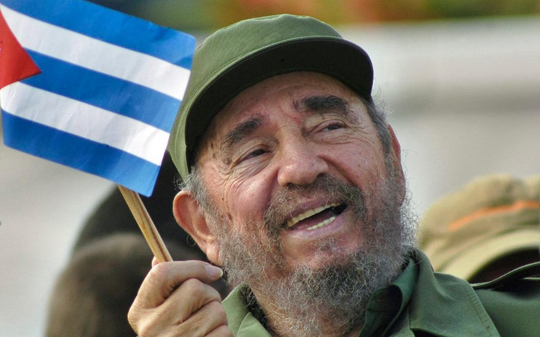
fc

With a shaking voice, his younger brother, Raul Castro, announced on state television that his brother died at 10:29 p.m. on Friday night.

Castro's reign over the island-nation 90 miles from Florida was marked by the US-backed Bay of Pigs invasion in 1961 and the Cuban Missile Crisis a year later that brought the world to the brink of nuclear war.

The bearded revolutionary, who survived a crippling US trade embargo as well as dozens, possibly hundreds, of assassination plots, died eight years after ill health forced him to formally hand power over to Raul.

Castro overcame imprisonment at the hands of dictator Fulgencio Batista, exile in Mexico and a disastrous start to his rebellion before triumphantly riding into Havana in January 1959 to become, at age 32, the youngest leader in Latin America. For decades, he served as an inspiration and source of support to revolutionaries from Latin America to Africa.

His commitment to socialism was unwavering, though his power finally began to fade in mid-2006 when a gastrointestinal ailment forced him to hand over the presidency to Raul in 2008, provisionally at first and then permanently.

His defiant image lingered long after he gave up his trademark Cohiba cigars for health reasons and his tall frame grew stooped. "Socialism or death" remained Castro's rallying cry even as Western-style democracy swept the globe and other communist regimes in China and Vietnam embraced capitalism, leaving this island of 11 million people an economically crippled Marxist curiosity.

He survived long enough to see Raul Castro negotiate an opening with US President Barack Obama on December 17, 2014, when Washington and Havana announced they would move to restore diplomatic ties for the first time since they were severed in 1961.

He cautiously blessed the historic deal with his lifelong enemy in a letter published after a month-long silence. "It's a tragedy," said Dayan Montalvo, a 22-year-old nurse. "We all grew up with him. I feel really hurt by the news that we just heard."

Fidel Castro Ruz was born August 13, 1926, in eastern Cuba's sugar country, where his Spanish immigrant father worked first recruiting labor for US sugar companies and later built up a prosperous plantation of his own.

Castro attended Jesuit schools, then the University of Havana, where he received law and social science degrees. His life as a rebel began in 1953 with a reckless attack on the Moncada military barracks in the eastern city of Santiago. Most of his comrades were killed and Fidel and his brother Raul went to prison.

Castro cobbled revolutionary groups together into the new Cuban Communist Party, with him as first secretary. Labor unions lost the right to strike. The Catholic Church and other religious institutions were harassed. Neighborhood "revolutionary defence committees" kept an eye on everyone.

Castro exported revolution to Latin American countries in the 1960s, and dispatched Cuban troops to Africa to fight Western-backed regimes in the 1970s. Over the decades, he sent Cuban doctors abroad to tend to the poor, and gave sanctuary to fugitive Black Panther leaders from the US.

But the collapse of the Soviet bloc ended billions in preferential trade and subsidies for Cuba, sending its economy into a tailspin. Castro briefly experimented with an opening to foreign capitalists and limited private enterprise.

As the end of the Cold War eased global tensions, many Latin American and European countries re-established relations with Cuba. In January 1998, Pope John Paul II visited a nation that had been officially atheist until the early 1990s.

Aided by a tourism boom, the economy slowly recovered and Castro steadily reasserted government control, stifling much of the limited free enterprise tolerated during harder times.

As flamboyant as he was in public, Castro tried to lead a discreet private life. He and his first wife, Mirta Diaz Balart, had one son before divorcing in 1956. Then, for more than four decades, Castro had a relationship with Dalia Soto del Valle. They had five sons together and were said to have married quietly in 1980.

By the time Castro resigned 49 years after his triumphant arrival in Havana, he was the world's longest ruling head of government, aside from monarchs. In retirement, Castro voiced unwavering support as Raul slowly but deliberately enacted sweeping changes to the Marxist system he had built.

His longevity allowed the younger brother to consolidate control, perhaps lengthening the revolution well past both men's lives. In February 2013, Raul announced that he would retire as president in 2018 and named newly minted Vice President Miguel Diaz-Canel as his successor.

"I'll be 90 years old soon," Castro said at an April 2016 communist party congress where he made his most extensive public appearance in years. "Soon I'll be like all the others.

The time will come for all of us, but the ideas of the Cuban Communists will remain as proof that on this planet, if one works with fervor and dignity, they can produce the material and cultural goods that human beings need and that need to be fought for without ever giving up."

Comments

Congi Shan
 - 
Saturday, 26 Nov 2016

The whole nation suffered because of this man. Not different from dictators Saddam, Gaddafi & Kim Kong Un

Fawad
 - 
Saturday, 26 Nov 2016

CIA tried 500 times to kill him .....Americans are real terrorists

Fedrick
 - 
Saturday, 26 Nov 2016

Red salute to fidel castro and his revolution!

karthik
 - 
Saturday, 26 Nov 2016

Indians can expect the biggest party in the world issuing membership to the expired revolutionary.

Kavya
 - 
Saturday, 26 Nov 2016

Real communism was followed by Karl Marx who envisaged an egalitarian society unlike the Ambanis and Mallyas of today.

Veerendra Hegde
 - 
Saturday, 26 Nov 2016

He kept an enviable and long record as the only leader who ruled a state for more than 50 years! He fought the mighty US and was recognised as one of the tall leaders in the world, with his demise, it is the end of an era! RIP comrade!

Jayaraj
 - 
Saturday, 26 Nov 2016

it is the end of a long innings.. made colorful by his continued anti US stance...... his cigar and the beard made him a recognizable figure who it is said has survived many number of attempts on his life ....MAY HIS SOUL REST IN PEACE......

Add new comment

  • Coastaldigest.com reserves the right to delete or block any comments.
  • Coastaldigset.com is not responsible for its readers’ comments.
  • Comments that are abusive, incendiary or irrelevant are strictly prohibited.
  • Please use a genuine email ID and provide your name to avoid reject.
Agencies
July 3,2020

The dollar's dominance will slowly melt away over the coming year on weakening global demand and a sombre U.S. economic outlook, according to a Reuters poll of currency forecasters whose views depend on there being no second coronavirus shock.

Despite fears a surge in new Covid-19 cases would delay economies reopening and stymie a tentative recovery, world stocks have rallied - with the S&P 500 finishing higher in June, marking its biggest quarterly percentage gain since the height of the technology boom in 1998.

Caught between bets in favour of riskier investments, weak U.S. economic prospects as well as an easing in the thirst for dollars after the Federal Reserve flooded markets with liquidity, the greenback fell nearly 1.0 per cent last month. It was its worst monthly performance since December.

While there was a dire prognosis from the top U.S. medical expert on the coronavirus' spread, the June 25-July 1 poll of over 70 analysts showed weak dollar projections as Fed Chair Jerome Powell on Monday reiterated the economic outlook for the world's largest economy was uncertain.

"The dollar rises in two instances: when you see risk off or when there is a situation where the U.S. is leading the global recovery, and we don't think that's going to be the case anytime soon," said Gavin Friend, senior FX strategist at NAB Group in London.

"The U.S. is playing fast and loose with the virus, and chronologically they're behind the rest of the world."

Currency speculators, who had built up trades against the dollar to the highest in two years during May, increased their out-of-favour dollar bets further last week, the latest positioning data showed.

About 80 per cent of analysts, 53 of 66, said the likely path for the dollar over the next six months was to trade around current levels, alternating between slight gains and losses in a range. That suggests the greenback may be at a crucial crossroad as more currency strategists have turned bearish.

But more than 90 per cent, or 63 of 68, said a second shock from the pandemic would push the dollar higher. Five said it would push the U.S. currency lower.

Much will also depend on debt servicing and repayments by Asian, European and other international borrowers in U.S. dollars.

While an early shortage of dollars in March from the pandemic's first shock pushed the Fed to open currency swap lines with major central banks, international funding strains have eased significantly since. In recent weeks, usage of the facility has reduced dramatically.

That trend is expected to continue over the next six months with major central banks' usage of swap lines to "stay around current levels", according to 32 of 46 analysts. While 13 predicted a sharp drop, only one respondent said use of them would "rise sharply".

The dollar index, which measures the greenback's strength against six other major currencies, has slipped over 5 per cent since touching a more than three-year high in March.

When asked which currencies would perform better against the dollar by end-December, a touch over half of 49 respondents said major developed market ones, with the remaining almost split between commodity-linked and emerging market currencies.

"The dollar is so overvalued, and has been overvalued for a long time, it's time now for it to come back down again, as we head towards the (U.S.) election," added NAB's Friend.

Over the last quarter, the euro has staged a 1.8 per cent comeback after falling by a similar margin during the first three months of the year. For the month of June, the euro was up 1.2 per cent against the dollar.

The single currency was now expected to gain about 2.5 per cent to trade at $1.15 in a year from around $1.12 on Wednesday, slightly stronger than $1.14 predicted last month. While those findings are similar to what analysts have been predicting for nearly two years, there was a clear shift in their outlook for the euro, with the range of forecasts showing higher highs and higher lows from last month.

"In comparison to even a month or two ago, the outlook in Europe has improved significantly," said Lee Hardman, currency strategist at MUFG.

"I think that makes the euro look relatively more attractive and cheap against the likes of the dollar. We're not arguing strongly for the euro to surge higher, we're just saying, after the weakness we have seen in recent years, there is the potential for that weakness to start to reverse."

Comments

Add new comment

  • Coastaldigest.com reserves the right to delete or block any comments.
  • Coastaldigset.com is not responsible for its readers’ comments.
  • Comments that are abusive, incendiary or irrelevant are strictly prohibited.
  • Please use a genuine email ID and provide your name to avoid reject.
News Network
June 2,2020

London/Milan, Jun 2: World Health Organization experts and a range of other scientists said on Monday there was no evidence to support an assertion by a high profile Italian doctor that the coronavirus causing the COVID-19 pandemic has been losing potency.

Professor Alberto Zangrillo, head of intensive care at Italy's San Raffaele Hospital in Lombardy, which bore the brunt of Italy's COVID-19 epidemic, on Sunday told state television that the new coronavirus "clinically no longer exists".

But WHO epidemiologist Maria Van Kerkhove, as well as several other experts on viruses and infectious diseases, said Zangrillo's comments were not supported by scientific evidence.

There is no data to show the new coronavirus is changing significantly, either in its form of transmission or in the severity of the disease it causes, they said.

"In terms of transmissibility, that has not changed, in terms of severity, that has not changed," Van Kerkhove told reporters.

It is not unusual for viruses to mutate and adapt as they spread, and the debate on Monday highlights how scientists are monitoring and tracking the new virus. The COVID-19 pandemic has so far killed more than 370,000 people and infected more than 6 million.

Martin Hibberd, a professor of emerging infectious disease at the London School of Hygiene & Tropical Medicine, said major studies looking at genetic changes in the SARS-CoV-2 virus that causes COVID-19 did not support the idea that it was becoming less potent, or weakening in any way.

"With data from more than 35,000 whole virus genomes, there is currently no evidence that there is any significant difference relating to severity," he said in an emailed comment.

Zangrillo, well known in Italy as the personal doctor of former Prime Minister Silvio Berlusconi, said his comments were backed up by a study conducted by a fellow scientist, Massimo Clementi, which Zangrillo said would be published next week.

Zangrillo told Reuters: "We have never said that the virus has changed, we said that the interaction between the virus and the host has definitely changed."

He said this could be due either to different characteristics of the virus, which he said they had not yet identified, or different characteristics in those infected.

The study by Clementi, who is director of the microbiology and virology laboratory of San Raffaele, compared virus samples from COVID-19 patients at the Milan-based hospital in March with samples from patients with the disease in May.

"The result was unambiguous: an extremely significant difference between the viral load of patients admitted in March compared to" those admitted last month, Zangrillo said.

Oscar MacLean, an expert at the University of Glasgow's Centre for Virus Research, said suggestions that the virus was weakening were "not supported by anything in the scientific literature and also seem fairly implausible on genetic grounds."

Comments

Add new comment

  • Coastaldigest.com reserves the right to delete or block any comments.
  • Coastaldigset.com is not responsible for its readers’ comments.
  • Comments that are abusive, incendiary or irrelevant are strictly prohibited.
  • Please use a genuine email ID and provide your name to avoid reject.
News Network
April 26,2020

Apr 26: The Chinese city of Wuhan, where the global coronavirus pandemic began, now has no remaining cases in its hospitals, a health official told reporters on Sunday.

"The latest news is that by April 26, the number of new coronavirus patients in Wuhan was at zero, thanks to the joint efforts of Wuhan and medical staff from around the country," National Health Commission spokesman Mi Feng said at a briefing.

The city had reported 46,452 cases, 56% of the national total. It saw 3,869 fatalities, or 84% of China's total.

Comments

Add new comment

  • Coastaldigest.com reserves the right to delete or block any comments.
  • Coastaldigset.com is not responsible for its readers’ comments.
  • Comments that are abusive, incendiary or irrelevant are strictly prohibited.
  • Please use a genuine email ID and provide your name to avoid reject.