


Fidel Castro, who defied 10 US presidents in his 50 year rule, dies aged 90

November 26, 2016

Havana, Nov 26: Former President Fidel Castro, who led a rebel army to improbable victory in Cuba, embraced Soviet-style communism and defied the power of 10 US presidents during his half century rule, has died at age 90.
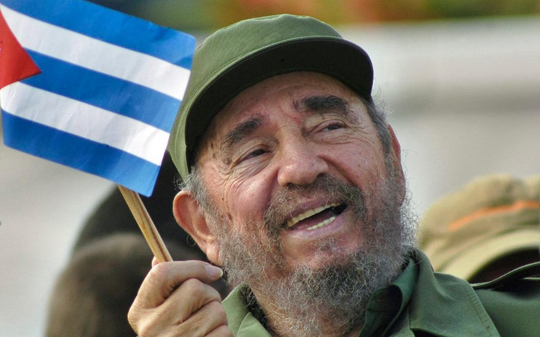
fc

With a shaking voice, his younger brother, Raul Castro, announced on state television that his brother died at 10:29 p.m. on Friday night.

Castro's reign over the island-nation 90 miles from Florida was marked by the US-backed Bay of Pigs invasion in 1961 and the Cuban Missile Crisis a year later that brought the world to the brink of nuclear war.

The bearded revolutionary, who survived a crippling US trade embargo as well as dozens, possibly hundreds, of assassination plots, died eight years after ill health forced him to formally hand power over to Raul.

Castro overcame imprisonment at the hands of dictator Fulgencio Batista, exile in Mexico and a disastrous start to his rebellion before triumphantly riding into Havana in January 1959 to become, at age 32, the youngest leader in Latin America. For decades, he served as an inspiration and source of support to revolutionaries from Latin America to Africa.

His commitment to socialism was unwavering, though his power finally began to fade in mid-2006 when a gastrointestinal ailment forced him to hand over the presidency to Raul in 2008, provisionally at first and then permanently.

His defiant image lingered long after he gave up his trademark Cohiba cigars for health reasons and his tall frame grew stooped. "Socialism or death" remained Castro's rallying cry even as Western-style democracy swept the globe and other communist regimes in China and Vietnam embraced capitalism, leaving this island of 11 million people an economically crippled Marxist curiosity.

He survived long enough to see Raul Castro negotiate an opening with US President Barack Obama on December 17, 2014, when Washington and Havana announced they would move to restore diplomatic ties for the first time since they were severed in 1961.

He cautiously blessed the historic deal with his lifelong enemy in a letter published after a month-long silence. "It's a tragedy," said Dayan Montalvo, a 22-year-old nurse. "We all grew up with him. I feel really hurt by the news that we just heard."

Fidel Castro Ruz was born August 13, 1926, in eastern Cuba's sugar country, where his Spanish immigrant father worked first recruiting labor for US sugar companies and later built up a prosperous plantation of his own.

Castro attended Jesuit schools, then the University of Havana, where he received law and social science degrees. His life as a rebel began in 1953 with a reckless attack on the Moncada military barracks in the eastern city of Santiago. Most of his comrades were killed and Fidel and his brother Raul went to prison.

Castro cobbled revolutionary groups together into the new Cuban Communist Party, with him as first secretary. Labor unions lost the right to strike. The Catholic Church and other religious institutions were harassed. Neighborhood "revolutionary defence committees" kept an eye on everyone.

Castro exported revolution to Latin American countries in the 1960s, and dispatched Cuban troops to Africa to fight Western-backed regimes in the 1970s. Over the decades, he sent Cuban doctors abroad to tend to the poor, and gave sanctuary to fugitive Black Panther leaders from the US.

But the collapse of the Soviet bloc ended billions in preferential trade and subsidies for Cuba, sending its economy into a tailspin. Castro briefly experimented with an opening to foreign capitalists and limited private enterprise.

As the end of the Cold War eased global tensions, many Latin American and European countries re-established relations with Cuba. In January 1998, Pope John Paul II visited a nation that had been officially atheist until the early 1990s.

Aided by a tourism boom, the economy slowly recovered and Castro steadily reasserted government control, stifling much of the limited free enterprise tolerated during harder times.

As flamboyant as he was in public, Castro tried to lead a discreet private life. He and his first wife, Mirta Diaz Balart, had one son before divorcing in 1956. Then, for more than four decades, Castro had a relationship with Dalia Soto del Valle. They had five sons together and were said to have married quietly in 1980.

By the time Castro resigned 49 years after his triumphant arrival in Havana, he was the world's longest ruling head of government, aside from monarchs. In retirement, Castro voiced unwavering support as Raul slowly but deliberately enacted sweeping changes to the Marxist system he had built.

His longevity allowed the younger brother to consolidate control, perhaps lengthening the revolution well past both men's lives. In February 2013, Raul announced that he would retire as president in 2018 and named newly minted Vice President Miguel Diaz-Canel as his successor.

"I'll be 90 years old soon," Castro said at an April 2016 communist party congress where he made his most extensive public appearance in years. "Soon I'll be like all the others.

The time will come for all of us, but the ideas of the Cuban Communists will remain as proof that on this planet, if one works with fervor and dignity, they can produce the material and cultural goods that human beings need and that need to be fought for without ever giving up."

Comments

Congi Shan
 - 
Saturday, 26 Nov 2016

The whole nation suffered because of this man. Not different from dictators Saddam, Gaddafi & Kim Kong Un

Fawad
 - 
Saturday, 26 Nov 2016

CIA tried 500 times to kill him .....Americans are real terrorists

Fedrick
 - 
Saturday, 26 Nov 2016

Red salute to fidel castro and his revolution!

karthik
 - 
Saturday, 26 Nov 2016

Indians can expect the biggest party in the world issuing membership to the expired revolutionary.

Kavya
 - 
Saturday, 26 Nov 2016

Real communism was followed by Karl Marx who envisaged an egalitarian society unlike the Ambanis and Mallyas of today.

Veerendra Hegde
 - 
Saturday, 26 Nov 2016

He kept an enviable and long record as the only leader who ruled a state for more than 50 years! He fought the mighty US and was recognised as one of the tall leaders in the world, with his demise, it is the end of an era! RIP comrade!

Jayaraj
 - 
Saturday, 26 Nov 2016

it is the end of a long innings.. made colorful by his continued anti US stance...... his cigar and the beard made him a recognizable figure who it is said has survived many number of attempts on his life ....MAY HIS SOUL REST IN PEACE......

Add new comment

  • Coastaldigest.com reserves the right to delete or block any comments.
  • Coastaldigset.com is not responsible for its readers’ comments.
  • Comments that are abusive, incendiary or irrelevant are strictly prohibited.
  • Please use a genuine email ID and provide your name to avoid reject.
News Network
June 2,2020

Minneapolis, Jun 2: An official autopsy released Monday ruled that George Floyd, the African-American man whose death at police hands set off unrest across the United States, died in a homicide involving "neck compression".

George, 46, died of "cardiopulmonary arrest complicating law enforcement subdual, restraint, and neck compression," and the manner of death was "homicide," the Hennepin County Medical Examiner in Minneapolis said in a statement.

Floyd's other significant health conditions were listed as "arteriosclerotic and hypertensive heart disease; fentanyl intoxication; recent methamphetamine use."

The statement added that the "manner of death is not a legal determination of culpability or intent."

It emphasized that under Minnesota state law "the Medical Examiner is a neutral and independent office and is separate and distinct from any prosecutorial authority or law enforcement agency."

Comments

Add new comment

  • Coastaldigest.com reserves the right to delete or block any comments.
  • Coastaldigset.com is not responsible for its readers’ comments.
  • Comments that are abusive, incendiary or irrelevant are strictly prohibited.
  • Please use a genuine email ID and provide your name to avoid reject.
News Network
June 30,2020

Washington, Jun 30: Indian-American Medha Raj has been named by Democratic presidential candidate Joe Biden as his digital chief of staff, a key role in his election campaigns which are entirely going virtual due to the Covid-19 pandemic in the US.

In this capacity, Raj will work across all facets of the digital department to streamline and coordinate how to maximise the impact of its digital outputs, the Biden campaign said.

“Excited to share that I've joined Joe Biden's campaign as the Digital Chief of Staff. 130 days to the election and we're not going to waste a minute!” she said on LinkedIn.

Raj comes from Pete Buttigieg's campaign, who has now endorsed Biden.

The news was first reported by CNN, which the news channel said is part of the efforts of the Biden campaign to adapt to an almost entirely virtual campaign trail brought on by the coronavirus pandemic.

The US is the hardest-hit country by the coronavirus pandemic, with more than 2.64 million official cases and over 128,000 deaths.

According to CNN, Clarke Humphrey, who previously worked on Hillary Clinton's 2016 campaign, will act as the Biden campaign's new deputy digital director for the grassroots fundraising.

Jose Nunez is the campaign's new digital organising director.

He is from the Kamala Harris' campaign. Christian Tom is the new director of digital partnerships. Over the past few months, Biden has been relying more and more on digital campaigning and raising funds virtually.

A graduate in international politics from Georgetown University, Raj has earned her MBA from Stanford University.

Biden, 77, is challenging the 74-year-old Republican incumbent President Donald Trump in the November 3 presidential elections.

Former US vice president Biden would formally accept his Democratic presidential nomination at the party’s scaled back convention in Wisconsin’s Milwaukee city on August 20.

In view of the coronavirus pandemic, the Democratic National Convention Committee (DNCC) on Wednesday announced its convention plan to broadcast from Milwaukee and across the nation to reach out to all Americans.

According to some of the latest opinion polls, Biden is leading by more than eight percentage points over Trump.

Comments

Add new comment

  • Coastaldigest.com reserves the right to delete or block any comments.
  • Coastaldigset.com is not responsible for its readers’ comments.
  • Comments that are abusive, incendiary or irrelevant are strictly prohibited.
  • Please use a genuine email ID and provide your name to avoid reject.
News Network
April 10,2020

Melbourne, Apr 10: Scientists have identified six drug candidates from more than 10,000 compounds that may help treat COVID-19.

The research, published in the journal Nature, tested the efficacy of approved drugs, drug candidates in clinical trials and other compounds.

"Currently there are no targeted therapeutics or effective treatment options for COVID-19," said Professor Luke Guddat from the University of Queensland in Australia.

"In order to rapidly discover lead compounds for clinical use, we initiated a programme of high-throughput drug screening, both in laboratories and also using the latest computer software to predict how different drugs bind to the virus," Guddat said.

The project targeted the main COVID-19 virus enzyme, known as the main protease or Mpro, which plays a pivotal role in mediating viral replication, the researchers said.

This makes it an attractive drug target for this virus, and as people don't naturally have this enzyme, compounds that target it are likely to have low toxicity, they said.

"We add the drugs directly to the enzyme or to cell cultures growing the virus and assess how much of each compound is required to stop the enzyme from working or to kill the virus. If the amount is small, then we have a promising compound for further studies," said Guddat.

After assaying thousands of drugs, researchers found of the six that appear to be effective in inhibiting the enzyme, one is of particular interest.

"We're particularly looking at several leads that have been subjected to clinical trials including for the prevention and treatment of various disorders such as cardiovascular diseases, arthritis, stroke, atherosclerosis and cancer," Guddat said.

Researchers said compounds that are already along the pipeline to drug discovery are preferred, as they can be further tested as antivirals at an accelerated rate compared to new drug leads that would have to go through this process from scratch.

"With continued and up-scaled efforts we are optimistic that new candidates can enter the COVID-19 drug discovery pipeline in the near future," Guddat said.

Comments

Add new comment

  • Coastaldigest.com reserves the right to delete or block any comments.
  • Coastaldigset.com is not responsible for its readers’ comments.
  • Comments that are abusive, incendiary or irrelevant are strictly prohibited.
  • Please use a genuine email ID and provide your name to avoid reject.