


Fidel Castro, who defied 10 US presidents in his 50 year rule, dies aged 90

November 26, 2016

Havana, Nov 26: Former President Fidel Castro, who led a rebel army to improbable victory in Cuba, embraced Soviet-style communism and defied the power of 10 US presidents during his half century rule, has died at age 90.
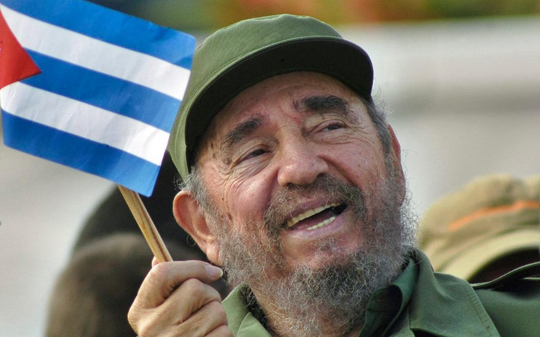
fc

With a shaking voice, his younger brother, Raul Castro, announced on state television that his brother died at 10:29 p.m. on Friday night.

Castro's reign over the island-nation 90 miles from Florida was marked by the US-backed Bay of Pigs invasion in 1961 and the Cuban Missile Crisis a year later that brought the world to the brink of nuclear war.

The bearded revolutionary, who survived a crippling US trade embargo as well as dozens, possibly hundreds, of assassination plots, died eight years after ill health forced him to formally hand power over to Raul.

Castro overcame imprisonment at the hands of dictator Fulgencio Batista, exile in Mexico and a disastrous start to his rebellion before triumphantly riding into Havana in January 1959 to become, at age 32, the youngest leader in Latin America. For decades, he served as an inspiration and source of support to revolutionaries from Latin America to Africa.

His commitment to socialism was unwavering, though his power finally began to fade in mid-2006 when a gastrointestinal ailment forced him to hand over the presidency to Raul in 2008, provisionally at first and then permanently.

His defiant image lingered long after he gave up his trademark Cohiba cigars for health reasons and his tall frame grew stooped. "Socialism or death" remained Castro's rallying cry even as Western-style democracy swept the globe and other communist regimes in China and Vietnam embraced capitalism, leaving this island of 11 million people an economically crippled Marxist curiosity.

He survived long enough to see Raul Castro negotiate an opening with US President Barack Obama on December 17, 2014, when Washington and Havana announced they would move to restore diplomatic ties for the first time since they were severed in 1961.

He cautiously blessed the historic deal with his lifelong enemy in a letter published after a month-long silence. "It's a tragedy," said Dayan Montalvo, a 22-year-old nurse. "We all grew up with him. I feel really hurt by the news that we just heard."

Fidel Castro Ruz was born August 13, 1926, in eastern Cuba's sugar country, where his Spanish immigrant father worked first recruiting labor for US sugar companies and later built up a prosperous plantation of his own.

Castro attended Jesuit schools, then the University of Havana, where he received law and social science degrees. His life as a rebel began in 1953 with a reckless attack on the Moncada military barracks in the eastern city of Santiago. Most of his comrades were killed and Fidel and his brother Raul went to prison.

Castro cobbled revolutionary groups together into the new Cuban Communist Party, with him as first secretary. Labor unions lost the right to strike. The Catholic Church and other religious institutions were harassed. Neighborhood "revolutionary defence committees" kept an eye on everyone.

Castro exported revolution to Latin American countries in the 1960s, and dispatched Cuban troops to Africa to fight Western-backed regimes in the 1970s. Over the decades, he sent Cuban doctors abroad to tend to the poor, and gave sanctuary to fugitive Black Panther leaders from the US.

But the collapse of the Soviet bloc ended billions in preferential trade and subsidies for Cuba, sending its economy into a tailspin. Castro briefly experimented with an opening to foreign capitalists and limited private enterprise.

As the end of the Cold War eased global tensions, many Latin American and European countries re-established relations with Cuba. In January 1998, Pope John Paul II visited a nation that had been officially atheist until the early 1990s.

Aided by a tourism boom, the economy slowly recovered and Castro steadily reasserted government control, stifling much of the limited free enterprise tolerated during harder times.

As flamboyant as he was in public, Castro tried to lead a discreet private life. He and his first wife, Mirta Diaz Balart, had one son before divorcing in 1956. Then, for more than four decades, Castro had a relationship with Dalia Soto del Valle. They had five sons together and were said to have married quietly in 1980.

By the time Castro resigned 49 years after his triumphant arrival in Havana, he was the world's longest ruling head of government, aside from monarchs. In retirement, Castro voiced unwavering support as Raul slowly but deliberately enacted sweeping changes to the Marxist system he had built.

His longevity allowed the younger brother to consolidate control, perhaps lengthening the revolution well past both men's lives. In February 2013, Raul announced that he would retire as president in 2018 and named newly minted Vice President Miguel Diaz-Canel as his successor.

"I'll be 90 years old soon," Castro said at an April 2016 communist party congress where he made his most extensive public appearance in years. "Soon I'll be like all the others.

The time will come for all of us, but the ideas of the Cuban Communists will remain as proof that on this planet, if one works with fervor and dignity, they can produce the material and cultural goods that human beings need and that need to be fought for without ever giving up."

Comments

Congi Shan
 - 
Saturday, 26 Nov 2016

The whole nation suffered because of this man. Not different from dictators Saddam, Gaddafi & Kim Kong Un

Fawad
 - 
Saturday, 26 Nov 2016

CIA tried 500 times to kill him .....Americans are real terrorists

Fedrick
 - 
Saturday, 26 Nov 2016

Red salute to fidel castro and his revolution!

karthik
 - 
Saturday, 26 Nov 2016

Indians can expect the biggest party in the world issuing membership to the expired revolutionary.

Kavya
 - 
Saturday, 26 Nov 2016

Real communism was followed by Karl Marx who envisaged an egalitarian society unlike the Ambanis and Mallyas of today.

Veerendra Hegde
 - 
Saturday, 26 Nov 2016

He kept an enviable and long record as the only leader who ruled a state for more than 50 years! He fought the mighty US and was recognised as one of the tall leaders in the world, with his demise, it is the end of an era! RIP comrade!

Jayaraj
 - 
Saturday, 26 Nov 2016

it is the end of a long innings.. made colorful by his continued anti US stance...... his cigar and the beard made him a recognizable figure who it is said has survived many number of attempts on his life ....MAY HIS SOUL REST IN PEACE......

Add new comment

  • Coastaldigest.com reserves the right to delete or block any comments.
  • Coastaldigset.com is not responsible for its readers’ comments.
  • Comments that are abusive, incendiary or irrelevant are strictly prohibited.
  • Please use a genuine email ID and provide your name to avoid reject.
News Network
June 2,2020

London/Milan, Jun 2: World Health Organization experts and a range of other scientists said on Monday there was no evidence to support an assertion by a high profile Italian doctor that the coronavirus causing the COVID-19 pandemic has been losing potency.

Professor Alberto Zangrillo, head of intensive care at Italy's San Raffaele Hospital in Lombardy, which bore the brunt of Italy's COVID-19 epidemic, on Sunday told state television that the new coronavirus "clinically no longer exists".

But WHO epidemiologist Maria Van Kerkhove, as well as several other experts on viruses and infectious diseases, said Zangrillo's comments were not supported by scientific evidence.

There is no data to show the new coronavirus is changing significantly, either in its form of transmission or in the severity of the disease it causes, they said.

"In terms of transmissibility, that has not changed, in terms of severity, that has not changed," Van Kerkhove told reporters.

It is not unusual for viruses to mutate and adapt as they spread, and the debate on Monday highlights how scientists are monitoring and tracking the new virus. The COVID-19 pandemic has so far killed more than 370,000 people and infected more than 6 million.

Martin Hibberd, a professor of emerging infectious disease at the London School of Hygiene & Tropical Medicine, said major studies looking at genetic changes in the SARS-CoV-2 virus that causes COVID-19 did not support the idea that it was becoming less potent, or weakening in any way.

"With data from more than 35,000 whole virus genomes, there is currently no evidence that there is any significant difference relating to severity," he said in an emailed comment.

Zangrillo, well known in Italy as the personal doctor of former Prime Minister Silvio Berlusconi, said his comments were backed up by a study conducted by a fellow scientist, Massimo Clementi, which Zangrillo said would be published next week.

Zangrillo told Reuters: "We have never said that the virus has changed, we said that the interaction between the virus and the host has definitely changed."

He said this could be due either to different characteristics of the virus, which he said they had not yet identified, or different characteristics in those infected.

The study by Clementi, who is director of the microbiology and virology laboratory of San Raffaele, compared virus samples from COVID-19 patients at the Milan-based hospital in March with samples from patients with the disease in May.

"The result was unambiguous: an extremely significant difference between the viral load of patients admitted in March compared to" those admitted last month, Zangrillo said.

Oscar MacLean, an expert at the University of Glasgow's Centre for Virus Research, said suggestions that the virus was weakening were "not supported by anything in the scientific literature and also seem fairly implausible on genetic grounds."

Comments

Add new comment

  • Coastaldigest.com reserves the right to delete or block any comments.
  • Coastaldigset.com is not responsible for its readers’ comments.
  • Comments that are abusive, incendiary or irrelevant are strictly prohibited.
  • Please use a genuine email ID and provide your name to avoid reject.
News Network
July 20,2020

Islamabad, Jul 20: Six advisors of Pakistan Prime Minister Imran Khan posses dual citizenships and several of top 20 aides have admitted of owning movable and immovable assets worth millions of dollars abroad.

The list was published on the official website of Pakistan government's cabinet division.
All the dual nationals were working as special assistants to the prime minister (SAPM). 

These people include SAPM on Overseas Pakistanis Syed Zulfiqar Abbas Bukhari (UK), SAPM on Power Division Shahzad Qasim (US), SAPM on Petroleum Nadeem Babar (US), SAPM on Political Affairs Shahbaz Gill (US), SAPM on Parliamentary Coordination Nadeem Afzal Gondal (Canada) and SAPM on Digital Pakistan Tania Aidrus (Canadian citizenship by birth).

According to Gulf News report, the wealthiest SAPM is Power Division and Mineral Resources Assistant Shahzad Syed Qasim who has assets worth over Rs 4 billion followed by SAPM on Petroleum Nadeem Babar with assets worth Rs 2.75 billion. Meanwhile, Adviser for Overseas Pakistanis Syed Zulfiqar Abbas Bukhari's net assets is estimated over Rs 2 billion.

Giving further details of the wealthiest SAPM, the official website stated that the PM's aide on Power Division and Coordination of Marketing and Development of Mineral Resources owns assets in Pakistan, UAE and US. His three properties in UAE include two villas in Jumeirah Golf Estates and Sienna Lakes, Jumeirah Golf Estates and an apartment at Park Towers, DIFC - all worth Dh20,688,000. He has three cars in the UAE worth Dh400,000 and in the US, he has property worth US$865,000 while he has Rs 4 billion in various local and foreign bank accounts and retirement funds including $2.1 million in US.

Meanwhile, Nadeem Babbar, who is Special Assistant on Petroleum Division, owns assets worth over Rs 2.7 billion, including several properties in Pakistan and abroad and stakes in more than 30 local and foreign companies.

The Gulf News further reported that in the list Dr Moeed Yusuf's, Special Assistant to the Prime Minister on National Security Division and Strategic Policy Planning, the name was also included but was later withdrawn as it was clarified that he had the US residency and only holds the citizenship of Pakistan as per the affidavit submitted to the government. "I have not returned to the US since I took up my current responsibility, have no employment or income in the US nor do I have any millions worth properties abroad" Dr Yusuf was quoted as saying.

The latest list on PM Imran Khan's advisors possessing dual nationalities has sparked strong criticisms by the Opposition leaders.

Comments

Add new comment

  • Coastaldigest.com reserves the right to delete or block any comments.
  • Coastaldigset.com is not responsible for its readers’ comments.
  • Comments that are abusive, incendiary or irrelevant are strictly prohibited.
  • Please use a genuine email ID and provide your name to avoid reject.
News Network
February 22,2020

Johannesburg, Feb 22: To meet shortage of skilled nursing staff, private hospitals in South Africa are recruiting senior Indian nurses for their good work ethics and ability to become efficient trainers for the local staff, according to a media report.

A report at a 2018 jobs summit indicated that the country had a shortage of more than 47,000 nurses.

The shortage of the skilled nursing staff has been attributed to several factors, including preference of highly qualified nurses to emigrate or take up contract employment in countries such as the UK, the United Aarb Emirates, Saudi Arabia or New Zealand for want of higher salaries, a report in the weekly Business Times said.

Mediclinic, one of South Africa's largest private hospital groups, confirmed that it is recruiting 150 nurses from India this year.

“To supplement our training, as an internal strategy, we will continue to recruit senior registered nurses from India,” a Mediclinic spokesperson told the Business Times.

Mediclinic started recruiting nurses from India in 2005 but could not provide details about how many among the more than 8,800 nurses it employs at its hospitals are from India.

Another company, Life Healthcare SA, said it employed 135 Indian nurses between 2008 and 2014.

Top managements at the hospital groups lauded senior Indian nurses as being very efficient trainers for local staff.

“But we find that many of them prefer coming here on short-term contracts due to family commitments," a hospital executive said on the basis of anonymity.

The official said that the few who apply for long-term positions are usually young newly-qualified nurses, which is not the group in demand.

“They work hard, with a patient-oriented work ethic, and do not have the nine-to-five approach of many local nurses, especially those who are unionised," the official said.

“We would be very happy to take in more nursing staff from India," the official added.

Comments

Add new comment

  • Coastaldigest.com reserves the right to delete or block any comments.
  • Coastaldigset.com is not responsible for its readers’ comments.
  • Comments that are abusive, incendiary or irrelevant are strictly prohibited.
  • Please use a genuine email ID and provide your name to avoid reject.