


Fidel Castro, who defied 10 US presidents in his 50 year rule, dies aged 90

November 26, 2016

Havana, Nov 26: Former President Fidel Castro, who led a rebel army to improbable victory in Cuba, embraced Soviet-style communism and defied the power of 10 US presidents during his half century rule, has died at age 90.
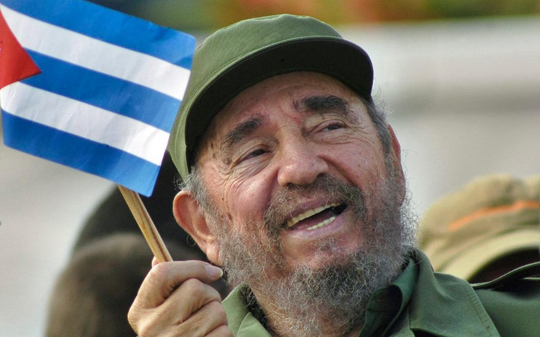
fc

With a shaking voice, his younger brother, Raul Castro, announced on state television that his brother died at 10:29 p.m. on Friday night.

Castro's reign over the island-nation 90 miles from Florida was marked by the US-backed Bay of Pigs invasion in 1961 and the Cuban Missile Crisis a year later that brought the world to the brink of nuclear war.

The bearded revolutionary, who survived a crippling US trade embargo as well as dozens, possibly hundreds, of assassination plots, died eight years after ill health forced him to formally hand power over to Raul.

Castro overcame imprisonment at the hands of dictator Fulgencio Batista, exile in Mexico and a disastrous start to his rebellion before triumphantly riding into Havana in January 1959 to become, at age 32, the youngest leader in Latin America. For decades, he served as an inspiration and source of support to revolutionaries from Latin America to Africa.

His commitment to socialism was unwavering, though his power finally began to fade in mid-2006 when a gastrointestinal ailment forced him to hand over the presidency to Raul in 2008, provisionally at first and then permanently.

His defiant image lingered long after he gave up his trademark Cohiba cigars for health reasons and his tall frame grew stooped. "Socialism or death" remained Castro's rallying cry even as Western-style democracy swept the globe and other communist regimes in China and Vietnam embraced capitalism, leaving this island of 11 million people an economically crippled Marxist curiosity.

He survived long enough to see Raul Castro negotiate an opening with US President Barack Obama on December 17, 2014, when Washington and Havana announced they would move to restore diplomatic ties for the first time since they were severed in 1961.

He cautiously blessed the historic deal with his lifelong enemy in a letter published after a month-long silence. "It's a tragedy," said Dayan Montalvo, a 22-year-old nurse. "We all grew up with him. I feel really hurt by the news that we just heard."

Fidel Castro Ruz was born August 13, 1926, in eastern Cuba's sugar country, where his Spanish immigrant father worked first recruiting labor for US sugar companies and later built up a prosperous plantation of his own.

Castro attended Jesuit schools, then the University of Havana, where he received law and social science degrees. His life as a rebel began in 1953 with a reckless attack on the Moncada military barracks in the eastern city of Santiago. Most of his comrades were killed and Fidel and his brother Raul went to prison.

Castro cobbled revolutionary groups together into the new Cuban Communist Party, with him as first secretary. Labor unions lost the right to strike. The Catholic Church and other religious institutions were harassed. Neighborhood "revolutionary defence committees" kept an eye on everyone.

Castro exported revolution to Latin American countries in the 1960s, and dispatched Cuban troops to Africa to fight Western-backed regimes in the 1970s. Over the decades, he sent Cuban doctors abroad to tend to the poor, and gave sanctuary to fugitive Black Panther leaders from the US.

But the collapse of the Soviet bloc ended billions in preferential trade and subsidies for Cuba, sending its economy into a tailspin. Castro briefly experimented with an opening to foreign capitalists and limited private enterprise.

As the end of the Cold War eased global tensions, many Latin American and European countries re-established relations with Cuba. In January 1998, Pope John Paul II visited a nation that had been officially atheist until the early 1990s.

Aided by a tourism boom, the economy slowly recovered and Castro steadily reasserted government control, stifling much of the limited free enterprise tolerated during harder times.

As flamboyant as he was in public, Castro tried to lead a discreet private life. He and his first wife, Mirta Diaz Balart, had one son before divorcing in 1956. Then, for more than four decades, Castro had a relationship with Dalia Soto del Valle. They had five sons together and were said to have married quietly in 1980.

By the time Castro resigned 49 years after his triumphant arrival in Havana, he was the world's longest ruling head of government, aside from monarchs. In retirement, Castro voiced unwavering support as Raul slowly but deliberately enacted sweeping changes to the Marxist system he had built.

His longevity allowed the younger brother to consolidate control, perhaps lengthening the revolution well past both men's lives. In February 2013, Raul announced that he would retire as president in 2018 and named newly minted Vice President Miguel Diaz-Canel as his successor.

"I'll be 90 years old soon," Castro said at an April 2016 communist party congress where he made his most extensive public appearance in years. "Soon I'll be like all the others.

The time will come for all of us, but the ideas of the Cuban Communists will remain as proof that on this planet, if one works with fervor and dignity, they can produce the material and cultural goods that human beings need and that need to be fought for without ever giving up."

Comments

Congi Shan
 - 
Saturday, 26 Nov 2016

The whole nation suffered because of this man. Not different from dictators Saddam, Gaddafi & Kim Kong Un

Fawad
 - 
Saturday, 26 Nov 2016

CIA tried 500 times to kill him .....Americans are real terrorists

Fedrick
 - 
Saturday, 26 Nov 2016

Red salute to fidel castro and his revolution!

karthik
 - 
Saturday, 26 Nov 2016

Indians can expect the biggest party in the world issuing membership to the expired revolutionary.

Kavya
 - 
Saturday, 26 Nov 2016

Real communism was followed by Karl Marx who envisaged an egalitarian society unlike the Ambanis and Mallyas of today.

Veerendra Hegde
 - 
Saturday, 26 Nov 2016

He kept an enviable and long record as the only leader who ruled a state for more than 50 years! He fought the mighty US and was recognised as one of the tall leaders in the world, with his demise, it is the end of an era! RIP comrade!

Jayaraj
 - 
Saturday, 26 Nov 2016

it is the end of a long innings.. made colorful by his continued anti US stance...... his cigar and the beard made him a recognizable figure who it is said has survived many number of attempts on his life ....MAY HIS SOUL REST IN PEACE......

Add new comment

  • Coastaldigest.com reserves the right to delete or block any comments.
  • Coastaldigset.com is not responsible for its readers’ comments.
  • Comments that are abusive, incendiary or irrelevant are strictly prohibited.
  • Please use a genuine email ID and provide your name to avoid reject.
Agencies
March 14,2020

San Francisco, Mar 14: Microsoft on friday announced that co-founder Bill Gates has left its board of directors to devote more time to philanthropy.

The 64-year-old stopped being involved in day-to-day operations at the firm more than a decade ago, turning his attention to the foundation he launched with his wife, Melinda.

Gates served as chairman of Microsoft's board of directors until early in 2014 and has now stepped away entirely, according to the Redmond-based technology giant.

“It's been a tremendous honor and privilege to have worked with and learned from Bill over the years,” Microsoft chief executive and company veteran Satya Nadella said in a release.

Nadella said Microsoft would continue to benefit from Gates' “technical passion and advice” in his continuing role as a technical advisor.
“I am grateful for Bill's friendship and look forward to continuing to work alongside him,” he added.

Gates left his CEO position in 2000, handing the company reins to Steve Ballmer to devote more time to his charitable foundation.

He gave up the role of chairman at the same time Nadella became Microsoft's third CEO in 2014.

Regularly listed among the world's richest people, William H. Gates was a geeky-looking young man when he and Paul Allen co-founded Microsoft in 1975.

Gates went on to turn his attention from software to fighting disease and other humanitarian challenges with his wife, under the auspices of the Bill and Melinda Gates Foundation.

Comments

Add new comment

  • Coastaldigest.com reserves the right to delete or block any comments.
  • Coastaldigset.com is not responsible for its readers’ comments.
  • Comments that are abusive, incendiary or irrelevant are strictly prohibited.
  • Please use a genuine email ID and provide your name to avoid reject.
News Network
April 2,2020

United Nations, Apr 2: The global economy could shrink by up to one per cent in 2020 due to the coronavirus pandemic, a reversal from the previous forecast of 2.5 per cent growth, the UN has said, warning that it may contract even further if restrictions on the economic activities are extended without adequate fiscal responses.

The analysis by the UN Department of Economic and Social Affairs (DESA) said the COVID-19 pandemic is disrupting global supply chains and international trade. With nearly 100 countries closing national borders during the past month, the movement of people and tourism flows have come to a screeching halt.

"Millions of workers in these countries are facing the bleak prospect of losing their jobs. Governments are considering and rolling out large stimulus packages to avert a sharp downturn of their economies which could potentially plunge the global economy into a deep recession. In the worst-case scenario, the world economy could contract by 0.9 per cent in 2020," the DESA said, adding that the world economy had contracted by 1.7 per cent during the global financial crisis in 2009.

It added that the contraction could be even higher if governments fail to provide income support and help boost consumer spending.

The analysis noted that before the outbreak of the COVID-19, world output was expected to expand at a modest pace of 2.5 per cent in 2020, as reported in the World Economic Situation and Prospects 2020.

Taking into account rapidly changing economic conditions, the UN DESA's World Economic Forecasting Model has estimated best and worst-case scenarios for global growth in 2020.

In the best-case scenario with moderate declines in private consumption, investment and exports and offsetting increases in government spending in the G-7 countries and China global growth would fall to 1.2 per cent in 2020.

"In the worst-case scenario, the global output would contract by 0.9 per cent instead of growing by 2.5 per cent in 2020," it said, adding that the scenario is based on demand-side shocks of different magnitudes to China, Japan, South Korea, the US and the EU, as well as an oil price decline of 50 per cent against our baseline of USD 61 per barrel.

The severity of the economic impact will largely depend on two factors - the duration of restrictions on the movement of people and economic activities in major economies; and the actual size and efficacy of fiscal responses to the crisis.

A well-designed fiscal stimulus package, prioritising health spending to contain the spread of the virus and providing income support to households most affected by the pandemic would help to minimise the likelihood of a deep economic recession, it said.

According to the forecast, lockdowns in Europe and North America are hitting the service sector hard, particularly industries that involve physical interactions such as retail trade, leisure and hospitality, recreation and transportation services. Collectively, such industries account for more than a quarter of all jobs in these economies.

The DESA said as businesses lose revenue, unemployment is likely to increase sharply, transforming a supply-side shock to a wider demand-side shock for the economy.

Against this backdrop, the UN-DESA is joining a chorus of voices across the UN system calling for well-designed fiscal stimulus packages which prioritize health spending and support households most affected by the pandemic.

Urgent and bold policy measures are needed, not only to contain the pandemic and save lives, but also to protect the most vulnerable in our societies from economic ruin and to sustain economic growth and financial stability, Under-Secretary-General for Economic and Social Affairs Liu Zhenmin said.

The analysis also warns that the adverse effects of prolonged economic restrictions in developed economies will soon spill over to developing countries via trade and investment channels.

A sharp decline in consumer spending in the European Union and the United States will reduce imports of consumer goods from developing countries.

Developing countries, particularly those dependent on tourism and commodity exports, face heightened economic risks. Global manufacturing production could contract significantly, and the plummeting number of travellers is likely to hurt the tourism sector in small island developing States, which employs millions of low-skilled workers, it said.

Meanwhile, the decline in commodity-related revenues and a reversal of capital flows are increasing the likelihood of debt distress for many nations. Governments may be forced to curtail public expenditure at a time when they need to ramp up spending to contain the pandemic and support consumption and investment.

UN Chief Economist and Assistant Secretary-General for Economic Development Elliot Harris said the collective goal must be a resilient recovery which puts the planet back on a sustainable track. We must not lose sight how it is affecting the most vulnerable population and what that means for sustainable development, he said.

The alarms raised by UN-DESA echo another report, released on March 31, in which UN experts issued a broad appeal for a large-scale, coordinated, comprehensive multilateral response amounting to at least 10 per cent of global gross domestic product (GDP).

According to estimates by the Johns Hopkins University, confirmed coronavirus cases across the world now stand at over 932,600 and over 42,000 deaths.

Comments

Add new comment

  • Coastaldigest.com reserves the right to delete or block any comments.
  • Coastaldigset.com is not responsible for its readers’ comments.
  • Comments that are abusive, incendiary or irrelevant are strictly prohibited.
  • Please use a genuine email ID and provide your name to avoid reject.
Agencies
July 17,2020

Washington, Jul 17: US President Donald Trump's economic adviser Larry Kudlow has said that TikTok may cut off ties to its Chinese parent and become a 100 per cent American company to circumvent demands to ban it as India has done.

"I think TikTok is going to pull out of the holding company which is China-run and operate as an independent American company," he told reporters at the White House on Thursday.

The US has not made a final decision on whether to ban it - which has been suggested by Secretary of State Mike Pompeo, he said.

TikTok being divested by ByteDance Technology Company "is a much better solution than banning or pushing away", said Kudlow, who is the Director of the National Economic Council.

He said that its services will be located in the US and "it will become an hundred per cent American company".

If it becomes a US company without Chinese links, India may have to reconsider the ban on the short video app wildly popular in the country.

India banned TikTok along with 58 other Chinese apps on June 29 citing threats to its defence and national security.

The ban came after a deadly clash between Indian and Chinese troops along the Line of Actual Control in Ladakh.

Under Beijing's National Security Law, all Chinese companies have to provide intelligence requested by the government, creating risks for users and their countries.

India was TikTok's biggest market outside of China, where it operates as Douyin.

There were about 200 million users in India and over 300 million downloads.

The US comes next with over 30 million users for the app.

Comments

Add new comment

  • Coastaldigest.com reserves the right to delete or block any comments.
  • Coastaldigset.com is not responsible for its readers’ comments.
  • Comments that are abusive, incendiary or irrelevant are strictly prohibited.
  • Please use a genuine email ID and provide your name to avoid reject.