


Fidel Castro, who defied 10 US presidents in his 50 year rule, dies aged 90

November 26, 2016

Havana, Nov 26: Former President Fidel Castro, who led a rebel army to improbable victory in Cuba, embraced Soviet-style communism and defied the power of 10 US presidents during his half century rule, has died at age 90.
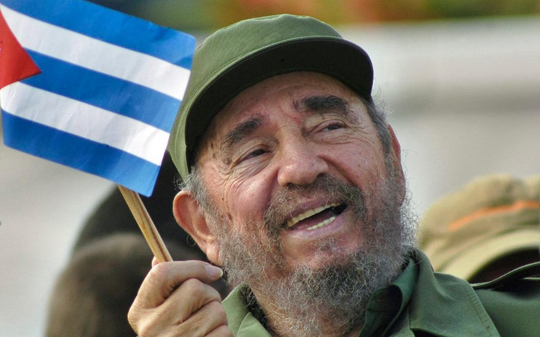
fc

With a shaking voice, his younger brother, Raul Castro, announced on state television that his brother died at 10:29 p.m. on Friday night.

Castro's reign over the island-nation 90 miles from Florida was marked by the US-backed Bay of Pigs invasion in 1961 and the Cuban Missile Crisis a year later that brought the world to the brink of nuclear war.

The bearded revolutionary, who survived a crippling US trade embargo as well as dozens, possibly hundreds, of assassination plots, died eight years after ill health forced him to formally hand power over to Raul.

Castro overcame imprisonment at the hands of dictator Fulgencio Batista, exile in Mexico and a disastrous start to his rebellion before triumphantly riding into Havana in January 1959 to become, at age 32, the youngest leader in Latin America. For decades, he served as an inspiration and source of support to revolutionaries from Latin America to Africa.

His commitment to socialism was unwavering, though his power finally began to fade in mid-2006 when a gastrointestinal ailment forced him to hand over the presidency to Raul in 2008, provisionally at first and then permanently.

His defiant image lingered long after he gave up his trademark Cohiba cigars for health reasons and his tall frame grew stooped. "Socialism or death" remained Castro's rallying cry even as Western-style democracy swept the globe and other communist regimes in China and Vietnam embraced capitalism, leaving this island of 11 million people an economically crippled Marxist curiosity.

He survived long enough to see Raul Castro negotiate an opening with US President Barack Obama on December 17, 2014, when Washington and Havana announced they would move to restore diplomatic ties for the first time since they were severed in 1961.

He cautiously blessed the historic deal with his lifelong enemy in a letter published after a month-long silence. "It's a tragedy," said Dayan Montalvo, a 22-year-old nurse. "We all grew up with him. I feel really hurt by the news that we just heard."

Fidel Castro Ruz was born August 13, 1926, in eastern Cuba's sugar country, where his Spanish immigrant father worked first recruiting labor for US sugar companies and later built up a prosperous plantation of his own.

Castro attended Jesuit schools, then the University of Havana, where he received law and social science degrees. His life as a rebel began in 1953 with a reckless attack on the Moncada military barracks in the eastern city of Santiago. Most of his comrades were killed and Fidel and his brother Raul went to prison.

Castro cobbled revolutionary groups together into the new Cuban Communist Party, with him as first secretary. Labor unions lost the right to strike. The Catholic Church and other religious institutions were harassed. Neighborhood "revolutionary defence committees" kept an eye on everyone.

Castro exported revolution to Latin American countries in the 1960s, and dispatched Cuban troops to Africa to fight Western-backed regimes in the 1970s. Over the decades, he sent Cuban doctors abroad to tend to the poor, and gave sanctuary to fugitive Black Panther leaders from the US.

But the collapse of the Soviet bloc ended billions in preferential trade and subsidies for Cuba, sending its economy into a tailspin. Castro briefly experimented with an opening to foreign capitalists and limited private enterprise.

As the end of the Cold War eased global tensions, many Latin American and European countries re-established relations with Cuba. In January 1998, Pope John Paul II visited a nation that had been officially atheist until the early 1990s.

Aided by a tourism boom, the economy slowly recovered and Castro steadily reasserted government control, stifling much of the limited free enterprise tolerated during harder times.

As flamboyant as he was in public, Castro tried to lead a discreet private life. He and his first wife, Mirta Diaz Balart, had one son before divorcing in 1956. Then, for more than four decades, Castro had a relationship with Dalia Soto del Valle. They had five sons together and were said to have married quietly in 1980.

By the time Castro resigned 49 years after his triumphant arrival in Havana, he was the world's longest ruling head of government, aside from monarchs. In retirement, Castro voiced unwavering support as Raul slowly but deliberately enacted sweeping changes to the Marxist system he had built.

His longevity allowed the younger brother to consolidate control, perhaps lengthening the revolution well past both men's lives. In February 2013, Raul announced that he would retire as president in 2018 and named newly minted Vice President Miguel Diaz-Canel as his successor.

"I'll be 90 years old soon," Castro said at an April 2016 communist party congress where he made his most extensive public appearance in years. "Soon I'll be like all the others.

The time will come for all of us, but the ideas of the Cuban Communists will remain as proof that on this planet, if one works with fervor and dignity, they can produce the material and cultural goods that human beings need and that need to be fought for without ever giving up."

Comments

Congi Shan
 - 
Saturday, 26 Nov 2016

The whole nation suffered because of this man. Not different from dictators Saddam, Gaddafi & Kim Kong Un

Fawad
 - 
Saturday, 26 Nov 2016

CIA tried 500 times to kill him .....Americans are real terrorists

Fedrick
 - 
Saturday, 26 Nov 2016

Red salute to fidel castro and his revolution!

karthik
 - 
Saturday, 26 Nov 2016

Indians can expect the biggest party in the world issuing membership to the expired revolutionary.

Kavya
 - 
Saturday, 26 Nov 2016

Real communism was followed by Karl Marx who envisaged an egalitarian society unlike the Ambanis and Mallyas of today.

Veerendra Hegde
 - 
Saturday, 26 Nov 2016

He kept an enviable and long record as the only leader who ruled a state for more than 50 years! He fought the mighty US and was recognised as one of the tall leaders in the world, with his demise, it is the end of an era! RIP comrade!

Jayaraj
 - 
Saturday, 26 Nov 2016

it is the end of a long innings.. made colorful by his continued anti US stance...... his cigar and the beard made him a recognizable figure who it is said has survived many number of attempts on his life ....MAY HIS SOUL REST IN PEACE......

Add new comment

  • Coastaldigest.com reserves the right to delete or block any comments.
  • Coastaldigset.com is not responsible for its readers’ comments.
  • Comments that are abusive, incendiary or irrelevant are strictly prohibited.
  • Please use a genuine email ID and provide your name to avoid reject.
News Network
April 27,2020

Seoul/South Korea, Apr 27: North Korean leader Kim Jong Un is "alive and well", a top security adviser to the South's President Moon Jae-in said, downplaying rumours over Kim's health following his absence from a key anniversary.
"Our government position is firm," said Moon's special adviser on national security Moon Chung-in, in an interview with CNN on Sunday. "Kim Jong Un is alive and well."

The adviser said that Kim had been staying in Wonsan -- a resort town in the country's east -- since April 13, adding: "No suspicious movements have so far been detected."

Conjecture about Kim's health has grown since his conspicuous absence from the April 15 celebrations for the birthday of his grandfather Kim Il Sung, the North's founder -- the most important day in the country's political calendar.

Kim has not made a public appearance since presiding over a Workers' Party politburo meeting on April 11, and the following day state media reported him inspecting fighter jets at an air defence unit.

North Korean leader Kim Jong Un was not gravely ill, two South Korean government sources said on Tuesday, following reports he had undergone a cardiovascular procedure and was now in "grave danger."

His absence unleashed a series of unconfirmed media reports over his condition, which officials in Seoul previously poured cold water on.

"We have nothing to confirm and no special movement has been detected inside North Korea as of now," the South's presidential office said in a statement last week.

South Korea's unification minister Kim Yeon-chul reiterated Monday that remained the case, adding the "confident" conclusion was drawn from "a complex process of intelligence gathering and assessment".

'Grave danger'

Daily NK, an online media outlet run mostly by North Korean defectors, has reported Kim was undergoing treatment after a cardiovascular procedure earlier this month.

Citing an unidentified source inside the country, it said Kim, who is in his mid-30s, had needed urgent treatment due to heavy smoking, obesity and fatigue.

Soon afterwards, CNN reported that Washington was "monitoring intelligence" that Kim was in "grave danger" after undergoing surgery, quoting what it said was an anonymous US official.

US President Donald Trump on Thursday rejected reports that Kim was ailing but declined to state when he was last in touch with him.

On Monday, the official Rodong Sinmun newspaper reported that Kim had sent a message of thanks to workers on the giant Wonsan Kalma coastal tourism project.

It was the latest in a series of reports in recent days of statements issued or actions taken in Kim's name, although none has carried any pictures of him.

Satellite images reviewed by 38North, a US-based think tank, showed a train probably belonging to Kim at a station in Wonsan last week.

It cautioned that the train's presence did not "indicate anything about his health" but did "lend weight" to reports he was staying on the country's eastern coast.

Reporting from inside the isolated North is notoriously difficult, especially regarding anything to do with its leadership, which is among its most closely guarded secrets.

Previous absences from the public eye on Kim's part have prompted speculation about his health.

In 2014 he dropped out of sight for nearly six weeks before reappearing with a cane. Days later, the South's spy agency said he had undergone surgery to remove a cyst from his ankle.

Comments

Add new comment

  • Coastaldigest.com reserves the right to delete or block any comments.
  • Coastaldigset.com is not responsible for its readers’ comments.
  • Comments that are abusive, incendiary or irrelevant are strictly prohibited.
  • Please use a genuine email ID and provide your name to avoid reject.
News Network
February 6,2020

Washington, Feb 6: The US has expressed concern over the current situation of religious freedom in India and raised the issue with Indian officials, a senior State Department official has said.

The remarks came in the wake of widespread protests held across India against the Citizenship Amendment Act (CAA).

The senior State Department official, on condition of anonymity, said that he has met with officials in India about what is taking place in the nation and expressed concern.

"We are concerned about what's taking place in India. I have met with the Indian foreign minister. I've met with the Indian ambassador (to express my concern)," the official, who was recently in India, told reporters on Wednesday.

The US has also "expressed desire first to try to help and work through some of these issues", the official said as Secretary of State Mike Pompeo launched a 27-nation International Religious Freedom Alliance.

"To me, the initial step we try to do in most places is say what can we do to be of help you work through an issue to where there's not religious persecution. That's the first step, is just saying can we work with you on this," the official said.

India maintains that the Indian Constitution guarantees fundamental rights to all its citizens, including its minority communities.

It is widely acknowledged that India is a vibrant democracy where the Constitution provides protection of religious freedom, and where democratic governance and rule of law further promote and protect fundamental rights, a senior official of the Ministry of External Affairs has said.

According to the CAA, members of Hindu, Sikh, Buddhist, Jain, Parsi and Christian communities who have come from Pakistan, Bangladesh and Afghanistan till December 31, 2014 following religious persecution there will get Indian citizenship.

The Indian government has been emphasising that the new law will not deny any citizenship rights, but has been brought to protect the oppressed minorities of neighbouring countries and give them citizenship.

Defending the CAA, Prime Minister Narendra Modi last month said that the law is not about taking away citizenship, it is about giving citizenship.

"We must all know that any person of any religion from any country of the world who believes in India and its Constitution can apply for Indian citizenship through due process. There's no problem in that," he said.

Comments

Add new comment

  • Coastaldigest.com reserves the right to delete or block any comments.
  • Coastaldigset.com is not responsible for its readers’ comments.
  • Comments that are abusive, incendiary or irrelevant are strictly prohibited.
  • Please use a genuine email ID and provide your name to avoid reject.
News Network
January 25,2020

Beijing, Jan 25: The death toll due to the novel coronavirus (2019-nCoV) outbreak in China has soared to 41, while the number of infected persons were 1,287, the National Health Commission said on Saturday.

The Commission said that 444 fresh cases were reported since Friday, with 237 patients in serious conditions, while 38 had been cured and discharged from hospitals, reports Efe news.

Health authorities have carried out check-ups on 15,197 people who have come into close contact with the infected persons. Nearly 14,000 of them continue to be monitored for symptoms.

The others cases outside of China were reported in France (two), Australia (one), Thailand (four including two cured), Japan (two including one cured), South Korea (two), the US (two), Vietnam (two), Singapore (three), Nepal (one), Hong Kong (five), Macao (two) and Taiwan (three).

The symptoms of the new coronavirus, provisionally designated by the World Health Organization as 2019-nCoV, are similar to those of cold but may be accompanied by fever and fatigue, dry cough and dyspnea (shortness of breath).

The WHO has so far to declared the outbreak as an international health emergency.

Strict measures were being carried out in China, which include complete suspension of transport in around a dozen cities in Hubei province and also cancelling Chinese New Year celebrations.

Traditional events at Lama Temple and Ditan Park in Beijing were cancelled due to the risk of spreading the virus, authorities reported Friday, while the famous Forbidden City has also been closed indefinitely.

Wuhan, the capital of Hubei, where the virus was first reported, has been on lockdown since Thursday to prevent further spread of the virus and the city's authorities have begun to build a "special hospital" with 1,000 beds for infected patients.

"Construction of the special hospital with a capacity of 1,000 beds for patients with #nCoV2019 has begun in Wuhan," official China Daily said on Twitter.

The hospital in Wuhan will be based on the model of a similar facility that was built in just seven days in Beijing to deal with SARS in 2003.

Comments

Add new comment

  • Coastaldigest.com reserves the right to delete or block any comments.
  • Coastaldigset.com is not responsible for its readers’ comments.
  • Comments that are abusive, incendiary or irrelevant are strictly prohibited.
  • Please use a genuine email ID and provide your name to avoid reject.