


Fidel Castro, who defied 10 US presidents in his 50 year rule, dies aged 90

November 26, 2016

Havana, Nov 26: Former President Fidel Castro, who led a rebel army to improbable victory in Cuba, embraced Soviet-style communism and defied the power of 10 US presidents during his half century rule, has died at age 90.
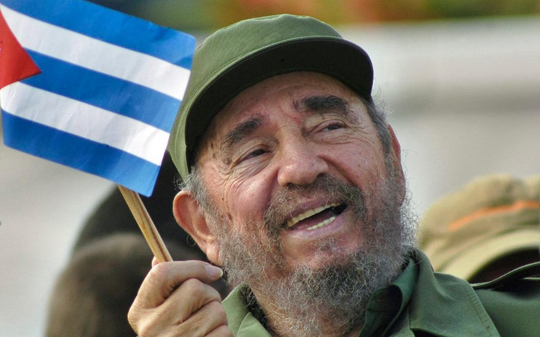
fc

With a shaking voice, his younger brother, Raul Castro, announced on state television that his brother died at 10:29 p.m. on Friday night.

Castro's reign over the island-nation 90 miles from Florida was marked by the US-backed Bay of Pigs invasion in 1961 and the Cuban Missile Crisis a year later that brought the world to the brink of nuclear war.

The bearded revolutionary, who survived a crippling US trade embargo as well as dozens, possibly hundreds, of assassination plots, died eight years after ill health forced him to formally hand power over to Raul.

Castro overcame imprisonment at the hands of dictator Fulgencio Batista, exile in Mexico and a disastrous start to his rebellion before triumphantly riding into Havana in January 1959 to become, at age 32, the youngest leader in Latin America. For decades, he served as an inspiration and source of support to revolutionaries from Latin America to Africa.

His commitment to socialism was unwavering, though his power finally began to fade in mid-2006 when a gastrointestinal ailment forced him to hand over the presidency to Raul in 2008, provisionally at first and then permanently.

His defiant image lingered long after he gave up his trademark Cohiba cigars for health reasons and his tall frame grew stooped. "Socialism or death" remained Castro's rallying cry even as Western-style democracy swept the globe and other communist regimes in China and Vietnam embraced capitalism, leaving this island of 11 million people an economically crippled Marxist curiosity.

He survived long enough to see Raul Castro negotiate an opening with US President Barack Obama on December 17, 2014, when Washington and Havana announced they would move to restore diplomatic ties for the first time since they were severed in 1961.

He cautiously blessed the historic deal with his lifelong enemy in a letter published after a month-long silence. "It's a tragedy," said Dayan Montalvo, a 22-year-old nurse. "We all grew up with him. I feel really hurt by the news that we just heard."

Fidel Castro Ruz was born August 13, 1926, in eastern Cuba's sugar country, where his Spanish immigrant father worked first recruiting labor for US sugar companies and later built up a prosperous plantation of his own.

Castro attended Jesuit schools, then the University of Havana, where he received law and social science degrees. His life as a rebel began in 1953 with a reckless attack on the Moncada military barracks in the eastern city of Santiago. Most of his comrades were killed and Fidel and his brother Raul went to prison.

Castro cobbled revolutionary groups together into the new Cuban Communist Party, with him as first secretary. Labor unions lost the right to strike. The Catholic Church and other religious institutions were harassed. Neighborhood "revolutionary defence committees" kept an eye on everyone.

Castro exported revolution to Latin American countries in the 1960s, and dispatched Cuban troops to Africa to fight Western-backed regimes in the 1970s. Over the decades, he sent Cuban doctors abroad to tend to the poor, and gave sanctuary to fugitive Black Panther leaders from the US.

But the collapse of the Soviet bloc ended billions in preferential trade and subsidies for Cuba, sending its economy into a tailspin. Castro briefly experimented with an opening to foreign capitalists and limited private enterprise.

As the end of the Cold War eased global tensions, many Latin American and European countries re-established relations with Cuba. In January 1998, Pope John Paul II visited a nation that had been officially atheist until the early 1990s.

Aided by a tourism boom, the economy slowly recovered and Castro steadily reasserted government control, stifling much of the limited free enterprise tolerated during harder times.

As flamboyant as he was in public, Castro tried to lead a discreet private life. He and his first wife, Mirta Diaz Balart, had one son before divorcing in 1956. Then, for more than four decades, Castro had a relationship with Dalia Soto del Valle. They had five sons together and were said to have married quietly in 1980.

By the time Castro resigned 49 years after his triumphant arrival in Havana, he was the world's longest ruling head of government, aside from monarchs. In retirement, Castro voiced unwavering support as Raul slowly but deliberately enacted sweeping changes to the Marxist system he had built.

His longevity allowed the younger brother to consolidate control, perhaps lengthening the revolution well past both men's lives. In February 2013, Raul announced that he would retire as president in 2018 and named newly minted Vice President Miguel Diaz-Canel as his successor.

"I'll be 90 years old soon," Castro said at an April 2016 communist party congress where he made his most extensive public appearance in years. "Soon I'll be like all the others.

The time will come for all of us, but the ideas of the Cuban Communists will remain as proof that on this planet, if one works with fervor and dignity, they can produce the material and cultural goods that human beings need and that need to be fought for without ever giving up."

Comments

Congi Shan
 - 
Saturday, 26 Nov 2016

The whole nation suffered because of this man. Not different from dictators Saddam, Gaddafi & Kim Kong Un

Fawad
 - 
Saturday, 26 Nov 2016

CIA tried 500 times to kill him .....Americans are real terrorists

Fedrick
 - 
Saturday, 26 Nov 2016

Red salute to fidel castro and his revolution!

karthik
 - 
Saturday, 26 Nov 2016

Indians can expect the biggest party in the world issuing membership to the expired revolutionary.

Kavya
 - 
Saturday, 26 Nov 2016

Real communism was followed by Karl Marx who envisaged an egalitarian society unlike the Ambanis and Mallyas of today.

Veerendra Hegde
 - 
Saturday, 26 Nov 2016

He kept an enviable and long record as the only leader who ruled a state for more than 50 years! He fought the mighty US and was recognised as one of the tall leaders in the world, with his demise, it is the end of an era! RIP comrade!

Jayaraj
 - 
Saturday, 26 Nov 2016

it is the end of a long innings.. made colorful by his continued anti US stance...... his cigar and the beard made him a recognizable figure who it is said has survived many number of attempts on his life ....MAY HIS SOUL REST IN PEACE......

Add new comment

  • Coastaldigest.com reserves the right to delete or block any comments.
  • Coastaldigset.com is not responsible for its readers’ comments.
  • Comments that are abusive, incendiary or irrelevant are strictly prohibited.
  • Please use a genuine email ID and provide your name to avoid reject.
News Network
July 1,2020

Jul 1: Hong Kong police moved swiftly on Wednesday against protesters gearing up for the first rally since the introduction of sweeping security legislation, making their first arrest under it and warning of punishment for pro-independence material.

Beijing on Tuesday unveiled the details of the much-anticipated law after weeks of uncertainty, pushing China's freest city and one of the world's most glittering financial hubs onto a more authoritarian path.

As hundreds of protesters gathered downtown for an annual rally marking the 23rd anniversary of the former British colony's handover to China, riot police used pepper spray to arrest at least two people, while one metro station closed.

Police, who earlier banned the rally, cited the law for the first time in confronting protesters and they also made their first arrest under it - a man holding a flag advocating independence.

"You are displaying flags or banners/chanting slogans/or conducting yourselves with an intent such as secession or subversion, which may constitute offences under the ... national security law," police said in a message displayed on a purple banner.

The law will punish crimes of secession, subversion, terrorism and collusion with foreign forces with up to life in prison, heralding a more authoritarian era for the Asian financial hub.

China's parliament adopted it in response to months of pro-democracy protests last year triggered by fears that Beijing was stifling the city's freedoms, guaranteed by a "one country, two systems" formula agreed when it returned to Chinese rule.

Authorities in Beijing and Hong Kong have repeatedly said the legislation is aimed at a few "troublemakers" and will not affect rights and freedoms, nor investor interests.

But critics fear it will crush the freedoms that are seen as key to Hong Kong's success as a financial centre.

"With the release of the full detail of the law, it should be clear to those in any doubt that this is not the Hong Kong they grew up in," said Hasnain Malik, head of equity research, Tellimer in Dubai.

"The difference is that U.S. and China relations are far worse and this could be used as a pretext to impede the role of Hong Kong as a finance hub."

In Beijing, Zhang Xiaoming, executive deputy director of Beijing's Hong Kong and Macau Affairs Office, told reporters suspects arrested by Beijing's new security office in Hong Kong could be tried on the mainland.

He said the mainland's national security office abided by Chinese law and that Hong Kong's legal system could not be expected to implement the laws of the mainland. Article 55 of the law states that Beijing's national security office in Hong Kong could exercise jurisdiction over "complex" or "serious" cases.

Mainland security agencies will also be based in Hong Kong officially for the first time, with powers that go beyond city laws.

"The law is a birthday gift to (Hong Kong) and will show its precious value in the future," Zhang said, adding the law would not be applied retroactively.

On July 1 last year, hundreds of protesters stormed and vandalised the city's legislature to protest against a now-scrapped bill that would have allowed extraditions to mainland China.

Those protests evolved into calls for greater democracy, paralysing parts of the city and paving the way for Beijing's imposition of the law this week.

'INEVITABLE'

Speaking at a flag-raising ceremony to mark the handover anniversary, the city's Beijing-backed leader, Carrie Lam, said the law was the most important development since the city's return to Chinese rule.

"It is also an inevitable and prompt decision to restore stability," Lam said at the same harbour-front venue where 23 years ago the last colonial governor, Chris Patten, a staunch critic of the security law, tearfully handed back Hong Kong to Chinese rule.

Some pro-Beijing officials and political commentators say the law is aimed at sealing Hong Kong's "second return" to the motherland after the first failed to bring residents to heel.

Luo Huining, the head of Beijing's top representative office in Hong Kong, said at the ceremony the law was a "common aspiration" of Hong Kong citizens.

Critics denounced the lack of transparency surrounding the details of the legislation until it was unveiled. It came into force at 11 p.m. (1500 GMT) on Tuesday.

Some pro-democracy activists gave up membership of their groups just before the law came into force, though calling for the campaign for democracy to go on offshore.

"I saw this morning there are celebrations for Hong Kong's handover, but to me it is a funeral, a funeral for 'one country two systems'," said democracy lawmaker Kwok Ka-ki.

Comments

Add new comment

  • Coastaldigest.com reserves the right to delete or block any comments.
  • Coastaldigset.com is not responsible for its readers’ comments.
  • Comments that are abusive, incendiary or irrelevant are strictly prohibited.
  • Please use a genuine email ID and provide your name to avoid reject.
News Network
May 15,2020

May 15: Global tensions simmered over the race for a coronavirus vaccine Thursday, as the United States and China traded jabs, and France slammed pharmaceuticals giant Sanofi for suggesting the US would get any eventual vaccine first.

Scientists are working at breakneck speed to develop a vaccine for COVID-19, the disease caused by the virus, which has killed more than 300,000 people worldwide and pummelled economies.

From the US to Europe to Asia, national and local governments are easing lockdown orders to get people back to work -- while fretting over a possible second wave of infections.

Increased freedom of movement means an increased risk of contracting the virus, and so national labs and private firms are labouring to find the right formula for a vaccine.

The European Union's medicines agency offered some hope when it said one could be ready in a year, based on data from clinical trials already underway.

But Marco Cavaleri, the EMA's head of vaccines strategy, acknowledged that timeline was a "best-case scenario," and cautioned that "there may be delays."

The race for a vaccine has exposed a raw nerve in relations between the United States and China, where the virus was first detected late last year in the central city of Wuhan.

Two US agencies warned Wednesday that Chinese hackers were trying to steal COVID-19 vaccine research -- a claim Beijing rejected as "smearing" its reputation.

US President Donald Trump, who has ratcheted up the rhetoric against China, said he doesn't even want to engage with Chinese leader Xi Jinping -- potentially imperilling a trade deal between the world's top two economies.

"I'm very disappointed in China. I will tell you that right now," he said in an interview with Fox Business.

"There are many things we could do. We could do things. We could cut off the whole relationship."

On Capitol Hill, an ousted US health official told Congress that the Trump government had no strategy in place to find and distribute a vaccine to millions of Americans, warning of the "darkest winter" ahead.

"We don't have a single point of leadership right now for this response, and we don't have a master plan," said Rick Bright, who was removed last month as head of the US agency charged with developing a coronavirus vaccine.

The United States has registered nearly 86,000 deaths linked to COVID-19 -- the highest toll of any nation.

World leaders were among 140 signatories to a letter published Thursday saying any vaccine should not be patented and that the science should be shared among nations.

"Governments and international partners must unite around a global guarantee which ensures that, when a safe and effective vaccine is developed, it is produced rapidly at scale and made available for all people, in all countries, free of charge," it said.

But a row erupted in France after drugmaker Sanofi said it would reserve first shipments of any vaccine it discovered to the United States.

The comments prompted a swift rebuke from the French government -- President Emmanuel Macron's office said any vaccine should be treated as "a global public good, which is not submitted to market forces."

Sanofi chief executive Paul Hudson said the US had a risk-sharing model that allowed for manufacturing to start before a vaccine had been finally approved -- while Europe did not.

"The US government has the right to the largest pre-order because it's invested in taking the risk," Hudson told Bloomberg News.

Macron's top officials are scheduled to meet with Sanofi executives about the issue next week.

The search for a vaccine became even more urgent after the World Health Organization said the disease may never go away and the world would have to learn to live with it for good.

"This virus may become just another endemic virus in our communities and this virus may never go away," said Michael Ryan, the UN body's emergencies director.

The prospect of the disease lingering leaves governments facing a delicate balancing act between suppressing the pathogen and getting their economies up and running.

In the US, more grim economic data emerged Thursday, with nearly three million more Americans applying for unemployment benefits.

That takes the overall total to 36.5 million -- more than 10 percent of the US population.

Further signs of the damage to businesses emerged when Lloyd's of London forecast the pandemic will cost the global insurance industry about $203 billion.

European markets closed down, but Wall Street rallied despite the new jobless claims. In a sign of progress, the New York Stock Exchange trading floor was due to reopen on May 26.

The reopening of economies continued in earnest across Europe, where the EU has set out proposals for a phased restart of travel and the eventual lifting of border controls.

"Maybe it's a mistake, but we have no choice. Without tourists, we won't get by!" Enrico Facchetti, a 61-year-old former goldsmith, said of Venice's reopening.

Japan -- the world's third largest economy -- lifted a state of emergency across most of the country except for Tokyo and Osaka.

And Canadian Prime Minister Justin Trudeau said national parks would partially reopen on June 1.

But in Latin America, the virus continued to surge, with a 60 percent leap in cases in the Chilean capital of Santiago.

Authorities said 2,000 new graves were being dug at the main cemetery.

South Sudan reported its first COVID-19 death on Thursday.

And in Bangladesh, the first case was confirmed in the teeming Rohingya refugee camps in Bangladesh, which are home to nearly one million people.

Comments

Add new comment

  • Coastaldigest.com reserves the right to delete or block any comments.
  • Coastaldigset.com is not responsible for its readers’ comments.
  • Comments that are abusive, incendiary or irrelevant are strictly prohibited.
  • Please use a genuine email ID and provide your name to avoid reject.
News Network
April 30,2020

Los Angeles, Apr 30: Los Angeles will begin offering coronavirus">coronavirus testing for free to all citizens regardless of whether they have symptoms, Mayor Eric Garcetti said on Wednesday, adding that LA is the first major US city to take such an initiative.

During the press conference, Garcetti announced that all county residents can now get free coronavirus">coronavirus testing. 

He said the announcement will only apply to city residents for now, but that a similar plan is in development for Los Angeles County,
Garcetti also took to Twitter to announce the same. "Announcing that L.A. is now the first major city in America to offer free COVID-19 testing to all residents. 

While priority will still be given to those with symptoms, individuals without symptoms can also be tested. Sign up at Coronavirus.LACity.org/Testing," he said
Under the new guidelines, priority for the same- or next-day testing will still be given to people with symptoms, such as a fever, cough, and shortness of breath. The free testing will also be prioritized for certain critical frontline workers who interact with the public.

Until now, only residents with symptoms as well as essential workers and those in institutional settings like nursing homes could be tested.

On Wednesday, the LA County reported 1,541 new cases, bringing the total to 22,485 - a seven per cent increase since yesterday.

This includes a backlog of cases that were processed. In the city, there were 683 new cases on Wednesday, bringing the total to 10,380 -- a 7 percent increase since yesterday.

Comments

Add new comment

  • Coastaldigest.com reserves the right to delete or block any comments.
  • Coastaldigset.com is not responsible for its readers’ comments.
  • Comments that are abusive, incendiary or irrelevant are strictly prohibited.
  • Please use a genuine email ID and provide your name to avoid reject.