


Fidel Castro, who defied 10 US presidents in his 50 year rule, dies aged 90

November 26, 2016

Havana, Nov 26: Former President Fidel Castro, who led a rebel army to improbable victory in Cuba, embraced Soviet-style communism and defied the power of 10 US presidents during his half century rule, has died at age 90.
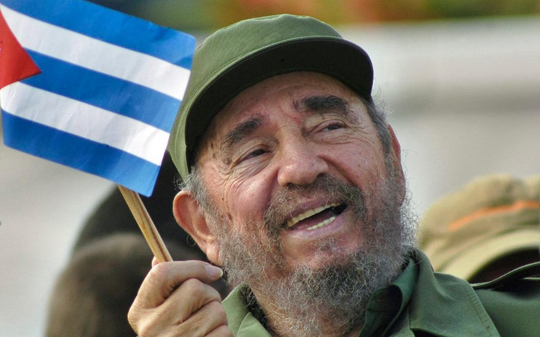
fc

With a shaking voice, his younger brother, Raul Castro, announced on state television that his brother died at 10:29 p.m. on Friday night.

Castro's reign over the island-nation 90 miles from Florida was marked by the US-backed Bay of Pigs invasion in 1961 and the Cuban Missile Crisis a year later that brought the world to the brink of nuclear war.

The bearded revolutionary, who survived a crippling US trade embargo as well as dozens, possibly hundreds, of assassination plots, died eight years after ill health forced him to formally hand power over to Raul.

Castro overcame imprisonment at the hands of dictator Fulgencio Batista, exile in Mexico and a disastrous start to his rebellion before triumphantly riding into Havana in January 1959 to become, at age 32, the youngest leader in Latin America. For decades, he served as an inspiration and source of support to revolutionaries from Latin America to Africa.

His commitment to socialism was unwavering, though his power finally began to fade in mid-2006 when a gastrointestinal ailment forced him to hand over the presidency to Raul in 2008, provisionally at first and then permanently.

His defiant image lingered long after he gave up his trademark Cohiba cigars for health reasons and his tall frame grew stooped. "Socialism or death" remained Castro's rallying cry even as Western-style democracy swept the globe and other communist regimes in China and Vietnam embraced capitalism, leaving this island of 11 million people an economically crippled Marxist curiosity.

He survived long enough to see Raul Castro negotiate an opening with US President Barack Obama on December 17, 2014, when Washington and Havana announced they would move to restore diplomatic ties for the first time since they were severed in 1961.

He cautiously blessed the historic deal with his lifelong enemy in a letter published after a month-long silence. "It's a tragedy," said Dayan Montalvo, a 22-year-old nurse. "We all grew up with him. I feel really hurt by the news that we just heard."

Fidel Castro Ruz was born August 13, 1926, in eastern Cuba's sugar country, where his Spanish immigrant father worked first recruiting labor for US sugar companies and later built up a prosperous plantation of his own.

Castro attended Jesuit schools, then the University of Havana, where he received law and social science degrees. His life as a rebel began in 1953 with a reckless attack on the Moncada military barracks in the eastern city of Santiago. Most of his comrades were killed and Fidel and his brother Raul went to prison.

Castro cobbled revolutionary groups together into the new Cuban Communist Party, with him as first secretary. Labor unions lost the right to strike. The Catholic Church and other religious institutions were harassed. Neighborhood "revolutionary defence committees" kept an eye on everyone.

Castro exported revolution to Latin American countries in the 1960s, and dispatched Cuban troops to Africa to fight Western-backed regimes in the 1970s. Over the decades, he sent Cuban doctors abroad to tend to the poor, and gave sanctuary to fugitive Black Panther leaders from the US.

But the collapse of the Soviet bloc ended billions in preferential trade and subsidies for Cuba, sending its economy into a tailspin. Castro briefly experimented with an opening to foreign capitalists and limited private enterprise.

As the end of the Cold War eased global tensions, many Latin American and European countries re-established relations with Cuba. In January 1998, Pope John Paul II visited a nation that had been officially atheist until the early 1990s.

Aided by a tourism boom, the economy slowly recovered and Castro steadily reasserted government control, stifling much of the limited free enterprise tolerated during harder times.

As flamboyant as he was in public, Castro tried to lead a discreet private life. He and his first wife, Mirta Diaz Balart, had one son before divorcing in 1956. Then, for more than four decades, Castro had a relationship with Dalia Soto del Valle. They had five sons together and were said to have married quietly in 1980.

By the time Castro resigned 49 years after his triumphant arrival in Havana, he was the world's longest ruling head of government, aside from monarchs. In retirement, Castro voiced unwavering support as Raul slowly but deliberately enacted sweeping changes to the Marxist system he had built.

His longevity allowed the younger brother to consolidate control, perhaps lengthening the revolution well past both men's lives. In February 2013, Raul announced that he would retire as president in 2018 and named newly minted Vice President Miguel Diaz-Canel as his successor.

"I'll be 90 years old soon," Castro said at an April 2016 communist party congress where he made his most extensive public appearance in years. "Soon I'll be like all the others.

The time will come for all of us, but the ideas of the Cuban Communists will remain as proof that on this planet, if one works with fervor and dignity, they can produce the material and cultural goods that human beings need and that need to be fought for without ever giving up."

Comments

Congi Shan
 - 
Saturday, 26 Nov 2016

The whole nation suffered because of this man. Not different from dictators Saddam, Gaddafi & Kim Kong Un

Fawad
 - 
Saturday, 26 Nov 2016

CIA tried 500 times to kill him .....Americans are real terrorists

Fedrick
 - 
Saturday, 26 Nov 2016

Red salute to fidel castro and his revolution!

karthik
 - 
Saturday, 26 Nov 2016

Indians can expect the biggest party in the world issuing membership to the expired revolutionary.

Kavya
 - 
Saturday, 26 Nov 2016

Real communism was followed by Karl Marx who envisaged an egalitarian society unlike the Ambanis and Mallyas of today.

Veerendra Hegde
 - 
Saturday, 26 Nov 2016

He kept an enviable and long record as the only leader who ruled a state for more than 50 years! He fought the mighty US and was recognised as one of the tall leaders in the world, with his demise, it is the end of an era! RIP comrade!

Jayaraj
 - 
Saturday, 26 Nov 2016

it is the end of a long innings.. made colorful by his continued anti US stance...... his cigar and the beard made him a recognizable figure who it is said has survived many number of attempts on his life ....MAY HIS SOUL REST IN PEACE......

Add new comment

  • Coastaldigest.com reserves the right to delete or block any comments.
  • Coastaldigset.com is not responsible for its readers’ comments.
  • Comments that are abusive, incendiary or irrelevant are strictly prohibited.
  • Please use a genuine email ID and provide your name to avoid reject.
News Network
February 26,2020

Feb 26: Looking out over the world’s largest cricket stadium, the seats jammed with more than 100,000 people, India’s prime minister heaped praise on his American visitor.

“The leadership of President Trump has served humanity,” Prime Minister Narendra Modi said Monday, highlighting Trump’s fight against terrorism and calling his 36-hour visit to India a watershed in India-U.S. relations.

The crowds cheered. Trump beamed.

“The ties between India and the U.S. are no longer just any other partnership,” Modi said. “It is a far greater and closer relationship.”

India, it seems, loves Donald Trump. It seemed obvious from the thousands who turned out to wave as his motorcade snaked through the city of Ahmedabad, and from the tens of thousands who filled the city’s new stadium. It seemed obvious from the hug that Modi gave Trump after he descended from Air Force One, and from the hundreds of billboards proclaiming Trump’s visit.

But it’s not so simple.

Because while Trump is genuinely popular in India, his clamorous and carefully choreographed welcome was also about Asian geopolitics, China’s growing power and a masterful Indian politician who gave his American visitor exactly what he wanted.

Modi “is doing this not necessarily because he loves Trump,” said Tanvi Madan, the director of the India Project at the Brookings Institution in Washington, D.C. “It’s very much about Trump as the leader of the U.S. and recognizing what it is that Trump himself likes.”

Trump likes crowds — big crowds — and the foot soldiers of India’s political parties have long known how to corral enough people to make any politician look popular. In a city like Ahmedabad, the capital of Modi’s home state of Gujarat and the center of his power base, it wouldn’t take much effort to fill a cavernous sports stadium. It was more surprising that a handful of seats remained empty, and that some in the stands had left even before Trump had finished his speech.

For India, good relations with the U.S. are deeply important: They signal that India is a serious global player, an issue that has long been important to New Delhi, and help cement an alliance that both nations see as a counterweight to China’s rise.

“For both countries, their biggest rival is China,” said John Echeverri-Gent, a professor at the University of Virginia whose research often focuses on India. “China is rapidly expanding its presence in the Indian Ocean, which India has long considered its backyard and its exclusive realm for security concerns.”

“It’s very clearly a major concern for both India and the United States,” he said.

Trump isn’t the first U.S. president that Modi has courted. In 2015, then-President Barack Obama was the first American chief guest at India’s Republic Day parade, a powerful symbolic gesture. Obama also got a Modi hug, and the media in both countries were soon writing about the two leaders’ “bromance.”

Trump is popular in India, even if some of that is simply because he’s the U.S. president. A 2019 Pew Research Center poll showed that 56% of Indians had confidence in Trump’s abilities in world affairs, one of only a handful of countries where he has that level of approval. But Obama was also popular: Before he left office, he had 58% approval in world affairs among Indians.

The Pew poll also indicated that Trump’s support was higher among supporters of Modi’s Hindu nationalist party.

That’s not surprising. Both men have fired up their nationalist bases with anti-Muslim rhetoric and government policies, from Trump’s travel bans to Modi’s crackdown in Kashmir, India’s only Muslim-majority state.

And Trump’s Indian support is far from universal. Protests against his trip roiled cities from New Delhi to Hyderabad to the far northeastern city of Gauhati, although those demonstrations were mostly overshadowed by protests over a new Indian citizenship law that Modi backs.

Modi, who is widely popular in India, has faced weeks of protests over the law, which provides fast track naturalization for some foreign-born religious minorities — but not Muslims. While Trump talked about ties with India on Tuesday, Hindus and Muslims fought in violent clashes that left at least 10 people dead over two days.

In some ways, Modi and Trump are powerful echoes of each other.

They have overlapping political styles. Both are populists who see themselves as brash, rule-breaking outsiders who disdain their countries’ traditional elites. Both are seen by their critics as having authoritarian leanings. Both surround themselves with officials who rarely question their decisions.

But are they friends?

Trump says yes. “Really, we feel very strongly about each other,” he said at a New Delhi press briefing.

But many observers aren’t so sure.

“The question is how much of this is real chemistry, as opposed to what I’d call planned chemistry” orchestrated for diplomatic reasons, said Madan. “It’s so hard to know if you’re not in the room.”

Certainly, Modi understands America’s importance to India. While the two countries continue to bicker about trade issues, the prime minister organized a welcome that impressed even India’s news media, which have watched countless choreographed mass political rallies.

“There is no other country for whose leader India would hold such an event, and for which an Indian prime minister would lavish such rhetoric,” the Hindustan Times said in an editorial.

“The spectacle and the sound were worth a thousand agreements.”

Comments

Add new comment

  • Coastaldigest.com reserves the right to delete or block any comments.
  • Coastaldigset.com is not responsible for its readers’ comments.
  • Comments that are abusive, incendiary or irrelevant are strictly prohibited.
  • Please use a genuine email ID and provide your name to avoid reject.
News Network
May 20,2020

Washington, May 20: The United States recorded another 1,536 coronavirus deaths over the past 24 hours, the Johns Hopkins University tracker said.

That figure, tallied as of 8:30 pm (0030 GMT), raises to 91,845 the total number of COVID-19 deaths in the US.

The US tops the global rankings both for the highest death toll and the highest number of infections, with more than 1.5 million cases.

Comments

Add new comment

  • Coastaldigest.com reserves the right to delete or block any comments.
  • Coastaldigset.com is not responsible for its readers’ comments.
  • Comments that are abusive, incendiary or irrelevant are strictly prohibited.
  • Please use a genuine email ID and provide your name to avoid reject.
Agencies
April 20,2020

Hong Kong, Apr 20: Oil prices collapsed to more than two-decade lows Monday as traders grow concerned that storage facilities are reaching their limits, while equities were mixed, with some support coming from signs that the coronavirus may have peaked in Europe and the United States.

US crude benchmark West Texas Intermediate briefly plunged almost 20 percent to below 15 -- its lowest since 1999 -- as stockpiles continue to build owing to a crash in demand caused by the COVID-19 pandemic.

Analysts said this month's agreement between top producers to slash output by 10 million barrels a day was having little impact on the oil crisis because of lockdowns and travel restrictions that are keeping billions of people at home.

WTI was hit particularly hard as its main US storage facilities in Cushing, Oklahoma, were filling up.

ANZ said "crude oil prices remained under pressure, as projections of weaker demand weigh on sentiment".

"Despite the OPEC+ alliance agreeing to an unprecedented cut in output, the physical market is awash with oil," it said, referring to the Organization of the Petroleum Exporting Countries and non-OPEC partners.

And AxiCorp's Stephen Innes added: "It's a dump at all cost as no one... wants delivery of oil, with Cushing storage facilities filling by the minute.

"It hasn't taken long for the market to recognise that the OPEC+ deal will not, in its present form, be enough to balance oil markets." Stock traders were in slightly more buoyant mood as governments start to consider how and when to ease lockdowns that have crippled the global economy.

Italy, Spain, France and Britain reported drops in daily death tolls and slowing infection rates.

"We are scoring points against the epidemic," said Prime Minister Edouard Philippe, while insisting "we are not out of the health crisis yet".

Meanwhile, in the US, Andrew Cuomo, governor of badly hit New York state, said the disease was "on the descent", though he cautioned it was "no time to get cocky".

Mounting evidence suggests that the lockdowns and social distancing are slowing the spread of the virus.

That has intensified planning in many countries to begin loosening curbs on movement and easing the crushing pressure on national economies.

Adding to the sense of hope was a report indicating promising research on a drug to treat coronavirus.

Hong Kong, Shanghai and Seoul were each up 0.1 percent, while Wellington added 0.4 percent.

However, Tokyo went into the break 0.9 percent lower, while Sydney and Manila dropped one percent apiece. There were also losses in Taipei, Singapore and Jakarta.

"The longer investors have to contemplate future economic issues while they wait for more countries to be on the downward slope of the pandemic curve, the more scope there is of risk assets pricing in a difficult future," Chris Iggo, of AXA Investment Managers UK, said.

Investors are keeping an eye on Washington, where Congress and the White House are working towards a 450 billion economic relief plan for small business to add to the trillions already pledged to support the economy.

Big-name companies including IBM, Netflix and Coca-Cola are due to deliver their earnings reports.

Comments

Add new comment

  • Coastaldigest.com reserves the right to delete or block any comments.
  • Coastaldigset.com is not responsible for its readers’ comments.
  • Comments that are abusive, incendiary or irrelevant are strictly prohibited.
  • Please use a genuine email ID and provide your name to avoid reject.