Muslim empowerment: Justice Sachar urges Karnataka govt to form EOC

[email protected] (CD Network)
November 28, 2016

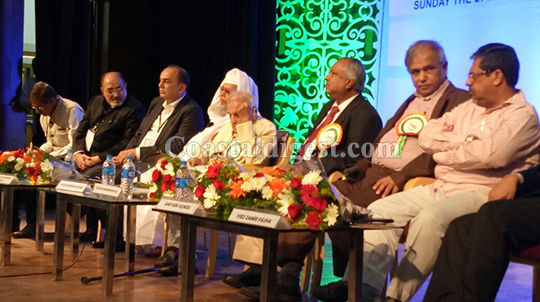
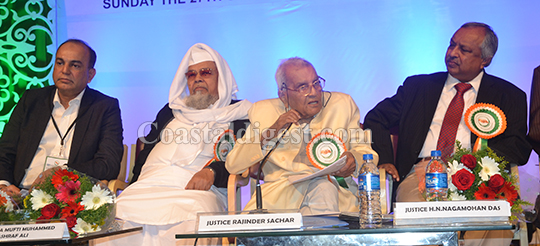
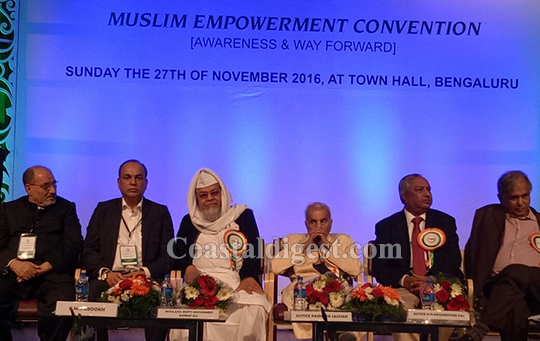
Bengaluru, Nov 27: “All state governments should set up the Equal Opportunity Commission and public sector also should come under the preview of this commission. Then only, the Other Backward Classes including Muslims can get equal opportunities in education and employment,” said Justice Rajinder Sachar.
empormnt 6

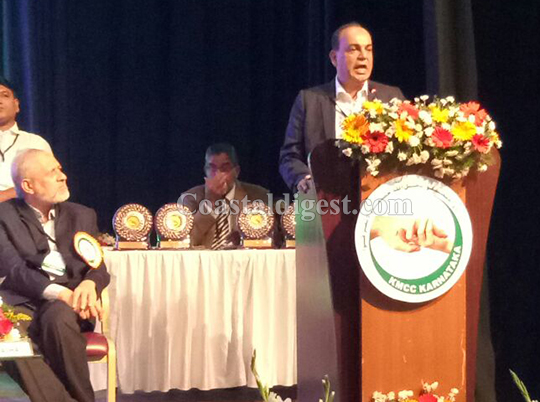
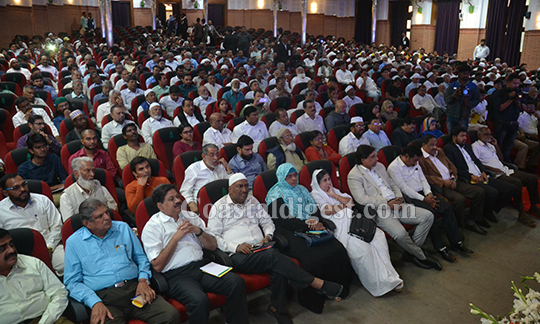
He was delivering a talk on Muslim Empowerment at the launching ceremony of Karnataka Muslim Coordination Committee (KMCC), a social organisation intended to work for communal harmony and empowerment of Muslim community through democratic means, at Town Hall, here on Sunday.

He said that if Karnataka government has real commitment toward OBCs then it should form Equal Opportunity Commission immediately in the state.

“The Sachar committee report is not just related to Muslims, It is related to all other communities. In a democratic country all communities should get equal opportunities. But Muslims in India are deprived from equal opportunities in education, employment and political appointments. Muslims are undivided part of India and any kind of apathy against them is against constitutional aspires,” he said adding that if a government fails to protect the interest of any minorities it will lose the moral right to rule the state.

Stating that Muslims are part of Indian culture and have contributed immensely to attain freedom, Justice Sachar endorsed the Karnataka government's decision to honour Tipu Sultan, who sacrificed his life fighting against British imperialists.

He emphasized that his report on the social, economical and educational status of the minorities was based on facts and it was the collective responsibility of all the people to see that the report is implemented to strike a balance in rendering social justice. He made it clear that there is nothing wrong to fight for right and lamented that even Karnataka government ruled by Conges has not implemented his suggestions to constitute an 'equal opportunity commission' to look into discrimination among different sections of people in employment other fields even at private sector.

B M Farooq, CMD of Fiza group of industries, and treasurer KMCC, in his key note address explained the objectives of the newly formed NGO and the need to coordinate the minority communities and other marginalized section of people for a common cause in the face of various threats faced by it.

He pointed out that state governments in India have failed to implement the recommendations of Sachar Committee report. “Many argue that implementation of the recommendations of the Sachar Committee Report would virtually divide the society. The plight of Muslims in India remains to be pathetic while many other communities with political and administrative influence snatch away all liberties to the detriment of the community. Muslims were accused of being not loyal to the Indian state, of being terrorists, and politicians who tried to help them risked being accused of "appeasing" them,” he lamented.

The launch of Karnataka Muslim Coordination Committee (KMCC) is an earnest endeavor to unite all sections of the underprivileged and oppressed in the society for a collective bargain for the rights and liberties they are entitled to, he said.

The Muslims, Dalits and other minorities should be united and there should be a social awareness created to fight for their rights in a democratic manner. The political parties have treated the minority community, especially the Muslim community as a vote bank and the community is ill treated and neglected. Poverty, illiteracy and backwardness are rampant and the government does nothing to improve the standard of the community, he complained.

The members of the Muslim community are targeted by the police and false cases are filed against them without affording them any opportunity to even get the legal assistance. Those who take up the cause have been branded astraitors'. Though Muslims are staunch patriots and are ready to sacrifice anything for the nation, they are very often described as anti national. The situation should be changed. Launch of KMCC is only a small step in the right direction.

Muslim community does not have a constructive leadership to enable it to achieve the rights, liberties and privileges to which the community is entitled to and the first and foremost objective of KMCC will be to achieve a constructive leadership and platform for the community from which, the community may be guided in the right direction.

Muslim Community is deprived of education, jobs and government services for want of proper guidance. Our endeavor will be held the youth in the community to acquire knowledge, education in the best school and colleges so that they would be able to stand on their own leg to achieve the goal of securing positions in the legislative, executive and judicial appointments with dignity.

Muslim community is targeted falsely accused of terrorism and other disruptive activities for no fault of them for political gains. KMCC would like to form a squad of professionals to act as awatchdog' against such atrocities against the members of the community and also to alleviate any such tendencies shown by any group of the community by properly educating and creating awareness amongst them.

To protect the interest of the community against the atrocities committed by the administrative or law enforcing agencies without any cogent evidence and to provide legal and financial assistance to them if they are falsely implicated or targeted in the opinion of the expert level committee of the Organization.

“We are for a strong India. We condemn any form of cross border terrorism targeting our nation and we are ready to sacrifice our lives for the sake of this great nation. At the same time, we demand a decent living and equal opportunity to serve the nation with dignity. Let us fight for our right. Let might be not right,” he said.

Mr. Amithabh Khundu, the Chairman of the Sachar Commission Evaluation Committee, presented the statistics and stressed the need to act on the report submitted showing the backwardness of the minorities in many fronts on account of discrimination of the community. He hoped that central govt would take appropriate step to alleviate the disparities. Justice H N Nagmohan Das also spoke.

The function was inaugurated by Moulana Mufti Muhammed Ashraf Ali, Amir-e-Shariat, Karnataka. Syed Zameer Pasha, IAS (retired) welcomed the gatherings. Haris and Hanif Mohammed compered the programme. Mirza Mehadi proposed vote of thanks.

empormnt 2

empormnt 1

empormnt 3

empormnt 4

empormnt 5

empormnt 7

Comments

Mr ABDULGAFFAR GHORI
 - 
Saturday, 17 Dec 2016

Free training of different courses for OBC under the aegis of Min of Minorities, Govt of India. Free hostel, boarding and with stipend. The duration is for 3-4 months. . There is placement assistance given after successful completion of the courses. NTTF has undertaken to train people from our community.. For more details pl visit www.nttftrg.com. Pl help to spread this message among the needy thro' email, phone, whatsup etc. Similar vocational courses under the same/similar schemes, all over the country, different agencies are doing this.

yaseer arfath
 - 
Monday, 28 Nov 2016

Great committee nd superb speech I agreed about your all rules it's awesome sir I hope so you became greatest nd big name full committee in future

yaseer arfath
 - 
Monday, 28 Nov 2016

Great committee nd superb speech i agreed about your all committee's rules it's awesome sir i hope your committee become more then name full in future .....

yaseer arfath
 - 
Monday, 28 Nov 2016

Great function nd speech was superb awesome..... i hope this committee make big name in future..... thank you....

Add new comment

  • Coastaldigest.com reserves the right to delete or block any comments.
  • Coastaldigset.com is not responsible for its readers’ comments.
  • Comments that are abusive, incendiary or irrelevant are strictly prohibited.
  • Please use a genuine email ID and provide your name to avoid reject.
News Network
February 20,2020

Kalaburagi, Feb 20: All India Majlis-e-Ittehadul Muslimeen (AIMIM) leader Waris Pathan on Wednesday said that 15 crore Muslims can dominate 100 crore Hindus.

"The time has now come for us to unite and achieve freedom. Remember we are 15 crore but can dominate over 100 crores," said Pathan while addressing an anti-CAA rally here.

"They tell us that we have kept our women in the front - only the lionesses have come out and you are already sweating. You can understand what would happen if all of us come together," he said.

The CAA grants citizenship to Hindu, Sikh, Jain, Parsi, Buddhist, and Christian refugees from Pakistan, Afghanistan, and Bangladesh, who came to India on or before December 31, 2014.

Protests have erupted across the country against the Citizenship Amendment Act (CAA), the National Register of Citizens (NRC) and the National Population Register (NPR).

Comments

Add new comment

  • Coastaldigest.com reserves the right to delete or block any comments.
  • Coastaldigset.com is not responsible for its readers’ comments.
  • Comments that are abusive, incendiary or irrelevant are strictly prohibited.
  • Please use a genuine email ID and provide your name to avoid reject.
coastaldigest.com news network
May 26,2020

Bengaluru, May 26: The Karnataka government today resolved to continue with the online method of education as a new normal in the field of higher education. 

Holding the review of the Higher Education department, Chief Minister B S Yediyurappa expressed interest in providing online education to students in higher educational institutes.

Yediyurappa directed the officials to look into the possibilities of extending online education from as early as Pre-University level so that the new method can easily be followed as they scale up the academic career. 

Keeping in mind the less expenditure and online teaching being cost-effective, Yediyurappa said, “If you compare online teaching with the regular classroom teaching, it is not only cost-effective but also helps in savings in terms of resources. Officials must look into the new method and start introducing it as early as PU classes.”

Comments

Add new comment

  • Coastaldigest.com reserves the right to delete or block any comments.
  • Coastaldigset.com is not responsible for its readers’ comments.
  • Comments that are abusive, incendiary or irrelevant are strictly prohibited.
  • Please use a genuine email ID and provide your name to avoid reject.
News Network
July 28,2020

Hounde, Jul 28: Coronavirus and its restrictions are pushing already hungry communities over the edge, killing an estimated 10,000 more young children a month as meager farms are cut off from markets and villages are isolated from food and medical aid, the United Nations warned Monday.

In the call to action shared with The Associated Press ahead of publication, four UN agencies warned that growing malnutrition would have long-term consequences, transforming individual tragedies into a generational catastrophe.

Hunger is already stalking Haboue Solange Boue, an infant from Burkina Faso who lost half her former body weight of 5.5 pounds (2.5 kilograms) in just a month. Coronavirus restrictions closed the markets, and her family sold fewer vegetables. Her mother was too malnourished to nurse.

“My child,” Danssanin Lanizou whispered, choking back tears as she unwrapped a blanket to reveal her baby's protruding ribs.

More than 550,000 additional children each month are being struck by what is called wasting, according to the UN — malnutrition that manifests in spindly limbs and distended bellies. Over a year, that's up 6.7 million from last year's total of 47 million. Wasting and stunting can permanently damage children physically and mentally.

“The food security effects of the COVID crisis are going to reflect many years from now,” said Dr. Francesco Branca, the WHO head of nutrition. “There is going to be a societal effect.”

From Latin America to South Asia to sub-Saharan Africa, more poor families than ever are staring down a future without enough food.

In April, World Food Program head David Beasley warned that the coronavirus economy would cause global famines “of biblical proportions” this year. There are different stages of what is known as food insecurity; famine is officially declared when, along with other measures, 30% of the population suffers from wasting.

The World Food Program estimated in February that one Venezuelan in three was already going hungry, as inflation rendered salaries nearly worthless and forced millions to flee abroad. Then the virus arrived.

“Every day we receive a malnourished child,” said Dr. Francisco Nieto, who works in a hospital in the border state of Tachira.

In May, Nieto recalled, after two months of quarantine, 18-month-old twins arrived with bodies bloated from malnutrition. The children's mother was jobless and living with her own mother. She told the doctor she fed them only a simple drink made with boiled bananas.

“Not even a cracker? Some chicken?” he asked.

“Nothing,” the children's grandmother responded. By the time the doctor saw them, it was too late: One boy died eight days later.

The leaders of four international agencies — the World Health Organization, UNICEF, the World Food Program and the Food and Agriculture Organization — have called for at least dollar 2.4 billion immediately to address global hunger.

But even more than lack of money, restrictions on movement have prevented families from seeking treatment, said Victor Aguayo, the head of UNICEF's nutrition program.

“By having schools closed, by having primary health care services disrupted, by having nutritional programs dysfunctional, we are also creating harm,” Aguayo said. He cited as an example the near-global suspension of Vitamin A supplements, which are a crucial way to bolster developing immune systems.

In Afghanistan, movement restrictions prevent families from bringing their malnourished children to hospitals for food and aid just when they need it most. The Indira Gandhi hospital in the capital, Kabul, has seen only three or four malnourished children, said specialist Nematullah Amiri. Last year, there were 10 times as many.

Because the children don't come in, there's no way to know for certain the scale of the problem, but a recent study by Johns Hopkins University indicated an additional 13,000 Afghans younger than 5 could die.

Afghanistan is now in a red zone of hunger, with severe childhood malnutrition spiking from 690,000 in January to 780,000 — a 13% increase, according to UNICEF.

In Yemen, restrictions on movement have blocked aid distribution, along with the stalling of salaries and price hikes. The Arab world's poorest country is suffering further from a fall in remittances and a drop in funding from humanitarian agencies.

Yemen is now on the brink of famine, according to the Famine Early Warning Systems Network, which uses surveys, satellite data and weather mapping to pinpoint places most in need.

Some of the worst hunger still occurs in sub-Saharan Africa. In Sudan, 9.6 million people live from one meal to the next — a 65% increase from the same time last year.

Lockdowns across Sudanese provinces, as around the world, have dried up work and incomes for millions. With inflation hitting 136%, prices for basic goods have more than tripled.

“It has never been easy but now we are starving, eating grass, weeds, just plants from the earth,” said Ibrahim Youssef, director of the Kalma camp for internally displaced people in war-ravaged south Darfur.

Adam Haroun, an official in the Krinding camp in west Darfur, recorded nine deaths linked with malnutrition, otherwise a rare occurrence, over the past two months — five newborns and four older adults, he said.

Before the pandemic and lockdown, the Abdullah family ate three meals a day, sometimes with bread, or they'd add butter to porridge. Now they are down to just one meal of “millet porridge” — water mixed with grain. Zakaria Yehia Abdullah, a farmer now at Krinding, said the hunger is showing “in my children's faces.”

“I don't have the basics I need to survive,” said the 67-year-old, who who hasn't worked the fields since April. “That means the 10 people counting on me can't survive either.”

Comments

Add new comment

  • Coastaldigest.com reserves the right to delete or block any comments.
  • Coastaldigset.com is not responsible for its readers’ comments.
  • Comments that are abusive, incendiary or irrelevant are strictly prohibited.
  • Please use a genuine email ID and provide your name to avoid reject.