


Women activists enter Haji Ali dargah

November 29, 2016

Mumbai, Nov 29: Marking a victory for campaign for gender equality in places of worship, a group of women activists today entered the sanctum sanctorum of Haji Ali dargah here and offered prayers.
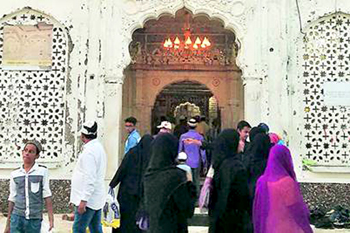
hajiThe entry by members of Bharatiya Muslim Mahila Andolan (BMMA) into the mausoleum came more than a month after the Haji Ali Dargah Trust told the Supreme Court it will allow women inside the inner sanctum of the shrine. Women devotees' entry into it was banned a few years ago.

"Around 400 women from BMMA today went to the dargah. We also offered a 'chaadar' (shawl) there and paid our respects to the saint," Zakia Soman, co-founder of BMMA, told PTI.

She said the trustees were very courteous and did not resist their entry into the sanctum sanctorum of the dargah, one of the famous landmarks of Mumbai.

"On the contrary, they offered us tea and spoke to us for some time. Their welcoming stand towards women is a great moral victory for us," she said.

The Bombay High Court had in August lifted the ban on women from entering the inner area of the dargah, saying it contravenes Articles 14, 15 and 25 (dealing with fundamental rights) of the Constitution.

BMMA, an NGO, was one of the petitioners which had challenged the ban, imposed by the Haji Ali Trust in 2012, in the High Court. The 2012 ban was based on the trust's notion that it is a "grievous sin" to let women into the inner area.

In early October, the trust moved the Supreme Court challenging the HC order. However in late October, the trust climbed down from its earlier stand and told the apex court it will grant access to women in the prohibited area.

The dargah, said to date back 600 years, is a popular religious place located on an island off South Mumbai. It houses a mosque and the tomb of Muslim saint Sayed Peer Haji Ali Shah Bukhari and is visited by people of all faiths.

Women's rights activist Trupti Desai had led a well publicised campaign seeking equal access to female devotees in places of worship, including the dargah.

After the HC order in August, she offered prayers at the shrine, but did not enter its core area.

Comments

shaji
 - 
Thursday, 1 Dec 2016

BMMA is a financially supported organisation of RSS and the founder lady is wife of one RSS leader. She has managed to lure and fool some uneducated and poor ladies by giving money. she has nothing to do with Islam or Muslims. She did not cry while thousands of muslim women were raped and killed in Gujarat. she is not crying for the mother of Najeeb. this lady is a liar.

SHAHID
 - 
Wednesday, 30 Nov 2016

All the darga worshippers are innocent and dont have the proper knowledge of islam, they just follow the foothold of their elders... and majority of darga worshippers are illiterate, in islam worship place only one its masjid and its permissible in islam for women to enter in mosque and pray......in islam darga doesnt exist then where is the question of entering women to darga....if you enter darga and worship you have comited shirk and it takes you away from islam

Sadik
 - 
Wednesday, 30 Nov 2016

BMMA is wing of RSS and women head of BMMA she is wife of RSS extremists.
Darga is not in Islam. This RSS women using innocent Muslim women for political gain. Dont be scapegoat and stick to deen.

Ahmed K./C.
 - 
Wednesday, 30 Nov 2016

17 times a day in fardh salat alone we recite sura al fatiha, and one of the sentence is:-
\You (alone) we worship, and you (alone) we ask for help.\"

Even those who visit and seek something in DARGA also in prayers recite the same verse as above.

ARE THEY LYING TO ALLAH ???????????????"

Althaf
 - 
Wednesday, 30 Nov 2016

Entering Darga or entering temple it is the same. If you worship anything except Allah then destination will be HELL.
May allah guide our muslims. Darga is a place of shirk and khurafath.
There is no relation between islam and darga

Abdul
 - 
Tuesday, 29 Nov 2016

There is no \DARGA\" System in ISLAM. People should seek anything from only Allah. May Allah guide right path to all Muslims."

Add new comment

  • Coastaldigest.com reserves the right to delete or block any comments.
  • Coastaldigset.com is not responsible for its readers’ comments.
  • Comments that are abusive, incendiary or irrelevant are strictly prohibited.
  • Please use a genuine email ID and provide your name to avoid reject.
coastaldigest.com news network
April 13,2020

Mangaluru: The Karnataka-Kerala border closure at Talapady amidst nationwide Covid-19 lockdown has not only prevented the movement of vehicles and people from Kasaragod to Mangaluru but also stopped the supply of life-saving drugs from Karnataka’s medical hub to its bordering district.

Hundreds of people from Kasaragod and Kannur districts who were treated in hospitals of Mangaluru for past several years are still dependent on some of the medicines that are available only in Mangaluru. Such medicines have become inaccessible for Keralites following the border closure. Every day, a number of people from Kerala call their acquaintances in Mangaluru to see if there is a way to get medicine.

In fact, Karnataka government has blocked all 23 roads that connect the state with Kerala. The reason given was, Kasaragod is the hotbed of coronavirus and allowing traffic even in emergency cases might lead to spread of Covid-19 in border districts of Dakshina Kannada, Kodagu and Mysuru. The attitude has resulted in the death of around a dozen people in Kasaragod district in last couple of weeks.

Even after the intervention of the Supreme Court a few days ago, the authorities in Karnataka are facing the allegation of being hostile either by blocking the way ahead or turning a deaf ear to the patients reaching their border. 

At this juncture, three Good Samaritans – P K G Anoop Kumar of Canara Engineering College, Mangaluru, Satheesh Shetty of Kasaragod Patla and P Jayaprakash of Ponnangala – have come to the aid of the Malayalee patients who are dependent on medicines from Mangaluru. 

The three activists who are currently staying (in fact stranded amidst lockdown) in Mangaluru, are delivering life-saving medicines to patients in Kerala through Kerala fire servicemen and policemen posted at the Talapady border. 

Anoop Kumar says that took the initiative after a woman, Maria Augustine from Chemberi (Taliparamba) Nellikkutty, contacted him for a medicine. He managed to buy it from a medical store in the port city and handed it over to a Kerala fire serviceman at Talapady border. 

All three are activists of Communist Party of India (Marxist). After moving to Mangaluru, they set up ‘We Donate Charitable Society’ to donate blood. The activists say that they are ready to dispatch medicines from Mangaluru to any person in Kerala. Those Keralites who are in need of medicines from may contact: 888471344 - Anoop, 9895135881 - Jayaprakash

Comments

abdullah
 - 
Sunday, 21 Jun 2020

Salute to you dears.  May God bless you.  HOpe public and Govt will appreciate your sacrifice and support you.

Add new comment

  • Coastaldigest.com reserves the right to delete or block any comments.
  • Coastaldigset.com is not responsible for its readers’ comments.
  • Comments that are abusive, incendiary or irrelevant are strictly prohibited.
  • Please use a genuine email ID and provide your name to avoid reject.
Agencies
May 8,2020

Washington D.C., May 8: The prime time for brain development in a child's life is the first year, where the infant spends most of the time asleep. It is the time when neural connections form and sensory memories are encoded.

However, when sleep is disrupted, as occurs more often among children with autism, brain development may be affected, too.

New research led by the University of Washington finds that sleep problems in a baby's first 12 months may not only precede an autism diagnosis but also may be associated with altered growth trajectory in a key part of the brain, the hippocampus.

The study, which was published in the American Journal of Psychiatry, researchers report that in a sample of more than 400 taken of 6- to 12-month-old infants, those who were later diagnosed with autism were more likely to have had difficulty falling asleep.

It also states that this sleep difficulty was associated with altered growth trajectories in the hippocampus.

"The hippocampus is critical for learning and memory, and changes in the size of the hippocampus have been associated with poor sleep in adults and older children.

As many as 80 per cent of the children with autism spectrum disorder have sleep problems," said Annette Estes, director of the UW Autism Center and senior author of the study.

"In our clinical experience, parents have a lot of concerns about their children's sleep, and in our work on early autism intervention, we observed that sleep problems were holding children and families back," added Estes, who is also a UW professor of speech and hearing sciences.

"It could be that altered sleep is part-and-parcel of autism for some children. One clue is that behavioural interventions to improve sleep don't work for all children with autism, even when their parents are doing everything just right. This suggests that there may be a biological component to sleep problems for some children with autism," said Estes.

To consider links among sleep, brain development, and autism, researchers at the IBIS Network looked at MRI scans of 432 infants, surveyed parents about sleep patterns, and measured cognitive functioning using a standardized assessment.

At the outset of the study, infants were classified according to their risk for developing autism: Those who were at higher risk of developing autism -- about two-thirds of the study sample -- had an older sibling who had already been diagnosed.

Infant siblings of children with autism have a 20 per cent chance of developing autism spectrum disorder -- a much higher risk than children in the general population.

In the current study, 127 of the 432 infants were identified as "low risk" at the time the MRI scans were taken because they had no family history of autism.

They later evaluated all the participants at 24 months of age to determine whether they had developed autism. Of the roughly 300 children originally considered "high familial risk," 71 were diagnosed with autism spectrum disorder at that age.

Problems with sleep were more common among the infants later diagnosed with an autism spectrum disorder, as were larger hippocampi. No other subcortical brain structures were affected, including the amygdala, which is responsible for certain emotions and aspects of memory, or the thalamus, a signal transmitter from the spinal cord to the cerebral cortex.

The authors note that while parents reported more sleep difficulties among infants who developed autism compared to those who did not, the differences were very subtle and only observed when looking at group averages across hundreds of infants.

Sleep patterns in the first years of life change rapidly as infants transition from sleeping around the clock to a more adult-like sleep/wake cycle. Until further research is completed, Estes said, it is not possible to interpret challenges with sleep as an early sign of increased risk for autism.

Comments

Add new comment

  • Coastaldigest.com reserves the right to delete or block any comments.
  • Coastaldigset.com is not responsible for its readers’ comments.
  • Comments that are abusive, incendiary or irrelevant are strictly prohibited.
  • Please use a genuine email ID and provide your name to avoid reject.
News Network
March 28,2020

Gadag, Mar 28: At a time when the adminsitration is insisting on social diatancing due to COVID-19 outbreak, scores of people gathered in large numbers at an Agricultural Produce Market Committee (APMC) market in Gadag district to buy essential commodities.

Both men and women could be seen standing in large groups near the vendors to buy fruits and vegetables. Some of the customers were also heard bargaining with the sellers in the morning today.

A couple of days back, Prime Minister Narendra Modi emphasised that social distancing is the only way to counter the spread of COVID-19, saying the virus does not discriminate and it can infect anyone.

Interacting with the people of Varanasi through video conferencing, the Prime Minister had stated that some people, despite being empowered with knowledge, are not pay heed to warning which is unfortunate.

He said the 'Mahabharata' war was won in 18 days and the war against coronavirus will take 21 days and the aim is to win it.

According to the Union Health Ministry, there are 873 confirmed cases of COVID-19 in India.

Comments

Add new comment

  • Coastaldigest.com reserves the right to delete or block any comments.
  • Coastaldigset.com is not responsible for its readers’ comments.
  • Comments that are abusive, incendiary or irrelevant are strictly prohibited.
  • Please use a genuine email ID and provide your name to avoid reject.