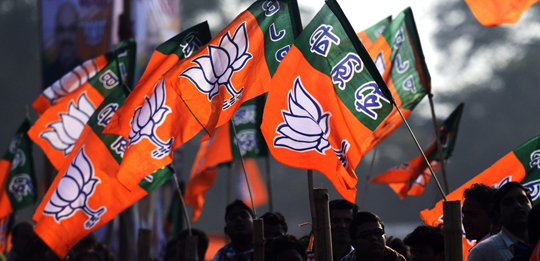
BJP demands ban on PFI, KFD for allegedly killing Sangh Parivar workers

December 1, 2016

Belagavi, Dec  1: The BJP on Wednesday sought an explanation from the state government in the Legislative Assembly on the reason behind the withdrawal of cases against Popular Front of India (PFI) and Karnataka Forum for Dignity (KFD).

bjp copy

Participating is a discussion on the law and order situation in the state, R?Ashoka (BJP) sought to know the rationale behind the government's move which comes at a time when Kerala government, in an affidavit submitted in the Kerala High Court, has stated the two organisations are involved in anti-national activities and pose a threat for the country.

Ashoka said the two organisations are behind the murders of RSS?and BJP?workers and demanded that the case be handed over to the National Investigative Agency (NIA).

He also sought that the two organisations should be banned with immediate effect. Both organisations took shape after the Students Islamic Movement of India (SIMI) was banned, he said.

Ashoka said cases of communal and political violence are on the rise in the state. RSS?and BJP workers  volunteers are being murdered in a planned manner, he said. The ramification of the government's move could have drastic implications, Leader of the Opposition Jagadish Shettar said.

Comments

Mohammed musthafa
 - 
Thursday, 1 Dec 2016

Along with that, add Drs,vhp,rss,vhp

shaji
 - 
Thursday, 1 Dec 2016

Every Indian knows that the most terrorist groups in India are RSS/BD/RS and other outfits of sangh parivar. Terrorists from these groups are spreading hatred between different communities and give hate speech, but no action is taken on them.

Well Said
 - 
Thursday, 1 Dec 2016

Why not the PFI, KFD, SDPI, NDF demands or protest against RSS,VHP to ban??? only this people have rights to demand for any organization Ban? Let PFI, KFD, SDPI, NDF make protest and demand for Ban. (for your FYI.. iam not related to any Organization)

Abu Muhammad
 - 
Thursday, 1 Dec 2016

Ashok, based on your own argument why cant the Govt ban both BJP & RSS for killing CPM workers in Kerala, murder in various jails and bomb explosions elsewhere in India? Common man have the same standard for the same crime.

A. Mangalore
 - 
Thursday, 1 Dec 2016

Congratulations PFI and KFD. The RSS recommended that you are strong party who are fighting against communalism and goondaism.

They can't digest any one talking or standing against them.

Good Job .

Rikaz
 - 
Thursday, 1 Dec 2016

We need just 2 strongest parties in India and rest should be banned once and for all.....no political parties doing any favor for human kind, they are all there to make money for them and their family members and relatives....that is all....if government wants to ban any kachira parties then clean up everything...no need...they are all anti religion and working against human kind...

suleman
 - 
Thursday, 1 Dec 2016

PFI, KFD ok...RSS...Bajrang illa yaake...?

Add new comment

  • Coastaldigest.com reserves the right to delete or block any comments.
  • Coastaldigset.com is not responsible for its readers’ comments.
  • Comments that are abusive, incendiary or irrelevant are strictly prohibited.
  • Please use a genuine email ID and provide your name to avoid reject.
coastaldigest.com news network
June 13,2020

Mangaluru, June 13:  The Central Crime Branch of Bengaluru City Police, which is digging up old cases involving underworld gangster Ravi Pujari, has now launched a fresh probe into the murder of human rights lawyer Naushad Kashimji.

Kashimji was gunned down on April 9, 2009 at the basement of his apartment in Falnir in Mangaluru. Ravi Pujari had allegedly ordered the hit. 

As part of investigation, a team from Benglauru CCB has come to Mangaluru. CCB sleuths, who obtained Pujari’s police custody in connection with this case, are tying up the loose ends pertaining to the murder of Kashimji who was representing D-Company hitman Abdul Rashid Hassan Malbari aka Malbari. 

Pujari was said to be unhappy over Kashimji representing Malbari. Pujari had also allegedly issued life threats, directing him to desist from doing so.

Kashimji had reportedly received more than 10 international threat calls from March 30 to April 9 (the day he was murdered). According to a senior police officer, the advocate had not informed the police or his then senior Purushottam Poojary about receiving the threat calls. “This came to light when police went through his call records later,” the officer explained.

“CCB team is primarily focusing on Pujari’s role in the advocate’s sensational murder,” a senior CCB officer handling the investigating said. 

“We have also lined up other cases in which Pujari is allegedly involved, but had filed the chargesheet against him in absentia as he was then a fugitive,” the officer added. The team is now picking up threads of Pujari’s involvement cases in Dakshina Kannada, Udupi and Chikkamagaluru districts.

Pujari, currently in police custody in Bengaluru, is accused in more than 30 cases reported in Mangaluru from 2007 to 2018. Majority of the cases against Pujari pertain to extortion and extending death threats, one relating to murder, three to shootings/ abduction and one where he supplied money to his henchmen in prison. Police have filed ‘C’ report in 17 out of 28 threat call cases and ‘B’ report in one case. Rest are in different stages of trial.

Comments

Add new comment

  • Coastaldigest.com reserves the right to delete or block any comments.
  • Coastaldigset.com is not responsible for its readers’ comments.
  • Comments that are abusive, incendiary or irrelevant are strictly prohibited.
  • Please use a genuine email ID and provide your name to avoid reject.
News Network
June 26,2020

Bengaluru, Jun 26: The National Restaurant Association of India (NRAI) on Thursday came up with a Standard Operating Procedure (SOP) for restaurants whereby among other physical distancing norms, it has suggested a 2-metre gap between tables.

Formulated in partnership with Releski, a Bengaluru based skill-tech company, the SoP suggests that in case of back-to-back seating, people sitting with their backs towards each other will have their seats divided by 'Plexiglass' divider raised up to 2 meters from the ground.

"In a typical restaurant, the improvised seating plan should have a minimum distance of 2 metres between tables. The distance of 2 metres (6 feet) between tables should measure from one edge of the table to the other table's edge," it said.

In case of loose or free seating such as in banquet style or food court style seating, a minimum 2 meters of distance should be maintained between tables.

The guidelines noted that, to encourage physical distancing, restaurants have to sacrifice their seating capacity, to promote health and safety, and also to gain trust from their patrons.

"In order to perform this, divide your restaurants under different sectors. Pull out your restaurant's floor plan and colour code different sections red and yellow. Red sections are potential areas where maximum footfall or traffic is observed. Yellow sections are areas where the footfalls are average," it said.

All the red sections are encircled or bordered by placing barricades or Q manager and will open at specific points to access the yellow section and all the opening points will have hand sanitisers and sprays, and every guest who walks from red zones to yellow zones will sanitise himself/herself to reduce the chances of contamination.

For air conditioning, the guidelines of CPWD shall be followed which inter alia emphasises that the temperature setting of all air conditioning devices should be in the range of 24-30 degree Celsius, relative humidity should be in the range of 40- 65 per cent, intake of fresh air should be as much as possible and cross ventilation should be adequate, the guidelines suggested.

The industry body has also suggested appointment of a COVID-free Ambassador who would operate as the Chief Health Officer within the restaurant team, preferably from the management team in each shift.

The ambassador's would put the new daily work routines into practice, to monitor compliance with good practice and to lead the preventative measures, adapt to health & safety recommendations and requirements of the restaurant and oversee the implementation of the norms.

Anurag Katriar, President of NRAI and CEO & Executive Director of deGustibus Hospitality, said: "Every restaurant cutting across formats is facing the harsh reality of subdued to shut business volumes in the present and the uncertainty of business environment in the future. One thing is certain that hygiene and safety will be a key differentiator in the post-pandemic restaurant operations."

Comments

Add new comment

  • Coastaldigest.com reserves the right to delete or block any comments.
  • Coastaldigset.com is not responsible for its readers’ comments.
  • Comments that are abusive, incendiary or irrelevant are strictly prohibited.
  • Please use a genuine email ID and provide your name to avoid reject.
News Network
February 14,2020

Bhuj, Feb 14: In a horrifying incident, as many as 68 undergraduate girls were paraded through their college into the restroom and forced to individually remove their undergarments to prove that they were not menstruating. 

This shameful exercise was conducted at Shri Sahjanand Girls’ Institute (SSGI) in Gujarat’s Bhuj under the supervision of principal and other teachers. 

It all began after the hostel rector complained to the principal that some of the inmates had been violating the Hindu religious norms specifically for menstruating females.

According to the sect’s norms, menstruating females are barred from entering the temple and kitchen. They are even forbidden from touching other students. However, the hostel administration reportedly complained to principal Rita Raninga that some girls who were having their periods not just mingled with other hostel inmates, but also entered the kitchen and ventured near the temple on the premises. 

“It was sheer mental torture and we don’t have words to describe it,” a student who underwent the traumatic experience said, adding that there were total 68 girls who were forced to pass through the test.

“The hostel administration levelled this allegation and insulted us on Wednesday. On Thursday, when we were attending lectures, rector Anjaliben called the principal and complained about this. We were forced to leave our classrooms and queue up outside in the passage. The principal abused and insulted us, asking which of us were having our periods. Two of us who were menstruating stepped aside,” said another victim.

“Despite this, we were all taken to the washroom. There, female teachers asked us to individually remove our undergarments so they could check if we were menstruating,” she added.

Another teenage undergraduate said, “We come from farflung villages. The college campus houses a school that runs classes from Class 1to 12. They provide hostel facilities to the school students. The college does not have its own hostel. We live with the school-kids in their hostel.”

She added, “The principal, hostel rector and the trustees harass us regularly over the issue of menstruation. We are punished for having periods. This happens even if we follow their religious rules. They made us remove our undergarments because they thought some of us were lying about not having periods, and mingling with the others against rules. But the humiliation meted out to us on Thursday was the last straw. When we protested against this, trustee Pravin Pindoria told us that we could take legal action if we wanted but we would have to first leave the hostel. He also forced the students to sign a letter saying nothing happened in college. But enough is enough.”

Kutch University authorities have, meanwhile, swung into action and a five-member team including in-charge vice-chancellor, Darshna Dholakia, and two other senior female professors visited the college on Thursday. “We will speak to the students and the college authority and later initiate appropriate action based on the findings,” Dholakia said.

Run by followers of Swaminarayan Mandir, the college was set up in 2012 but moved into a new building on the premises of Shree Swaminarayan Kanya Mandir in 2014. The college which offers BCom, BA and BSc courses has about 1,500 students of which 68, who come from remote villages, stay in the hostel on campus. The college is known for its pro-Hindutva stance.


Comments

Add new comment

  • Coastaldigest.com reserves the right to delete or block any comments.
  • Coastaldigset.com is not responsible for its readers’ comments.
  • Comments that are abusive, incendiary or irrelevant are strictly prohibited.
  • Please use a genuine email ID and provide your name to avoid reject.