


Fake In India': Techie praised by Modi arrested for printing fake Rs 2K notes

[email protected] (CD Network)
December 3, 2016

New Delhi, Dec 3: A budding engineer, whose “innovation” was appreciated by the Prime Minister Narendra Modi at aMake In India' event last year, has now been arrested for printing fake notes of newly introduced currency of Rs 2,000.
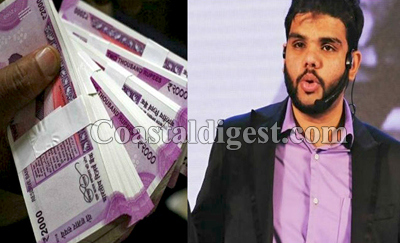
abhinavThe 21-year-old B.Tech graduate Abhinav Verma, who also belongs to an Indian Army family, was arrested by Punjab police wit Rs 42 lakh fake currency in the denomination of Rs 2,000 notes in Mohali, Punjab on Thursday.

He was arrested over a tip-off provided to Punjab police, along with two of his accomplices – his cousin Vishakha Verma and Ludhiana-based property dealer Suman Nagpal. According to sources, the trio were duping people by exchanging fake currency (of Rs 2,000) with old Rs 500 and Rs 1,000 notes on a 30 per cent commission.

Parminder Singh, SP Mohali said that the fake currency was recovered on Wednesday from a brand new luxury Audi SUV which was used by Abhinav. The vehicle also had a red beacon, which is allowed only for VVIPs only.

In last few days Punjab police officials across India have been conducting raids to arrest two members of the gang who slipped away. The cops said that the currency given by the gang to their customers even after charging customers was fake.

The cops were stunned when they found that Abhinav Verma is the same person whose work was appreciated by Narendra Modi at Make India event last year.

According to reports, Abhinav is an engineering graduate who is into manufacturing sensors which are supposed to be installed in the sticks for visually handicapped. Abhinav's office is in Chandigarh and it was also used to print fake currency of Rs 2,000 denomination at his office only.

While Abhinav and his cousin Vishakha Verma, an MBA student printed the fake currency, the property dealer was responsible played the role of dispensing it to people who were looking to convert their unaccounted wealth to the new currency. The cops found notes with same serial number.

Last year, Abhinav got a mention from PM Modi in December at the Indian Science Congress in Bengaluru. At the age of 18, he created “Live Braille”, a device to help the vision-impaired to walk without a walking stick.

It gained popularity and was touted as an innovation under the “Make In India' programme. Live Braille has reportedly won awards at major engineering institutes across the country and at Illinois State University. It also won the TiEGER Award by TiE Silicon Valley USA.

Comments

A. Mangalore
 - 
Saturday, 3 Dec 2016

One of Bangladeshi terrorist has liked Zakir Naik's face book talk.
His organization is banned.
Now Modi praised Abhinav and Abhinav is inspired with Mr. Modi
Now what action you take against Modi ????
Thousand dollar question.

abdullah
 - 
Saturday, 3 Dec 2016

Now Modi should be arrested and his all outfits should be banned.
Because this youth is inspired by Modi...

Add new comment

  • Coastaldigest.com reserves the right to delete or block any comments.
  • Coastaldigset.com is not responsible for its readers’ comments.
  • Comments that are abusive, incendiary or irrelevant are strictly prohibited.
  • Please use a genuine email ID and provide your name to avoid reject.
News Network
July 17,2020

Bengaluru, July 17: The government of Karnataka has decided to issue caste and income certificates to Brahmins in the state to reduce the socio-economic inequality faced by the community.

“A notification has been issued to tehsildars in all 30 districts to issue caste and income certificates to Brahmins so that they can also benefit from the government schemes and scholarships,” a Revenue Department official told said.

The notification comes a month after the Karnataka State Brahmin Development Board on June 10 appealed to Chief Minister B.S. Yediyurappa to issue the certificates to the traditionally dominant community, which accounts for 3 per cent of the 7 crore state population.

“Though Brahmins are in ‘minority’ in terms of their population across the state, they need caste and income certificates to benefit from the welfare schemes meant for the economic weaker sections such as SC, ST and OBC groups,” the official said.

The board was set up in March 2019 as a state-run company with Rs 5 crore authorised capital and Rs 5 crore equity and is registered with the Registrar of Companies.

The notification was issued to the local bodies and taluk offices after several members of the community complained to state Revenue Minister R. Ashoka that they were unable to benefit from the welfare schemes in the absence of the certificates.

The certificates will also help students from the community to avail scholarships for higher studies from the state-funded board if their gross annual family income is less than Rs 8 lakh per year.

The board has also urged the state government to implement the 10 per cent quota for its community members under the economically weaker sections, as applicable for Central government jobs and admissions to central institutions.

Noting that every community has people who are forward and backward economically for various reasons, including historical, the official said the board would be empowered to serve the Brahmins.

“The board will provide interest-free loans to the financially weaker sections of the community,” said its Chairman H.S. Sachidananda Murthy.

Comments

Add new comment

  • Coastaldigest.com reserves the right to delete or block any comments.
  • Coastaldigset.com is not responsible for its readers’ comments.
  • Comments that are abusive, incendiary or irrelevant are strictly prohibited.
  • Please use a genuine email ID and provide your name to avoid reject.
News Network
June 26,2020

Bengaluru, Jun 26: The National Restaurant Association of India (NRAI) on Thursday came up with a Standard Operating Procedure (SOP) for restaurants whereby among other physical distancing norms, it has suggested a 2-metre gap between tables.

Formulated in partnership with Releski, a Bengaluru based skill-tech company, the SoP suggests that in case of back-to-back seating, people sitting with their backs towards each other will have their seats divided by 'Plexiglass' divider raised up to 2 meters from the ground.

"In a typical restaurant, the improvised seating plan should have a minimum distance of 2 metres between tables. The distance of 2 metres (6 feet) between tables should measure from one edge of the table to the other table's edge," it said.

In case of loose or free seating such as in banquet style or food court style seating, a minimum 2 meters of distance should be maintained between tables.

The guidelines noted that, to encourage physical distancing, restaurants have to sacrifice their seating capacity, to promote health and safety, and also to gain trust from their patrons.

"In order to perform this, divide your restaurants under different sectors. Pull out your restaurant's floor plan and colour code different sections red and yellow. Red sections are potential areas where maximum footfall or traffic is observed. Yellow sections are areas where the footfalls are average," it said.

All the red sections are encircled or bordered by placing barricades or Q manager and will open at specific points to access the yellow section and all the opening points will have hand sanitisers and sprays, and every guest who walks from red zones to yellow zones will sanitise himself/herself to reduce the chances of contamination.

For air conditioning, the guidelines of CPWD shall be followed which inter alia emphasises that the temperature setting of all air conditioning devices should be in the range of 24-30 degree Celsius, relative humidity should be in the range of 40- 65 per cent, intake of fresh air should be as much as possible and cross ventilation should be adequate, the guidelines suggested.

The industry body has also suggested appointment of a COVID-free Ambassador who would operate as the Chief Health Officer within the restaurant team, preferably from the management team in each shift.

The ambassador's would put the new daily work routines into practice, to monitor compliance with good practice and to lead the preventative measures, adapt to health & safety recommendations and requirements of the restaurant and oversee the implementation of the norms.

Anurag Katriar, President of NRAI and CEO & Executive Director of deGustibus Hospitality, said: "Every restaurant cutting across formats is facing the harsh reality of subdued to shut business volumes in the present and the uncertainty of business environment in the future. One thing is certain that hygiene and safety will be a key differentiator in the post-pandemic restaurant operations."

Comments

Add new comment

  • Coastaldigest.com reserves the right to delete or block any comments.
  • Coastaldigset.com is not responsible for its readers’ comments.
  • Comments that are abusive, incendiary or irrelevant are strictly prohibited.
  • Please use a genuine email ID and provide your name to avoid reject.
News Network
May 10,2020

Mangaluru, May 10: A special train carrying 1,140 migrant workers stranded here in the lockdown has left Mangaluru railway station for Jharkhand.

Dakshina Kannada MP Nalin Kumar Kateel and Vedavyas Kamath, MLA, were present at the railway station on Saturday night when the train left.

Kamath said the workers who had registered on the state governments Seva Sindhu portal were brought to the railway station in Karnataka State Road Transport Corporation buses.

A health check-up was carried out before they boarded the train.

The district administration also provided food packets and water to the migrants at the station.

Three more trains will leave from Mangaluru for Uttar Pradesh, Bihar, and Jharkhand soon, he said.

Meanwhile, in a statement, Dakshina Kannada Deputy Commissioner Sindhu P Rupesh said train services are being arranged for migrant workers who have registered their names on the Seva Sindhu portal.

The workers will be informed when trains are arranged to their destinations and they need not throng the railway station unnecessarily, she said.

Around 20,000 workers have so far registered themselves online, including 5,000 from Jharkhand, 3,000 from Uttar Pradesh and 4,000 from Bihar.

Hundreds of migrant workers had on Friday staged a protest at the central railway station here, demanding that they be sent back home.

The workers went back to their camps only after district authorities and police gave them assurance that trains will be arranged in three days.

Comments

Add new comment

  • Coastaldigest.com reserves the right to delete or block any comments.
  • Coastaldigset.com is not responsible for its readers’ comments.
  • Comments that are abusive, incendiary or irrelevant are strictly prohibited.
  • Please use a genuine email ID and provide your name to avoid reject.