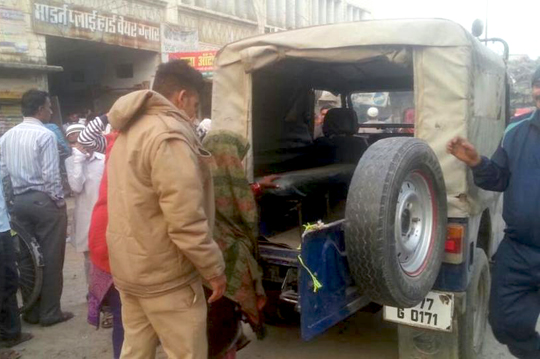
Woman delivers baby inside bank while waiting in queue

December 3, 2016

Kanpur, Dec 3: A woman delivered a healthy baby girl inside a bank in Kanpur Dehat district of Uttar Pradesh while she was waiting in a queue with her mother-in-law to withdraw cash on Friday.

kanpur

Other women present helped Sarvesha deliver the baby after an ambulance did not reach the Punjab National Bank's Jhinjhak branch. Cops then drove the mother and child to the hospital in a police van.

Sarvesha (30) was reportedly waiting at the bank to withdraw cash for the second time in two days. After failing to withdraw money on Thursday, she visited the bank again on Friday and went into labour around 4pm while waiting in a queue since morning.

“She is weak but the baby is healthy,” the woman's mother-in-law Shashi said. “I was afraid that I may lose Sarvesha but she delivered a beautiful baby and is recuperating”.

Sarvesha's husband Aashwendra dies in an accident in September this year and she was at the bank to withdraw the first instalment of the Rs 2.75 lakh compensation allotted to her, along with a house, by the government.

The Centre's move to scrap old Rs 500/1000 notes -- aimed at curbing black money -- has created chaos, with people queueing up outside banks and ATMs across the country to withdraw cash.

Comments

KhasaiKhane
 - 
Saturday, 3 Dec 2016

@Yogesh :

And also you have the most stupidest PM of the world, who sends his 90 year old mother to the bank, with a Photographer!

KhasaiKhane
 - 
Saturday, 3 Dec 2016

@Venki : I am surprised that you didn't say..\If soldiers can..\"

Jesus {AlyhiSalam} and Mary [AlyhiSalam] were guided by the Lord of the Worlds, the Most perfect.
To continue further about their blessed life to a Sanghi bigot is a waste

harish
 - 
Saturday, 3 Dec 2016

The poor are suffering in q lines while the rich are enjoying

Shalini
 - 
Saturday, 3 Dec 2016

ache din for pregnant. sabka sath sabka vikas, hospital bill saved.

Mahendra
 - 
Saturday, 3 Dec 2016

take modi and his entire cabinet to the international criminal court. thats the only way we can free ourselves from Hitler.

Add new comment

  • Coastaldigest.com reserves the right to delete or block any comments.
  • Coastaldigset.com is not responsible for its readers’ comments.
  • Comments that are abusive, incendiary or irrelevant are strictly prohibited.
  • Please use a genuine email ID and provide your name to avoid reject.
News Network
April 16,2020

New Delhi, Apr 16: Minority Affairs Minister Mukhtar Abbas Naqvi on Thursday directed state waqf boards to ensure strict implementation of lockdown and social distancing guidelines during the holy month of Ramzan starting next week amid the coronavirus pandemic.

At a meeting via video conferencing, Naqvi asked the state waqf boards' officials to create awareness among people to offer prayers and perform other religious rituals like "iftar (breaking of fast)" during Ramzan, which begins on April 24 or 25, staying inside their homes.

More than seven lakh registered mosques, eidgahs, imambadas, dargahs and other religious and social institutions come under state waqf boards across the country. The Central Waqf Council is the regulatory body of state waqf boards in India.

"We should cooperate with health workers, security forces, administrative officers, sanitation workers. They are working for our safety and well-being even putting their own lives at risk in this coronavirus pandemic," Naqvi said.

"We should also demolish rumours and misinformation being spread about quarantine and isolation centres by creating awareness among people that such centres are only meant to protect people, their families and the society from the pandemic," the minister said.

Naqvi told all the state waqf boards and religious and social organisations that everyone should remain cautious of any type of fake news and conspiracies aimed at creating misinformation. 

"Authorities have been working for safety and well-being of all citizens of the country without any discrimination. Such type of rumours and conspiracies are a nefarious design to weaken the fight against coronavirus," he said.

"We should work united to win this fight against corona by defeating any type of rumour, misinformation and conspiracy," the minister said.

Naqvi asked officials of all the state waqf boards to play an active and effective role in ensuring that people follow the guidelines of the Union Home Ministry, state governments and the Central Waqf Council while fulfilling religious responsibilities during Ramzan.

In view of the challenges of the COVID-19 pandemic, all religious and social activities and mass gatherings in all the temples, gurdwaras, churches and other religious and social places of the country have been stopped, he said. 

Similarly, any mass gatherings in mosques and other Muslim religious places of the country has also been stopped, Naqvi said.

He said that due to the COVID-19 threat, religious leaders as well as religious and social organisations from all regions of the country, have appealed to people to offer prayers and perform all other religious rituals staying inside their homes during Ramzan. 

Most of the Muslim nations of the world have also banned mass gatherings at mosques and other religious places during the holy month, he pointed out.

Prime Minister Narendra Modi, in cooperation with all the state governments, has been working effectively for the safety and well-being of the people, he said.

The cooperation of the people has brought great relief to India in the war against COVID-19 Naqvi said, adding that several challenges are still there before the country. 

"We can defeat these challenges of the coronavirus pandemic by following all the guidelines of the central and state governments strictly," he asserted.

Chairman and senior officials from state waqf boards such as Uttar Pradesh (Shia & Sunni), Andhra Pradesh, Bihar (Shia & Sunni), Dadra & Nagar Haveli, Haryana, Karnataka, Kerala, Madhya Pradesh, Punjab, West Bengal, Andaman & Nicobar, Assam, Manipur, among others participated in the meeting.

State waqf boards from Rajasthan, Telangana, Delhi, Chhattisgarh, Gujarat, Himachal Pradesh, Jammu and Kashmir, Jharkhand, Maharashtra, Odisha, Puducherry, Tamil Nadu, Tripura and Uttarakhand also participated.


Comments

Add new comment

  • Coastaldigest.com reserves the right to delete or block any comments.
  • Coastaldigset.com is not responsible for its readers’ comments.
  • Comments that are abusive, incendiary or irrelevant are strictly prohibited.
  • Please use a genuine email ID and provide your name to avoid reject.
News Network
March 28,2020

Bengaluru, Mar 28: Sun Tsu, in 'The Art of War' speaks of a skilful general who can subdue his enemy without any fighting. This constitutes the ultimate triumph which is referred to as stratagem. Today, we would need one such when we are faced with the '21-day corona challenge' for India.
Nearly four weeks back, Dr Jyothsna Rao, Dr Gururaj Rao and I sat across the OPD in the afternoon at HCG Bengaluru discussing our ongoing cancer immunology research. While on this topic, we drifted into the discussion on the coronavirus. During this engaging discussion, we wondered the similarity of the enigma between the virus and cancer. I paused to ask Dr Jyothsna and Dr Guru - how we wish we could do something against this virus.
Dr Jyothsna is a PhD from NCBS and had worked under Dr Ralph Steinman, physician and researcher from Rockefeller University, who won the Nobel Prize for his discovery of the dendritic cell and its role in adaptive immunity in 2011. Dr Gururaj is a molecular and cell biologist who did his PhD at the Chapel Hill, University of North Carolina and is the Director of iCrest.
Jyothsna while hearing our perplexing conversation on the covid intervened, "Yes, surely. I think we should take a break from cancer and focus on the innate and adaptive immunity role in COVID-19."
Thus began this sincere attempt to relook the human immune system from the eyes of the COVID-19.
We have 10 types of immune cells at the least which are widely dispersed in millions across the body. When our body is invaded by a foreign organism (bacteria, fungi or virus), these cells work with each other to destroy the invader.
Now, the question is - how do the immune cells talk to each other? They use small-molecule substances called cytokines (cyto means cells; kine means movement). There are many cytokines that are involved in work on the immune system. The most relevant for viruses are interferons.
Interferons (IFN) as the name reflects have an ability to interfere with the viral activity and stop their multiplication. These specialised signal proteins are released by our cells in response to a viral attack to forewarn other cells. They help build the antiviral proteins within the cells to kill the virus as it tries to invade the new cells.
Historically, interferons are a group of cytokines known to be potent antiviral agents against viruses and a hallmark cytokine induced by the host upon viral infections. Interferons possess unique immunoregulatory activities and are signature cytokines released by (TH1) T immune cells, which are crucial in viral infections.
As the outbreak of COVID-19 grapples us, an urgent need for finding strategies to combat the virus is growing. Coronaviruses (CoVs) are a group of RNA viruses. In patients infected with coronavirus, it was indicated that the activation of the IFN does not occur until 48 hours post-infection. Thus the delayed IFN-related antiviral response by the healthy cells leads to coronavirus evade the immune response.
Numerous studies have presented the success in defeating CoVs by the direct administration of IFNs. In a combination as a concoction, it was shown to synergistically inhibit the virus replication in vitro.
Moreover, it is understood that the earlier induction of IFNs in children although they have a less developed immune system could be the reason behind the children being least affected.
The key to success in reducing the disease fatality might be the stimulation of the immune responses to trigger IFN production at the very early stages of the disease, which might be done through the administration of IFN. Despite the evidence for the efficacy of IFNs in treating CoV-induced infections, the proper dosing and ideal timing for such interventions needs to be verified in clinical trials.
For the later stages of the diseases in advance stages where patients are on ventilator and have developed respiratory distress, we propose to utilise the mesenchymal cells derived from donor bone marrow that have been known to treat acute respiratory syndrome. Mesenchymal cells are known to possess anti-inflammatory activity and thus used often in autoimmune diseases.
With this scientific background, we have activated T cells from healthy donors, in a cGMP facility at iCrest - HCG hospital with an enriched cocktail of cytokines rich in Interferons. Injections of this cocktail we believe will result in a surge of cytokines in the body of the infected person and will boost his ability to fight the virus in the early phases. We are in the initial phases of this study and hope to be ready in the coming weeks with meaningful data on its potential utility.
Currently, it awaits government approvals (Union and state) and we have applied to central drugs authority for their initial evaluation and further directions.
As my Guru often expounded the philosophy of 'Seva' - the goal of education is knowledge, the end goal of knowledge is service. In this attempt to serve our fellow humans at this brink of unprecedented crisis, medical fraternity stands with you and promises to do our best for your safety.
We assure to exhaust every bit of our spirit in this fight against coronavirus. We have lost the sight of shores and travelled thus far, but that is the mandatory first step to cross the ocean. Are we going to succeed in this battle, is something only time will answer. 

Comments

Add new comment

  • Coastaldigest.com reserves the right to delete or block any comments.
  • Coastaldigset.com is not responsible for its readers’ comments.
  • Comments that are abusive, incendiary or irrelevant are strictly prohibited.
  • Please use a genuine email ID and provide your name to avoid reject.
Agencies
February 13,2020

Bengaluru, Feb 13: UK's Chancellor of the Exchequer Sajid Javid quit the Boris Johnson government as part of a cabinet reshuffle unfolding on Thursday and has been replaced by Rishi Sunak, reports said.

Indian-descent Sunak, 39, who is married to Akshata, the daughter of Infosys co-founder N.R. Narayana Murthy, was Chief Secretary to the Treasury since July 2019.

An analyst with Goldman Sachs before joining politics in 2014, Sunak, whose grandparents were from Punjab and emigrated to the UK from east Africa, is MP from Richmond (Yorkshire). He was Parliamentary Under-Secretary of State for Local Government in the Theresa May government.

Pakistani-descent Javid, who became the first Asian to become a Cabinet Minister when he was made Secretary of State of culture, Media and Sports in the David Cameron government in 2014 after stints as Economic Secretary to the Treasury (2012-13) and Financial Secretary (2013-14), was earlier the Home Secretary in the the Theresa May government.

He had then cleared absconding businessman Vijay Mallya's extradition to India in February last year following the decision by the Westminister Magistrates Court in December 2018.

Javid, who ran for Conservative Party leadership after May quit but lost to Boris Johnson, was made Chancellor by the later. In the reshuffle on Thursday, he was offered to retain his post if he fired all his advisors but declined and quit, the BBC reported.

Comments

Add new comment

  • Coastaldigest.com reserves the right to delete or block any comments.
  • Coastaldigset.com is not responsible for its readers’ comments.
  • Comments that are abusive, incendiary or irrelevant are strictly prohibited.
  • Please use a genuine email ID and provide your name to avoid reject.