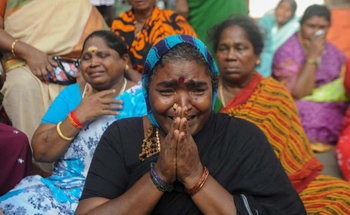
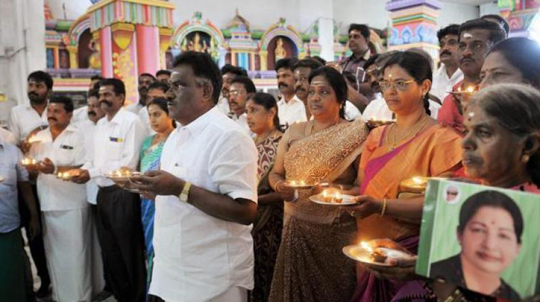
Jaya's situation 'extremely grave', says London specialist

December 5, 2016

Chennai, Dec 5: The condition of Tamil Nadu Chief Minister J Jayalalithaa is "extremely grave", the London doctor who is being consulted for her treatment said today.

jayagravem"Unfortunately, and in spite of the progress she had made, her underlying health conditions inevitably meant that the risk of further problems always remained," Dr Richard Beale said in a statement.

"The situation is extremely grave, but I can confirm that everything possible is being done to give her the best chance of surviving this shocking event. She is being cared for by a highly multi-disciplinary team and is now on extra corporeal life support.

"This is the most advanced level of support available and is the approach the best centres internationally would take in this situation. That this technology is available in Apollo Chennai reflects the high degree of expertise of this centre and, that at all times, Madam has received exceptional care from Apollo and AIIMS care team, which are equal of any in the world," he said.

He said his prayers and thoughts were with the Chief Minister, her family, her carers and the people of Tamil Nadu "at this very difficult time".

jayagrave

Comments

A. Mangalore
 - 
Monday, 5 Dec 2016

Neera Melana gulle nijawalla hariye......

Sherief
 - 
Monday, 5 Dec 2016

Our thoughts and prayers are with you as we wish for a complete and fast recovery. Get well soon.

Kannadiga
 - 
Monday, 5 Dec 2016

kannadigara sapa thattade erutha!

Add new comment

  • Coastaldigest.com reserves the right to delete or block any comments.
  • Coastaldigset.com is not responsible for its readers’ comments.
  • Comments that are abusive, incendiary or irrelevant are strictly prohibited.
  • Please use a genuine email ID and provide your name to avoid reject.
News Network
March 23,2020

New Delhi, Mar 23: The central government has asked state governments to take strict action against violators of the coronavirus lockdown being enforced in 80 districts across the country.

An official statement released on Monday said there will be a total lockdown in 80 districts where coronavirus cases have been reported. The shutdown will end on March 31.

Delhi's borders will remain sealed during the lockdown, but essential services related to health, food, water and power supply will continue, and 25 per cent of the DTC buses will run to transport people associated with essential services.

Prime Minister Narendra Modi earlier on Monday appealed to state governments to ensure that rules and regulations of the coronavirus lockdown are enforced as he noted that many people were not taking the measure seriously.

"Many people are still not taking the lockdown seriously. Please save yourself, save your family, follow the instructions seriously. I request state governments to ensure rules and laws are followed," he said in a tweet in Hindi.

Comments

Add new comment

  • Coastaldigest.com reserves the right to delete or block any comments.
  • Coastaldigset.com is not responsible for its readers’ comments.
  • Comments that are abusive, incendiary or irrelevant are strictly prohibited.
  • Please use a genuine email ID and provide your name to avoid reject.
News Network
June 17,2020

New Delhi, Jun 17: Police Surender Jeet Kaur, Assistant Commissioner of Delhi Police Surender Jeet Kaur, has held herself responsible for the death of her husband Charan Jeet Singh, who succumbed to Covid at a hospital in Delhi.

“My husband didn’t step out of the house when the lockdown started, but I went out daily because of my job… I will never be able to forgive myself,” Kaur on Tuesday, a day after losing her husband.

54-year-old Singh, a resident of Lajpat Nagar and a businessman, is survived by his wife and their 26-year-old son who lives in Canada.

Kaur, 57, ACP (Crimes Against Women) in the South-East district of the Delhi Police, is also ACP (Covid Cell) of the district. On May 20, five days after Kaur tested positive for the virus, her husband Singh tested positive, followed by the ACP’s 80-year-old father on May 24.

All of them had symptoms and while Kaur and Singh were admitted to Indraprastha Apollo hospital, her father was admitted to Max hospital in Saket. On May 26, Kaur returned home after recovering from the virus.

Kaur said, “I last spoke to my husband on May 22 night, when we were both admitted in the hospital in different wards. The doctor called me and said that my husband needs to be put on ventilator support. I had a video call with my husband. He was breathless and told me that his oxygen level was dropping. He showed me the monitor, the doctors in the room, and then said he was having trouble speaking and that he would send me WhatsApp messages.”

A day after he passed away, Kaur recalled the messages that Singh sent her just before being put on ventilator support. “He started sending me details of our finances, accounts… I told him to stop and asked him why he was telling me all this. He said I needed to know… Maybe he feared he wouldn’t come back. I prayed every day, at temples, mosques, churches and gurdwaras for him. I am devastated that he’s gone. We were to move to Canada to live with our son in 2023 after my retirement. We had so many plans.”

Kaur’s brother Maninder Ahluwalia said the hospital tried plasma therapy but Singh didn’t respond to the treatment. “He had diabetes and high BP, but those were always under control. We were hopeful,” he said.

The couple’s son joined on video call from Canada to watch his father’s last journey from the ambulance to the entrance of the crematorium. “My son couldn’t attend his father’s last rites because there are no flights… It’s so unfortunate,” said Kaur.

Friends and family remember Singh as a “jolly, disciplined and brave man”, while Kaur said he was the “perfect partner”. She said, “When I was an SHO-rank officer, I would work for 36 hours straight some days, and he would handle the house and our son who was growing up. I would miss family functions and important occasions but he would always go and make up for my absence. I was able to do this job for decades because of his support.”

On Tuesday afternoon, Singh was cremated in the presence of close family and members of the police fraternity. “The DCP and the Joint CP called me daily to enquire about my husband, other police officers too. I am grateful for their support. They didn’t let me feel alone for a single day,” said Kaur.

Comments

Add new comment

  • Coastaldigest.com reserves the right to delete or block any comments.
  • Coastaldigset.com is not responsible for its readers’ comments.
  • Comments that are abusive, incendiary or irrelevant are strictly prohibited.
  • Please use a genuine email ID and provide your name to avoid reject.
News Network
June 12,2020

Jun 12: There have been complaints of non-availability of beds or denial of treatment to coronavirus patients in the national capital despite nearly 70 per cent of beds in five designated hospitals run by the Delhi government lying vacant, with experts attributing it to people''s aversion towards state-run facilities.

As per the latest information shared on the Delhi Corona app on Thursday afternoon, more than 3,000 beds are lying vacant in these five dedicated COVID-19 hospitals that have a total capacity of 4,344 beds.

However, almost all beds at several big private hospitals are shown to be occupied.

Families of many COVID-19 patients, confirmed or suspected, have alleged in the past few weeks that they have been denied admission at many facilities or have not been able to get a bed for their kin.

Medical and public health experts feel it may be because of the image associated with government hospitals, related to infrastructure and hygiene conditions, and perhaps shortage of staff.

According to the latest data available on Delhi Corona app on Thursday afternoon, a total of 9,444 beds are available in private facilities and hospitals run by the central and Delhi governments. Out of these, 4,371 are vacant.

The app shows that beds are available at Delhi government-run hospitals dedicated for COVID-19 treatment such as LNJP Hospital (1,219), GTB Hospital (1,314), Rajiv Gandhi Super Speciality Hospital or RGSSH (242).

However, almost all beds at several big private hospitals are shown to be occupied.

At LNJP Hospital, there are a total of 2,000 beds, out of these 781 are occupied. GTB Hospital has total 1,500 beds, only 186 of which are occupied. Even at RGSSH, 258 of the 500 beds are occupied.

Beds are available at other dedicated COVID-19 facilities in the national capital too, according to the app. Deep Chand Bandhu Hospital has 94 unoccupied beds out of a total 176 and Satyawadi Raja Harishchandra Hospital has 145 vacant beds out of a total 168.

This makes a total of 4,344 COVID-19 beds at these five dedicated Delhi government hospitals, out of which 3,014 or 69.38 per cent are vacant.

A senior doctor at the RGSSH said, "We are only admitting very serious COVID-19 patients in the hospital. Those with mild symptoms, or asymptomatic ones, are either being home quarantined or being sent to COVID Care Centres. Our beds are on stand-by also to accommodate serious patients in case there is a sudden rush."

Delhi Heath Minster Satyendar Jain had recently said that some private hospitals could have been denying admission, but the Delhi government-run hospitals have not denied beds to any needy COVID-19 patient.

He had also said that main private hospitals are almost full to their capacity in terms of number of COVID-19 beds.

According to the app, at prominent private hospitals like Indraprastha Apollo, Max Hospital in Shalimar Bagh, Fortis Hospital in Shalimar Bagh, BL Kapur Hospital are fully occupied.

Max Hospital in Saket has a total of 200 beds for COVID-19 patients, and only one is vacant.

On June 9, the Delhi government had directed 22 private hospitals in the national capital to dedicate a total of 2,015 extra beds for treatment of coronavirus patients, revising its earlier allocation limit of 20 per cent.

Lawyer and public heath activist Ashok Agarwal said infrastructure and hygiene are two main factors, and people still want to "avoid government facilities".

"I know of cases, where people were willing to be on waiting list of private hospitals but did not go to a government hospital, even though beds were available," he said.

Even those who went to a government hospital for COVID-19 treatment, complained of "dirty toilets, and these being used by multiple patients", Agarwal said.

"Also, as the cases erupted successively over the months, many people got scared and were in two minds to go to a government hospital, as admitted patients were making allegations in videos and on social media about lack of proper services. Besides, there is shortage of medical staff at various facilities, and each patient needs to be attended to," he argued.

Delhi government hospitals and private facilities were directed to prominently display information about the availability of beds on a flex board at their main gates.

Delhi Lt Governor Anil Baijal on Wednesday ordered Delhi hospitals to display the availability of COVID and non-COVID beds, charges for rooms or beds along with contact details on a LED board outside the hospital.

Max Hospital sources said they were already displaying the status of beds on LED screens near their reception area even before the government order.

A spokesperson from Fortis Hospital said, "We are in the process of arranging to put up the displays as per the prescribed format."

Delhi recorded 1,501 fresh coronavirus cases on Wednesday, taking the COVID-19 tally in the city to over 32,000, and the death toll due to the disease mounted to 984, authorities said.


Comments

Add new comment

  • Coastaldigest.com reserves the right to delete or block any comments.
  • Coastaldigset.com is not responsible for its readers’ comments.
  • Comments that are abusive, incendiary or irrelevant are strictly prohibited.
  • Please use a genuine email ID and provide your name to avoid reject.