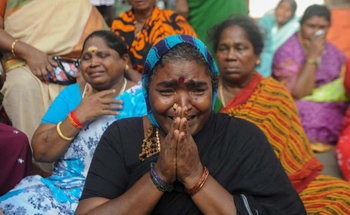
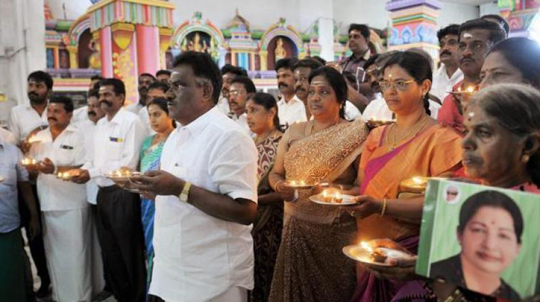
Jaya's situation 'extremely grave', says London specialist

December 5, 2016

Chennai, Dec 5: The condition of Tamil Nadu Chief Minister J Jayalalithaa is "extremely grave", the London doctor who is being consulted for her treatment said today.

jayagravem"Unfortunately, and in spite of the progress she had made, her underlying health conditions inevitably meant that the risk of further problems always remained," Dr Richard Beale said in a statement.

"The situation is extremely grave, but I can confirm that everything possible is being done to give her the best chance of surviving this shocking event. She is being cared for by a highly multi-disciplinary team and is now on extra corporeal life support.

"This is the most advanced level of support available and is the approach the best centres internationally would take in this situation. That this technology is available in Apollo Chennai reflects the high degree of expertise of this centre and, that at all times, Madam has received exceptional care from Apollo and AIIMS care team, which are equal of any in the world," he said.

He said his prayers and thoughts were with the Chief Minister, her family, her carers and the people of Tamil Nadu "at this very difficult time".

jayagrave

Comments

A. Mangalore
 - 
Monday, 5 Dec 2016

Neera Melana gulle nijawalla hariye......

Sherief
 - 
Monday, 5 Dec 2016

Our thoughts and prayers are with you as we wish for a complete and fast recovery. Get well soon.

Kannadiga
 - 
Monday, 5 Dec 2016

kannadigara sapa thattade erutha!

Add new comment

  • Coastaldigest.com reserves the right to delete or block any comments.
  • Coastaldigset.com is not responsible for its readers’ comments.
  • Comments that are abusive, incendiary or irrelevant are strictly prohibited.
  • Please use a genuine email ID and provide your name to avoid reject.
News Network
June 20,2020

New Delhi, Jun 20: A rare celestial event, annular solar eclipse, which is popularly known as the "ring of fire" eclipse, will be visible this Sunday in India.

It will be the first solar eclipse of this year takes place on the summer solstice, which is the longest day in the Northern Hemisphere.

While people living along the path annular eclipse passing through Anupgarh, Suratgarh, Sirsa, Jakhal, Kurukshetra, Yamunanagar, Dehradun, Tapowan and Joshimath will be able to see the annular phase, people in rest of India can witness a partial eclipse, said the Ministry of Science and Technology.

When Moon comes between the Sun and Earth, the shadow falls on the surface of the Earth. The Sun is entirely covered by the Moon for a brief period. Those places that are engulfed by the dark, dense umbral shadow of the Moon experience the total solar eclipse. In the regions that plunge into the soft diffused penumbral shadow of the Moon experience the partial eclipse.

"Annular solar eclipse is a particular case of the total solar eclipse. Like the total solar eclipse, the Moon is aligned with the Sun. However, on that day, the apparent size of the Moon happens to be a wee smaller than the Sun. Hence the Moon covers the central part of the Sun, and the rim of the Sun appear like a 'ring of fire' in the sky for a very brief moment" explains Samir Dhurde of The Inter-University Centre for Astronomy and Astrophysics, Pune.

During the solar eclipse, the apparent size of the Moon is smaller than that of the Sun by 1 per cent, the expert said.

Allying rumours that the eclipse will mark the end of coronavirus, Aniket Sule, Chairperson, Public Outreach and Education Committee of the Astronomical Society of India, said: "Solar eclipse is caused when the Moon comes in front of the Sun for a short time. As seen from Earth eclipses occur somewhere in the Earth 2 to 5 times a year. Eclipses do not impact microorganisms on Earth. Likewise there no danger in eating of stepping out during an eclipse. No mysterious rays come out of the Sun during an eclipse."

Comments

Add new comment

  • Coastaldigest.com reserves the right to delete or block any comments.
  • Coastaldigset.com is not responsible for its readers’ comments.
  • Comments that are abusive, incendiary or irrelevant are strictly prohibited.
  • Please use a genuine email ID and provide your name to avoid reject.
Agencies
January 15,2020

New Delhi, Jan 15: A Delhi court on Wednesday granted bail to Bhim Army chief Chandrashekhar Azad in connection with the Daryaganj violence case.

The court has ordered him not to hold any protest in Delhi till February 16th.

While hearing the case, the Judge had asked Azad's counsel to read out some of his social media posts.

Advocate Mehmood Pracha, representing Azad, had on Tuesday said that the petitioner was sent to jail without any evidence in connection with anti-CAA protests in Delhi's Darya Ganj area last year.

"I think the court's comments should become a precedent for the country. The Public Prosecutor at the behest of police tried to make this a communal issue. We told the court that the government has a problem with Azad because he made the CAA-NPR-NRC an issue for everyone. 
The Court also sought evidence," Pracha told ANI after Delhi's Tis Hazari court deferred the bail plea of Azad till today.

On Wednesday, the court pulled up the Delhi Police for failing to show any evidence against Azad.

Azad was arrested on December 21 last year after he led a march from Jama Masjid against the Citizenship (Amendment) Act. He was sent to judicial custody till January 18 at Tihar jail.

The Bhim Army chief was charged with rioting, unlawful assembly and inciting the mob to indulge in violence after vandalism in Delhi's Daryaganj area.

Comments

Add new comment

  • Coastaldigest.com reserves the right to delete or block any comments.
  • Coastaldigset.com is not responsible for its readers’ comments.
  • Comments that are abusive, incendiary or irrelevant are strictly prohibited.
  • Please use a genuine email ID and provide your name to avoid reject.
News Network
January 24,2020

New Delhi, Jan 24: Although India's Ujjwala programme encouraged adoption of liquefied petroleum gas (LPG) for cooking among the poor, households availing the scheme have not shifted away from using highly polluting fuels like firewood, a study reveals.

The researchers, including those from the University of British Columbia (UBC) in Canada, found that additional incentives to encourage regular use of cooking gas are necessary for a complete transition to clean cooking fuel among poor rural households.

They noted that about 2.9 billion people across Asia, Africa, and Latin America burn solid fuels like firewood to meet their cooking energy needs.

This has significant negative implications for public health, the environment, and societal development, according to the researchers.

Through the Pradhan Mantri Ujjwala Yojana (PMUY), India has provided capital cost subsidies to poor women to adopt a clean-burning cooking fuel or LPG.

The researchers explained that within the first 40 months of the scheme, more than 80 million households obtained LPG stoves.

However, the full benefits of LPG adoption depend on near complete replacement of polluting fuels with LPG, according to a research-based policy brief published in the journal Nature Energy.

The scientists said this cannot be assumed solely on the basis of LPG presence in the household.

"Our research shows that Ujjwala was able to attract new consumers rapidly, but those consumers did not start using LPG on a regular basis," Abhishek Kar, a postdoc at Columbia University in the US, told PTI.

The study analysed LPG sales data for over 25,000 consumers, including PMUY beneficiaries, as well as general rural LPG consumers in Koppal district of Karnataka.

The scientists employed data covering all LPG purchases of PMUY beneficiaries through their first year in the programme.

They also assessed the general rural population's purchases during their first five years as consumers to assess the effect of experience on use.

The findings estimate that an average rural family needs to purchase five 14.2 kilogramme-cylinders annually to meet half of their cooking needs.

However, the study said just seven per cent of PMUY beneficiaries in Koppal purchased five or more cylinders annually, suggesting that the beneficiaries seldom use LPG.

The general (nonPMUY) consumers in this region use on average two times more LPG cylinders than PMUY beneficiaries, the researchers noted.

Yet, only 45 per cent of nonPMUY consumers use five or more cylinders per year -- even after several years of experience with LPG, they said.

The team assessed price and seasonal factors affecting LPG use among the general population over a three-year period.

It found that LPG consumers are sensitive to price and seasonality -- LPG cylinder refill rates are lower in the summer when agricultural activity is limited, and cash is scarce.

"There was no scheme incentives to promote use, except general LPG subsidies which is available to all, including the urban middle class," said Kar, who was a Ph.D. scholar at UBC when the research was published.

"If there is no additional income, what cost would a poor family on an already tight budget cut to pay for an extra expense on a regular basis.

"Ujjwala has started the scheme of 5 kg-cylinder in response, but the impact of that on LPG sales is still publicly unknown," he said.

These findings, the researchers noted, suggest the need for additional measures to promote regular LPG use for all rural populations.

Although the finding come from a single district in Southern India, it may also apply to other areas with similar socio-economic conditions, they said.

A more expansive evaluation of PMUY would help design targeted incentives to transform infrequent users to regular users, according to the researchers.


Comments

Add new comment

  • Coastaldigest.com reserves the right to delete or block any comments.
  • Coastaldigset.com is not responsible for its readers’ comments.
  • Comments that are abusive, incendiary or irrelevant are strictly prohibited.
  • Please use a genuine email ID and provide your name to avoid reject.