


Demonetisation: ED enquiry op at 50 banks across country

December 7, 2016

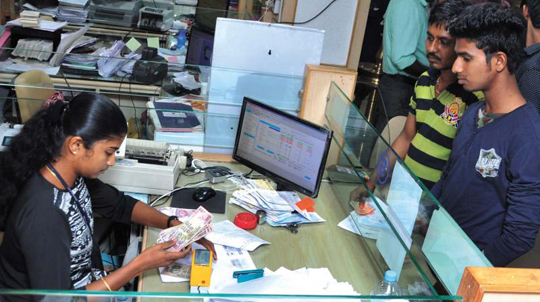
New Delhi, Dec 7: Stepping up action to check financial crimes post demonetisation, the ED today launched an 'enquiry of records' operation at over 50 bank branches across the country to detect money laundering and hawala dealing instances through these channels.
Demonetisation

Officials said multiple teams of the Enforcement Directorate (ED) swooped early morning at over 50 branches of at least ten banks, both in the private and public sector, along with banking auditors to "scrutinise" transaction records and account statements, armed with vital inputs gathered from financial snoop agencies.

They said ED teams have launched the operations at branches located in major cities like Delhi, Mumbai, Bengaluru, Hyderabad, Kolkata, Chennai and others based on records of transaction of these branches where the maximum amount of old notes have been deposited or huge cash has been deposited in bank accounts in one go or in a staggered fashion giving rise to suspicion of suspect deposits.

Officials said the sleuths and auditors are "looking at the banking transaction records post November 8" and instructions have been issued to these teams to ensure that regular operations and customer dealings are not affected due to this.

The ED, tasked with enforcing two important laws to check financial crimes--Prevention of Money Laundering Act (PMLA) and Foreign Exchange Management Act (FEMA)--has sourced Suspicious Transaction Reports (STRs) and Cash Transaction Reports (CTRs) of the banks under scanner from various financial intelligence agencies and has launched the operation to check possible financial irregularities, instances of money laundering and hawala dealings.

The agency had recently arrested two Axis Bank employees working at a branch in Delhi while probing a similar instance under PMLA.

ED, last week, had also conducted searches at 40 locations across the country in order to check black money held with currency exchanges, hawala dealers and others.

Comments

Skazi
 - 
Wednesday, 7 Dec 2016

Why only the transactions post Nov 8 are checked .... Make a comprehensive checking of all transactions from April 1 ....
Mr 56\ CHESTWALA... Pls show your courage"

Add new comment

  • Coastaldigest.com reserves the right to delete or block any comments.
  • Coastaldigset.com is not responsible for its readers’ comments.
  • Comments that are abusive, incendiary or irrelevant are strictly prohibited.
  • Please use a genuine email ID and provide your name to avoid reject.
News Network
May 3,2020

New Delhi, May 3: Union Health and Family Welfare Minister Dr Harsh Vardhan on Sunday said that India's COVID-19 mortality rate of 3.2 per cent is the lowest in the world and over 10,000 coronavirus patients have been discharged from hospitals after recovering from the disease so far.

"Today more than 10,000 COVID-19 patients have been discharged. Those still admitted at hospitals are on the road to recovery. If in last 14 days doubling rate was 10.5 days, then today it is around 12 days," the Minister told ANI after visiting Lady Hardinge Hospital.

"Our mortality rate of 3.2 per cent is the lowest in the world," he said.

With 2,644 more COVID-19 cases and 83 deaths in the last 24 hours, the number of people infected from coronavirus in the country has reached 39,980 including 1,301 deaths, said the Union Ministry of Health and Family Welfare on Sunday.

Currently, there are 28,046 active cases while 10,633 COVID-19 positive patients have been cured/discharged.

Comments

Add new comment

  • Coastaldigest.com reserves the right to delete or block any comments.
  • Coastaldigset.com is not responsible for its readers’ comments.
  • Comments that are abusive, incendiary or irrelevant are strictly prohibited.
  • Please use a genuine email ID and provide your name to avoid reject.
News Network
March 7,2020

New Delhi, Mar 7: Prime Minister Narendra Modi turned emotional on Saturday when a woman beneficiary of his government's generic medicine programme told him that she had seen God in him.

Dehradun-resident Deepa Shah, who suffered paralysis in 2011, was interacting with the prime minister through video-conference on the occasion of Jan Aushadhi Diwas.

"I have not seen god, but I have seen God in you," she said, tears rolling down her eyes.

Modi was visibly emotional as the woman repeated her remark.

She also thanked the Uttarakhand chief minister and others who had helped her all along and said doctors had once told her that she cannot be cured.

"But on hearing your voice I have become better," she told Modi while profusely thanking the prime minister for his efforts to reduce the cost of medicines.

An emotional prime minister paused for a moment before telling her that it was her courage that had won over her disease and that she must carry on with the spirit.

Shah was expressing her plight and how she had suffered due to high cost of medicines after she suffered from paralysis in 2011 and has now started saving Rs 3,500 every month after benefitting from the government's low-cost generic medicines programme.

Soon after Shah rose to express her views, Modi asked her to sit and speak as he said she was uncomfortable while standing.

"You have defeated disease with your own will power. Your courage is your god and that same courage has given you the strength to emerge from such a big crisis. You should carry on this confidence in you," Modi told her.

He said some people still keep spreading rumours about generic medicines, going by their past experience, wondering how can medicines be available so cheap and that there must be something wrong with the medicine.

"But, by seeing you countrymen would gain confidence that there is nothing wrong in generic medicines. These medicines are not at all of inferior quality than any other medicine. These medicines have been certified by the best laboratories. These medicines are made in India and is 'Make in India' and are cheap," the prime minister said.

He said there is demand for generic medicines from India across the world and the government has made it mandatory for doctors to prescribe generic medicines to patients, unless necessary.

Comments

Sameeksha
 - 
Monday, 9 Mar 2020

Wowww so emotional... Lol .really god in you??? Drama king and queen

angry indian
 - 
Sunday, 8 Mar 2020

in 2002 riot we have seen shaitan in you..how come shaitan become GOD...


did he put atleat one tear for his mother, did he feel sad when pregnant muslim woman brutally murdered..

this guy is 21st century dajjal..

Suresh SS
 - 
Sunday, 8 Mar 2020

Big Nautanki, Dramebaz

Add new comment

  • Coastaldigest.com reserves the right to delete or block any comments.
  • Coastaldigset.com is not responsible for its readers’ comments.
  • Comments that are abusive, incendiary or irrelevant are strictly prohibited.
  • Please use a genuine email ID and provide your name to avoid reject.
News Network
July 22,2020

New Delhi, Jul 22: India is responding with utmost urgency to coronavirus from the very beginning and has been continuously strengthening preparedness and response measures, WHO Regional Director (South-East Asia) Poonam Khetrapal Singh said on Wednesday.

"India is responding with utmost urgency to COVID-19 from the start. It's been continuously strengthening preparedness and response measures, including ramping up testing capacities, readying more hospitals, arranging and stocking up medicines and essentials," Singh said at a virtual briefing.

"India took bold, decisive and early measures earlier in the outbreak. The country did not witness an exponential increase in cases like some other countries which reported their first few cases along with India. Like in any other country the transmission of COVID-19 is not homogenous in India. There are areas yet to see a confirmed case, some have sporadic cases, in some areas some small clusters while we are witnessing large clusters in some megacities from the densely populated areas," Singh said.
She said WHO was aware of varying capacities at sub-national levels.

"Not unusual in a country as big as India and its population size that measures taken may often not be uniformly sufficient across all areas. Scaling up capacities and response remains a constant need in India."

Replying on the question of what more needs to be done in controlling the spread of COVID-19, she said all countries including India must continue to implement core public health and social distancing measures.

"Local epidemiology to guide our response for finding hotspots and testing, detecting, isolating and providing care to the affected, promoting safe hygiene practices and respiratory etiquette, protecting health workers and increasing health system capacity is also key," she said.

Comments

Add new comment

  • Coastaldigest.com reserves the right to delete or block any comments.
  • Coastaldigset.com is not responsible for its readers’ comments.
  • Comments that are abusive, incendiary or irrelevant are strictly prohibited.
  • Please use a genuine email ID and provide your name to avoid reject.