Demonetisation: ED enquiry op at 50 banks across country

December 7, 2016

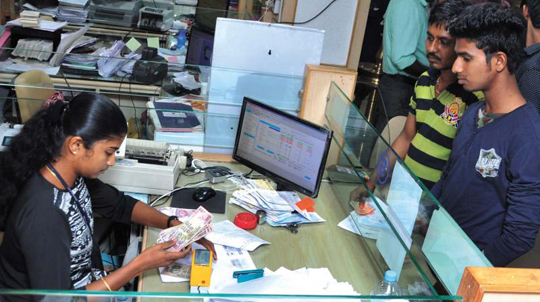
New Delhi, Dec 7: Stepping up action to check financial crimes post demonetisation, the ED today launched an 'enquiry of records' operation at over 50 bank branches across the country to detect money laundering and hawala dealing instances through these channels.

Demonetisation

Officials said multiple teams of the Enforcement Directorate (ED) swooped early morning at over 50 branches of at least ten banks, both in the private and public sector, along with banking auditors to "scrutinise" transaction records and account statements, armed with vital inputs gathered from financial snoop agencies.

They said ED teams have launched the operations at branches located in major cities like Delhi, Mumbai, Bengaluru, Hyderabad, Kolkata, Chennai and others based on records of transaction of these branches where the maximum amount of old notes have been deposited or huge cash has been deposited in bank accounts in one go or in a staggered fashion giving rise to suspicion of suspect deposits.

Officials said the sleuths and auditors are "looking at the banking transaction records post November 8" and instructions have been issued to these teams to ensure that regular operations and customer dealings are not affected due to this.

The ED, tasked with enforcing two important laws to check financial crimes--Prevention of Money Laundering Act (PMLA) and Foreign Exchange Management Act (FEMA)--has sourced Suspicious Transaction Reports (STRs) and Cash Transaction Reports (CTRs) of the banks under scanner from various financial intelligence agencies and has launched the operation to check possible financial irregularities, instances of money laundering and hawala dealings.

The agency had recently arrested two Axis Bank employees working at a branch in Delhi while probing a similar instance under PMLA.

ED, last week, had also conducted searches at 40 locations across the country in order to check black money held with currency exchanges, hawala dealers and others.

Comments

Skazi
 - 
Wednesday, 7 Dec 2016

Why only the transactions post Nov 8 are checked .... Make a comprehensive checking of all transactions from April 1 ....
Mr 56\ CHESTWALA... Pls show your courage"

Add new comment

  • Coastaldigest.com reserves the right to delete or block any comments.
  • Coastaldigset.com is not responsible for its readers’ comments.
  • Comments that are abusive, incendiary or irrelevant are strictly prohibited.
  • Please use a genuine email ID and provide your name to avoid reject.
News Network
February 11,2020

New Delhi, Feb 11: As the counting of votes for the Delhi Assembly polls began, Congress leader Digvijaya Singh on Tuesday raised doubts on EVMs, alleging that no machine having a chip is tamper-proof.

He called upon the Election Commission and the Supreme Court to take a fresh look at the use of EVMs in the country.

"No machine (which) has a chip is tamper-proof. Also please do for a moment think, why no developed country uses EVM," Singh said in a tweet.

"Would CEC and Hon Supreme Court please have a fresh look on EVM voting in India? We are the largest democracy in the world, we can't allow some unscrupulous people to hack results and steal the mandate of 1.3 billion people.

"If they match the votes in the counting unit. Declare the result. If they don't match then count the ballots of all polling booths in the assembly. It would convince everyone and save time also as this has been the consistent argument of CEC in favour of EVM," the Congress leader said.

Polling for the 70-member Delhi Assembly polls was held on Saturday.

The Election Commission on Sunday announced that the final voter turnout was 62.59 per cent, five per cent less than 2015.

Comments

Add new comment

  • Coastaldigest.com reserves the right to delete or block any comments.
  • Coastaldigset.com is not responsible for its readers’ comments.
  • Comments that are abusive, incendiary or irrelevant are strictly prohibited.
  • Please use a genuine email ID and provide your name to avoid reject.
Agencies
June 30,2020

United Nations, Jun 30: India accounts for 45.8 million of the world's 142.6 million "missing females" over the past 50 years, a report by the United Nations said on Tuesday, noting that the country along with China form the majority of such women globally.

The State of World Population 2020 report released on Tuesday by the United Nations Population Fund (UNFPA), the world organisation's sexual and reproductive health agency, said that the number of missing women has more than doubled over the past 50 years - from 61 million in 1970 to a cumulative 142.6 million in 2020.

Of this global figure, India accounted for 45.8 million missing females as of 2020 and China accounted for 72.3 million.

Missing females are women missing from the population at given dates due to the cumulative effect of postnatal and prenatal sex selection in the past, the agency said.

Between 2013 and 2017, about 460,000 girls in India were missing' at birth each year. According to one analysis, gender-biased sex selection accounts for about two-thirds of the total missing girls, and post-birth female mortality accounts for about one-third, the report said.

Citing data by experts, it said that China and India together account for about 90-95 per cent of the estimated 1.2 million to 1.5 million missing female births annually worldwide due to gender-biased (prenatal) sex selection.

The two countries also account for the largest number of births each year, it said.

The report cites data by Alkema, Leontine and others, 2014 National, Regional, and Global Sex Ratios of Infant, Child, and under-5 Mortality and Identification of Countries with Outlying Ratios: A Systematic Assessment' from The Lancet Global Health.

According to their analysis, India has the highest rate of excess female deaths, 13.5 per 1,000 female births, which suggests that an estimated one in nine deaths of females below the age of 5 may be attributed to postnatal sex selection.

The report notes that governments have also taken action to address the root causes of sex selection. India and Vietnam have included campaigns that target gender stereotypes to change attitudes and open the door to new norms and behaviours.

They spotlight the importance of daughters and highlight how girls and women have changed society for the better. Campaigns that celebrate women's progress and achievements may resonate more where daughter-only families can be shown to be prospering, it said.

The report said that successful education-related interventions include the provision of cash transfers conditional on school attendance; or support to cover the costs of school fees, books, uniforms and supplies, taking note of successful cash-transfer initiatives such as Apni Beti Apna Dhan' in India.

It said that preference for a male child manifested in sex selection has led to dramatic, long-term shifts in the proportions of women and men in the populations of some countries.

This demographic imbalance will have an inevitable impact on marriage systems. In countries where marriage is nearly universal, many men may need to delay or forego marriage because they will be unable to find a spouse, the report said.

This so-called "marriage squeeze", where prospective grooms outnumber prospective brides, has already been observed in some countries and affects mostly young men from lower economic strata.

"At the same time, the marriage squeeze could result in more child marriages, the report said citing experts.

Some studies suggest that the marriage squeeze will peak in India in 2055. The proportion of men who are still single at the age of 50 is forecast to rise after 2050 in India to 10 per cent, it said.

The UN report said that every year, millions of girls globally are subjected to practices that harm them physically and emotionally, with the full knowledge and consent of their families, friends and communities.

At least 19 harmful practices, ranging from breast ironing to virginity testing, are considered human rights violations, according to the UNFPA report, which focuses on the three most prevalent ones: female genital mutilation, child marriage, and extreme bias against daughters in favour of sons.

Harmful practices against girls cause profound and lasting trauma, robbing them of their right to reach their full potential, says UNFPA Executive Director Dr. Natalia Kanem.

This year, an estimated 4.1 million girls will be subjected to female genital mutilation. Today, 33,000 girls under age 18 will be forced into marriages, usually to much older men and an extreme preference for sons over daughters in some countries has fuelled gender-biased sex selection or extreme neglect that leads to their death as children, resulting in the 140 million missing females.

The report said that ending child marriage and female genital mutilation worldwide is possible within 10 years by scaling up efforts to keep girls in school longer and teach them life skills and to engage men and boys in social change.

Investments totalling USD 3.4 billion a year through 2030 would end these two harmful practices and end the suffering of an estimated 84 million girls, it said.

A recent analysis revealed that if services and programmes remain shuttered for six months due to the COVID-19 pandemic, an additional 13 million girls may be forced into marriage and 2 million more girls may be subjected to female genital mutilation between now and 2030.

The pandemic both makes our job harder and more urgent as so many more girls are now at risk, Kanem said.


Comments

Add new comment

  • Coastaldigest.com reserves the right to delete or block any comments.
  • Coastaldigset.com is not responsible for its readers’ comments.
  • Comments that are abusive, incendiary or irrelevant are strictly prohibited.
  • Please use a genuine email ID and provide your name to avoid reject.
Agencies
July 24,2020

Lucknow, Jul 24: The Congress in Uttar Pradesh on Friday protested against what it dubbed as deliberate and systematic deletions of chapters dealing in freedom struggle and the party's role in it from the syllabi of Classes 10 and 12 of the Secondary Education Board.

Congress leader Anugrah Narain Singh said: "The deletions effected in Class 12 syllabus clearly has political overtones. Chapters dealing with the freedom movement and the Congress role in it have been cut out. The BJP has no role of its own in the country's history and, therefore, wants that the new generations should not learn about the Congress contribution as well."

A Congress delegation submitted a memorandum to UP Eduction Board Secretary Divya Kant Shukla to demand restoration of the deleted chapters and topics.

BJP MP Rita Bahuguna Joshi accused the opposition Congress of "turning every occasion into a political opportunity during the pandemic".

"The Congress is unnecessarily making an issue out of this. Only some portions have been deleted from the syllabi due to shortening of the academic session due to the nationwide lockdown. People already know about the Congress and the cut in the syllabi is only temporary. The Congress is unnecessarily trying to create a political controversy," she said.

Prof Yogeshwar Tiwari of the History Department in the Allahabad University dubbed the changes made in the syllabi as "unfortunate". "The history is not of the Congress alone -- it is the history of the nation and every student must know about it," he said.

Comments

Add new comment

  • Coastaldigest.com reserves the right to delete or block any comments.
  • Coastaldigset.com is not responsible for its readers’ comments.
  • Comments that are abusive, incendiary or irrelevant are strictly prohibited.
  • Please use a genuine email ID and provide your name to avoid reject.