


Demonetisation: ED enquiry op at 50 banks across country

December 7, 2016

New Delhi, Dec 7: Stepping up action to check financial crimes post demonetisation, the ED today launched an 'enquiry of records' operation at over 50 bank branches across the country to detect money laundering and hawala dealing instances through these channels.
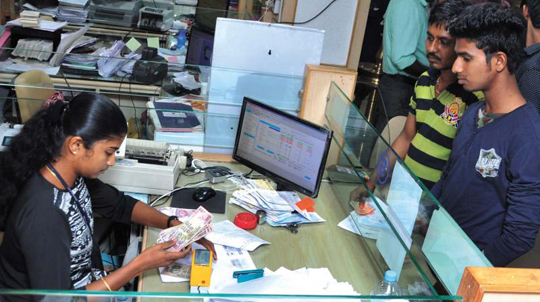
Demonetisation

Officials said multiple teams of the Enforcement Directorate (ED) swooped early morning at over 50 branches of at least ten banks, both in the private and public sector, along with banking auditors to "scrutinise" transaction records and account statements, armed with vital inputs gathered from financial snoop agencies.

They said ED teams have launched the operations at branches located in major cities like Delhi, Mumbai, Bengaluru, Hyderabad, Kolkata, Chennai and others based on records of transaction of these branches where the maximum amount of old notes have been deposited or huge cash has been deposited in bank accounts in one go or in a staggered fashion giving rise to suspicion of suspect deposits.

Officials said the sleuths and auditors are "looking at the banking transaction records post November 8" and instructions have been issued to these teams to ensure that regular operations and customer dealings are not affected due to this.

The ED, tasked with enforcing two important laws to check financial crimes--Prevention of Money Laundering Act (PMLA) and Foreign Exchange Management Act (FEMA)--has sourced Suspicious Transaction Reports (STRs) and Cash Transaction Reports (CTRs) of the banks under scanner from various financial intelligence agencies and has launched the operation to check possible financial irregularities, instances of money laundering and hawala dealings.

The agency had recently arrested two Axis Bank employees working at a branch in Delhi while probing a similar instance under PMLA.

ED, last week, had also conducted searches at 40 locations across the country in order to check black money held with currency exchanges, hawala dealers and others.

Comments

Skazi
 - 
Wednesday, 7 Dec 2016

Why only the transactions post Nov 8 are checked .... Make a comprehensive checking of all transactions from April 1 ....
Mr 56\ CHESTWALA... Pls show your courage"

Add new comment

  • Coastaldigest.com reserves the right to delete or block any comments.
  • Coastaldigset.com is not responsible for its readers’ comments.
  • Comments that are abusive, incendiary or irrelevant are strictly prohibited.
  • Please use a genuine email ID and provide your name to avoid reject.
News Network
March 29,2020

Mumbai, Mar 29: Virologist Minal Dakhave Bhosale led from the front to create India's first coronavirus testing kit even when she was in the last stage of her pregnancy.

Bhosale's efforts paid the price with her team delivering the testing kit in a record time of six weeks.

Bhosale gave birth to a baby girl just a day before submitting the kit to the authorities for evaluation.

"It was like giving birth to two babies," Bhosale told PTI over the phone.

The virologist said both the journeys - that happened in parallel - were not without challenges.

"There were complications in the pregnancy while work on the test kit was on. The baby was delivered through cesarean," she said.

Bhosale said she felt that it was the right time to serve the people to help them in combating the coronavirus threat.

"I had been working for five years in this field and if I don't work in emergency situations when my services are needed the most, then what is the use?" she said.

Though Bhosale was not able to visit the office due to the pregnancy, she was guiding a team of 10 persons working on the project at Mylab Discovery in Pune.

The strong bonds forged with the team over the years and their support made it possible, she said.

Company's co-founder Shrikant Patole said just like drug discovery, test kits too go through a lot of quality checks to improve the precision.

He credited Bhosale for the success of the project.

The COVID-19 testing kit delivered by Bhosale's team will reduce the time taken for delivering a result to 2.5 hours from the prevalent practice of eight hours.

A pioneering approach to testing without compromising on the results was adopted, Bhosale said.

The Maylab test kit will cost Rs1,200, a quarter of Rs 4,500 per kit that the government has been spending on testing so far.

"I'm happy that I could do something for the country," Bhosale said.

As of Friday, only 27,000 of the 1.3 billion people were tested for the virus in the country.

According to experts, high scale testing is essential because it alone can ensure an early diagnosis of COVID-19 and lower down the fatalities.

The company is confident of ramping up the capacity at its plant in Lonavala to deliver 100,000 kits a week, Patole said.

He said the authorities are helping the company, including giving priority for shipping of the raw materials.

Comments

Add new comment

  • Coastaldigest.com reserves the right to delete or block any comments.
  • Coastaldigset.com is not responsible for its readers’ comments.
  • Comments that are abusive, incendiary or irrelevant are strictly prohibited.
  • Please use a genuine email ID and provide your name to avoid reject.
News Network
January 12,2020

New Delhi, Jan 12: As many as 109 children were sexually abused every day in India in 2018, according to the data by the National Crime Records Bureau, which showed a 22 per cent jump in such cases from the previous year.

According to the recently released NCRB data, 32,608 cases were reported in 2017 while 39,827 cases were reported in 2018 under the Protection of Children from Sexual Offences Act (POCSO).

POCSO Act, 2012 is a comprehensive law to provide for the protection of children from offences of sexual assault, sexual harassment and pornography. It requires special treatment of cases relating to child sexual abuse such as setting-up of special courts, special prosecutors, and support persons for child victims.

As many as 21,605 child rapes were recorded in 2018 which included 21,401 rapes of girls and 204 of boys, the data showed.

The highest number of child rapes were recorded in Maharashtra at 2,832 followed by Uttar Pradesh at 2023 and Tamil Nadu at 1457, the data showed.

Overall crimes against children has increased steeply over six times in the decade over 2008-2018, from 22,500 cases recorded in 2008 to 1,41,764 cases in 2018, according to the NCRB data from 2008 and 2018.

In 2017, 1,29,032 cases of crime against children were recorded.

Priti Mahara, Director of Policy Research and Advocacy at CRY – Child Rights and You (CRY) said, that while on the one hand, the increasing numbers of crimes against children are extremely alarming, it also suggests an increasing trend in reporting which is a positive sign as it reflects people's faith in the system.

"It also provides a direction in which government interventions must be made and evidence needs to be created. While some major efforts have been taken to ensure child protection, a lot more is needed to see expected results on the ground," Mahara said.

In percentage terms, major crime against children during 2018 were kidnapping and abduction which accounted for 44.2 per cent followed by cases under POCSO, which accounted for 34.7 per cent, the data showed.

A total of 67,134 children (19,784 male,47,191 female and 159 transgender) were reported missing in 2018. During the year 2018, a total of 71,176 children (22,239 male, 48,787 female and 150 transgender) were traced, the NCRB data said.

As many as 781 cases of use of child for pornography or storing child pornography material was also recorded in 2018, more than double that of  2017 when 331 such cases were recorded, the data showed.

The state-wise segregation of crimes against children reveals Uttar Pradesh, Madhya Pradesh, Maharashtra, Delhi and Bihar accounted for 51 per cent of all crimes in the country, the data said.

While Uttar Pradesh tops the list with 19,936 recorded crimes against children (14 per cent of total crimes), Madhya Pradesh and Maharashtra are the close second and third with 18,992 and 18,892 crimes registered respectively.

The report also showed that cases of sexual harassment in shelter homes against women and children reportedly increased by 30 per cent, from 544 cases recorded in 2017 to 707 cases in 2018.

Mahara suggested that financial investments must be adequately increased with a focus on prevention of crimes against children and the identification of vulnerable children and families.

"Strengthening community-level child protection system is also a key to prevention. While there is growing evidence of the precarious lives that children in India are leading, it is essential that this evidence is used to effectively inform policy and programme initiatives," she said.

As many as 501 incidences were also recorded under The Prohibition of Child Marriage Act, a 26 per cent jump from 2017 when 395 cases were reported under the Act.

Comments

Add new comment

  • Coastaldigest.com reserves the right to delete or block any comments.
  • Coastaldigset.com is not responsible for its readers’ comments.
  • Comments that are abusive, incendiary or irrelevant are strictly prohibited.
  • Please use a genuine email ID and provide your name to avoid reject.
Agencies
June 29,2020

New Delhi, Jun 29: The Supreme Court on Monday asked the Central government to find out the facts related to blacklisting and canceling of visas of foreign nationals who attended the congregation of Tablighi Jamaat in Nizamuddin area here.

A three-judge bench headed by Justice AM Khanwilkar and also comprising Justices Dinesh Maheshwari and Sanjiv Khanna asked the Centre to find out the facts related to the matter and fixed it for further hearing on July 2.

The apex court asked Solicitor General Tushar Mehta "if visas of these foreigners are canceled, then why are they still in India?"

"You (Centre) can deport them. If visas are not canceled, then, it is a different situation," the court said. The top court was hearing a number of petitions challenging blacklisting and cancellation of visas filed by few foreigners.

Mehta sought more time to file a reply on the matter, after which the court posted the matter for further hearing on July 2.

The petitions, filed by the foreign nationals from 35 countries, have sought directions to the Ministry of Home Affairs (MHA) to remove their names from the blacklist, reinstate their visas and facilitate their return to their respective countries.

The petitions sought to declare the decision of the MHA of blacklisting the foreign nationals who attended the Tablighi Jamaat congregation as "arbitrary".

"Unilateral blacklisting of 960 foreigners by the Home Ministry vide press release dated April 2, 2020, and the subsequent blacklisting of around 2500 foreigners as reported on June 4, 2020, is in violation of Article 21. Therefore, it is void and unconstitutional as the petitioners have neither been provided any hearing nor notice or intimation in this regard," the plea said.

One of the petitioners named Fareedah Cheema, a Thai national in the seventh month of her pregnancy, said she was quarantined in March, like other foreign nationals but was released from quarantine only in late May and is still at a facility under restricted movements, without the avenue to go back to her home nation and experience the birth of her child with security and dignity, with her loved ones.

These foreign nationals presently in India were blacklisted for a period of 10 years from traveling to India for their alleged involvement in Tablighi Jamaat activities.

The Home Ministry had said that foreign Tablighi Jamaat members, who were staying in India in violation of visa rules during the nationwide lockdown implemented to combat the COVID-19 spread, have been blacklisted.
A large congregation organised by Tablighi Jamaat in the national capital in March had emerged as a major COVID-19 hotspot in the country.

The government had said the decision of banning the foreign Tablighi Jamaat members was taken after details of foreigners found illegally living in mosques and religious places emerged from various states across the country.

Comments

Add new comment

  • Coastaldigest.com reserves the right to delete or block any comments.
  • Coastaldigset.com is not responsible for its readers’ comments.
  • Comments that are abusive, incendiary or irrelevant are strictly prohibited.
  • Please use a genuine email ID and provide your name to avoid reject.