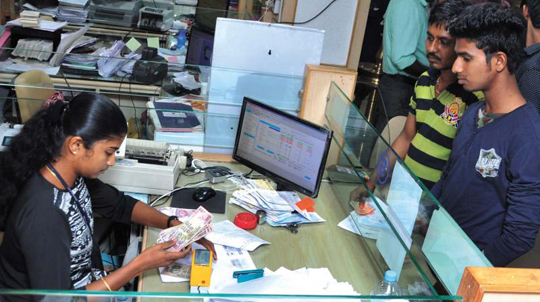
Demonetisation: ED enquiry op at 50 banks across country

December 7, 2016

New Delhi, Dec 7: Stepping up action to check financial crimes post demonetisation, the ED today launched an 'enquiry of records' operation at over 50 bank branches across the country to detect money laundering and hawala dealing instances through these channels.

Demonetisation

Officials said multiple teams of the Enforcement Directorate (ED) swooped early morning at over 50 branches of at least ten banks, both in the private and public sector, along with banking auditors to "scrutinise" transaction records and account statements, armed with vital inputs gathered from financial snoop agencies.

They said ED teams have launched the operations at branches located in major cities like Delhi, Mumbai, Bengaluru, Hyderabad, Kolkata, Chennai and others based on records of transaction of these branches where the maximum amount of old notes have been deposited or huge cash has been deposited in bank accounts in one go or in a staggered fashion giving rise to suspicion of suspect deposits.

Officials said the sleuths and auditors are "looking at the banking transaction records post November 8" and instructions have been issued to these teams to ensure that regular operations and customer dealings are not affected due to this.

The ED, tasked with enforcing two important laws to check financial crimes--Prevention of Money Laundering Act (PMLA) and Foreign Exchange Management Act (FEMA)--has sourced Suspicious Transaction Reports (STRs) and Cash Transaction Reports (CTRs) of the banks under scanner from various financial intelligence agencies and has launched the operation to check possible financial irregularities, instances of money laundering and hawala dealings.

The agency had recently arrested two Axis Bank employees working at a branch in Delhi while probing a similar instance under PMLA.

ED, last week, had also conducted searches at 40 locations across the country in order to check black money held with currency exchanges, hawala dealers and others.

Comments

Skazi
 - 
Wednesday, 7 Dec 2016

Why only the transactions post Nov 8 are checked .... Make a comprehensive checking of all transactions from April 1 ....
Mr 56\ CHESTWALA... Pls show your courage"

Add new comment

  • Coastaldigest.com reserves the right to delete or block any comments.
  • Coastaldigset.com is not responsible for its readers’ comments.
  • Comments that are abusive, incendiary or irrelevant are strictly prohibited.
  • Please use a genuine email ID and provide your name to avoid reject.
News Network
April 23,2020

Apr 23: Mukesh Ambani is again Asia's richest person after a deal with Mark Zuckerberg's Facebook Inc. sent his conglomerate's stock surging.

Ambani's fortune rose about $4.7 billion to $49.2 billion on Wednesday, after Reliance Industries Ltd. gained 10%. The jump put Ambani about $3.2 billion ahead of China's Jack Ma, according to the Bloomberg Billionaires Index. The ranking updates after the close of each trading day in the U.S.

Facebook Inc. will invest $5.7 billion in the U.S. social-networking giant's biggest deal since the 2014 purchase of WhatsApp as it seeks a broader foothold in its biggest global market. The U.S. company will buy about 10% of Jio Platforms, which brings together digital apps and a wireless platform under one umbrella, the Mumbai-based company said in a statement Wednesday.

Before Wednesday, Ambani -- who owns the world's largest oil refinery -- had declined by $14 billion on the index in 2020, the biggest dollar fall of anyone in Asia. Alibaba Group Holding Ltd.'s Ma, whose foundation this week donated 100 million masks to the World Health Organization to fight the Covid-19 pandemic, had lost almost $1 billion through Tuesday.

"At the core of our partnership is the commitment that Mark Zuckerberg, founder of Facebook, and I share for the all-around digital transformation of India," Ambani said in a web video posted on Jio's Facebook page, adding that Facebook's brands have become household names in India. "WhatsApp in particular, has entered our people's daily vocabulary in all the 23 official languages of India."

The partnership with Jio would allow Zuckerberg to step up his expansion in a country that is rapidly embracing online payment and e-commerce as more people get smartphones. Jio Infocomm quickly moved into a position of dominance by offering free plans and undercutting wireless market rivals.

With its half-billion internet users, the South Asian country is a key market for the world's largest technology companies, including Amazon.com Inc., Apple Inc., Microsoft Corp. and Alphabet Inc.'s Google. In India, Facebook has about 250 million users, while WhatsApp has more than 400 million.

That should help Jio bolster its reach, according to James Crabtree, author of 'The Billionaire Raj,' a book on the country's wealthiest people. But the transaction also shows the extent of Ambani's own influence, he said.

"This deal clearly shows that if you want to play big in Indian tech, you need to play nice with Mukesh Ambani."


Ambani's fortune rose about $4.7 billion to $49.2 billion on Wednesday, after Reliance Industries Ltd. gained 10%. The jump put Ambani about $3.2 billion ahead of China's Jack Ma, according to the Bloomberg Billionaires Index. The ranking updates after the close of each trading day in the U.S.

Facebook Inc. will invest $5.7 billion in the U.S. social-networking giant's biggest deal since the 2014 purchase of WhatsApp as it seeks a broader foothold in its biggest global market. The U.S. company will buy about 10% of Jio Platforms, which brings together digital apps and a wireless platform under one umbrella, the Mumbai-based company said in a statement Wednesday.

Before Wednesday, Ambani -- who owns the world's largest oil refinery -- had declined by $14 billion on the index in 2020, the biggest dollar fall of anyone in Asia. Alibaba Group Holding Ltd.'s Ma, whose foundation this week donated 100 million masks to the World Health Organization to fight the Covid-19 pandemic, had lost almost $1 billion through Tuesday.

"At the core of our partnership is the commitment that Mark Zuckerberg, founder of Facebook, and I share for the all-around digital transformation of India," Ambani said in a web video posted on Jio's Facebook page, adding that Facebook's brands have become household names in India. "WhatsApp in particular, has entered our people's daily vocabulary in all the 23 official languages of India."

The partnership with Jio would allow Zuckerberg to step up his expansion in a country that is rapidly embracing online payment and e-commerce as more people get smartphones. Jio Infocomm quickly moved into a position of dominance by offering free plans and undercutting wireless market rivals.

With its half-billion internet users, the South Asian country is a key market for the world's largest technology companies, including Amazon.com Inc., Apple Inc., Microsoft Corp. and Alphabet Inc.'s Google. In India, Facebook has about 250 million users, while WhatsApp has more than 400 million.

That should help Jio bolster its reach, according to James Crabtree, author of 'The Billionaire Raj,' a book on the country's wealthiest people. But the transaction also shows the extent of Ambani's own influence, he said.

"This deal clearly shows that if you want to play big in Indian tech, you need to play nice with Mukesh Ambani."

Comments

Add new comment

  • Coastaldigest.com reserves the right to delete or block any comments.
  • Coastaldigset.com is not responsible for its readers’ comments.
  • Comments that are abusive, incendiary or irrelevant are strictly prohibited.
  • Please use a genuine email ID and provide your name to avoid reject.
News Network
March 30,2020

New Delhi, Mar 30: The government on Monday said there was no plan to extend the 21-day lockdown which came intro force on Tuesday midnight.

The Press Information Bureau (PIB) of the Ministry of Information and Broadcasting tweeted, saying Cabinet Secretary Rajiv Gauba has denied media reports claiming that the government will extend the lockdown.

"There are rumours & media reports, claiming that the Government will extend the #Lockdown21 when it expires. The Cabinet Secretary has denied these reports, and stated that they are baseless," it said.

The 21-day lockdown is aimed at checking the spread of the coronavirus.

Following the lockdown, there has been a massive exodus of migrant workers from big cities to their villages after being rendered jobless.

Comments

Add new comment

  • Coastaldigest.com reserves the right to delete or block any comments.
  • Coastaldigset.com is not responsible for its readers’ comments.
  • Comments that are abusive, incendiary or irrelevant are strictly prohibited.
  • Please use a genuine email ID and provide your name to avoid reject.
News Network
February 19,2020

New Delhi, Feb 19: India will switch to the world's cleanest petrol and diesel from April 1 as it leapfrogs straight to Euro-VI emission compliant fuels from Euro-IV grades now - a feat achieved in just three years and not seen in any of the large economies around the globe.

India will join the select league of nations using petrol and diesel containing just 10 parts per million of sulphur as it looks to cut vehicular emissions that are said to be one of the reasons for the choking pollution in major cities.

Sanjiv Singh, Chairman of Indian Oil Corp (IOC) - the firm that controls roughly half of the country's fuel market, said almost all refineries began producing ultra-low sulphur BS-VI (equivalent to Euro-VI grade) petrol and diesel by the end of 2019 and oil companies have now undertaken the tedious task of replacing every drop of fuel in the country with the new one.

"We are absolutely on track for supplying BS-VI fuel from April 1. Almost all refineries have begun supplying BS-VI fuel and the same has reached storage depots across the country," he said.

From storage depots, the fuel has started travelling to petrol pumps and in the next few weeks all of them will only have BS-VI grade petrol and diesel, he said. "We are 100 per cent confident that fuel that will flow from nozzles at all the petrol pumps in the country on April 1 will be BS-VI emission compliant fuel."

India adopted Euro-III equivalent (or Bharat Stage-III) fuel with a sulphur content of 350 ppm in 2010 and then took seven years to move to BS-IV that had a sulphur content of 50 ppm. From BS-IV to BS-VI it took just three years.

"It was a conscious decision to leapfrog to BS-VI as first upgrading to BS-V and then shifting to BS-VI would have prolonged the journey to 4 to 6 years. Besides, oil refineries, as well as automobile manufacturers, would have had to make investments twice - first to producing BS-V grade fuel and engines and then BS-VI ones," he said.

State-owned oil refineries spent about Rs 35,000 crore to upgrade plants that could produce ultra-low sulphur fuel. This investment is on top of Rs 60,000 crore they spent on refinery upgrades in the previous switchovers.

BS-VI has a sulphur content of just 10 ppm and emission standards are as good as CNG.

Originally, Delhi and its adjoining towns were to have BS-VI fuel supplies by April 2019 and the rest of the country was to get same supplies from April 2020.

But oil marketing companies switched over to supply of BS-VI grade fuels in the national capital territory of Delhi on April 1, 2018.

The supply of BS-VI fuels was further extended to four contiguous districts of Rajasthan and eight of Uttar Pradesh in the National Capital Region (NCR) on April 1, 2019, together with the city of Agra.

BS-VI grade fuels were made available in 7 districts of Haryana from October 1, 2019.

Singh said the new fuel will result in a reduction in NOx in BS-VI compliant vehicles by 25 per cent in petrol cars and by 70 per cent in diesel cars.

The switchover, he said, is a tedious task as every drop of old, higher-sulphur content fuel has to be flushed out in depots, pipelines and tanks before being replaced by BS-VI.

"We are confident of disruption-free switchover to BS-VI supplies across the country," he said. "What we will be supplying is the best quality available anywhere in the world. You don't have any better fuel that is supplied in any part of the world. Perhaps our BS-VI fuel will be better than equivalent fuel in some parts of the US and Europe."

India adopted a fuel upgradation programme in the early 1990s. Low lead gasoline (petrol) was introduced in 1994 in Delhi, Mumbai, Kolkata and Chennai. On February 1, 2000, unleaded gasoline was mandated nationwide.

Similarly, BS-2000 (Euro-I equivalent, BS-1) vehicle emission norms were introduced for new vehicles from April 2000. BS-II (Euro-II equivalent) emission norms for new cars were introduced in Delhi from 2000 and extended to the other metro cities in 2001.

Benzene limits have been reduced progressively from 5 per cent in 2000 to 1 per cent nationwide. Lead content in gasoline was removed in phases and only unleaded gasoline is being produced and sold from February 1, 2000.

The octane number of gasoline signifies the improved performance of the engine. Loss in octane number due to phasing out of lead was made up by installing new facilities in the refinery and changes in refinery operation. RON (Research Octane Number) of gasoline for BS-2000 spec was increased to 88. This has over time been increased to 91.

Singh said sulphur reduction will reduce Particulate Matter (PM) emissions even in the in-use older generation diesel vehicles.

Comments

Add new comment

  • Coastaldigest.com reserves the right to delete or block any comments.
  • Coastaldigset.com is not responsible for its readers’ comments.
  • Comments that are abusive, incendiary or irrelevant are strictly prohibited.
  • Please use a genuine email ID and provide your name to avoid reject.