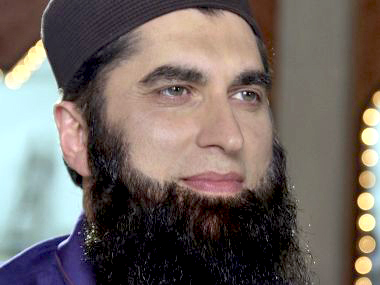
Junaid Jamshed dead: Pakistan actors mourn death renowned singer and preacher

December 8, 2016

Islamabad, Dec 8: Popular Pakistani actor Fakhr-e-Alam and model-turned-actress Urwa Hocane were among the first few celebrities who mourned for renowned singer and preacher Junaid Jamshed, who died in a plane crash in Khyber Pakhtunkhwa on Wednesday.

Junaid's family — his wife and their three children — were also believed to be on board Pakistan International Airlines (PIA) flight PK-661.

JunaidShocked by the tragic death of his dear friend, actor Fakhr-e-Alam wrote on his Twitter page: "Dear Junaid, I shall cherish all our memories together. Prayers for your final journey. Till we meet again."

Urwa, known for starring in films such as Na Maalom Afraad and Maalik, tweeted: "Saddened beyond words! Rest in peace Junaid Jamshed and all the people who were on board! Inna Lillahi Wa Inna Ilaihi Rajiun."

Actor Hamza Ali Abbasi tweeted: "You will be missed Junaid bhai"

Born in 1963, Junaid adorned many hats and includes of a recording artist, television personality, fashion designer and singer-songwriter.

As part of the band "Vital Signs", Junaid gained nationwide recognition with 1987 album Vital Signs 1 which included the hit tracks Dil Dil Pakistan and Tum Mil Gaye.

Junaid of Vital Signs, his solo album was released in 1994 and was quite successful too. His other two albums were Us Rah Par and Dil Ki Baat.

In 2004, he bid adieu to his music career and focused on preaching, which paved way to religious recitals on television.

Comments

Althaf
 - 
Thursday, 8 Dec 2016

Inna Lillahi Wainna Ilahihi Rajioon.. May allah grant him Jannah. Ameen

Add new comment

  • Coastaldigest.com reserves the right to delete or block any comments.
  • Coastaldigset.com is not responsible for its readers’ comments.
  • Comments that are abusive, incendiary or irrelevant are strictly prohibited.
  • Please use a genuine email ID and provide your name to avoid reject.
News Network
June 16,2020

Mumbai, Jun 16: The International Space University (ISU) in France has paid homage to Sushant Singh Rajput in a statement, saying the news of the actor's death was "deeply saddening".

Rajput was found dead in his Bandra apartment on Sunday.

According to an official, Mumbai Police found out during the probe that the 34-year-old actor was under medication for depression.

The official Twitter handle of ISU on Monday tweeted how Rajput was supposed to visit the campus last year but was unable to due to scheduling conflict.

"We are deeply saddened by the dramatic news on the death of well known Indian actor Sushant Singh Rajput. Mr Singh Rajput was a believer and strong supporter of STEM education and was following ISU on social media.

"He had even accepted an invitation to visit ISU's Central Campus in the summer of 2019 but other agenda priorities prevented him from travelling to Strasbourg," the statement by the university read.

ISU paid condolences to Rajput's family and friends, saying the actor's memory will "remain among his thousands of followers across India and all over the world".

Rajput had enrolled at Delhi Technical University (DTU) in 2003, which was then known as Delhi College of Engineering, but left the course to pursue his showbiz dreams.

Even after leaving the four-year degree course, he remained fascinated with science and had a deep interest in astronomy.

As part of his research for the film "Chanda Mama Door Ke", he also visited the National Aeronautics and Space Administration (NASA) in 2017.

Rajput had stayed in NASA to train for his role as an astronaut for the film, which was eventually shelved.

The actor also owned Meade 14" LX600 telescope.

Comments

Add new comment

  • Coastaldigest.com reserves the right to delete or block any comments.
  • Coastaldigset.com is not responsible for its readers’ comments.
  • Comments that are abusive, incendiary or irrelevant are strictly prohibited.
  • Please use a genuine email ID and provide your name to avoid reject.
News Network
January 23,2020

Jan 23: Calling himself an optimist who believes in the goodness of people, director Kabir Khan says everything these days is being looked at through the prism of religion but India is about more than that.

The director of blockbusters such as Bajrangi Bhaijaan and Ek Tha Tiger said he is happy he has a platform as a filmmaker to present a counterpoint to the prevailing narrative based on religious fault lines.

"I’m an optimist who believes in the goodness of the people. But yes, there is a certain level of bigotry that has crept in. Everything is being looked at through the prism of religion but India is not about that.

"It sounds like a cliché but when I was growing up, I was not aware of my religion. That was the greatness of this country,” Kabir told news agency.

He said he is a product of a mixed marriage and is pained to see the social fabric being tattered.

“I have celebrated the best that Indian secularism has to offer. But to see the greatness of this country being simplified and broken down into religious fault lines is a painful experience,” he added.

According to Kabir, it is dangerous to see history through the prism of religion, whether in cinema or society. But it is important to revisit history to know what happened and one can always find something that is relevant for the present, he said.

The director, who started as a documentary filmmaker, returns to his roots for a five-episode series on Subhas Chandra Bose's Indian National Army, The Forgotten Army: Azaadi Ke Liye, on Amazon Prime, his most expensive project yet.

Asked whether this is a difficult time for filmmakers, Kabir said he believes art thrives in the time of strife and, as a storyteller, his politics will always reflect in his work.

“Every film has its politics and every filmmaker has to reflect his or her politics. Every film of mine will reflect my politics and it will never change according to the popular mood of the audience. But a film should not be just about that. Politics should be in the layers beneath," he said.

He terms his 2015 Salman Khan-starrer Bajrangi Bhaijaan an "extremely political" film. At face value, it can also be enjoyed as the story of a mute Pakistani girl who drifts into India and is taken back to her homeland by a Hanuman devotee. But there is so much more. The "chicken song", for instance, was a sly reference to the beef ban controversy at the time, he said.

"I won’t say it is a difficult time for me as a filmmaker. It is good that I have a platform where I can talk and present a counterpoint and I refuse to believe that the entire country believes the narrative that is being sent out. There are millions and millions of people, and perhaps the majority, that does not believe. And if I present the counterpoint, they will think about it.”

Discussing his new series, the director said it has always fascinated him that the sacrifice of the men and women who comprised the INA is just a forgotten footnote in history.

“I wanted to make something that stands the test of time. It goes down in posterity,” Khan, who first explored the subject in a Doordarshan documentary 20 years ago, said.

For the documentary, he traveled with former INA officers Captain Lakshmi Sahgal and Captain Gurbaksh Singh Dhillon from Singapore to India via erstwhile Burma, retracing the route that the INA followed.

“The documentary got me a lot of attention and acclaim but the story just never left me. It's actually the first script I ever wrote and I landed up with that script in Bombay from Delhi. I realised very soon that nobody's going to give me a budget of this size to make my first film.

"And then after every film, I would pick up the script and say, ‘Okay, this is the one I want to make’, because this is the story that made me want to become a filmmaker. On the way, I ended up making eight other films but this is really the story that I wanted to make,” he said.

Kabir is happy that the story has come out as a series, not a film, as it would have required to compromise with the budget and other elements.

"Without giving any numbers, this is the most expensive project I have ever worked on… It required that kind of budget."

Kabir believes the INA was responsible for bringing down the morale of the British establishment, which realised it would be impossible to keep the country colonised without the support of the local army.

"There are a lot of debates and discussions about what happened with the INA and the controversies around it. The whole point is that, if you want to judge what the Army did, sure that's your prerogative, but at least get to know what they did. Nobody knows what happened with the Army from 1942 to 1945."

He added that 55,000 men and women of the INA fought for independence and 47,000 of them died.

"Not a single person from that Army was ever taken back into the independent Army, which is such an amazing fact... the fact that the British called them traitors became the narrative and we also started assuming that they were traitors."

"They were the only women's regiment in the whole world 70 years ago. That's what they thought about women's importance in society. I don't know whether they will be happy with what the current situation is," he said.


Comments

Add new comment

  • Coastaldigest.com reserves the right to delete or block any comments.
  • Coastaldigset.com is not responsible for its readers’ comments.
  • Comments that are abusive, incendiary or irrelevant are strictly prohibited.
  • Please use a genuine email ID and provide your name to avoid reject.
Agencies
July 11,2020

New Delhi, Jul 11: The COVID-19 triggered restrictions on cinema exhibition industry have not only disheartened movie goers, but axed several thousand jobs and costed the industry an estimated ₹ 5,000 crore in revenue.

The sector has been one of the hardest hit due to COVID-19 pandemic and the subsequent restrictions implemented to curb its spread.

Presently, cinemas and multiplexes continue to remain in the list of prohibited activities under the Centre's Unlock 2.0 Guidelines.

In an interview to media persons, movie exhibition major Inox Leisure's Chief Executive Alok Tandon said, "The industry on an average collects about ₹ 1,000 crore a month of 'Box Office' and on an average generates about ₹ 500 crore a month of ancillary revenues."

"Keeping in mind that the lockdown has been effective for more than 100 days now, which is about 3.5 months, the cinema exhibition industry would have accumulated losses worth ₹ 5,000 crore so far."

According to Tandon, associated businesses such as pre and post-production, make-up artistes, graphics, film set fabrication, film crew, events, marketing, F&B services have all been impacted due to the restrictions.

"With the production and exhibition of movies coming to a halt, the industry was bound to witness some job losses," he said without divulging any estimates.

As per industry data, the multiplex industry in India employs more than 200,000 people directly and accounts for nearly 60 % of revenues of the film business.

On the way forward, Tandon elaborated that the industry expects to regain business momentum and sentiment post resumption of operations.

"We believe it will be a matter of a couple of blockbusters, and we will be back to our usual operational numbers," he said.

"We are rightfully relying on the unshakeable passion of the Indian movie lovers, who are yearning to step out and spend time enjoying the giant screen experience."

Furthermore, he cited that industry has sent representation to the Centre for immediate re-commencement of operations and a support package.

"We have requested for financial support in the form of salary subsidies during the lockdown period, interest-free loans for three years, exemptions from various taxes and duties, like 'GST, Show tax, LBETs and Property taxes' for a period of one year from the date of operations, waiver on electricity minimum demand charges for one year and auto renewal of licenses and permits for the next one year," he said.

"We have been talking to our mall developer partners and are working together with them to see through this phase."

However, even after re-commencement, the industry anticipates at least 3-6 months before things return anywhere close to normal.

"The cinema ecosystem is such that we will need all the aspects of the business to swing into action and fire together for us to see a resurgence, and we are highly optimistic about the same," he said.

In terms of global experience, Tandon pointed out that cinemas have started operating in more than 25 major countries, and some of those markets are witnessing a healthy response.

"India is a massive movie market and we are confident that the passionate and responsible movie lovers will turn up in huge numbers to enjoy their favourite form of entertainment and also follow the prevention guidelines at the same time, ensuring a safe and steady revival of the cinema exhibition sector," Tandon said.

The film exhibition industry in India is mainly comprised of single screen and multiplexes.

At present there are around 9,527 cinemas across the country, including 6,327 single and 3,200 multiplex screens.

Comments

Add new comment

  • Coastaldigest.com reserves the right to delete or block any comments.
  • Coastaldigset.com is not responsible for its readers’ comments.
  • Comments that are abusive, incendiary or irrelevant are strictly prohibited.
  • Please use a genuine email ID and provide your name to avoid reject.