



In Germany, a few Muslim refugees convert to Christianity

December 10, 2016

Berlin, Dec 10: Clad in white at a Berlin church, asylum seekers Saeed, Veronica, Farida and Matin were just about to become Christians on a recent Sunday.chrs
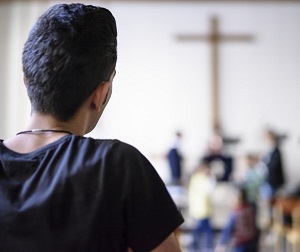
"Do you believe from the bottom of your heart that Jesus Christ is your Lord and saviour, and will you follow him every day of your life?" Pastor Matthias Linke asked them. "If so, say yes."

All four replied with a frank "Ja", to the enthusiastic applause of the faithful at the Free Evangelical Church, and were plunged head-to-toe into a baptism basin.

"I am very, very happy, I feel... how to say?", said 20-year-old Iran native Matin right after his baptism, placing his hand on his chest.

Muslim refugees have recently been taking the same step throughout Germany, where nearly 900,000 asylum seekers arrived in 2015.

Church leaders have confirmed a notable, though not huge, trend upward, but have not provided statistics.

"In our diocese, there are several groups of refugees who are preparing for baptism, and there are more and more requests," said Felix Goldinger, a Catholic priest in Speyer, southwestern Germany.

Many come from Iran and Afghanistan, some from Syria or Eritrea, he said.

"I am currently handling a group of 20 people but I do not know how many will go through until baptism," he said.

Over the course of their preparations, which last nearly a year in Goldinger's diocese, potential converts are encouraged to weigh their own motivations.

"During this period, it is important that they examine their original religion, Islam, and the reasons why they want to change it," he said.
"We are obviously pleased that people want to be baptised, but it is very important for us that they are sure of their decision."

Goldinger said that "many people recall what they have experienced in their country", including "terrorist acts committed in the name of religion. They see Christianity as a religion of love and respect for life."

In Iran, said Linke, many had been in contact with unrecognised churches in the Islamic republic, where conversion is prohibited, and then had to flee.

Other refugees met Christians on their journey to Europe.

This was the case for Saeed, a 31-year-old aeronautical engineer who spent four months in Turkey with a Christian and then became interested in his religion. Like fellow new convert Veronica, Saeed is from Afghanistan.

Reading the Bible "helped in times of trouble," he says.

It was in Greece, recalled Matin, that he first came in touch with the Christian faith. After he arrived in Germany, he approached the Free Evangelical Church through his German friends.

His sister Farida followed him and they began preparations -- in German and Farsi -- for baptism.

Farida said she "was looking for a church" and wanted to choose her religion "in complete freedom".

"This is a very important reason to become a Christian," said Linke.

Among refugees who adopt Germany's dominant religion, he said, "there is a strong desire to decide for themselves, in a free and personal way, the direction of their lives".

Churches concede that some conversions are motivated by a desire to integrate into German society, or even by the belief that they will increase their chances of gaining political asylum.

Countries that send Muslim converts to Christianity back to their homelands put them potentially at great risk.

Apostasy or blasphemy can be punished with jail or death sentences in some Muslim countries, among them Iran, Mauritania, Saudi Arabia and Afghanistan.

For jihadist groups such as the Islamic State, conversion is also a punishable sin.

"There are refugees who think that if they convert, it will be easier for them to stay here, but it is not systematic," Goldinger said.

"Do they change religion in order to be able to stay in Germany? This is an important issue for the authorities," said Linke, who is often consulted by the state Office for Migration and Refugees.

"I have no guarantees, I can only ask them: 'do you really believe with all your heart?' After their baptism, most of them live as Christians and come to church," he added.

Outside their new community, the converts nonetheless usually try to remain discreet.

"They may face difficult situations in refugee homes, where the majority are Muslims," said Thomas Klammt, in charge of migration issues at the Union of Free German Evangelical Churches.

"They may also be afraid for their families left behind in their country of origin."

Matin said he stays in contact with relatives back home -- especially his mother, who had "accepted" his willingness to convert.

"She calls me every Sunday to ask if I have been to mass," he said, laughing.

Comments

shaji
 - 
Sunday, 11 Dec 2016

Christian missionaries are luring these deserted people to change their religion. This is their tactics being practiced in many poor countries.

Rashid
 - 
Sunday, 11 Dec 2016

One , who really applied muslim or community connected muslim , never select other religion... Allah considers eligible to 'jannah' , whether he dies as 'muslim' ... that is why muslim always prays to die as muslims...

Mohammad.n
 - 
Saturday, 10 Dec 2016

Failed in Allah's test

Add new comment

  • Coastaldigest.com reserves the right to delete or block any comments.
  • Coastaldigset.com is not responsible for its readers’ comments.
  • Comments that are abusive, incendiary or irrelevant are strictly prohibited.
  • Please use a genuine email ID and provide your name to avoid reject.
Agencies
July 7,2020

Washington DC, Jul 7: With US President Donald Trump promoting re-opening the economy, the country has now four epicentres of coronavirus instead of one -- Los Angeles, cities in Texas, cities in Florida and Arizona. This has led to the governors fearing that their hospitals could be overrun with patients.

"We are right back where we were at the peak of the epidemic during the New York outbreak...The difference now is that we really had one epicentre of spread when New York was going through its hardship. Now, we really have four major epicentres of spread -- Los Angeles, cities in Texas, cities in Florida and Arizona. Florida looks to be in the worst shape," Scott Gottlieb, former Food and Drug Administration commissioner was quoted by The Washington Post as saying in an interview.

As per the latest data, Florida, New York and California have crossed the 200,000 mark of coronavirus cases.

After Texas continued to break its own record of registering the highest number of coronavirus cases, Austin Mayor Steve Adler (D) was quoted as saying in an interview, "If we do not change this trajectory, then I am within two weeks of having our hospitals overrun."

He further said that intensive care units in the city will start overflowing within 10 days.

Echoing similar sentiments, Judge Lina Hidalgo, the top elected official in Harris County, said, "As long as we're doing as little as possible and hoping for the best, we are always going to be chasing this thing. We are always going to be behind and the virus will always outrun us...And so what we need right now is to do what works, which is a stay-home order."

She was stripped of authority to issue stay-at-home orders after Governor Greg Abbott decided to move forward with the reopening plan.

"It is clear that the (coronavirus) growth is exponential at this point...We have been breaking record after record after record... the last couple of weeks," Miami Mayor Francis Suarez was quoted as saying in an interview.

"The city of Miami was the last city in the entire state of Florida to open. I was criticized for waiting so long. But there is no doubt that the fact that when we reopened, people started socialising as if... the virus didn't exist."

He further said that if the numbers do not begin to fall "more drastic measures" will be taken in the coming week.

As per the latest update by the Johns Hopkins University, a total of 2,938,625 people in the US have tested coronavirus positive and 130,306 deaths have been reported so far.

Comments

Add new comment

  • Coastaldigest.com reserves the right to delete or block any comments.
  • Coastaldigset.com is not responsible for its readers’ comments.
  • Comments that are abusive, incendiary or irrelevant are strictly prohibited.
  • Please use a genuine email ID and provide your name to avoid reject.
News Network
July 10,2020

Lahore, Jul 10: The Punjab government enforced smart lockdown in seven cities of the province for 15 days with an immediate effect from Thursday night, The News International reported.

The Primary and Secondary Healthcare Department on Thursday issued a notification under the Punjab Infectious Diseases Ordinance 2020, about enforcement of lockdown in Lahore, Multan, Faisalabad, Gujranwala, Sialkot, Gujrat and Rawalpindi, till July 24 midnight.

In Lahore, the lockdown will be enforced in A2 Block Township, EME Society, Main Bazaar Chungi Amr Sadhu, Punjab Government Servants Housing Scheme, Wapda Town, C-Block Jauhar Town and Green City.

The basic necessities of life will remain available in smart lockdown areas. "The purpose of the smart lockdown is to minimise movement of people in hotspots of positive coronavirus cases," said Capt (retd) Muhammad Usman, Secretary, Primary and Secondary Healthcare Department.

The country registered 2,751 new COVID-19 cases during the last 24 hours, taking the tally to 243,599 on Friday. The province-wise breakup includes 85,261 cases in Punjab, 100,900 cases in Sindh, 29,406 in Khyber Pakhtunkhwa, 11,099 in Balochistan, 13,829 in Islamabad, 1,619 in Gilgit-Baltistan and 1,485 in Pakistan-occupied Kashmir.

The death toll due to the virus reached 5,058 with 75 more deaths reported over the last 24 hours, as per data cited by Radio Pakistan.

Comments

Add new comment

  • Coastaldigest.com reserves the right to delete or block any comments.
  • Coastaldigset.com is not responsible for its readers’ comments.
  • Comments that are abusive, incendiary or irrelevant are strictly prohibited.
  • Please use a genuine email ID and provide your name to avoid reject.
News Network
May 2,2020

Balochistan, May 1: Sajid Hussain, Editor-in-Chief of Balochistan Times, has been found dead in a Swedish town, the police have confirmed.

The Swedish police informed his family on Thursday night that they discovered his body from a river in Uppsala, The Times reported.
The Baloch journalist had been missing from the Swedish city since March 2 this year.

Sajid, 39, left Pakistan in 2012 and had been living as a refugee in Sweden since 2017. He wrote extensively on the suffering of the Balochis at the hands of the Pakistani military establishment.

His work often got him into trouble as the authorities did not like his reporting of Balochistan's forbidden stories, the reason he had to leave and live in exile.

The Baloch journalist was found dead two months after he went missing in Sweden.
Sajid left Pakistan because of security threats from Pakistan Army and its intelligence service ISI.

The spokesperson of the Baloch National Movement, Hammal Haider told news agency: "We are deeply saddened by the demise of prominent Baloch intellectual and writer Sajid Hussain."
"His death is indeed a loss of a great mind for the people of Balochistan. Due to his straightforwardness, he was loved among all journalistic, literary and political circles," added Haider.

"After this incident, we have serious concerns about our members and other Baloch refugees living in the West," he said.

Comments

Add new comment

  • Coastaldigest.com reserves the right to delete or block any comments.
  • Coastaldigset.com is not responsible for its readers’ comments.
  • Comments that are abusive, incendiary or irrelevant are strictly prohibited.
  • Please use a genuine email ID and provide your name to avoid reject.