Muslim empowerment: Justice Sachar urges Karnataka govt to form EOC

[email protected] (CD Network)
November 28, 2016

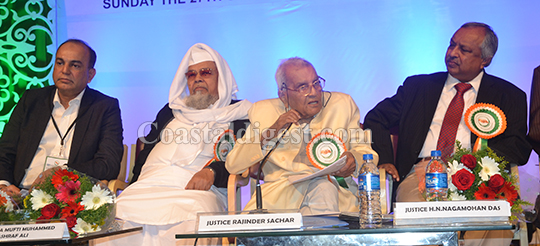
Bengaluru, Nov 27: “All state governments should set up the Equal Opportunity Commission and public sector also should come under the preview of this commission. Then only, the Other Backward Classes including Muslims can get equal opportunities in education and employment,” said Justice Rajinder Sachar.
empormnt 6

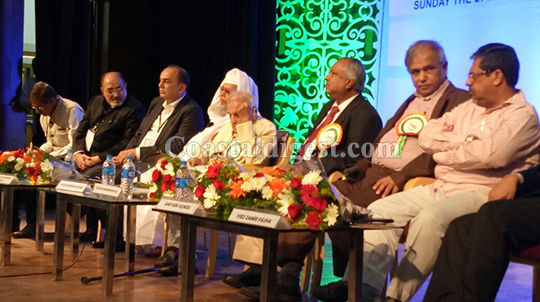
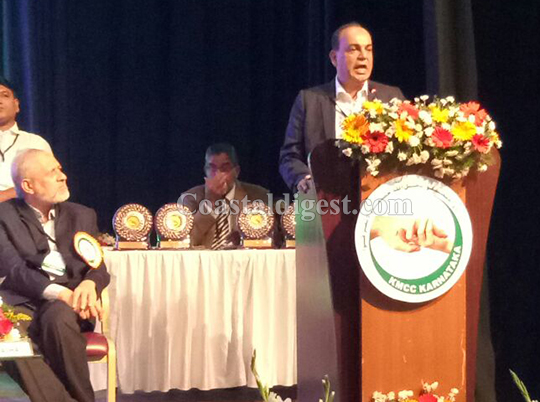
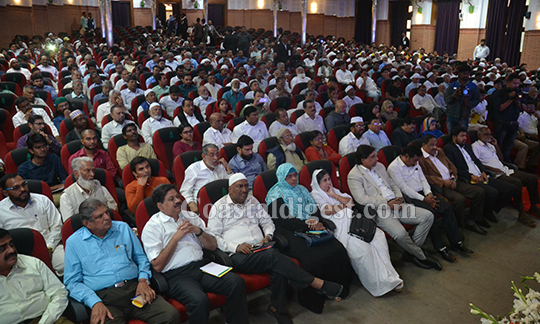
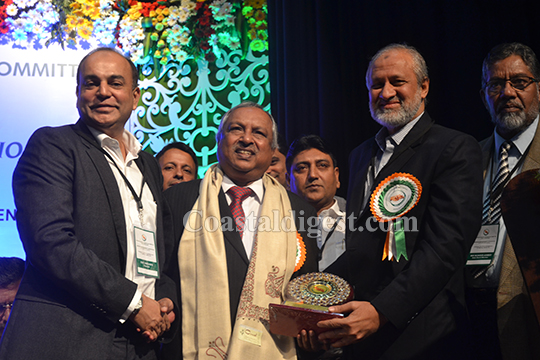
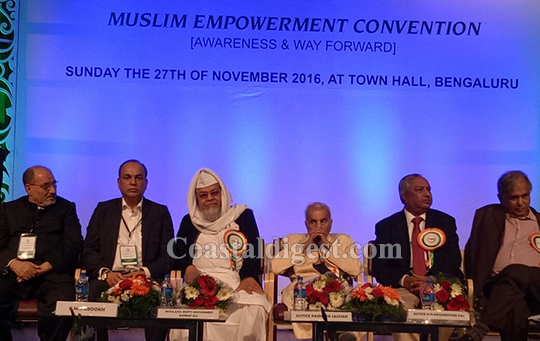
He was delivering a talk on Muslim Empowerment at the launching ceremony of Karnataka Muslim Coordination Committee (KMCC), a social organisation intended to work for communal harmony and empowerment of Muslim community through democratic means, at Town Hall, here on Sunday.

He said that if Karnataka government has real commitment toward OBCs then it should form Equal Opportunity Commission immediately in the state.

“The Sachar committee report is not just related to Muslims, It is related to all other communities. In a democratic country all communities should get equal opportunities. But Muslims in India are deprived from equal opportunities in education, employment and political appointments. Muslims are undivided part of India and any kind of apathy against them is against constitutional aspires,” he said adding that if a government fails to protect the interest of any minorities it will lose the moral right to rule the state.

Stating that Muslims are part of Indian culture and have contributed immensely to attain freedom, Justice Sachar endorsed the Karnataka government's decision to honour Tipu Sultan, who sacrificed his life fighting against British imperialists.

He emphasized that his report on the social, economical and educational status of the minorities was based on facts and it was the collective responsibility of all the people to see that the report is implemented to strike a balance in rendering social justice. He made it clear that there is nothing wrong to fight for right and lamented that even Karnataka government ruled by Conges has not implemented his suggestions to constitute an 'equal opportunity commission' to look into discrimination among different sections of people in employment other fields even at private sector.

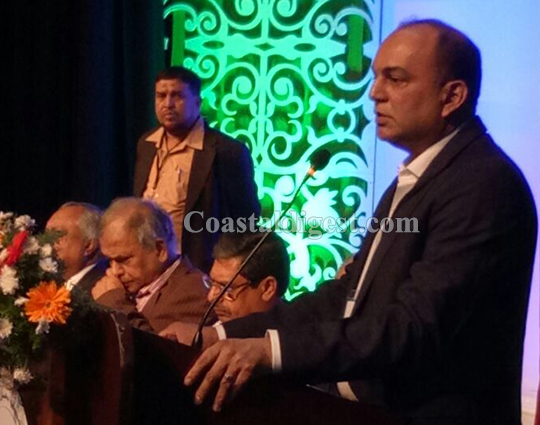
B M Farooq, CMD of Fiza group of industries, and treasurer KMCC, in his key note address explained the objectives of the newly formed NGO and the need to coordinate the minority communities and other marginalized section of people for a common cause in the face of various threats faced by it.

He pointed out that state governments in India have failed to implement the recommendations of Sachar Committee report. “Many argue that implementation of the recommendations of the Sachar Committee Report would virtually divide the society. The plight of Muslims in India remains to be pathetic while many other communities with political and administrative influence snatch away all liberties to the detriment of the community. Muslims were accused of being not loyal to the Indian state, of being terrorists, and politicians who tried to help them risked being accused of "appeasing" them,” he lamented.

The launch of Karnataka Muslim Coordination Committee (KMCC) is an earnest endeavor to unite all sections of the underprivileged and oppressed in the society for a collective bargain for the rights and liberties they are entitled to, he said.

The Muslims, Dalits and other minorities should be united and there should be a social awareness created to fight for their rights in a democratic manner. The political parties have treated the minority community, especially the Muslim community as a vote bank and the community is ill treated and neglected. Poverty, illiteracy and backwardness are rampant and the government does nothing to improve the standard of the community, he complained.

The members of the Muslim community are targeted by the police and false cases are filed against them without affording them any opportunity to even get the legal assistance. Those who take up the cause have been branded astraitors'. Though Muslims are staunch patriots and are ready to sacrifice anything for the nation, they are very often described as anti national. The situation should be changed. Launch of KMCC is only a small step in the right direction.

Muslim community does not have a constructive leadership to enable it to achieve the rights, liberties and privileges to which the community is entitled to and the first and foremost objective of KMCC will be to achieve a constructive leadership and platform for the community from which, the community may be guided in the right direction.

Muslim Community is deprived of education, jobs and government services for want of proper guidance. Our endeavor will be held the youth in the community to acquire knowledge, education in the best school and colleges so that they would be able to stand on their own leg to achieve the goal of securing positions in the legislative, executive and judicial appointments with dignity.

Muslim community is targeted falsely accused of terrorism and other disruptive activities for no fault of them for political gains. KMCC would like to form a squad of professionals to act as awatchdog' against such atrocities against the members of the community and also to alleviate any such tendencies shown by any group of the community by properly educating and creating awareness amongst them.

To protect the interest of the community against the atrocities committed by the administrative or law enforcing agencies without any cogent evidence and to provide legal and financial assistance to them if they are falsely implicated or targeted in the opinion of the expert level committee of the Organization.

“We are for a strong India. We condemn any form of cross border terrorism targeting our nation and we are ready to sacrifice our lives for the sake of this great nation. At the same time, we demand a decent living and equal opportunity to serve the nation with dignity. Let us fight for our right. Let might be not right,” he said.

Mr. Amithabh Khundu, the Chairman of the Sachar Commission Evaluation Committee, presented the statistics and stressed the need to act on the report submitted showing the backwardness of the minorities in many fronts on account of discrimination of the community. He hoped that central govt would take appropriate step to alleviate the disparities. Justice H N Nagmohan Das also spoke.

The function was inaugurated by Moulana Mufti Muhammed Ashraf Ali, Amir-e-Shariat, Karnataka. Syed Zameer Pasha, IAS (retired) welcomed the gatherings. Haris and Hanif Mohammed compered the programme. Mirza Mehadi proposed vote of thanks.
empormnt 2

empormnt 1

empormnt 3

empormnt 4

empormnt 5

empormnt 7

Comments

Mr ABDULGAFFAR GHORI
 - 
Saturday, 17 Dec 2016

Free training of different courses for OBC under the aegis of Min of Minorities, Govt of India. Free hostel, boarding and with stipend. The duration is for 3-4 months. . There is placement assistance given after successful completion of the courses. NTTF has undertaken to train people from our community.. For more details pl visit www.nttftrg.com. Pl help to spread this message among the needy thro' email, phone, whatsup etc. Similar vocational courses under the same/similar schemes, all over the country, different agencies are doing this.

yaseer arfath
 - 
Monday, 28 Nov 2016

Great committee nd superb speech I agreed about your all rules it's awesome sir I hope so you became greatest nd big name full committee in future

yaseer arfath
 - 
Monday, 28 Nov 2016

Great committee nd superb speech i agreed about your all committee's rules it's awesome sir i hope your committee become more then name full in future .....

yaseer arfath
 - 
Monday, 28 Nov 2016

Great function nd speech was superb awesome..... i hope this committee make big name in future..... thank you....

Add new comment

  • Coastaldigest.com reserves the right to delete or block any comments.
  • Coastaldigset.com is not responsible for its readers’ comments.
  • Comments that are abusive, incendiary or irrelevant are strictly prohibited.
  • Please use a genuine email ID and provide your name to avoid reject.
News Network
February 19,2020

Bengaluru, Feb 19: Pointing out that there was a deliberate attempt to cover up police excesses by implicating innocent persons at whim, the Karnataka High Court on Tuesday granted conditional bail to 21 people who were accused by police of involving in violence during the protests against the Citizenship Amendment Act (CAA) in Mangaluru.

Allowing the bail petitions of Ashik and 20 others from Udupi and Dakshina Kannada districts, Justice John Michael Cunha said the overzealousness of the police is also evident from the fact that FIRs were registered under Section 307 of IPC against the persons killed by the police themselves.

“In an offence involving a large number of people, the identity and participation of each accused must be fixed with reasonable certainty. In the present cases, the identity appears to have been fixed on the basis of their affiliation to PFI and they being members of the Muslim community. Though it is stated that the involvement of the petitioners is captured in CCTV footage and photographs, no such material is produced before the court showing the presence of any of the petitioners at the spot, armed with deadly weapons,” the judge noted.

In the statement of objections filed by the State Public Prosecutor-I, it was stated that there was a hint of Muslim youths holding protest on December 19, 2019, opposing the implementation of CAA. Prohibitory orders were clamped in that connection. This assertion indicated that the common object of the assembly was to oppose the implementation of CAA and National Register for Citizens (NRC) which, by itself, was not an “unlawful object”, the judge pointed out.

‘Pics show cops throwing stones at crowd’

Justice Cunha also said the material collected by the investigators did not contain any specific evidence regarding the presence of any of the petitioners at the spot. On the other hand, omnibus allegations were made against the Muslim crowd of 1,500-2,000, alleging that they were armed with weapons like stones, soda bottles and glass pieces. The photographs produced by the SPP depicted that hardly any member of the crowd were armed with weapons, except one of them holding a bottle. In none of these photographs, police station or policemen were seen in the vicinity, the judge noted.

“On the other hand, photographs produced by the petitioners show that the policemen themselves were pelting stones at the crowd. The petitioners have produced copies of the complaints lodged by the dependants of the deceased who died due to police firing and the endorsement made thereon reveals that even though the law required the police to register independent FIRs in view of the specific complaint made against the police officers making out cognizable offences, the police have failed to register FIRs. This goes to show that a deliberate attempt is underway to cover up police excesses by implicating innocent persons at the whims and caprice of the police,” the judge observed.

In the wake of counter-allegations against the police and in the backdrop of their failure to register FIRs based on complaints lodged by the families of victims, the possibility of false and mistaken implication could not be ruled out, the judge said. In these circumstances, it would be a travesty of justice to deny bail to the petitioners and sacrifice their liberties to the mercy of the district administration and police. The records indicate that a deliberate attempt has been made to trump up evidence and to deprive the liberties of the petitioners by fabricating evidence. None of the petitioners have any criminal antecedents, the court said.

“The allegations levelled against the petitioners are not punishable with death or imprisonment for life. There is no direct evidence to connect them with the alleged offence. The investigation appears to be malafide and partisan. In the circumstances, in order to protect the rights and liberties of the petitioners, it is necessary to admit them to bail,” the judge said.

The petitioners were arrested and remanded in judicial custody after the anti-CAA protests on charges of being members of an unlawful assembly, armed with lethal weapons, attempting to set fire to the North Police Station in Mangaluru, obstructing the police from discharging their duties and causing damage to public property, etc., on December 19 in violation of the prohibitory orders. They moved the High Court as their bail pleas had been rejected by a sessions court in Dakshina Kannada.

Comments

Add new comment

  • Coastaldigest.com reserves the right to delete or block any comments.
  • Coastaldigset.com is not responsible for its readers’ comments.
  • Comments that are abusive, incendiary or irrelevant are strictly prohibited.
  • Please use a genuine email ID and provide your name to avoid reject.
coastaldiget.com web desk
June 18,2020

Amidst heightened border tensions between Indian and China, senior BJP leader and Madhya Pradesh Chief Minister Shivraj Singh Chouhan's two year old tweet comparing his party with Communist Party of China started going viral. 

The tweet, dated 26 June, 2016 reads: "Communist Party of China & BJP have done numerous works in social field. This way, there is tremendous similarities between the two parties." (sic)

Twitterati dug up this tweet after over 20 Indian Army personnel, including a colonel, were killed in a clash with Chinese troops in the Galwan Valley in eastern Ladakh earlier this week.

Soon after Chouhan's tweet went viral, netizens took to the micro-blogging site and slammed BJP. One user said, "Interesting comment by Hindutva ITSELF to recognise how similar they are with China. No doubt. Both believe in Dragon Throne .... and brutal absolute control." Another user said, "No wonder the BJP & China both agree that PLA never crossed into Indian territory."

Comments

Add new comment

  • Coastaldigest.com reserves the right to delete or block any comments.
  • Coastaldigset.com is not responsible for its readers’ comments.
  • Comments that are abusive, incendiary or irrelevant are strictly prohibited.
  • Please use a genuine email ID and provide your name to avoid reject.
Media Release
February 14,2020

Veteran journalist P. Sainath has said that the nation is in a crisis. And this crisis is not limited to just the rural area. It has become a national crisis at various areas such as agriculture, education, economy, job creation etc.

He was delivering the endowment lecture on the topic ‘Indian democracy at the post-liberalization and post-truth era’ at Media Manthan 2020 organized by the PG department of journalism and mass communication at St Aloysius College (Autonomous). 

Mr Sainath said that the many policies adopted in the 90s led to India becoming unusually unequal. Referring to the speech Ambedkar had made at the Constituent Assembly while handing over the draft of the Constitution, Mr Sainath said, “Ambedkar had warned about the weakness of Indian democracy that liberty without equality allows the supremacy of a few over the multitude. Liberty, equality and fraternity must be kept together as we cannot have one without the other.” 

Mr Sainath stated that the agrarian crisis was no longer about the loss of productivity, employment or about farmer suicide; it was a societal, civilizational crisis. Commenting on the lopsided policies such as cow-slaughter ban, he explained how cow slaughter ban had adversely affected many industries due to their interdependency. While Muslims who slaughtered cows were rendered helpless, the cattle traders who were mostly OBCs lost their earnings as the cattle prices crashed. An important industry like Kolhapur sandals industry in Maharashtra went bankrupt as a result of the cow slaughter ban in Maharashtra. He said the policymakers had no idea how the rural industries were interconnected. Demonetisation too devastated the rural economy as 98 percent of rural transactions happen through cash. 

Mr Sainath also spoke about the crisis of inequality which affects the Dalits and the Adivasis far more than anyone else as 90 percent of the rural households take home less than Rs 10,000/- per month. “Women are yet another group whose labour is never counted in the gross domestic product. Women and girls globally do unpaid work which amounts to about 12.5 billion working hours per year. Monetarily speaking, this is worth 10.8 trillion dollars,” Mr Sainath added. 

Speaking about the crisis of jobs Mr Sainath said that major companies were laying off employees just to create more profits for the investors and the adoption of artificial intelligence in the industry would further destroy millions of jobs.

Rector of St Aloysius College Institutions Fr Dionysius Vaz SJ, Principal Dr (Fr) Praveen Martis SJ, HOD of Journalism and Mass Communication department Dr (Fr) Melwyn Pinto SJ were present.

‘Veerappan and Vijay Mallya’s business models are interesting!’

Addressing the gathering during his endowment lecture on Friday, Mr Sainath made an interesting comment on the so called ‘revenue model’. “Whenever I visit IIMs and IITs for lectures on my PARI project, the students there ask me what my revenue model for my project is. I tell them that I do not have a revenue model. In fact, journalism does not begin with a revenue model. Gandhiji, Ambedkar, Bhagat Singh were all great journalists. But they did not have a revenue model,” Mr Sainath said.

On a lighter note, he said that the best revenue model that he liked was that of forest brigand Veerappan and liquor baron Vijay Mallya. “Veerappan ruled the forest for forty years and from the top ministers to the villagers he could dictate terms and liver royally. Similarly, Mallya’s revenue model was to steal the banks and run away abroad and live like a king,” Mr Sainath added.

Journalism is not and can never be a business. It is a calling, he opined. While newspaper can be a business, television can be a business, journalism per se cannot be reduced to a business. “Unfortunately today, journalists are recruited on a contract basis and they have no bargaining power; and there are no unions to fight for their cause. Hence, they are at the mercy of the corporate media houses for their survival and are made to write stories that cannot be called journalism,” Mr Sainath said.

Answering a question as to the pressures he faced as a journalist, he said that external pressures from the government or others could be very well handled. It is the internal pressures from once own media house that journalists find it difficult to manage.


Comments

Add new comment

  • Coastaldigest.com reserves the right to delete or block any comments.
  • Coastaldigset.com is not responsible for its readers’ comments.
  • Comments that are abusive, incendiary or irrelevant are strictly prohibited.
  • Please use a genuine email ID and provide your name to avoid reject.