



In parting shot, John Kerry tears into Israel over settlements

December 29, 2016

Washington, Dec 29: US secretary of state John Kerry tore into Israel on Wednesday for settlement-building, accusing Prime Minister Benjamin Netanyahu of dragging Israel away from democracy and forcefully rejecting the notion that America had abandoned Israel with a controversial UN vote. Netanyahu accused the Obama administration of a biased bid to blame Israel for failure to reach a peace deal.
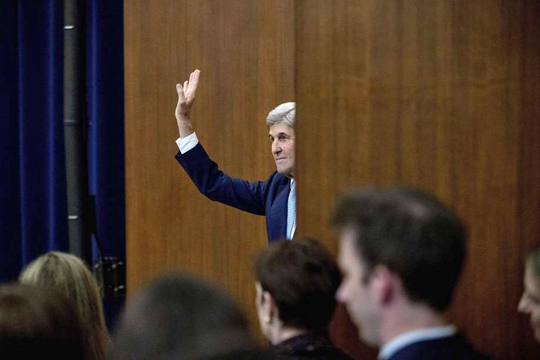
John

In a farewell speech, Kerry laid out a two-state vision for peace that he won't be in office to implement, but that the US hoped might be heeded even after President Barack Obama's term ends. He defended Obama's move last week to allow the UN Security Council to declare Israeli settlements illegal, the spark that set off an extraordinary and deepening diplomatic spat between the US and its closest Mideast ally.

"If the choice is one state, Israel can either be Jewish or democratic, it cannot be both, and it won't ever really be at peace," Kerry said in a speech that ran more than an hour, a comprehensive airing of grievances that have built up in the Obama administration over eight years but were rarely, until this month, discussed publicly.

Netanyahu pushed back in a hastily arranged televised statement in which he suggested he was done with the Obama administration and ready to deal with President-elect Donald Trump, who has sided squarely with Israel. The Israeli leader faulted Kerry for obsessing over settlements while paying mere "lip service" to Palestinian attacks and incitement of violence.

"Israelis do not need to be lectured about the importance of peace by foreign leaders," Netanyahu said from Jerusalem.

The dueling recriminations marked a low point for US-Israel relations, and a bitter end to eight years of frustrated ties between Obama and Netanyahu, who quarreled repeatedly over settlements, the peace process and Obama's nuclear deal with Iran.

Trump, who has assured Israel it merely needs to "hang on" until he takes over, wouldn't say Wednesday whether settlements should be reined in. But he told reporters Israel was being "treated very, very unfairly by a lot of different people."

It was unclear whether Israel came up in a phone call Obama, while vacationing in Hawaii, placed to Trump on Wednesday morning. Nor was it obvious what impact Kerry's speech, coming in the final days of the administration, might have.

Netanyahu expressed concern that a French-hosted summit next month could lead to an international framework that the UN Security Council might then codify with Obama's assent, boxing Israel in. Yet Kerry seemed to rule out the possibility Obama would take more parting shots, such as promoting that type of UN resolution or recognizing Palestinian statehood.

The diplomatic fracas erupted last week when the US, in a departure from past policy, decided to abstain rather than veto a UN Security Council resolution calling Israeli settlements in the West Bank and east Jerusalem a violation of international law. Israel was incensed, and on Wednesday, Netanyahu claimed Israel has "absolute, indispensable evidence" the US actually spearheaded the resolution.

Netanyahu offered what he called proof of US collusion: a document, leaked to an Egyptian newspaper, that purports to be a Palestinian account of a December meeting between top US and Palestinian officials. But White House spokesman Ned Price called it a "total fabrication" and added: "This meeting never occurred."

Palestinian President Mahmoud Abbas responded to the speech by reaffirming that he's ready to resume peace talks if Israel halts settlement construction.

Kerry, unveiling a six-part outline of what a future peace deal could look like, deviated from the traditional US message that foreign powers shouldn't impose a solution. His outline tracked closely with principles long assumed to be part of an eventual deal, and Kerry insisted he was merely describing what's emerged as points of general agreement.

Though Kerry faulted Palestinian leaders for insufficiently condemning violence and terrorism against Israelis, most of his speech focused on Israel. He said the two-state solution, the basis for all serious peace talks for years, was "now in serious jeopardy," and called Netanyahu's' government "the most right-wing in Israel's history."

He invoked the widespread concern that the growing Arab population in Israel and the Palestinian territories will eventually make Jews a minority in Israel, creating a demographic crisis for Israel unless there's a separate Palestinian state.

"The settler agenda is defining the future of Israel. And their stated purpose is clear: They believe in one state," Kerry said.

The US, the Palestinians and most of the world oppose Israeli settlement construction in the West Bank and east Jerusalem, territories captured by Israel in 1967 and claimed by the Palestinians for an independent state. But Israel's government argues previous construction freezes failed to advance a peace deal and that the future of the settlements — now home to 600,000 Israelis — must be resolved in direct talks between Israelis and Palestinians.

While Israel's Arab population has citizenship rights, the roughly 2.5 million Palestinians living in the occupied West Bank do not. Israel has annexed east Jerusalem, where Palestinians have residency rights but few have citizenship, in a move not internationally recognized.

Kerry said a future deal would have to ensure secure borders for Israel and a Palestinian state formed in territories Israel captured in the 1967 Mideast war, with "mutually agreed, equivalent swaps." He said both countries must fully recognize each other, ensure access to religious sites and relinquish all other existing claims. Kerry also called for assistance to help Palestinian refugees.

Yet he offered fewer details about how to get to such a deal, given the failure of so many previous attempts, including his own nine-month effort that collapsed in 2014. He urged Israelis and Palestinians to take "realistic steps on the ground now" to begin separating themselves into two states.

Kerry reiterated that the Obama administration's commitment to Israel was as strong as that of previous presidents, but he also noted that previous US administrations had also abstained on certain resolutions critical of Israel.

Comments

Skazi
 - 
Thursday, 29 Dec 2016

These bullshit leaders do not have courage to take right decisions , while they are in office ..... At the end of their term, they just bark some thing and quit .....

Add new comment

  • Coastaldigest.com reserves the right to delete or block any comments.
  • Coastaldigset.com is not responsible for its readers’ comments.
  • Comments that are abusive, incendiary or irrelevant are strictly prohibited.
  • Please use a genuine email ID and provide your name to avoid reject.
News Network
July 20,2020

Islamabad, Jul 20: Six advisors of Pakistan Prime Minister Imran Khan posses dual citizenships and several of top 20 aides have admitted of owning movable and immovable assets worth millions of dollars abroad.

The list was published on the official website of Pakistan government's cabinet division.
All the dual nationals were working as special assistants to the prime minister (SAPM). 

These people include SAPM on Overseas Pakistanis Syed Zulfiqar Abbas Bukhari (UK), SAPM on Power Division Shahzad Qasim (US), SAPM on Petroleum Nadeem Babar (US), SAPM on Political Affairs Shahbaz Gill (US), SAPM on Parliamentary Coordination Nadeem Afzal Gondal (Canada) and SAPM on Digital Pakistan Tania Aidrus (Canadian citizenship by birth).

According to Gulf News report, the wealthiest SAPM is Power Division and Mineral Resources Assistant Shahzad Syed Qasim who has assets worth over Rs 4 billion followed by SAPM on Petroleum Nadeem Babar with assets worth Rs 2.75 billion. Meanwhile, Adviser for Overseas Pakistanis Syed Zulfiqar Abbas Bukhari's net assets is estimated over Rs 2 billion.

Giving further details of the wealthiest SAPM, the official website stated that the PM's aide on Power Division and Coordination of Marketing and Development of Mineral Resources owns assets in Pakistan, UAE and US. His three properties in UAE include two villas in Jumeirah Golf Estates and Sienna Lakes, Jumeirah Golf Estates and an apartment at Park Towers, DIFC - all worth Dh20,688,000. He has three cars in the UAE worth Dh400,000 and in the US, he has property worth US$865,000 while he has Rs 4 billion in various local and foreign bank accounts and retirement funds including $2.1 million in US.

Meanwhile, Nadeem Babbar, who is Special Assistant on Petroleum Division, owns assets worth over Rs 2.7 billion, including several properties in Pakistan and abroad and stakes in more than 30 local and foreign companies.

The Gulf News further reported that in the list Dr Moeed Yusuf's, Special Assistant to the Prime Minister on National Security Division and Strategic Policy Planning, the name was also included but was later withdrawn as it was clarified that he had the US residency and only holds the citizenship of Pakistan as per the affidavit submitted to the government. "I have not returned to the US since I took up my current responsibility, have no employment or income in the US nor do I have any millions worth properties abroad" Dr Yusuf was quoted as saying.

The latest list on PM Imran Khan's advisors possessing dual nationalities has sparked strong criticisms by the Opposition leaders.

Comments

Add new comment

  • Coastaldigest.com reserves the right to delete or block any comments.
  • Coastaldigset.com is not responsible for its readers’ comments.
  • Comments that are abusive, incendiary or irrelevant are strictly prohibited.
  • Please use a genuine email ID and provide your name to avoid reject.
Agencies
April 14,2020

The US Commission on International Religious Freedom (USCIRF) has reprimanded the Imran Khan government for denying food aid to Hindus and Christians in Pakistan amid the coronavirus pandemic and warned that it will trigger an additional crisis due to religious discrimination.

The USCIRF is an independent federal government entity set up by the US Congress to monitor and report on religious freedom in the world.

Pakistan continues to be in the tier one of the USCIRF list of the countries whose record on religious freedom remains abysmal.

In a statement issue on Monday, the USCIRF said it was troubled by the reports of food aid being denied to Hindus and Christians in Pakistan amid pandemic.

Citing one of the examples of religious discrimination, the USCIRF said that in Karachi, the Saylani Welfare International Trust, a non-government organization set up to help the homeless and seasonal workers, has been refusing food aid to Hindus and Christians and providing it only Muslims.

Describing such actions "reprehensible", the USCIRF commissioner Anurima Bhargava said: "As COVID-19 continues to spread, vulnerable communities within Pakistan are fighting hunger and to keep their families safe and healthy. Food aid must not be denied because of one's faith."
One of the USCIRF commissioners, Johnnie Moore warned that if the Khan government continued with such policies, Pakistan would add an additional crisis.

"In a recent address by Prime Minister Khan to the international community, he highlighted that the challenge facing governments in the developing world is to save people from dying of hunger while also trying to halt the spread of COVID-19. This is a monumental task laying before many countries.

"Prime Minister Khan's government has the opportunity to lead the way but they must not leave religious minorities behind. Otherwise, they may add on top of it all one more crisis, created by religious discrimination and inter-communal strife."

The organization which makes foreign policy recommendations to the US President, the Secretary of State, and Congress, urged the Pakistani government to ensure that food aid from distributing organizations is shared equally with Hindus, Christians, and other religions minorities.

Last year, in its annual report, the USCIRF had noted that Hindus and Christians in Pakistan "face continued threats to their security and are subjected to various forms of harassment and social exclusion".

Comments

Add new comment

  • Coastaldigest.com reserves the right to delete or block any comments.
  • Coastaldigset.com is not responsible for its readers’ comments.
  • Comments that are abusive, incendiary or irrelevant are strictly prohibited.
  • Please use a genuine email ID and provide your name to avoid reject.
News Network
April 7,2020

London, Apr 7: British Prime Minister Boris Johnson was moved to the intensive care unit of a London hospital after his coronavirus symptoms worsened Monday, just a day after he was admitted for what were said to be routine tests.

Johnson was admitted to St. Thomas’ Hospital late Sunday, 10 days after he was diagnosed with COVID-19, the first major world leader to be confirmed to have the virus.

Downing Street said Johnson was conscious and did not require ventilation, but he was moved into intensive care in case he needs it later, his office said in a statement.

Britain has no official post of deputy prime minister, but Foreign Secretary Dominic Raab has been designated to take over should Johnson become incapacitated.

Hours earlier, Johnson tweeted that he was in good spirits and thanked the National Health Service for taking care of him and others with the disease.

“On the advice of my doctor, I went into hospital for some routine tests as I’m still experiencing coronavirus symptoms,″ Johnson said in the tweet. “I’m in good spirits and keeping in touch with my team, as we work together to fight this virus and keep everyone safe.″

The prime minister's spokesman said earlier Monday that Johnson had spent a comfortable night and remained in charge of government after being admitted to the hospital because his cough and fever persisted.

Johnson's spokesman, James Slack, refused to say what kind of tests Johnson was undergoing. He insisted that "the PM remains in charge of the government."

“He is receiving updates in hospital and is continuing to receive a (ministerial red) box" of files and briefing papers, Slack said.

Prime Minister Narendra Modi on Monday hoped that his British counterpart Boris Johnson, admitted to a hospital for treatment of coronavirus, finds himself in perfect health soon.

"Hang in there, Prime Minister @BorisJohnson! Hope to see you out of hospital and in perfect health very soon," the prime minister wrote on Twitter.

The 55-year-old leader had been quarantined in his Downing Street residence since being diagnosed with COVID-19 on March 26. He continued to preside at daily meetings on the outbreak until Sunday. He released several video messages during his 10 days in isolation urging Britons to stay home and observe social distancing measures to help slow the spread of the virus.

Speaking earlier at the government's daily coronavirus press briefing, Raab said Johnson was being “regularly updated," but said he had not spoken to him since Saturday.

“He's in charge, but he’ll continue to take doctors’ advice on what to do next," Raab said.

Politicians from all parties wished Johnson a quick recovery. Opposition Labour Party leader Keir Starmer tweeted: “Terribly sad news. All the country’s thoughts are with the Prime Minister and his family during this incredibly difficult time."

Johnson's fiancee, Carrie Symonds, who is pregnant, is herself recovering from coronavirus symptoms.

Johnson was admitted to the hospital as a message to the nation from Queen Elizabeth II was being broadcast Sunday evening. The 93-year-old monarch urged the public to show resolve and follow advice to stay inside.

Concerns had been growing about Johnson’s welfare ever since he posted a message Friday saying that he was feeling better, though was still feverish.

The virus causes mild to moderate symptoms in most people, but for some, especially older adults and the infirm, it can cause pneumonia and lead to death.

The government said Monday that 51,608 people had been confirmed to have the coronavirus in Britain, 5,373 of whom have died.

Derek Hill, a professor of medical imaging science at University College London, said that since COVID-19 causes difficulty breathing, one test performed on people with the disease is lung imaging with ultrasound or CT scans to see how badly they might be affected.

Hill said there are various types of breathing help, depending on the person and the difficulties.

“The reasons some people get seriously ill with COVID-19 while others have minor symptoms is not yet fully understood,″ Hill said. “But doctors managing these patients report that more men than women have serious problems, and patients who are overweight or have previous health problems are at higher risk."

Comments

Add new comment

  • Coastaldigest.com reserves the right to delete or block any comments.
  • Coastaldigset.com is not responsible for its readers’ comments.
  • Comments that are abusive, incendiary or irrelevant are strictly prohibited.
  • Please use a genuine email ID and provide your name to avoid reject.