



In parting shot, John Kerry tears into Israel over settlements

December 29, 2016

Washington, Dec 29: US secretary of state John Kerry tore into Israel on Wednesday for settlement-building, accusing Prime Minister Benjamin Netanyahu of dragging Israel away from democracy and forcefully rejecting the notion that America had abandoned Israel with a controversial UN vote. Netanyahu accused the Obama administration of a biased bid to blame Israel for failure to reach a peace deal.
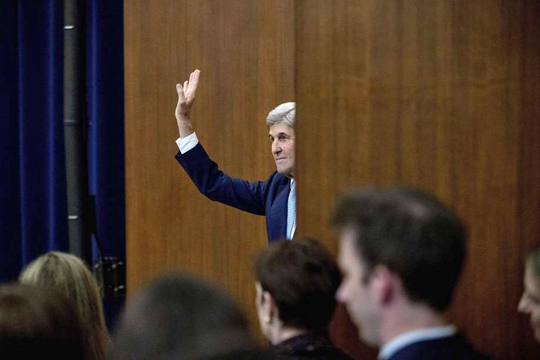
John

In a farewell speech, Kerry laid out a two-state vision for peace that he won't be in office to implement, but that the US hoped might be heeded even after President Barack Obama's term ends. He defended Obama's move last week to allow the UN Security Council to declare Israeli settlements illegal, the spark that set off an extraordinary and deepening diplomatic spat between the US and its closest Mideast ally.

"If the choice is one state, Israel can either be Jewish or democratic, it cannot be both, and it won't ever really be at peace," Kerry said in a speech that ran more than an hour, a comprehensive airing of grievances that have built up in the Obama administration over eight years but were rarely, until this month, discussed publicly.

Netanyahu pushed back in a hastily arranged televised statement in which he suggested he was done with the Obama administration and ready to deal with President-elect Donald Trump, who has sided squarely with Israel. The Israeli leader faulted Kerry for obsessing over settlements while paying mere "lip service" to Palestinian attacks and incitement of violence.

"Israelis do not need to be lectured about the importance of peace by foreign leaders," Netanyahu said from Jerusalem.

The dueling recriminations marked a low point for US-Israel relations, and a bitter end to eight years of frustrated ties between Obama and Netanyahu, who quarreled repeatedly over settlements, the peace process and Obama's nuclear deal with Iran.

Trump, who has assured Israel it merely needs to "hang on" until he takes over, wouldn't say Wednesday whether settlements should be reined in. But he told reporters Israel was being "treated very, very unfairly by a lot of different people."

It was unclear whether Israel came up in a phone call Obama, while vacationing in Hawaii, placed to Trump on Wednesday morning. Nor was it obvious what impact Kerry's speech, coming in the final days of the administration, might have.

Netanyahu expressed concern that a French-hosted summit next month could lead to an international framework that the UN Security Council might then codify with Obama's assent, boxing Israel in. Yet Kerry seemed to rule out the possibility Obama would take more parting shots, such as promoting that type of UN resolution or recognizing Palestinian statehood.

The diplomatic fracas erupted last week when the US, in a departure from past policy, decided to abstain rather than veto a UN Security Council resolution calling Israeli settlements in the West Bank and east Jerusalem a violation of international law. Israel was incensed, and on Wednesday, Netanyahu claimed Israel has "absolute, indispensable evidence" the US actually spearheaded the resolution.

Netanyahu offered what he called proof of US collusion: a document, leaked to an Egyptian newspaper, that purports to be a Palestinian account of a December meeting between top US and Palestinian officials. But White House spokesman Ned Price called it a "total fabrication" and added: "This meeting never occurred."

Palestinian President Mahmoud Abbas responded to the speech by reaffirming that he's ready to resume peace talks if Israel halts settlement construction.

Kerry, unveiling a six-part outline of what a future peace deal could look like, deviated from the traditional US message that foreign powers shouldn't impose a solution. His outline tracked closely with principles long assumed to be part of an eventual deal, and Kerry insisted he was merely describing what's emerged as points of general agreement.

Though Kerry faulted Palestinian leaders for insufficiently condemning violence and terrorism against Israelis, most of his speech focused on Israel. He said the two-state solution, the basis for all serious peace talks for years, was "now in serious jeopardy," and called Netanyahu's' government "the most right-wing in Israel's history."

He invoked the widespread concern that the growing Arab population in Israel and the Palestinian territories will eventually make Jews a minority in Israel, creating a demographic crisis for Israel unless there's a separate Palestinian state.

"The settler agenda is defining the future of Israel. And their stated purpose is clear: They believe in one state," Kerry said.

The US, the Palestinians and most of the world oppose Israeli settlement construction in the West Bank and east Jerusalem, territories captured by Israel in 1967 and claimed by the Palestinians for an independent state. But Israel's government argues previous construction freezes failed to advance a peace deal and that the future of the settlements — now home to 600,000 Israelis — must be resolved in direct talks between Israelis and Palestinians.

While Israel's Arab population has citizenship rights, the roughly 2.5 million Palestinians living in the occupied West Bank do not. Israel has annexed east Jerusalem, where Palestinians have residency rights but few have citizenship, in a move not internationally recognized.

Kerry said a future deal would have to ensure secure borders for Israel and a Palestinian state formed in territories Israel captured in the 1967 Mideast war, with "mutually agreed, equivalent swaps." He said both countries must fully recognize each other, ensure access to religious sites and relinquish all other existing claims. Kerry also called for assistance to help Palestinian refugees.

Yet he offered fewer details about how to get to such a deal, given the failure of so many previous attempts, including his own nine-month effort that collapsed in 2014. He urged Israelis and Palestinians to take "realistic steps on the ground now" to begin separating themselves into two states.

Kerry reiterated that the Obama administration's commitment to Israel was as strong as that of previous presidents, but he also noted that previous US administrations had also abstained on certain resolutions critical of Israel.

Comments

Skazi
 - 
Thursday, 29 Dec 2016

These bullshit leaders do not have courage to take right decisions , while they are in office ..... At the end of their term, they just bark some thing and quit .....

Add new comment

  • Coastaldigest.com reserves the right to delete or block any comments.
  • Coastaldigset.com is not responsible for its readers’ comments.
  • Comments that are abusive, incendiary or irrelevant are strictly prohibited.
  • Please use a genuine email ID and provide your name to avoid reject.
News Network
February 26,2020

Feb 26: China’s massive travel restrictions, house-to-house checks, huge isolation wards and lockdowns of entire cities bought the world valuable time to prepare for the global spread of the new virus.

But with troubling outbreaks now emerging in Italy, South Korea and Iran, and U.S. health officials warning Tuesday it’s inevitable it will spread more widely in America, the question is: Did the world use that time wisely and is it ready for a potential pandemic?

“It’s not so much a question of if this will happen anymore, but rather more a question of exactly when this will happen — and how many people in this country will have severe illness,” said Dr. Nancy Messonnier of the U.S. Centers for Disease Control and Prevention.

Some countries are putting price caps on face masks to combat price gouging, while others are using loudspeakers on trucks to keep residents informed. In the United States and many other nations, public health officials are turning to guidelines written for pandemic flu and discussing the possibility of school closures, telecommuting and canceling events.

Countries could be doing even more: training hundreds of workers to trace the virus’ spread from person to person and planning to commandeer entire hospital wards or even entire hospitals, said Dr. Bruce Aylward, the World Health Organization’s envoy to China, briefing reporters Tuesday about lessons learned by the recently returned team of international scientists he led.

“Time is everything in this disease,” Aylward said. “Days make a difference with a disease like this.”

The U.S. National Institutes of Health’s infectious disease chief, Dr. Anthony Fauci, said the world is “teetering very, very close” to a pandemic. He credits China’s response for giving other nations some breathing room.

China locked down tens of millions of its citizens and other nations imposed travel restrictions, reducing the number of people who needed health checks or quarantines outside the Asian country.

It “gave us time to really brush off our pandemic preparedness plans and get ready for the kinds of things we have to do,” Fauci said. “And we’ve actually been quite successful because the travel-related cases, we’ve been able to identify, to isolate” and to track down those they came in contact with.

With no vaccine or medicine available yet, preparations are focused on what’s called “social distancing” — limiting opportunities for people to gather and spread the virus.

That played out in Italy this week. With cases climbing, authorities cut short the popular Venice Carnival and closed down Milan’s La Scala opera house. In Japan, Prime Minister Shinzo Abe called on companies to allow employees to work from home, while the Tokyo Marathon has been restricted to elite runners and other public events have been canceled.

Is the rest of the world ready?

In Africa, three-quarters of countries have a flu pandemic plan, but most are outdated, according to authors of a modeling study published last week in The Lancet medical journal. The slightly better news is that the African nations most connected to China by air travel — Egypt, Algeria and South Africa — also have the most prepared health systems on the continent.

Elsewhere, Thailand said it would establish special clinics to examine people with flu-like symptoms to detect infections early. Sri Lanka and Laos imposed price ceilings for face masks, while India restricted the export of personal protective equipment.

India’s health ministry has been framing step-by-step instructions to deal with sustained transmissions that will be circulated to the 250,000 village councils that are the most basic unit of the country’s sprawling administration.

Vietnam is using music videos on social media to reach the public. In Malaysia, loudspeakers on trucks blare information through the streets.

In Europe, portable pods set up at United Kingdom hospitals will be used to assess people suspected of infection while keeping them apart from others. France developed a quick test for the virus and has shared it with poorer nations. German authorities are stressing “sneezing etiquette” and Russia is screening people at airports, railway stations and those riding public transportation.

In the U.S., hospitals and emergency workers for years have practiced for a possible deadly, fast-spreading flu. Those drills helped the first hospitals to treat U.S. patients suffering from COVID-19, the disease caused by the virus.

Other hospitals are paying attention. The CDC has been talking to the American Hospital Association, which in turn communicates coronavirus news daily to its nearly 5,000 member hospitals. Hospitals are reviewing infection control measures, considering using telemedicine to keep potentially infectious patients from making unnecessary trips to the hospital and conserving dwindling supplies of masks and gloves.

What’s more, the CDC has held 17 different calls reaching more than 11,000 companies and organizations, including stadiums, universities, faith leaders, retailers and large corporations. U.S. health authorities are talking to city, county and state health departments about being ready to cancel mass gathering events, close schools and take other steps.

The CDC’s Messonnier said Tuesday she had contacted her children’s school district to ask about plans for using internet-based education should schools need to close temporarily, as some did in 2009 during an outbreak of H1N1 flu. She encouraged American parents to do the same, and to ask their employers whether they’ll be able to work from home.

“We want to make sure the American public is prepared,” Messonnier said.

How prepared are U.S. hospitals?

“It depends on caseload and location. I would suspect most hospitals are prepared to handle one to two cases, but if there is ongoing local transmission with many cases, most are likely not prepared just yet for a surge of patients and the ‘worried well,’” Dr. Jennifer Lighter, a pediatric infectious diseases specialist at NYU Langone in New York, said in an email.

In the U.S., a vaccine candidate is inching closer to first-step safety studies in people, as Moderna Inc. has delivered test doses to Fauci’s NIH institute. Some other companies say they have candidates that could begin testing in a few months. Still, even if those first safety studies show no red flags, specialists believe it would take at least a year to have something ready for widespread use. That’s longer than it took in 2009, during the H1N1 flu pandemic — because that time around, scientists only had to adjust regular flu vaccines, not start from scratch.

The head of the World Health Organization, Tedros Adhanom Ghebreyesus, said the U.N. health agency’s team in China found the fatality rate between 2% and 4% in the hard-hit city of Wuhan, the virus’ epicenter, and 0.7% elsewhere.

The world is “simply not ready,” said the WHO’s Aylward. “It can get ready very fast, but the big shift has to be in the mindset.”

Aylward advised other countries to do “really practical things” now to get ready.

Among them: Do you have hundreds of workers lined up and trained to trace the contacts of infected patients, or will you be training them after a cluster pops up?

Can you take over entire hospital wards, or even entire hospitals, to isolate patients?

Are hospitals buying ventilators and checking oxygen supplies?

Countries must improve testing capacity — and instructions so health workers know which travelers should be tested as the number of affected countries rises, said Johns Hopkins University emergency response specialist Lauren Sauer. She pointed to how Canada diagnosed the first traveler from Iran arriving there with COVID-19, before many other countries even considered adding Iran to the at-risk list.

If the disease does spread globally, everyone is likely to feel it, said Nancy Foster, a vice president of the American Hospital Association. Even those who aren’t ill may need to help friends and family in isolation or have their own health appointments delayed.

“There will be a lot of people affected even if they never become ill themselves,” she said.

Comments

Add new comment

  • Coastaldigest.com reserves the right to delete or block any comments.
  • Coastaldigset.com is not responsible for its readers’ comments.
  • Comments that are abusive, incendiary or irrelevant are strictly prohibited.
  • Please use a genuine email ID and provide your name to avoid reject.
Agencies
June 16,2020

India continues to remain ranked 43rd on an annual World Competitiveness Index compiled by Institute for Management Development (IMD) with some traditional weaknesses like poor infrastructure and insufficient education investment keeping its ranking low, the international business school said on Tuesday.

Singapore has retained its top position on the 63-nation list.

Denmark has moved up to the second position (from 8th last year), Switzerland has gained one place to rank 3rd, the Netherlands has retained its 4th place and Hong Kong has slipped to the fifth place (from 2nd in 2019).

The US has moved down to 10th place (from 3rd last year), while China has also slipped from 14th to 20th place. Among the BRICS nations, India is ranked second after China, followed by Russia (50th), Brazil (56th) and South Africa (59th).

India was ranked 41st on the IMD World Competitiveness Ranking, being produced by the business school based in Switzerland and Singapore every year since 1989, but had slipped to 45th in 2017 before improving to 44th in 2018 and then to 43rd in 2019.

While its overall position has remained unchanged in the 2020 list, it has recorded improvements in areas like long-term employment growth, current account balance, high-tech exports, foreign currency reserves, public expenditure on education, political stability and overall productivity, the IMD said.

However, it has moved down in areas like exchange rate stability, real GDP growth, competition legislation and taxes.

Arturo Bris, Head of Competitiveness Center at IMD Business School, said India continues to struggle on the list and the recent country rating downgrade by Moody’s reflects the uncertainties regarding the economy’s future.

"In our ranking this year, we again emphasize the traditional weaknesses of India -- poor infrastructure, an important deficit in education investment, and a health system that does not reach everybody. For India to follow the path of China, it must stress its intangible infrastructure," Bris said.

"In a less global world, with China, USA, and Europe looking inwards, currencies like the rupee (and the Brazilian real for instance) are going to suffer and display high volatilities.

"Moody’s has threatened the country with a downgrade to junk and that would put India in a terrible position to attract foreign capital. So the urgency for the government should be to fix the short-term problems—and this requires to improve the credibility of the government itself," Bris added.

With the exception of Singapore, the Philippines, Taiwan and the Korean Republic, most Asian economies dropped in rankings this year, the IMD said.

The reason for the Asian economies’ less stellar performance as a region, this year is partly the result of the trade frictions between China and the US, particularly because these economies are highly dependent on trade with China.

About Singapore, which moved to the top rank last year, the IMD said its position is largely driven by the relative ease of setting up business, availability of skilled labour and its cutting-edge technological infrastructure.

The IMD said the impact of COVID-19 on the competitiveness ranking has partially been captured by executives’ opinions about the effectiveness of the different health systems.

In the ASEAN countries included in the survey, only Singapore and Thailand have a positive performance in the effectiveness of the health infrastructure.

Comments

Add new comment

  • Coastaldigest.com reserves the right to delete or block any comments.
  • Coastaldigset.com is not responsible for its readers’ comments.
  • Comments that are abusive, incendiary or irrelevant are strictly prohibited.
  • Please use a genuine email ID and provide your name to avoid reject.
News Network
April 24,2020

Washington, Apr 24: The number of coronavirus cases in the US has surpassed 850,000, Johns Hopkins University Coronavirus Resource Center data revealed on Thursday (local time).
The country now has registered 8,56,209 cases overall, according to the data, including 47,272 deaths.

The US currently leads the world in the number of reported COVID-19 deaths and confirmed cases.

There are more than 2.6 million COVID-19 cases around the world and more than 1,85,000 deaths, according to the data.

Comments

Add new comment

  • Coastaldigest.com reserves the right to delete or block any comments.
  • Coastaldigset.com is not responsible for its readers’ comments.
  • Comments that are abusive, incendiary or irrelevant are strictly prohibited.
  • Please use a genuine email ID and provide your name to avoid reject.