ACB arrests land acquisition officer, revenue inspector for taking bribe

[email protected] (CD Network | Photos by Chakravarthi)
January 4, 2017

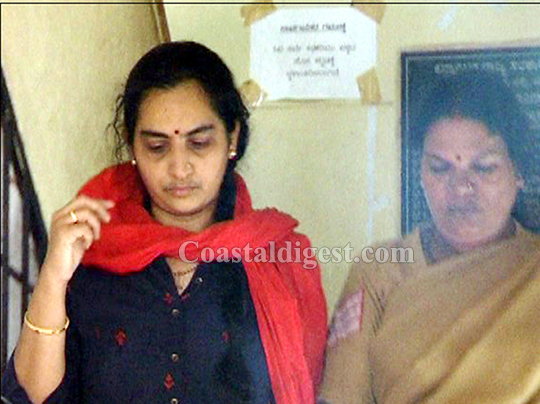
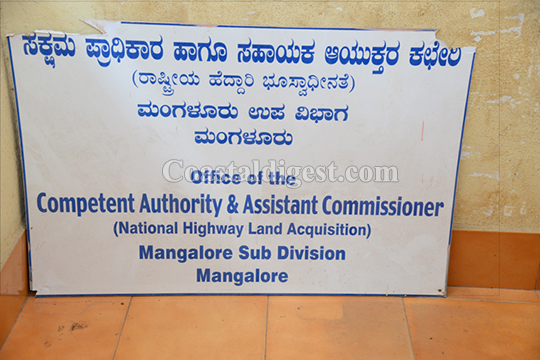
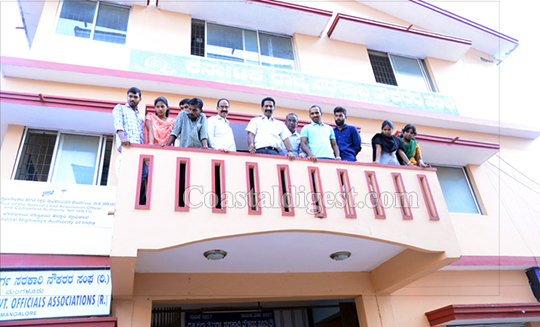
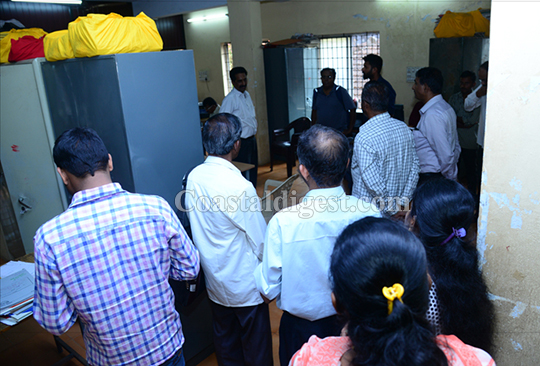
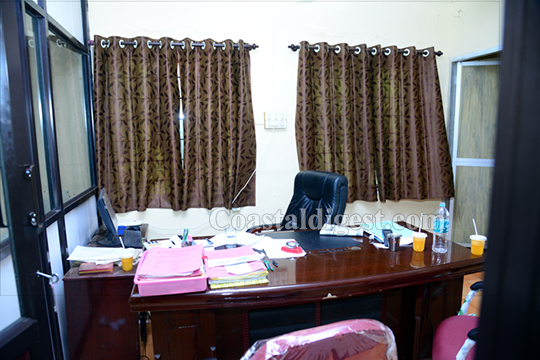
Mangaluru, Jan 4: A special land acquisition officer of NHAI and a revenue inspector were arrested by the Anti-Corruption Bureau (ACB) on Wednesday on charge of accepting a bribe of Rs 20,000 and Rs 5,000 for clearing a cheque, at NHAI office.

raid 1

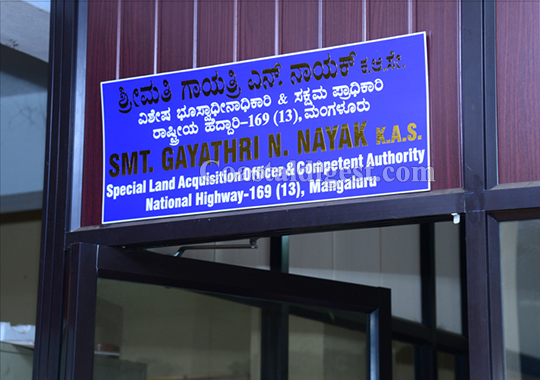
The arrested have been identified as Gayathri N Nayak, assistant commissioner, special land acquisition officer and executive director of Dr Shivaram Karanth Pilikula Nisargadhama and Tukrappa, revenue inspector, NHAI

According to Sudhir M Hegde, DSP, ACB, DK they had acted upon complaint of Yogish Kumar from Mulki where he complained that Gayathri N Nayak and Tukrappa had demanded Rs 25,000 for clearing a cheque of Rs 18 lakh.

The cheque was given as compensation to his two cents of land acquired by NHAI for road widening near Mulki.

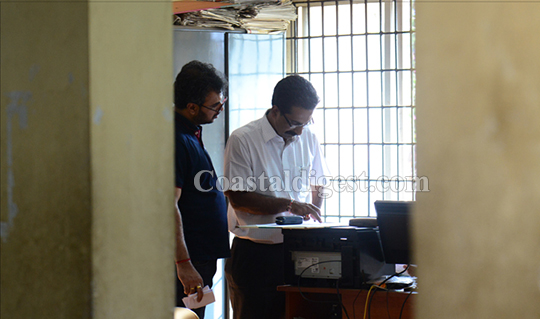
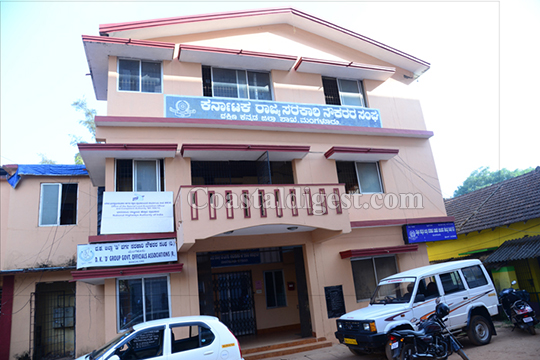
Based on his complaint, ACB sleuths arrested duo when Yogish went to NHAI office near Mini Vidhana Soudha to give bribe total of Rs 25,000.

Sudhir added that arrested persons have been sent to Judicial Custody till January 18.

raid 4

raid 5

raid 7

raid 9

raid 10

raid 11

raid 12

Comments

Add new comment

  • Coastaldigest.com reserves the right to delete or block any comments.
  • Coastaldigset.com is not responsible for its readers’ comments.
  • Comments that are abusive, incendiary or irrelevant are strictly prohibited.
  • Please use a genuine email ID and provide your name to avoid reject.
News Network
May 30,2020

Bengaluru, May 30: Health Minister B Sriramulu banned the consumption of chewing tobacco in public places on Saturday, which is marked as World Tobacco Day. The ban would include chewing paan masala and spitting in public places.

In June 2013, the state banned the manufacture, storage, sale, or distribution of gutka and paan masala containing tobacco or nicotine as ingredients to reduce the prevalence of tobacco use. On October 26, 2016, the state proscribed all kinds of chewing tobacco, containing tobacco or nicotine or both in accordance with the Supreme Court order.

Karnataka is the second state in India to ban e-cigarettes. The state also prohibited single cigarettes. Until September 2019, the state counselled 15,698 patients in tobacco cessation centres set up in private dental colleges.

Comments

Add new comment

  • Coastaldigest.com reserves the right to delete or block any comments.
  • Coastaldigset.com is not responsible for its readers’ comments.
  • Comments that are abusive, incendiary or irrelevant are strictly prohibited.
  • Please use a genuine email ID and provide your name to avoid reject.
News Network
April 16,2020

New Delhi, Apr 16: Minority Affairs Minister Mukhtar Abbas Naqvi on Thursday directed state waqf boards to ensure strict implementation of lockdown and social distancing guidelines during the holy month of Ramzan starting next week amid the coronavirus pandemic.

At a meeting via video conferencing, Naqvi asked the state waqf boards' officials to create awareness among people to offer prayers and perform other religious rituals like "iftar (breaking of fast)" during Ramzan, which begins on April 24 or 25, staying inside their homes.

More than seven lakh registered mosques, eidgahs, imambadas, dargahs and other religious and social institutions come under state waqf boards across the country. The Central Waqf Council is the regulatory body of state waqf boards in India.

"We should cooperate with health workers, security forces, administrative officers, sanitation workers. They are working for our safety and well-being even putting their own lives at risk in this coronavirus pandemic," Naqvi said.

"We should also demolish rumours and misinformation being spread about quarantine and isolation centres by creating awareness among people that such centres are only meant to protect people, their families and the society from the pandemic," the minister said.

Naqvi told all the state waqf boards and religious and social organisations that everyone should remain cautious of any type of fake news and conspiracies aimed at creating misinformation. 

"Authorities have been working for safety and well-being of all citizens of the country without any discrimination. Such type of rumours and conspiracies are a nefarious design to weaken the fight against coronavirus," he said.

"We should work united to win this fight against corona by defeating any type of rumour, misinformation and conspiracy," the minister said.

Naqvi asked officials of all the state waqf boards to play an active and effective role in ensuring that people follow the guidelines of the Union Home Ministry, state governments and the Central Waqf Council while fulfilling religious responsibilities during Ramzan.

In view of the challenges of the COVID-19 pandemic, all religious and social activities and mass gatherings in all the temples, gurdwaras, churches and other religious and social places of the country have been stopped, he said. 

Similarly, any mass gatherings in mosques and other Muslim religious places of the country has also been stopped, Naqvi said.

He said that due to the COVID-19 threat, religious leaders as well as religious and social organisations from all regions of the country, have appealed to people to offer prayers and perform all other religious rituals staying inside their homes during Ramzan. 

Most of the Muslim nations of the world have also banned mass gatherings at mosques and other religious places during the holy month, he pointed out.

Prime Minister Narendra Modi, in cooperation with all the state governments, has been working effectively for the safety and well-being of the people, he said.

The cooperation of the people has brought great relief to India in the war against COVID-19 Naqvi said, adding that several challenges are still there before the country. 

"We can defeat these challenges of the coronavirus pandemic by following all the guidelines of the central and state governments strictly," he asserted.

Chairman and senior officials from state waqf boards such as Uttar Pradesh (Shia & Sunni), Andhra Pradesh, Bihar (Shia & Sunni), Dadra & Nagar Haveli, Haryana, Karnataka, Kerala, Madhya Pradesh, Punjab, West Bengal, Andaman & Nicobar, Assam, Manipur, among others participated in the meeting.

State waqf boards from Rajasthan, Telangana, Delhi, Chhattisgarh, Gujarat, Himachal Pradesh, Jammu and Kashmir, Jharkhand, Maharashtra, Odisha, Puducherry, Tamil Nadu, Tripura and Uttarakhand also participated.

Comments

Add new comment

  • Coastaldigest.com reserves the right to delete or block any comments.
  • Coastaldigset.com is not responsible for its readers’ comments.
  • Comments that are abusive, incendiary or irrelevant are strictly prohibited.
  • Please use a genuine email ID and provide your name to avoid reject.
Agencies
February 6,2020

Even more than three years after demonetisation and all-out efforts to make most transactions through electronic, cash is still king, as it thrives in a digital India, said fintech start-up Paytm founder Vijay Sekhar Sharma.

"While cashless economy is not possible in India, less cash economy will be in the future. Less cash is the only solution, not the elimination of cash," Sharma told IANS in an interview after unveiling an all-in-one payment gateway on Tuesday.

Asserting that it would take 5-10 years for India to make the transition to digital payments from the traditional mode of cash, Sharma, 41, said the e-payment industry benefitted more from the November 8, 2016 note ban and withdrawal of old Rs 1,000 and Rs 500 denominations.

"I think it (demonetisation) helped the industry despite lack of specific help. But the world has changed since then. It is about the scale of distribution of merchants that is what is propelling digital payments," said Sharma.

Most of the cash not only came back into circulation, but also remains as the mode of payment for the majority due to its convenience for the people used to such transactions.

Expounding Paytm's zero service charge, Sharma said the strategy is sustainable as it leads to acquiring more customers and merchants, enabling newer business opportunities.

Paytm also does not levy a service charge to small merchants for its payments services, unlike organised players like Uber.

"Though there is a monetisation model, the merchants who are small shopkeepers, become our financial services customers as they open a bank account, which is profitable."

Paytm secured a Payments Bank license from the Reserve Bank of India to offer a savings bank account, Rupay debit card and money transfer services.

"We are banking on payment services acquiring customers and merchants who avail banking, lending, insurance, wealth and software services like billing software and business ledger software services eventually," Sharma noted.

The mobile first bank services include zero balance and zero digital transaction charge accounts.

"Basically, payments, cloud, commerce and financial services are a cohort we follow. So, payments is our customer as well as merchant acquisition. If it breaks even, we are happy because other line items make more money, he affirmed.

Noting that in a market like India, one cannot price services at a premium unlike in a developed country like the US, the billionaire businessman said a consumer in a developing country would not be able to afford such a hefty charge.

Forbes ranked Sharma as India's youngest billionaire in 2017, with a net worth of $2.1 billion.

While several countries operate on the model of higher service charges, Sharma said newer business models have to be discovered in India, as customer lifecycle value is accounted for more stages than in other nations.

Asked about an upscale retailer like Zara not giving a wallet payment option during its recent end of season sale in Bengaluru, Sharma said Paytm was addressing such hiccups with its all-in-one payment solutions.

"It's an opportunity, because if the retailer has our all-in-one point of sale machine, where in they enter the amount, it shows both the Quick Response code (QR) and card payment options," he observed.

Sharma compared older swiping payment machine to feature phones and modern ones to feature-rich smartphones.

"If you notice, they look like feature phones and the modern day card machine is more a smartphone like. You can add the smatphone components, which can add the features," reiterated Sharma.

Though Paytm's all-in-one QR point of sale machine integrates the billing system, its chief executive said it was not ideal to have an independent QR feature.

Paytm has 16 million strong merchant user base, which Sharma aims to raise to 26 million base in the next one year.

Sharma has launched in this tech city an all-in-one payment gateway and Paytm Business Payments solution, which enable digital payments through multiple methods for small and medium enterprises (SMEs) and an Android point of sale machine.

With the new gateway solution, collecting digital payments through multiple methods can be achieved seamlessly while Paytm Business Payments solution enables automated vendor payments, including employee salaries and customer refunds among others.

The One97 Communications-owned Paytm aims to help SMEs streamline and digitise their business activities using its new solutions, which enhance the overall efficiency of both accepting and making payments.

Paytm has a data bank of over 200 million saved cards and bank accounts, a feature which enables partner apps to shorten transaction times and propel faster conversions while using the all-in-one payment gateway.

Complementing the two solutions, Sharma also launched an all-in-one Android point of sale machine, which can accept payments through all forms such as cards, wallets, UPI apps and even cash.

The device has a QR code that supports all contact and contactless payments, coming with integrated billing software customized solutions for different sectors such as catering, ticketing, parking and others.

The handheld Android device is equipped with an in-built printer, scanner and can also generate bills.

Valued at $16 billion, Paytm is not alone in the fiercely competitive Indian fintech space where a dozen players like PhonePe, MobiKwik, Kotak 811 and deep pocketed international giants Google Pay and Amazon Pay are in the fray.


Comments

Add new comment

  • Coastaldigest.com reserves the right to delete or block any comments.
  • Coastaldigset.com is not responsible for its readers’ comments.
  • Comments that are abusive, incendiary or irrelevant are strictly prohibited.
  • Please use a genuine email ID and provide your name to avoid reject.