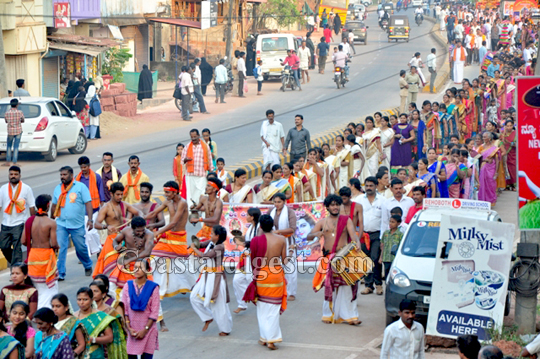
Ullal Muslims offer fruit juice to Hindu devotees during temple festival

[email protected] (CD Network | Photos by Moany Gutty)
January 7, 2017

Mangaluru, Jan 7: Amidst sporadic communal attacks and inflammatory speeches by politicians, the people of Ullal region have once again showed the world that they are the standard-bearers of peace, communal harmony and brotherhood.

ullaluliya 10

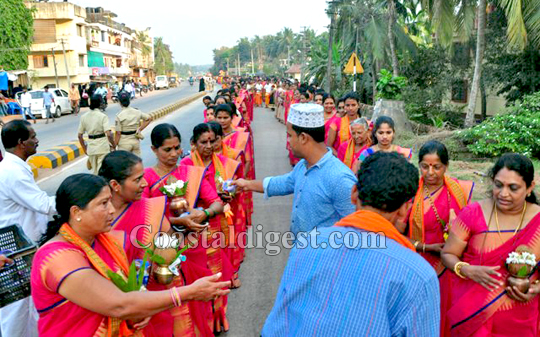
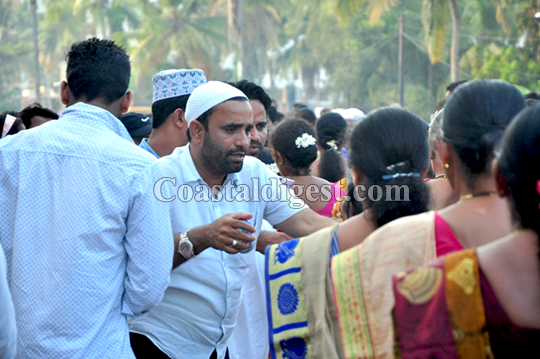
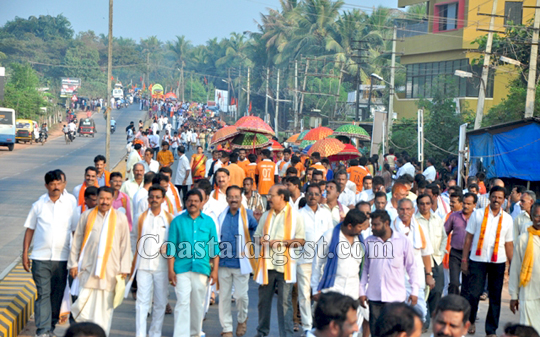
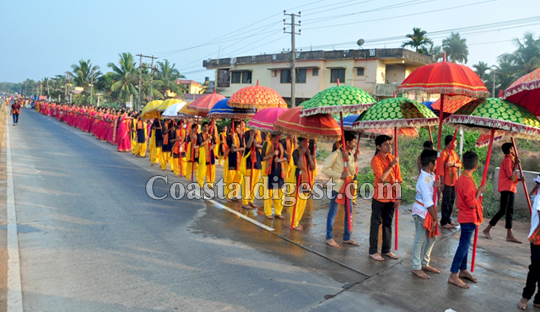
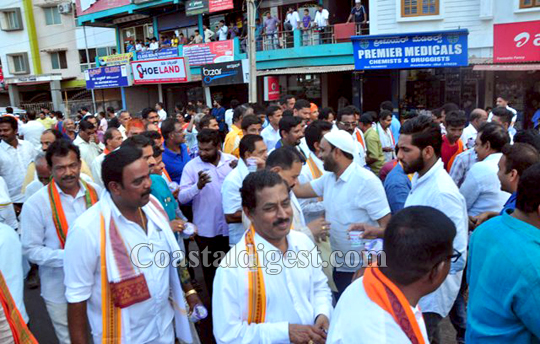
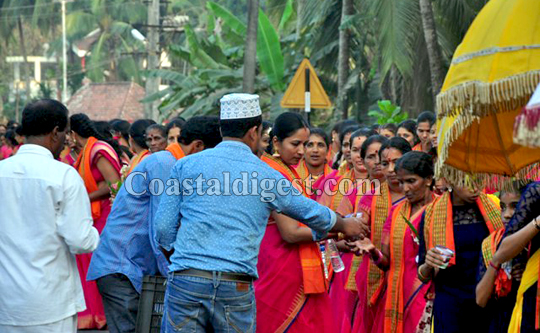
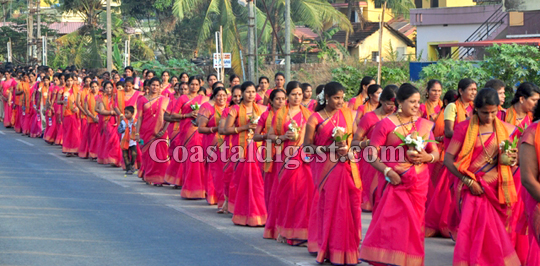
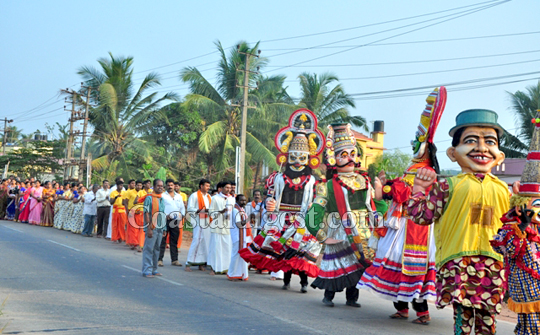
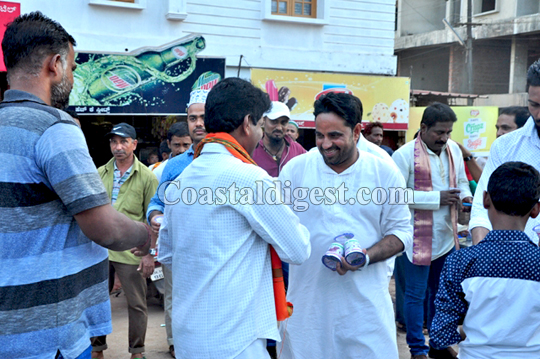
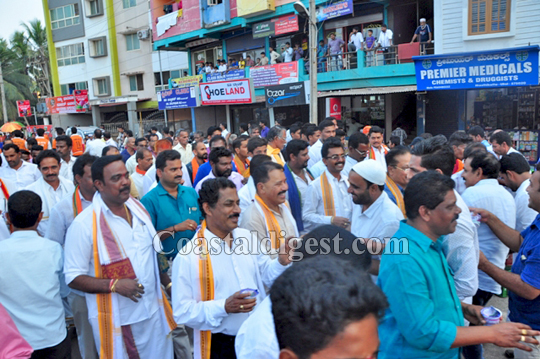
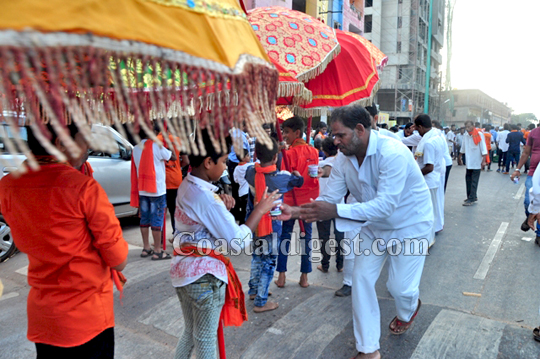
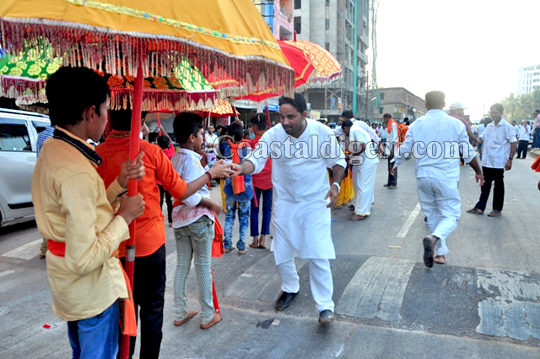
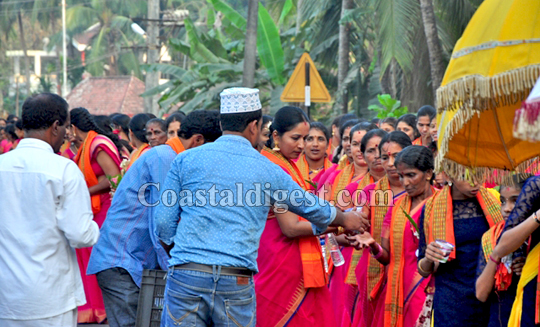
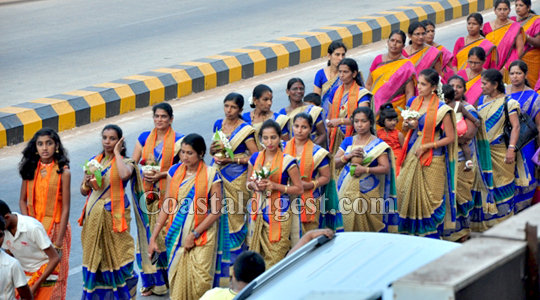
On Friday, Muslim brethren in Ullal showed an exemplary gesture that herald the message of communal harmony. While members of the Hindu community were celebrating annual festival at Sri Ullalthi Dharma Arasara Temple, Uliya in Ullal, Muslims in the region welcomed devotees by offering fruit juice. Muslim brethren not only offered soft drinks to Hindu devotees, but also extended festival wishes.

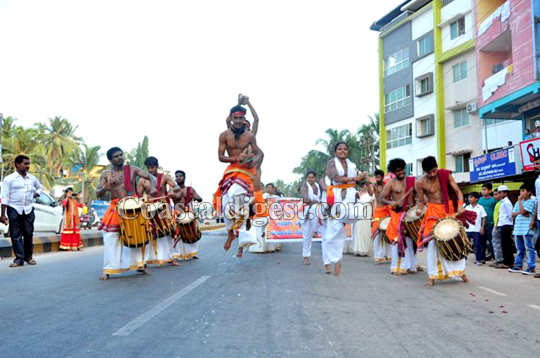
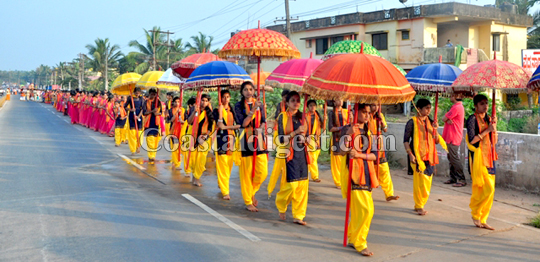
In fact, the occasion was Prathishte - Brahmakalashotsava and Dharma Nadavali Mahotsava of Sri Ullalthi Dharma Arasara Temple, which is one of the prominent Hindu shrines in the region.

The initiatives to offer fruit juice and welcome Hindu devotees to the festival was taken by the management committee of Sayyid Madani Ullal Darga, which is one of the famous Muslim shrine of South India. Minister for food, civil supplies and consumer affairs U T Khader too was behind the initiative as the region comes under his constituency - Mangaluru. Further, Khader also hails from the same place.

The initiative was well-praised by people in general and the police department in particular. Usually, police department is at the receiving end whenever incidents of communal clashes and murders report in Ullal.

Deputy Commissioner of police (crime) M Sanjeev Patil posted the pictures of Muslim brethren distributing fruit juice to Hindu devotees at the temple premises.

"Better days of Hindu - Muslim unity are here. Muslim friends have distributed cold drinks to devotees at Ullalti Amma Temple. A good initiative by Muslim youths in Ullal which needs to be continued," said Patil.

ullaluliya 1

ullaluliya 2

ullaluliya 7

ullaluliya 8

ullaluliya 9

ullaluliya 11

ullaluliya 13

ullaluliya 14

ullaluliya 15

ullaluliya 16

ullaluliya 17

ullaluliya 18

ullaluliya 19

ullaluliya 20

;">ullaluliya 21

ullaluliya 23

Comments

shaji
 - 
Sunday, 8 Jan 2017

Dear Nazeer Ullal, i do not agree with your comments. Please try to be good to others if you are a real Muslim. Islam does not spread hate. Be a model to others and dont let others to have bad image about islam and muslims. In case you cant do anything good, please dont hate anyone who does good job. If you cant appreciate them, please do not hate them.

Rikaz
 - 
Sunday, 8 Jan 2017

WE are human first....religion came afterwards....good gesture people of Ullal.....keep doing...May God bless.....

TWO EARS ATTACHED
 - 
Saturday, 7 Jan 2017

@nasser Ullal

Islam is peace and helping. A man who done bad things. And he had one good habit like feeding dogs. If Allah wills he might go to heaven.

There is no guarantee that a man pray 5 times. And his heart is full of hatred. T

Barkha Dutt
 - 
Saturday, 7 Jan 2017

@NAZEER ULLAL, AL JUBAIL KSA.... like this people should be hanged no rights to stay in india. always front to disturb the peace of society.

Anwar
 - 
Saturday, 7 Jan 2017

Nazeer Ullal,this is also a way of spreading love in society which is missing....Our Prophet had allowed Christians to pray in Masjid e Nabwi in Madina. Please spread love. Humanity is important.

Naren Bhatt
 - 
Saturday, 7 Jan 2017

Ullal people's surgical strike against a terrorist who threatened to set Dakshina Kannada on fire.

Ganesh
 - 
Saturday, 7 Jan 2017

wow two eyes are not enough to see.. that too in ullal.

Harish
 - 
Saturday, 7 Jan 2017

no words to say, just awesome.,

lalitha
 - 
Saturday, 7 Jan 2017

Integrity! good work by good muslims.

Khader
 - 
Saturday, 7 Jan 2017

hatsoff muslim brothers! indeed a great initiate for the happy society.

Rajeshwari
 - 
Saturday, 7 Jan 2017

good job muslim brothers, will unite to make india better.

jayaraj
 - 
Saturday, 7 Jan 2017

wow just wonderful to see this, amazing!!!

Mahesh
 - 
Saturday, 7 Jan 2017

nowhere can be seen like this, this only happens in mangalore.

NAZEER ULLAL
 - 
Saturday, 7 Jan 2017

this is not islam.....instead of serving them, the idol worshippers, let them serve the needy poor people. no where is mr. abdul rasheed haji the president of darga ullal?????

Add new comment

  • Coastaldigest.com reserves the right to delete or block any comments.
  • Coastaldigset.com is not responsible for its readers’ comments.
  • Comments that are abusive, incendiary or irrelevant are strictly prohibited.
  • Please use a genuine email ID and provide your name to avoid reject.
Agencies
May 8,2020

Washington D.C., May 8: The prime time for brain development in a child's life is the first year, where the infant spends most of the time asleep. It is the time when neural connections form and sensory memories are encoded.

However, when sleep is disrupted, as occurs more often among children with autism, brain development may be affected, too.

New research led by the University of Washington finds that sleep problems in a baby's first 12 months may not only precede an autism diagnosis but also may be associated with altered growth trajectory in a key part of the brain, the hippocampus.

The study, which was published in the American Journal of Psychiatry, researchers report that in a sample of more than 400 taken of 6- to 12-month-old infants, those who were later diagnosed with autism were more likely to have had difficulty falling asleep.

It also states that this sleep difficulty was associated with altered growth trajectories in the hippocampus.

"The hippocampus is critical for learning and memory, and changes in the size of the hippocampus have been associated with poor sleep in adults and older children.

As many as 80 per cent of the children with autism spectrum disorder have sleep problems," said Annette Estes, director of the UW Autism Center and senior author of the study.

"In our clinical experience, parents have a lot of concerns about their children's sleep, and in our work on early autism intervention, we observed that sleep problems were holding children and families back," added Estes, who is also a UW professor of speech and hearing sciences.

"It could be that altered sleep is part-and-parcel of autism for some children. One clue is that behavioural interventions to improve sleep don't work for all children with autism, even when their parents are doing everything just right. This suggests that there may be a biological component to sleep problems for some children with autism," said Estes.

To consider links among sleep, brain development, and autism, researchers at the IBIS Network looked at MRI scans of 432 infants, surveyed parents about sleep patterns, and measured cognitive functioning using a standardized assessment.

At the outset of the study, infants were classified according to their risk for developing autism: Those who were at higher risk of developing autism -- about two-thirds of the study sample -- had an older sibling who had already been diagnosed.

Infant siblings of children with autism have a 20 per cent chance of developing autism spectrum disorder -- a much higher risk than children in the general population.

In the current study, 127 of the 432 infants were identified as "low risk" at the time the MRI scans were taken because they had no family history of autism.

They later evaluated all the participants at 24 months of age to determine whether they had developed autism. Of the roughly 300 children originally considered "high familial risk," 71 were diagnosed with autism spectrum disorder at that age.

Problems with sleep were more common among the infants later diagnosed with an autism spectrum disorder, as were larger hippocampi. No other subcortical brain structures were affected, including the amygdala, which is responsible for certain emotions and aspects of memory, or the thalamus, a signal transmitter from the spinal cord to the cerebral cortex.

The authors note that while parents reported more sleep difficulties among infants who developed autism compared to those who did not, the differences were very subtle and only observed when looking at group averages across hundreds of infants.

Sleep patterns in the first years of life change rapidly as infants transition from sleeping around the clock to a more adult-like sleep/wake cycle. Until further research is completed, Estes said, it is not possible to interpret challenges with sleep as an early sign of increased risk for autism.

Comments

Add new comment

  • Coastaldigest.com reserves the right to delete or block any comments.
  • Coastaldigset.com is not responsible for its readers’ comments.
  • Comments that are abusive, incendiary or irrelevant are strictly prohibited.
  • Please use a genuine email ID and provide your name to avoid reject.
Ram Puniyani
February 10,2020

Noam Chomsky is one of the leading peace workers in the world. In the wake of America’s attack on Vietnam, he brought out his classic formulation, ‘manufacturing consent’. The phrase explains the state manipulating public opinion to have the public approve of it policies—in this case, the attack of the American state on Vietnam, which was then struggling to free itself from French colonial rule.

In India, we are witness to manufactured hate against religious minorities. This hatred serves to enhance polarisation in society, which undermines India’s democracy and Constitution and promotes support for a Hindu nation. Hate is being manufactured through multiple mechanisms. For example, it manifests in violence against religious minorities. Some recent ghastly expressions of this manufactured hate was the massive communal violence witnessed in Mumbai (1992-93), Gujarat (2002), Kandhamal (2008) and Muzaffarnagar (2013). Its other manifestation was in the form of lynching of those accused of having killed a cow or consumed beef. A parallel phenomenon is the brutal flogging, often to death, of Dalits who deal with animal carcasses or leather.

Yet another form of this was seen when Shambhulal Regar, indoctrinated by the propaganda of Hindu nationalists, burned alive Afrazul Khan and shot the video of the heinous act. For his brutality, he was praised by many. Regar was incited into the act by the propaganda around love jihad. Lately, we have the same phenomenon of manufactured hate taking on even more dastardly proportions as youth related to Hindu nationalist organisations have been caught using pistols, while police authorities look on.

Anurag Thakur, a BJP minster in the central government recently incited a crowd in Delhi to complete his chant of what should happen to ‘traitors of the country...” with a “they should be shot”. Just two days later, a youth brought a pistol to the site of a protest at Jamia Millia Islamia university and shouted “take Azaadi!” and fired it. One bullet hit a student of Jamia. This happened on 30 January, the day Nathuram Godse had shot Mahatma Gandhi in 1948. A few days later, another youth fired near the site of protests against the CAA and NRC at Shaheen Bagh. Soon after, he said that in India, “only Hindus will rule”.

What is very obvious is that the shootings by those associated with Hindu nationalist organisations are the culmination of a long campaign of spreading hate against religious minorities in India in general and against Muslims in particular. The present phase is the outcome of a long and sustained hate campaign, the beginning of which lies in nationalism in the name of religion; Muslim nationalism and Hindu nationalism. This sectarian nationalism picked up the communal view of history and the communal historiography which the British introduced in order to pursue their ‘divide and rule’ policy.

In India what became part of “social common sense” was that Muslim kings had destroyed Hindu temples, that Islam was spread by force, and that it is a foreign religion, and so on. Campaigns, such as the one for a temple dedicated to the Hindu god Rama to be built at the site where the Babri masjid once stood, further deepened the idea of a Muslim as a “temple-destroyer”. Aurangzeb, Tipu Sultan and other Muslim kings were tarnished as the ones who spread Islam by force in the subcontinent. The tragic Partition, which was primarily due to British policies, and was well-supported by communal streams also, was entirely attributed to Muslims. The Kashmir conflict, which is the outcome of regional, ethnic and other historical issues, coupled with the American policy of supporting Pakistan’s ambitions of regional hegemony, (which also fostered the birth of Al-Qaeda), was also attributed to the Muslims.

With recurring incidents of communal violence, these falsehoods went on going deeper into the social thinking. Violence itself led to ghettoisation of Muslims and further broke inter-community social bonds. On the one hand, a ghettoised community is cut off from others and on the other hand the victims come to be presented as culprits. The percolation of this hate through word-of-mouth propaganda, media and re-writing of school curricula, had a strong impact on social attitudes towards the minorities.

In the last couple of decades, the process of manufacturing hate has been intensified by the social media platforms which are being cleverly used by the communal forces. Swati Chaturvedi’s book, I Am a Troll: Inside the Secret World of the BJP’s Digital Army, tells us how the BJP used social media to spread hate. Whatapp University became the source of understanding for large sections of society and hate for the ‘Other’, went up by leaps and bounds. To add on to this process, the phenomenon of fake news was shrewdly deployed to intensify divisiveness.

Currently, the Shaheen Bagh movement is a big uniting force for the country; but it is being demonised as a gathering of ‘anti-nationals’. Another BJP leader has said that these protesters will indulge in crimes like rape. This has intensified the prevalent hate.

While there is a general dominance of hate, the likes of Shambhulal Regar and the Jamia shooter do get taken in by the incitement and act out the violence that is constantly hinted at. The deeper issue involved is the prevalence of hate, misconceptions and biases, which have become the part of social thinking.

These misconceptions are undoing the amity between different religious communities which was built during the freedom movement. They are undoing the fraternity which emerged with the process of India as a nation in the making. The processes which brought these communities together broadly drew from Gandhi, Bhagat Singh and Ambedkar. It is these values which need to be rooted again in the society. The communal forces have resorted to false propaganda against the minorities, and that needs to be undone with sincerity.

Combating those foundational misconceptions which create hatred is a massive task which needs to be taken up by the social organisations and political parties which have faith in the Indian Constitution and values of freedom movement. It needs to be done right away as a priority issue in with a focus on cultivating Indian fraternity yet again.


Comments

Add new comment

  • Coastaldigest.com reserves the right to delete or block any comments.
  • Coastaldigset.com is not responsible for its readers’ comments.
  • Comments that are abusive, incendiary or irrelevant are strictly prohibited.
  • Please use a genuine email ID and provide your name to avoid reject.
Media Release
July 22,2020

Mangaluru, Jul 22: City based APD Foundation has mooted the idea of giving state recognition and compensation for ‘Covid Saviors’, namely healthcare workers and civic officials who die in the line of duty in the war against Coronavirus pandemic. This suggestion was formally proposed by Abdullah A. Rehman, Founder & CEO, APD Foundation in a letter addressed to Shri Narendra Modi, Hon’ble Prime Minster of India and Shri B. S. Yediyurappa, Hon’ble Chief Minister of Karnataka on July 22, 2020.

In the letter Mr. Rehman asserts that COVID-19 pandemic has caused widespread devastation in the country and played havoc in the lives of the common man. In this scenario, the healthcare workers, such as doctors, nurses and paramedics along with civic officials have emerged as the saviors of the suffering humanity. They expose themselves to great personal risk while treating Covid patients. Many of them catch infection and a few of them have died. Such persons deserve to be recognized by the government for their supreme sacrifice.

Elaborating the rationale behind the proposal, the letter draws comparisons with practice of soldiers who die on the battlefield being glorified as ‘MARTYRS’. The slain soldiers are decorated posthumously with medals and titles of honour. Their families are provided with generous cash compensation so that the future of their widows, children and parents are safeguarded. They are provided with allotment of land, lucrative business opportunities like petrol pump / gas agency or reservation in government jobs for their spouse and children.

The letter suggests that healthcare workers and civic officials who succumb in the line of duty should also be similarly honoured. “Hence I propose that healthcare workers like doctors, nurses and paramedics who die while treating Covid patients should be recognized as ‘COVID SAVIORS’. Civic officials who are working for the cause should also be included in this scheme. Generous compensation should be paid to their families so that their future welfare is ensured as if they were alive,” Mr. Rehman has written.

The suggestion has been made in the wake of news reports that the Odhisha State Government has announced compensation of Rs. 50 lakhs and state honours for healthcare workers who die on Covid duty. Similarly the French government has announced a major increase in salary to its healthcare workers. In the same manner India too can provide optimum welfare to its health workers and set an example on the world stage.

“Though Covid pandemic is likely to be a temporary phenomenon, there is a need to recognize the service of those who are helping society to overcome this grave crisis. They inspire confidence in the hearts of the common people in the same manner as soldiers in uniform do. Hence I urge you to accept the suggestions made herein and announce the same at the earliest,” Mr. Rehman concludes in his letter.

Copies of the letter have also been sent to Shri Nalin Kumar Kateel, MP, Mangalore, Shri D. Vedavyas Kamath, MLA, Mangalore and Smt. Sindhu B. Rupesh, IAS, Deputy Commissioner, DK District for their information and follow up action.

Comments

Add new comment

  • Coastaldigest.com reserves the right to delete or block any comments.
  • Coastaldigset.com is not responsible for its readers’ comments.
  • Comments that are abusive, incendiary or irrelevant are strictly prohibited.
  • Please use a genuine email ID and provide your name to avoid reject.