



Airport gunman charged, US seeks death penalty

January 8, 2017

Fort Lauderdale, Jan 8: The Iraq war veteran accused of killing five travellers and wounding six others at a busy international airport in Florida has been charged and could face the death penalty if convicted.
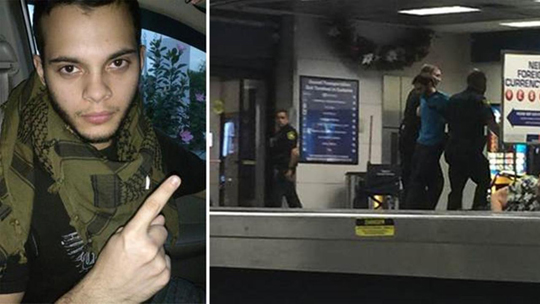
gunman

Esteban Santiago, 26, told investigators that he planned the attack, buying a one-way ticket to the Fort Lauderdale airport, a federal complaint said.

Authorities do not know why he chose his target and have not ruled out terrorism.

Santiago was yesterday charged with an act of violence at an international airport resulting in death which carries a maximum punishment of execution and weapons charges.

"Today's charges represent the gravity of the situation and reflect the commitment of federal, state and local law enforcement personnel to continually protect the community and prosecute those who target our residents and visitors," US Attorney Wifredo Ferrer said.

Authorities said during a news conference that they had interviewed roughly 175 people, including a lengthy interrogation with the cooperative suspect, a former National Guard soldier from Alaska.

Flights had resumed at the Fort Lauderdale airport after the bloodshed, though the terminal where the shooting happened remained closed.

Santiago spoke to investigators for several hours after he opened fire with a Walther 9mm semi-automatic handgun that he appears to have legally checked on a flight from Alaska. He had two magazines with him and emptied both of them, firing about 15 rounds, before he was arrested, the complaint said.

"We have not identified any triggers that would have caused this attack. We're pursuing all angles on what prompted him to carry out this horrific attack," FBI Agent George Piro said.

Investigators are combing through social media and other information to determine Santiago's motive, and it's too early to say whether terrorism played a role, Piro said.

In November, Santiago had walked into an FBI field office in Alaska saying the US government was controlling his mind and forcing him to watch Islamic State group videos, authorities said.

"He was a walk-in complaint. This is something that happens at FBI offices around the country every day," FBI agent Marlin Ritzman said.

On that day, Santiago had a loaded magazine on him, but had left a gun in his vehicle, along with his newborn child, authorities said. Officers seized the weapon and local officers took him to get a mental health evaluation. His girlfriend picked up the child.

On December 8, the gun was returned to Santiago. Authorities would not say if it was the same gun used in the airport attack.

Comments

Rashid
 - 
Sunday, 8 Jan 2017

Here , question is , what is the motive behind this killing....there should have one more question, what is the motive of FBI to force him to watch IS videos

shaji
 - 
Sunday, 8 Jan 2017

US Authrities will now say that he was mentally ill and he did the killings in his absent mind as he was not having any will to kill. However in case he was muslim, US officials wuld have declared him as terrorist having links with ISI, IM, LeT, JDT and so many muslim organisations including some NGOs. US officials would have made long story of the person having travelled to many muslim countries and having contact with various organisations.

aharkul
 - 
Sunday, 8 Jan 2017

Thank God he is Christian.. If it is Muslim they blame as terrorist...

Add new comment

  • Coastaldigest.com reserves the right to delete or block any comments.
  • Coastaldigset.com is not responsible for its readers’ comments.
  • Comments that are abusive, incendiary or irrelevant are strictly prohibited.
  • Please use a genuine email ID and provide your name to avoid reject.
News Network
May 19,2020

May 19: A Chinese laboratory has been developing a drug it believes has the power to bring the coronavirus pandemic to a halt.

The outbreak first emerged in China late last year before spreading across the world, prompting an international race to find treatments and vaccines.

A drug being tested by scientists at China's prestigious Peking University could not only shorten the recovery time for those infected, but even offer short-term immunity from the virus, researchers say.

Sunney Xie, director of the university's Beijing Advanced Innovation Center for Genomics, told AFP that the drug has been successful at the animal testing stage.

"When we injected neutralising antibodies into infected mice, after five days the viral load was reduced by a factor of 2,500," said Xie.

"That means this potential drug has (a) therapeutic effect."

The drug uses neutralising antibodies -- produced by the human immune system to prevent the virus infecting cells -- which Xie's team isolated from the blood of 60 recovered patients.

A study on the team's research, published Sunday in the scientific journal Cell, suggests that using the antibodies provides a potential "cure" for the disease and shortens recovery time.

Xie said his team had been working "day and night" searching for the antibody.

"Our expertise is single-cell genomics rather than immunology or virology. When we realised that the single-cell genomic approach can effectively find the neutralising antibody we were thrilled."

He added that the drug should be ready for use later this year and in time for any potential winter outbreak of the virus, which has infected 4.8 million people around the world and killed more than 315,000.

"Planning for the clinical trial is underway," said Xie, adding it will be carried out in Australia and other countries since cases have dwindled in China, offering fewer human guinea pigs for testing.

"The hope is these neutralised antibodies can become a specialised drug that would stop the pandemic," he said.

China already has five potential coronavirus vaccines at the human trial stage, a health official said last week.

But the World Health Organization has warned that developing a vaccine could take 12 to 18 months.

Scientists have also pointed to the potential benefits of plasma -- a blood fluid -- from recovered individuals who have developed antibodies to the virus enabling the body's defences to attack it.

More than 700 patients have received plasma therapy in China, a process which authorities said showed "very good therapeutic effects".

"However, it (plasma) is limited in supply," Xie said, noting that the 14 neutralising antibodies used in their drug could be put into mass production quickly.

Using antibodies in drug treatments is not a new approach, and it has been successful in treating several other viruses such as HIV, Ebola and Middle East Respiratory Syndrome (MERS).

Xie said his researchers had "an early start" since the outbreak started in China before spreading to other countries.

Ebola drug Remdesivir was considered a hopeful early treatment for COVID-19 -- clinical trials in the US showed it shortened the recovery time in some patients by a third -- but the difference in mortality rate was not significant.

The new drug could even offer short-term protection against the virus.

The study showed that if the neutralising antibody was injected before the mice were infected with the virus, the mice stayed free of infection and no virus was detected.

This may offer temporary protection for medical workers for a few weeks, which Xie said they are hoping to "extend to a few months".

More than 100 vaccines for COVID-19 are in the works globally, but as the process of vaccine development is more demanding, Xie is hoping that the new drug could be a faster and more efficient way to stop the global march of the coronavirus.

"We would be able to stop the pandemic with an effective drug, even without a vaccine," he said.

Comments

Add new comment

  • Coastaldigest.com reserves the right to delete or block any comments.
  • Coastaldigset.com is not responsible for its readers’ comments.
  • Comments that are abusive, incendiary or irrelevant are strictly prohibited.
  • Please use a genuine email ID and provide your name to avoid reject.
News Network
May 28,2020

New Delhi, May 28: Twitter CEO Jack Dorsey today reinforced his stance on pointing out "incorrect or disputed information about elections globally", a day after US President Donald Trump threatened to shutter social media over Twitter's actions on his posts.

Mr Dorsey appealed to "leave our employees out of this" as the face-off with Mr Trump is likely to escalate.

"Fact check: there is someone ultimately accountable for our actions as a company, and that's me. Please leave our employees out of this. We'll continue to point out incorrect or disputed information about elections globally. And we will admit to and own any mistakes we make," Mr Dorsey tweeted.

"This does not make us an 'arbiter of truth.' Our intention is to connect the dots of conflicting statements and show the information in dispute so people can judge for themselves. More transparency from us is critical so folks can clearly see the why behind our actions," said the Twitter CEO.

Fact check: there is someone ultimately accountable for our actions as a company, and that's me. Please leave our employees out of this. We'll continue to point out incorrect or disputed information about elections globally. And we will admit to and own any mistakes we make.

— jack (@jack) May 28, 2020

"Per our Civic Integrity policy (https://help.twitter.com/en/rules-and-policies/election-integrity-policy), the tweets yesterday may mislead people into thinking they don't need to register to get a ballot (only registered voters receive ballots). We're updating the link on

@realDonaldTrump tweet to make this more clear," Mr Dorsey tweeted.

Twitter had tagged two of Mr Trump's tweets in which he claimed that more mail-in voting would lead to what he called a "rigged election" this November. There is no evidence that attempts are being made to rig the election, and under the tweets Twitter posted a link which read: "Get the facts about mail-in ballots."

Five states in the US already conduct elections primarily by mail-in vote: Utah, Colorado, Hawaii, Washington and Oregon.

For years, Twitter has been accused of ignoring the US President's violation of platform rules with his daily, often hourly barrages of personal insults and inaccurate information sent to more than 80 million followers, news agency AFP reported.

But Twitter's slap on the wrist was enough to drive Mr Trump into a tirade - on Twitter - in which "Republicans feel that Social Media Platforms totally silence conservatives voices. We will strongly regulate, or close them down, before we can ever allow this to happen," Mr Trump said.

He said that an increase in mail-in ballots - seen in some states as vital for allowing people to avoid crowds during the COVID-19 pandemic - will undermine the election.

"It would be a free for all on cheating, forgery and the theft of Ballots," wrote Mr Trump, whose re-election campaign has been knocked off track by the coronavirus crisis. His torrent of angry tweets earned a top-10 trending hashtag: #TrumpMeltdown.

Facebook chief Mark Zuckerberg also waded in to the row, telling Fox News that his social network - still the biggest in the world - has a different policy. "I just believe strongly that Facebook should not be the arbiter of truth of everything that people say online," Mr Zuckerberg said in a snippet of the interview posted online Wednesday by Fox.

"I think, in general, private companies, especially these platform companies, shouldn't be in the position of doing that," he said.

 he claimed that the political right in the US is being censored.

"Republicans feel that Social Media Platforms totally silence conservatives voices. We will strongly regulate, or close them down, before we can ever allow this to happen," Mr Trump said.

He said that an increase in mail-in ballots - seen in some states as vital for allowing people to avoid crowds during the COVID-19 pandemic - will undermine the election.

"It would be a free for all on cheating, forgery and the theft of Ballots," wrote Mr Trump, whose re-election campaign has been knocked off track by the coronavirus crisis. His torrent of angry tweets earned a top-10 trending hashtag: #TrumpMeltdown.

Facebook chief Mark Zuckerberg also waded in to the row, telling Fox News that his social network - still the biggest in the world - has a different policy. "I just believe strongly that Facebook should not be the arbiter of truth of everything that people say online," Mr Zuckerberg said in a snippet of the interview posted online Wednesday by Fox.

"I think, in general, private companies, especially these platform companies, shouldn't be in the position of doing that," he said.

Comments

Add new comment

  • Coastaldigest.com reserves the right to delete or block any comments.
  • Coastaldigset.com is not responsible for its readers’ comments.
  • Comments that are abusive, incendiary or irrelevant are strictly prohibited.
  • Please use a genuine email ID and provide your name to avoid reject.
News Network
May 20,2020

Kensington (United States), May 20: The world cut its daily carbon dioxide emissions by 17% at the peak of the pandemic shutdown last month, a new study found.

But with life and heat-trapping gas levels inching back toward normal, the brief pollution break will likely be “a drop in the ocean" when it comes to climate change, scientists said.

In their study of carbon dioxide emissions during the coronavirus pandemic, an international team of scientists calculated that pollution levels are heading back up — and for the year will end up between 4% and 7% lower than 2019 levels.

That's still the biggest annual drop in carbon emissions since World War II.

It'll be 7% if the strictest lockdown rules remain all year long across much of the globe, 4% if they are lifted soon.

For a week in April, the United States cut its carbon dioxide levels by about one-third.

China, the world's biggest emitter of heat-trapping gases, sliced its carbon pollution by nearly a quarter in February, according to a study Tuesday in the journal Nature Climate Change. India and Europe cut emissions by 26% and 27% respectively.

The biggest global drop was from April 4 through 9 when the world was spewing 18.7 million tons (17 million metric tons) of carbon pollution a day less than it was doing on New Year's Day.

Such low global emission levels haven't been recorded since 2006. But if the world returns to its slowly increasing pollution levels next year, the temporary reduction amounts to ''a drop in the ocean," said study lead author Corinne LeQuere, a climate scientist at the University of East Anglia.

“It's like you have a bath filled with water and you're turning off the tap for 10 seconds," she said.

By April 30, the world carbon pollution levels had grown by 3.3 million tons (3 million metric tons) a day from its low point earlier in the month. Carbon dioxide stays in the air for about a century.

Outside experts praised the study as the most comprehensive yet, saying it shows how much effort is needed to prevent dangerous levels of further global warming.

“That underscores a simple truth: Individual behavior alone ... won't get us there,” Pennsylvania State University climate scientist Michael Mann, who wasn't part of the study, said in an email.

“We need fundamental structural change.”

If the world could keep up annual emission cuts like this without a pandemic for a couple decades, there's a decent chance Earth can avoid warming another 1.8 degrees (1 degree Celsius) of warming from now, study authors said. But getting the type of yearly cuts to reach that international goal is unlikely, they said.

If next year returns to 2019 pollution levels, it means the world has only bought about a year's delay in hitting the extra 1.8 degrees (1 degree Celsius) of warming that leaders are trying to avoid, LeQuere said. That level could still occur anywhere from 2050 to 2070, the authors said.

The study was carried out by Global Carbon Project, a consortium of international scientists that produces the authoritative annual estimate of carbon dioxide emissions. They looked at 450 databases showing daily energy use and introduced a measurement scale for pandemic-related societal “confinement” in its estimates.

Nearly half the emission reductions came from less transportation pollution, mostly involving cars and trucks, the authors said. By contrast, the study found that drastic reductions in air travel only accounted for 10% of the overall pollution drop.

In the US, the biggest pollution declines were seen in California and Washington with plunges of more than 40%.

Comments

Add new comment

  • Coastaldigest.com reserves the right to delete or block any comments.
  • Coastaldigset.com is not responsible for its readers’ comments.
  • Comments that are abusive, incendiary or irrelevant are strictly prohibited.
  • Please use a genuine email ID and provide your name to avoid reject.