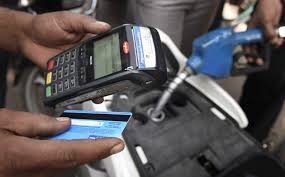
1% transaction fee: Petrol bunks to stop accepting cards from tonight

January 8, 2017

Jan 8: The petrol bunks across the country will stop accepting debit cards and credit cards for filling fuel from midnight on Sunday as banks will now debit a Merchant Discount Rate of 1 per cent from petroleum dealers, said President of All India Petroleum Dealers Association Ajay Bansal.

cardTalking to reporters after a two-day State-level convention of petroleum dealers here on Sunday, Mr. Bansal said each petroleum dealer was operating with a profit margin of 2 per cent.

On Saturday, banks referred to the Reserve Bank of India notification dated December 16 and said an MDR ranging between between 0.25 and 1 per cent will be deducted for each debit card transaction. An MDR of 1 per cent will be deducted for each credit card transaction.

“We are operating on a very thin margin. We cannot afford this deduction. Hence we have no other go than stop accepting debit and credit cards,” Mr. Bansal said. When pointed that the dealers are going against government directions, Mr. Bansal said they have no other option. Mr. Bansal said the decision to stop accepting debit and credit cards had been conveyed to Petroleum Ministry and Finance Ministry officials, he said.

Paytm and BHIM

Mr. Bansal said petroleum dealers will however accept payments through Paytm and Bhim apps. “But we have to stop accepting Paytm if they impose charge for each transaction,” he said. There are as many as 28,000 petrol bunks where Paytm was being accepted.

Mr. Bansal said the petroleum dealers are in favour of Central Government's move towards cashless transactions. “But we cannot afford to pay from our margin. We want our profit margin (of 2 per cent) intact,” he said.

Comments

Wonder Kotian
 - 
Monday, 9 Jan 2017

Wa master mind success, Fantastic \ cash less is not better than card less\" our great Anna!!!!!
\"While two fighting opponent fall down even he says my noose upside\" like all our great annaas say !!!!!!!
\" Now not wait and see, now wait and watch\""

Althaf
 - 
Sunday, 8 Jan 2017

Fenku ki tho Aisi ki taisi

Add new comment

  • Coastaldigest.com reserves the right to delete or block any comments.
  • Coastaldigset.com is not responsible for its readers’ comments.
  • Comments that are abusive, incendiary or irrelevant are strictly prohibited.
  • Please use a genuine email ID and provide your name to avoid reject.
Agencies
May 8,2020

Washington D.C., May 8: The prime time for brain development in a child's life is the first year, where the infant spends most of the time asleep. It is the time when neural connections form and sensory memories are encoded.

However, when sleep is disrupted, as occurs more often among children with autism, brain development may be affected, too.

New research led by the University of Washington finds that sleep problems in a baby's first 12 months may not only precede an autism diagnosis but also may be associated with altered growth trajectory in a key part of the brain, the hippocampus.

The study, which was published in the American Journal of Psychiatry, researchers report that in a sample of more than 400 taken of 6- to 12-month-old infants, those who were later diagnosed with autism were more likely to have had difficulty falling asleep.

It also states that this sleep difficulty was associated with altered growth trajectories in the hippocampus.

"The hippocampus is critical for learning and memory, and changes in the size of the hippocampus have been associated with poor sleep in adults and older children.

As many as 80 per cent of the children with autism spectrum disorder have sleep problems," said Annette Estes, director of the UW Autism Center and senior author of the study.

"In our clinical experience, parents have a lot of concerns about their children's sleep, and in our work on early autism intervention, we observed that sleep problems were holding children and families back," added Estes, who is also a UW professor of speech and hearing sciences.

"It could be that altered sleep is part-and-parcel of autism for some children. One clue is that behavioural interventions to improve sleep don't work for all children with autism, even when their parents are doing everything just right. This suggests that there may be a biological component to sleep problems for some children with autism," said Estes.

To consider links among sleep, brain development, and autism, researchers at the IBIS Network looked at MRI scans of 432 infants, surveyed parents about sleep patterns, and measured cognitive functioning using a standardized assessment.

At the outset of the study, infants were classified according to their risk for developing autism: Those who were at higher risk of developing autism -- about two-thirds of the study sample -- had an older sibling who had already been diagnosed.

Infant siblings of children with autism have a 20 per cent chance of developing autism spectrum disorder -- a much higher risk than children in the general population.

In the current study, 127 of the 432 infants were identified as "low risk" at the time the MRI scans were taken because they had no family history of autism.

They later evaluated all the participants at 24 months of age to determine whether they had developed autism. Of the roughly 300 children originally considered "high familial risk," 71 were diagnosed with autism spectrum disorder at that age.

Problems with sleep were more common among the infants later diagnosed with an autism spectrum disorder, as were larger hippocampi. No other subcortical brain structures were affected, including the amygdala, which is responsible for certain emotions and aspects of memory, or the thalamus, a signal transmitter from the spinal cord to the cerebral cortex.

The authors note that while parents reported more sleep difficulties among infants who developed autism compared to those who did not, the differences were very subtle and only observed when looking at group averages across hundreds of infants.

Sleep patterns in the first years of life change rapidly as infants transition from sleeping around the clock to a more adult-like sleep/wake cycle. Until further research is completed, Estes said, it is not possible to interpret challenges with sleep as an early sign of increased risk for autism.


Comments

Add new comment

  • Coastaldigest.com reserves the right to delete or block any comments.
  • Coastaldigset.com is not responsible for its readers’ comments.
  • Comments that are abusive, incendiary or irrelevant are strictly prohibited.
  • Please use a genuine email ID and provide your name to avoid reject.
News Network
February 26,2020

Mangaluru, Feb 26: The 'Yakshagana' stage in Karnataka is witnessing a curious spectacle with a Muslim woman artiste creating waves with her performances.

Arshiya, the artiste from Vittal in Dakshina Kannada district, is the first woman from the Muslim community to venture into the popular traditional theatre art form.

At one time, women were barred from Yakshagana stages.

A Muslim woman exponent on stage has attracted the attention of 'Yakshagana' lovers in the state.

Arshiya is now getting advanced training in her skills at the Kadali Kala Kendra under Ramesh Bhat here.

Arshiya, who is fond of 'Bannada Vesha' (villain roles), is now known in her stage name 'Tanu Vitla.'

She has already performed various episodes on stage and gained popularity.

Arshiya, currently working in an automobile showroom at Padil, said she was attracted to the art form from a very young age.

The initial enchantment with the art form came as she saw the role of Mahishasura in 'Sri Devi Mahatme Yakshagana Prasanga' (episode) performed near her home town.

She was attracted to all the elements of the art form, which combines music, percussion, dance, dialogues, stage techniques, make-up and costume.

Arshiya said she was also inspired by a teacher in her school at Vittal who trained her for a performance on stage during the school's annual day celebration.

She started performing on local stages at Vittal at the very young age of 10.

Arshiya now performs prominent roles on stage including Mahishasura in Sri Devi Mahatme Prasanga, the role which enamoured her in her childhood.

She also has donned the roles of Nishambhasura, Rakthabeejasura, Srinivas Kalyana, Sudarshanopakyana, Kadamba Kaushike and Shambavi Vijaya.

Her performances at Udupi and Karwar besides Mangaluru have earned her a lot of admirers, who love her 'Asura' roles, thanks to her loud voice.

Arshiya now wants to learn the 'Chende' (percussion instrument), which is an important element in Yakshagana performances.

Arshiya revealed that there was a bit of resistance from her community about her passion for the art form, but she had staunch backing of her family.

Comments

Add new comment

  • Coastaldigest.com reserves the right to delete or block any comments.
  • Coastaldigset.com is not responsible for its readers’ comments.
  • Comments that are abusive, incendiary or irrelevant are strictly prohibited.
  • Please use a genuine email ID and provide your name to avoid reject.
News Network
January 22,2020

Bengaluru, Jan 22: The Bengaluru Police on Wednesday said that the procedure is being followed to hand-over to the Mangaluru Police a suspect who surrendered before it two days after planting an improvised explosive device (IED) at the Mangaluru International Airport.

"He [the suspect] surrendered before police claiming to be responsible for the Mangaluru airport incident. He is being medically examined and we are preparing procedure to hand him over to the Mangaluru team which is already on their way," Bengaluru Deputy Commissioner of Police (DCP), Chetan Singh Rathore told the media persons.

Aditya Rao surrendered before Bengaluru Police today, days after a bag of IED was recovered from Mangaluru airport. He hails from Udupi and has engineering and MBA degrees.

An investigation team of Mangaluru police is flying to Bengaluru to question him. "Mangaluru city police investigation team is flying to Bengaluru shortly to investigate the developments in connection with MIA case..the team will question the suspect and will initiate further necessary legal action," Commissioner of Police, Mangaluru City, tweeted.

According to the police, the IED was recovered from a bag at Mangaluru airport on January 20. It was later defused in an open field by the personnel of the bomb disposal squad.

Comments

Fairman
 - 
Wednesday, 22 Jan 2020

Soon he should be rewarded a seat MLA or MLC.


Add new comment

  • Coastaldigest.com reserves the right to delete or block any comments.
  • Coastaldigset.com is not responsible for its readers’ comments.
  • Comments that are abusive, incendiary or irrelevant are strictly prohibited.
  • Please use a genuine email ID and provide your name to avoid reject.