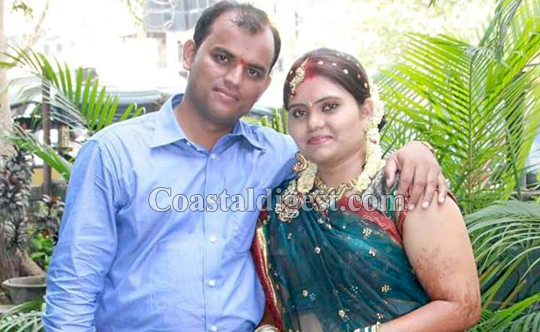
Young techie kills wife for oversharing on social media, hangs himself

January 20, 2017

Pune, Jan 20: Furious over a social media post, a techie in Pune allegedly strangled his wife and then hung himself at their home on Tuesday.

Techie

Rakesh Gangurde, 34, left a suicide note in which he reportedly said he was upset with his wife Sonali for sharing too much about their lives on social media.

Rakesh and 28-year-old Sonali had been married for four years and didn't have children. They allegedly fought frequently over Sonali's social media posts.

"As per the purported suicide note left by Rakesh, he was not happy with Sonali, who used to discuss details of family planning and other marital details with her friends on social media and that prompted him to take the drastic step," a police officer told the Press Trust of India.

Sonali's brothers found their bodies on Wednesday night when he came for a visit. Her mother had called her from Nashik but had grown worried when there was no response. She then called her sons and asked them to check on their sister.

The brothers went to the apartment and found it locked from inside. Alarmed, they called the police, who broke open the door. They found Rakesh hanging from a nylon rope and Sonali lying on the bed, the police officer said.

Rakesh, a science graduate as well as an MBA, was employed with a private firm.

He allegedly resigned a few days back and was about to start a new one. Sonali Gangurde, a computer engineer, had stopped working a few months ago, the police say.

Comments

abdul aziz s.a.
 - 
Saturday, 21 Jan 2017

SAD, why it happens more now a days, life is important , God had created us to be patience and follow life easily

Add new comment

  • Coastaldigest.com reserves the right to delete or block any comments.
  • Coastaldigset.com is not responsible for its readers’ comments.
  • Comments that are abusive, incendiary or irrelevant are strictly prohibited.
  • Please use a genuine email ID and provide your name to avoid reject.
coastaldigest.com news network
May 4,2020

Chikkamagaluru, May 4: KSRTC resumed its service from Chikkamagaluru district headquarters to taluk centres amidst the lockdown to contain COVID-19 on Monday. Chikkamagaluru is in the green zone.

Hundreds of passengers travelled to Sringeri, Mudigere, Koppa and Kadur taluks since morning from the Chikkamagaluru city.

According to KSRTC Divisional Controller, passengers who wish to travel to taluk centres have to register half an hour prior to the journey. 

Sanitisers were placed in the bus stand in Chikkamagaluru to sanitise hands before boarding the buses.

Comments

Add new comment

  • Coastaldigest.com reserves the right to delete or block any comments.
  • Coastaldigset.com is not responsible for its readers’ comments.
  • Comments that are abusive, incendiary or irrelevant are strictly prohibited.
  • Please use a genuine email ID and provide your name to avoid reject.
News Network
August 7,2020

Bengaluru, Aug 7: Amid the rising number of COVID-19 cases in Karnataka, the state's health department issued fresh guidelines for the disposal of bodies of COVID patients.

"Although an increased risk of COVID infection from a dead body to health workers or family members who follow standard precautions while handling the body is unlikely, the lack of scientific data requires the utmost care to avoid the inadvertent spread of COVID-19 during these times," the statement from the health department's press release read, emphasising on the dignity of the dead and the religious and cultural tradition.

The 23-page press release elaborated on guidelines regarding testing, handling of dead bodies and other specificities in relation to the management of COVID-19 bodies.

"Testing should not be insisted in every case of death, but only when they have a recorded history of influenza-like symptoms. The body should be handed over to the family members/ relatives in a dignified manner immediately after swab collection and hospitals should provide handouts with a list of dos and don'ts in English and Kannada laying down relevant information," the statement said.

It added, "At the mortuary, health care workers, mortuary staff and the family of the deceased body shall not come in direct contact with the dead body and must wear full personal protective equipment (PPE). If the family or relative are for any reason unable to cremate or bury the body, the local health authority shall arrange for the dignified last rites as per the religious traditions of the family."

Regarding autopsies (post mortem) on COVID-19 bodies, the state department said that they should be avoided, except in necessary circumstances.

The statement also gave detailed guidelines regarding the appropriate recording of COVID-19 deaths in line with the Indian Council of Medical Research (ICMR) guidelines.

Additionally, the health department made a statement about the admission procedure for COVID positive patients referred by other district administrations saying, "It is now mandatory for all the referrals from the BBMP admission and discharge of COVID positive patients to be done through the online COVID Hospital Bed Management System (CHBMS)."

The state's count of coronavirus cases was 1,51,449 in the past 24 hours.

So far, a total of 2,804 people have died due to COVID-19 in the state, while the average recovery rate in Karnataka is 49.3 per cent.

Comments

Add new comment

  • Coastaldigest.com reserves the right to delete or block any comments.
  • Coastaldigset.com is not responsible for its readers’ comments.
  • Comments that are abusive, incendiary or irrelevant are strictly prohibited.
  • Please use a genuine email ID and provide your name to avoid reject.
News Network
April 19,2020

Kasaragod, Apr 19: Kasaragod, Kerala's COVID-19 hotspot, is the only district in the southern state lacking adequate health infrastructure.

In spite of treating the highest number of COVID-19 patients in the state with meagre infrastructural facilities and even without the support of a medical college in the north Kerala district, no deaths have been reported due to coronavirus.

The state health department views the performance of M Kunhiraman and his team, consisting of Janardhana Naik and Krishna Naik, at the General hospital in Kasaragod as a success story.

"Not only did they control the situation quickly with minimum infrastructure, they also started turning out a large number of negative cases within a few weeks and creditably ensured zero mortality.

This can be showcased as a best global model," Chairman of the Information Education and Communication (IEC) Committee and Project Director Kerala State Aids Control Society, R Ramesh said.

Recalling the ordeal, Janardhana Naik said his first major challenge was the physical examination of a patient with suspected COVID-19.

"Even with the PPE kit, nobody knew how effective they were and it took a whole 30 minutes to wear them properly.

But as time passed, we got accustomed to it," he said.

The traditional method of dealing with a patient involved knowing his or her history, observation and physical examination.

For hundreds of years, the hands-on body approach has been the soul of the doctor-patient relationship -- taking the pulse, tapping on and listening to the chest, feeling lumps.

With the onset of COVID-19 all that has changed.

"In fact, the whole exercise was fraught with grave risks because everything connected with COVID-19 was new.

Doctors have to keep a distance even though the physical examination wearing a Personal Protective Equipment (PPE) is difficult.

Sounds from the body are inaudible, vision is blurred through the smog-covered goggles and a stethoscope seldom has any use," Janardhana Naik said.

It was from March 15 that the hospital started receiving COVID-19 patients, primarily from Dubai.

By the time the first person came, the hospital was ready for him.

Soon, patient numbers began to swell and in a couple of weeks they reached about 91.

From then on, it was teamwork.

Committees were formed for each and every task, including the help desk, IT, treatment, medical board, training, food, waste disposal and data maintenance.

Initially, patients had many misgivings about the hospital.

"Some were disillusioned and even aggressive. Some were not happy with the facilities the hospital had to offer.

But gradually through good treatment and counselling by a psychiatrist, who visited the hospital on alternate days, the confidence and mood of the patients changed and they became friendly with the staff," Naik elaborated.

Counselling was also given to the concerned family members of the patients.

Besides treatment, the medical staff had to spend a considerable amount of time clearing the doubts of patients.

When they got discharged some patients insisted on seeing the faces of the medical staff, who till then were anonymous entities covered from head to toe.

Some even wanted to take selfies with them.

However, the medical team politely turned down their requests and preferred to remain hidden in their work attires.

The mood of the patients also rubbed off on the doctors and hospital staff.

All the physicians and hospital staff are now more confident of dealing with contagious diseases after treating COVID-19 patients.

"Our previous experience of treating H1N1, Chikungunya and Dengue cases helped us a lot.

Words of encouragement from the Health Minister K K Shailaja, Health Principal Secretary Dr Rajan N Khobragade and Health Services Director Dr Sarita R L gave us the impetus to build up confidence.

Moreover, the field health workers did a wonderful job in containing the viral spread," Naik added.

As the number of coronavirus cases rose, the state government on April 5 deputed a 26-member medical team from Thiruvananthapuram to set up a COVID-19 hospital in the district.

They turned a block of the under construction Government Medical College as a hospital-like facility, setting up a 200 bed facility to treat coronavirus patients.


Comments

Add new comment

  • Coastaldigest.com reserves the right to delete or block any comments.
  • Coastaldigset.com is not responsible for its readers’ comments.
  • Comments that are abusive, incendiary or irrelevant are strictly prohibited.
  • Please use a genuine email ID and provide your name to avoid reject.