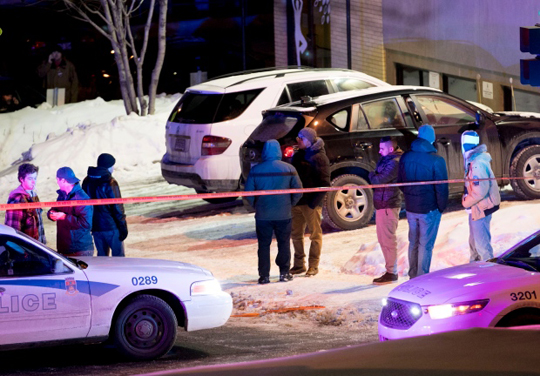
6 killed, many injured as terrorists attack Quebec City mosque

January 30, 2017

Quebec City, Jan 30: Up to six people were killed and several people wounded after gunmen opened fire at a mosque in Quebec City, media reported.

mosque

A Quebec police spokesman confirmed that there were people killed, but did not say how many.

Two suspects in the shooting late last night were arrested, he said.

Police did not rule out the possibility of a third suspect who had fled the scene.

The motive of the attack was not immediately clear.

A few dozen people were inside the Islamic Cultural Center when the shooting began just after 8:00 pm, CBC reported, citing its French-language service Radio-Canada.

The center's director said at least five people were killed, but that information had not been confirmed by police, CBC said.

Police set up a perimeter around the mosque where the shooting attack took place after evening prayers.

According to witnesses cited by Radio-Canada, two men entered the center and opened fire on the people inside.

Quebec's prime minister, Philippe Couillard, said in a series of Twitter posts that the government was "mobilized to ensure the security of the people of Quebec."

"Quebec categorically rejects this barbarous violence," he wrote. "Solidarity with Quebec people of Muslim faith."

The Islamic Cultural Center of Quebec, which is also known as the grand mosque of Quebec, had already been the target of hate: a pig's head was left on the doorstep last June during the Muslim holy month of Ramadan.

Comments

PedoMhdFkdAmna
 - 
Monday, 30 Jan 2017

Very sorry to hear only 6 died.

PedoMhdFkdAmna
 - 
Monday, 30 Jan 2017

Will they get 72 houries ?

Think Tank
 - 
Monday, 30 Jan 2017

We must appreciate and encourage to buy Canadian Goods like Turkey .... they are not partial ...they mean to protect all faiths ....unlike Trump's USA....United States of Aparthied

isaak
 - 
Monday, 30 Jan 2017

Mr CD At least mentioned in which country it happened .

Add new comment

  • Coastaldigest.com reserves the right to delete or block any comments.
  • Coastaldigset.com is not responsible for its readers’ comments.
  • Comments that are abusive, incendiary or irrelevant are strictly prohibited.
  • Please use a genuine email ID and provide your name to avoid reject.
News Network
August 7,2020

Bengaluru, Aug 7: Action will be taken against private hospitals that were violating government norms and charging exorbitant fees charges for the treatment of Covid-19 patients and suspects, said Water Resources Minister Ramesh Jarkiholi.

The government has taken action against private hospitals in Bengaluru and the same parameters would be adopted other cities, he said speaking to media persons in Belagavi on Friday.

Jarkiholi said that the government had noticed that patients were levied exorbitant charges for Covid-19 treatment. People too have complaints regarding the huge bills by these private hospitals and have demanded action.

“We are not under the obligation of any private hospital and stringent action will be taken against all erring and violating government tariffs. They will have to treat patients and follow the tariffs fixed,” he stated.

Belagavi Institute of Medical Sciences District Hospital had been directed to install CCTV cameras in Covid-19 wards and install monitors at reception to facilitate monitoring of treatment and condition of the wards. BIMS management was taken to task for not following the directive and have been given a deadline to install CCTV cameras, Jarkiholi informed.

Comments

Add new comment

  • Coastaldigest.com reserves the right to delete or block any comments.
  • Coastaldigset.com is not responsible for its readers’ comments.
  • Comments that are abusive, incendiary or irrelevant are strictly prohibited.
  • Please use a genuine email ID and provide your name to avoid reject.
News Network
March 29,2020

Mangaluru, Mar 29: Dakshina Kannada Co-operative Milk Producers’ Union Limited in a statement announced that their milk collection centres across Dakshina Kannada and Udupi districts will be closed on March 29 and 30.

Due to a shortage of storage space with them, the Union has decided to stop collecting milk on these two days, according to the statement issued here on Saturday.

The sale/retail of milk and milk products won’t be affected in these two days.

Comments

Add new comment

  • Coastaldigest.com reserves the right to delete or block any comments.
  • Coastaldigset.com is not responsible for its readers’ comments.
  • Comments that are abusive, incendiary or irrelevant are strictly prohibited.
  • Please use a genuine email ID and provide your name to avoid reject.
Agencies
May 8,2020

Washington D.C., May 8: The prime time for brain development in a child's life is the first year, where the infant spends most of the time asleep. It is the time when neural connections form and sensory memories are encoded.

However, when sleep is disrupted, as occurs more often among children with autism, brain development may be affected, too.

New research led by the University of Washington finds that sleep problems in a baby's first 12 months may not only precede an autism diagnosis but also may be associated with altered growth trajectory in a key part of the brain, the hippocampus.

The study, which was published in the American Journal of Psychiatry, researchers report that in a sample of more than 400 taken of 6- to 12-month-old infants, those who were later diagnosed with autism were more likely to have had difficulty falling asleep.

It also states that this sleep difficulty was associated with altered growth trajectories in the hippocampus.

"The hippocampus is critical for learning and memory, and changes in the size of the hippocampus have been associated with poor sleep in adults and older children.

As many as 80 per cent of the children with autism spectrum disorder have sleep problems," said Annette Estes, director of the UW Autism Center and senior author of the study.

"In our clinical experience, parents have a lot of concerns about their children's sleep, and in our work on early autism intervention, we observed that sleep problems were holding children and families back," added Estes, who is also a UW professor of speech and hearing sciences.

"It could be that altered sleep is part-and-parcel of autism for some children. One clue is that behavioural interventions to improve sleep don't work for all children with autism, even when their parents are doing everything just right. This suggests that there may be a biological component to sleep problems for some children with autism," said Estes.

To consider links among sleep, brain development, and autism, researchers at the IBIS Network looked at MRI scans of 432 infants, surveyed parents about sleep patterns, and measured cognitive functioning using a standardized assessment.

At the outset of the study, infants were classified according to their risk for developing autism: Those who were at higher risk of developing autism -- about two-thirds of the study sample -- had an older sibling who had already been diagnosed.

Infant siblings of children with autism have a 20 per cent chance of developing autism spectrum disorder -- a much higher risk than children in the general population.

In the current study, 127 of the 432 infants were identified as "low risk" at the time the MRI scans were taken because they had no family history of autism.

They later evaluated all the participants at 24 months of age to determine whether they had developed autism. Of the roughly 300 children originally considered "high familial risk," 71 were diagnosed with autism spectrum disorder at that age.

Problems with sleep were more common among the infants later diagnosed with an autism spectrum disorder, as were larger hippocampi. No other subcortical brain structures were affected, including the amygdala, which is responsible for certain emotions and aspects of memory, or the thalamus, a signal transmitter from the spinal cord to the cerebral cortex.

The authors note that while parents reported more sleep difficulties among infants who developed autism compared to those who did not, the differences were very subtle and only observed when looking at group averages across hundreds of infants.

Sleep patterns in the first years of life change rapidly as infants transition from sleeping around the clock to a more adult-like sleep/wake cycle. Until further research is completed, Estes said, it is not possible to interpret challenges with sleep as an early sign of increased risk for autism.


Comments

Add new comment

  • Coastaldigest.com reserves the right to delete or block any comments.
  • Coastaldigset.com is not responsible for its readers’ comments.
  • Comments that are abusive, incendiary or irrelevant are strictly prohibited.
  • Please use a genuine email ID and provide your name to avoid reject.