


Trump fires chief US lawyer who defied him on migrant ban

January 31, 2017

Washington, Jan 31: US President Donald Trump on Monday fired the acting attorney general, a holdover from the Obama administration, after she ordered Justice Department attorneys not to defend his controversial immigration orders.
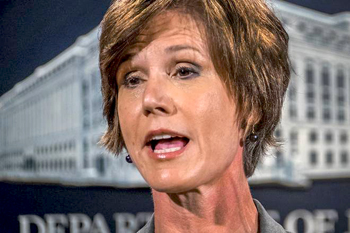
SallyIn a sharply worded statement, the White House called Sally Yates "weak on borders and very weak on illegal immigration" and also criticized Democrats for not yet confirming the appointment of attorney general-designate Jeff Sessions.

"The acting attorney general, Sally Yates, has betrayed the Department of Justice by refusing to enforce a legal order designed to protect the citizens of the United States," the White House said in a statement.

"This order was approved as to form and legality by the Department of Justice Office of Legal Counsel," it said.

"Tonight, President Trump relieved Ms Yates of her duties."

Federal prosecutor Dana Boente will serve as acting attorney general "until Senator Jeff Sessions is finally confirmed by the Senate, where he is being wrongly held up by Democrat senators for strictly political reasons," it said.

With Trump's White House facing multiple lawsuits and worldwide opprobrium over an order banning migrants from seven Muslim nations, Yates had whipped the rug from under her boss in a defiant and damaging parting shot.

In a memo to Department of Justice staff, Yates -- a career government lawyer promoted by Barack Obama -- expressed doubts about the legality and morality of Trump's decree, which has prompted mass protests.

"My responsibility is to ensure that the position of the Department of Justice is not only legally defensible, but is informed by our best view of what the law is," Yates wrote.

"I am not convinced that the defense of the executive order is consistent with these responsibilities nor am I convinced that the executive order is lawful," she added.

"For as long as I am the acting attorney general, the Department of Justice will not present arguments in defense of the executive order, unless and until I become convinced that it is appropriate to do so."

Yates's directive means that the US government, at least for now, has no authorized courtroom representation in the lawsuits.

It was a remarkable act of defiance against a tough-talking president who has showed little sign of brooking insubordination.

Sessions has not yet been confirmed by Congress. He faces a vote on the Senate Judiciary Committee Tuesday and must then be confirmed by the full Senate.

If confirmed, Sessions would almost certainly reverse course.

But Democratic lawmakers have vociferously opposed Trump's order and Republicans are privately seething over the way his White House has handled the issue.

The order signed on Friday suspended the arrival of all refugees for a minimum of 120 days, Syrian refugees indefinitely and bars citizens from Iran, Iraq, Libya, Somalia, Sudan, Syria and Yemen for 90 days.

Several federal judges have since filed temporary stays.

Firing Yates has uncomfortable echoes of President Richard Nixon's "Saturday night massacre" during the Watergate scandal.

Then, Nixon fired the Watergate special prosecutor, prompting the departures of his attorney general and deputy attorney general. The events catalyzed Nixon's impeachment.

On Sunday, attorneys general from 16 US states, including California and New York, condemned Trump's directive as "unconstitutional" and vowed to fight it.

Comments

PedoMhdFkdAmna
 - 
Tuesday, 31 Jan 2017

I hope all western countries ban Muslims forever

shaji
 - 
Tuesday, 31 Jan 2017

This shows the frustration of Trump and hope he will get more frustrations in the days to come for his unwise / illegal decisions which will effect US on all grounds. I hope public anger and disappoint towards Trump will grow day by day.

Add new comment

  • Coastaldigest.com reserves the right to delete or block any comments.
  • Coastaldigset.com is not responsible for its readers’ comments.
  • Comments that are abusive, incendiary or irrelevant are strictly prohibited.
  • Please use a genuine email ID and provide your name to avoid reject.
Agencies
July 2,2020

Moscow, Jul 2: Russian voters approved changes to the constitution that will allow President Vladimir Putin to hold power until 2036, but the weeklong plebiscite that concluded Wednesday was tarnished by widespread reports of pressure on voters and other irregularities.

With most of the nation's polls closed and 20% of precincts counted, 72% voted for the constitutional amendments, according to election officials.

For the first time in Russia, polls were kept open for a week to bolster turnout without increasing crowds casting ballots amid the coronavirus pandemic a provision that Kremlin critics denounced as an extra tool to manipulate the outcome.

A massive propaganda campaign and the opposition's failure to mount a coordinated challenge helped Putin get the result he wanted, but the plebiscite could end up eroding his position because of the unconventional methods used to boost participation and the dubious legal basis for the balloting.

By the time polls closed in Moscow and most other parts of Western Russia, the overall turnout was at 65%, according to election officials. In some regions, almost 90% of eligible voters cast ballots.

On Russia's easternmost Chukchi Peninsula, nine hours ahead of Moscow, officials quickly announced full preliminary results showing 80% of voters supported the amendments, and in other parts of the Far East, they said over 70% of voters backed the changes.

Kremlin critics and independent election observers questioned the turnout figures.

We look at neighboring regions, and anomalies are obvious there are regions where the turnout is artificially (boosted), there are regions where it is more or less real, Grigory Melkonyants, co-chair of the independent election monitoring group Golos, told The Associated Press.

Putin voted at a Moscow polling station, dutifully showing his passport to the election worker. His face was uncovered, unlike most of the other voters who were offered free masks at the entrance.

The vote completes a convoluted saga that began in January, when Putin first proposed the constitutional changes.

He offered to broaden the powers of parliament and redistribute authority among the branches of government, stoking speculation he might seek to become parliamentary speaker or chairman of the State Council when his presidential term ends in 2024.

His intentions became clear only hours before a vote in parliament, when legislator Valentina Tereshkova, a Soviet-era cosmonaut who was the first woman in space in 1963, proposed letting him run two more times.

The amendments, which also emphasize the primacy of Russian law over international norms, outlaw same-sex marriages and mention a belief in God as a core value, were quickly passed by the Kremlin-controlled legislature.

Putin, who has been in power for more than two decades longer than any other Kremlin leader since Soviet dictator Josef Stalin said he would decide later whether to run again in 2024.

He argued that resetting the term count was necessary to keep his lieutenants focused on their work instead of darting their eyes in search for possible successors.

Analyst Gleb Pavlovsky, a former Kremlin political consultant, said Putin's push to hold the vote despite the fact that Russia has thousands of new coronavirus infections each day reflected his potential vulnerabilities.

Putin lacks confidence in his inner circle and he's worried about the future, Pavlovsky said.

He wants an irrefutable proof of public support.

Even though the parliament's approval was enough to make it law, the 67-year-old Russian president put his constitutional plan to voters to showcase his broad support and add a democratic veneer to the changes.

But then the coronavirus pandemic engulfed Russia, forcing him to postpone the April 22 plebiscite.

The delay made Putin's campaign blitz lose momentum and left his constitutional reform plan hanging as the damage from the virus mounted and public discontent grew.

Plummeting incomes and rising unemployment during the outbreak have dented his approval ratings, which sank to 59%, the lowest level since he came to power, according to the Levada Center, Russia's top independent pollster.

Moscow-based political analyst Ekaterina Schulmann said the Kremlin had faced a difficult dilemma: Holding the vote sooner would have brought accusations of jeopardizing public health for political ends, while delaying it raised the risks of defeat.

Holding it in the autumn would have been too risky, she said.

In Moscow, several activists briefly lay on Red Square, forming the number 2036 with their bodies in protest before police stopped them.

Some others in Moscow and St. Petersburg staged one-person pickets and police didn't intervene.

Several hundred opposition supporters rallied in central Moscow to protest the changes, defying a ban on public gatherings imposed for the coronavirus outbreak. Police didn't intervene and even handed masks to the participants.

Authorities mounted a sweeping effort to persuade teachers, doctors, workers at public sector enterprises and others who are paid by the state to cast ballots. Reports surfaced from across the vast country of managers coercing people to vote.

The Kremlin has used other tactics to boost turnout and support for the amendments.

Comments

Add new comment

  • Coastaldigest.com reserves the right to delete or block any comments.
  • Coastaldigset.com is not responsible for its readers’ comments.
  • Comments that are abusive, incendiary or irrelevant are strictly prohibited.
  • Please use a genuine email ID and provide your name to avoid reject.
News Network
July 4,2020

Geneva, Jul 4: The World Health Organization has updated its account of the early stages of the COVID crisis to say it was alerted by its own office in China, and not by China itself, to the first pneumonia cases in Wuhan.

The UN health body has been accused by US President Donald Trump of failing to provide the information needed to stem the pandemic and of being complacent towards Beijing, charges it denies.

On April 9, WHO published an initial timeline of its communications, partly in response to criticism of its early response to the outbreak that has now claimed more than 521,000 lives worldwide.

In that chronology, WHO had said only that the Wuhan municipal health commission in the province of Hubei had on December 31 reported cases of pneumonia. The UN health agency did not however specify who had notified it.

WHO director Tedros Adhanom Ghebreyesus told a press conference on April 20 the first report had come from China, without specifying whether the report had been sent by Chinese authorities or another source.

But a new chronology, published this week by the Geneva-based institution, offers a more detailed version of events.

It indicates that it was the WHO office in China that on December 31 notified its regional point of contact of a case of "viral pneumonia" after having found a declaration for the media on a Wuhan health commission website on the issue.

The same day, WHO's epidemic information service picked up another news report transmitted by the international epidemiological surveillance network ProMed -- based in the United States -- about the same group of cases of pneumonia from unknown causes in Wuhan.

After which, WHO asked the Chinese authorities on two occasions, on January 1 and January 2, for information about these cases, which they provided on January 3.

WHO emergencies director Michael Ryan told a press conference on Friday that countries have 24-48 hours to officially verify an event and provide the agency with additional information about the nature or cause of an event.

Ryan added that the Chinese authorities immediately contacted WHO's as soon as the agency asked to verify the report.

US President Donald Trump has announced that his country, the main financial contributor to WHO, will cut its bridges with the institution, which he accuses of being too close to China and of having poorly managed the pandemic.

The WHO denies any complacency toward China.

Comments

Add new comment

  • Coastaldigest.com reserves the right to delete or block any comments.
  • Coastaldigset.com is not responsible for its readers’ comments.
  • Comments that are abusive, incendiary or irrelevant are strictly prohibited.
  • Please use a genuine email ID and provide your name to avoid reject.
News Network
June 23,2020

Jun 23: US President Donald Trump has issued a proclamation to suspend issuing of H-1B visas, which is popular among Indian IT professionals, along with other foreign work visas for the rest of the year.

Trump said the step was essential to help millions of Americans who have lost their jobs due to the current economic crisis.

Issuing the proclamation ahead of the November presidential elections, Trump has ignored the mounting opposition to the order by various business organisations, lawmakers and human rights bodies.

The proclamation that comes into effect on June 24, is expected to impact a large number of Indian IT professionals and several American and Indian companies who were issued H-1B visas by the US government for the fiscal year 2021 beginning October 1.

They would now have to wait at least till the end of the current year before approaching the US diplomatic missions to get stamping. It would also impact a large number of Indian IT professionals who are seeking renewal of their H-1B visas.

“In the administration of our Nation's immigration system, we must remain mindful of the impact of foreign workers on the United States labour market, particularly in the current extraordinary environment of high domestic unemployment and depressed demand for labour,” said the proclamation issued by Trump.

In his proclamation, Trump said that the overall unemployment rate in the United States nearly quadrupled between February and May of 2020 -- producing some of the most extreme unemployment rates ever recorded by the Bureau of Labor Statistics.

While the May rate of 13.3 percent reflects a marked decline from April, millions of Americans remain out of work.

The proclamation also extends till the end of the year his previous executive order that had banned issuing of new green cards of lawful permanent residency.

Green card holders, once admitted pursuant to immigrant visas, are granted "open-market" employment authorisation documents, allowing them immediate eligibility to compete for almost any job, in any sector of the economy, he said.

“American workers compete against foreign nationals for jobs in every sector of our economy, including against millions of aliens who enter the United States to perform temporary work. Temporary workers are often accompanied by their spouses and children, many of whom also compete against American workers,” Trump said.

“Under ordinary circumstances, properly administered temporary worker programmes can provide benefits to the economy. But under the extraordinary circumstances of the economic contraction resulting from the COVID-19 outbreak, certain non-immigrant visa programmes authorising such employment pose an unusual threat to the employment of American workers,” he said.

For example, Trump said, between February and April of 2020, more than 17 million United States jobs were lost in industries in which employers are seeking to fill worker positions tied to H-2B nonimmigrant visas.

“During this same period, more than 20 million United States workers lost their jobs in key industries where employers are currently requesting H-1B and L workers to fill positions,” he said.

“Also, the May unemployment rate for young Americans, who compete with certain J non-immigrant visa applicants, has been particularly high -- 29.9 percent for 16-19-year-olds, and 23.2 percent for the 20-24-year-old group,” he said.

“The entry of additional workers through the H-1B, H-2B, J, and L non-immigrant visa programmes, therefore, presents a significant threat to employment opportunities for Americans affected by the extraordinary economic disruptions caused by the COVID-19 outbreak,” Trump said.

Trump observed that excess labour supply is particularly harmful to workers at the margin between employment and unemployment -- those who are typically "last in" during an economic expansion and "first out" during an economic contraction.

In recent years, these workers have been disproportionately represented by historically disadvantaged groups, including African Americans and other minorities, those without a college degree, and Americans with disabilities, he said.

The proclamation suspends and limits entry into the US of H-1B, H-2B and L visas and their dependents till December 31, 2020. It also includes certain categories of J visas like an intern, trainee, teacher, camp counselor, or summer work travel programme.

The new rule would apply only to those who are outside the US, do not have a valid non-immigrant visa and an official travel document other than a visa to enter the country.

According to the proclamation, it does not have an impact on lawful permanent residents of the United States and foreign nationals who are spouses or child of an American citizen.

Foreign nationals seeking to enter the US to provide temporary labour or services essential to the food supply chain are also exempted from the latest proclamation.

Comments

Add new comment

  • Coastaldigest.com reserves the right to delete or block any comments.
  • Coastaldigset.com is not responsible for its readers’ comments.
  • Comments that are abusive, incendiary or irrelevant are strictly prohibited.
  • Please use a genuine email ID and provide your name to avoid reject.