



Indian teen discovers cheap way to make saltwater drinkable

February 5, 2017

San Francisco, Feb 5: An Indian-American student has found a cheaper and easier method to turn salt water into drinkable fresh water and his research has caught the attention of major technology firms and universities.
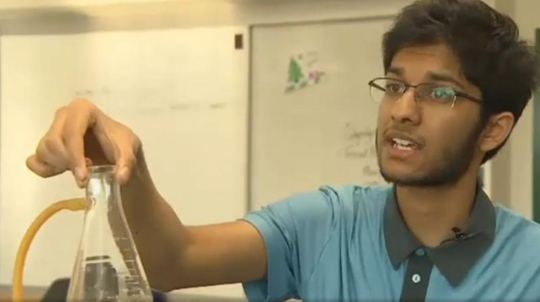
saltwater

Chaitanya Karamchedu from Portland, Oregon, is turning heads across the country all because of a science experiment that began in his high school classroom.

The Jesuit High School Senior told KPTV that he has big plans of changing the world.

"1 in 8 people do not have access to clean water, it's a crying issue that needs to be addressed," said Karamchedu.

He made up his mind to address the matter himself.

"The best access for water is the sea, so 70 per cent of the planet is covered in water and almost all of that is the ocean, but the problem is that's salt water," said Karamchedu.

Isolating drinkable water from the ocean in a cost effective way is a problem that has stumped scientists for years.

"Scientists looked at desalination, but it's all still inaccessible to places and it would cost too much to implement on a large scale," Karamchedu said.

Karamchedu figured it out, on his own, in a high school lab.

"The real genesis of the idea was realising that sea water is not fully saturated with salt," he was quoted as saying.

By experimenting with a highly absorbent polymer, the teen discovered a cost effective way to remove salt from ocean water and turn it into fresh water.

"It's not bonding with water molecules, it's bonding to the salt," said Karamchedu.

"People have been looking at the problem from one view point, how do we break those bonds between salt and the water? Chai came in and thought about it from a completely different angle," said Jesuit High School Biology Teacher Dr. Lara Shamieh.

"People were concentrated on that 10 per cent of water that's bonded to the salt in the sea and no one looked at the 90 per cent that was free. Chai just looked at it and said if 10 per cent is bonded and 90 per cent is free, then why are we so focused on this 10 per cent, let's ignore it and focus on the 90," Shamieh said.

It is a breakthrough that is estimated to impact millions of lives if ever implemented on a mass scale.

"What this is compared to current techniques, is that it's cheap and accessible to everyone, everyone can use it," said Shamieh.

Scientists across the country are taking note. He won a USD 10,000 award from the US Agency for International Global Development at Intel's International Science Fair and second place at MIT's TechCon Conference where he won more money to continue his research.

"They were very encouraging, they could see things into it that I couldn't, because they've been working their whole lives on this," said Karamchedu.

Back in January, Karamchedu was also named one of 300 Regeneron Science Talent Search Semifinalists. The STS is thought to be one of the most prestigious competitions in the country for high school seniors.

Comments

James Freeman
 - 
Monday, 6 Feb 2017

Nestle (Pepsi, Coca Cola, etc.) certainly won't like this! It was Nestle Chairman, Peter Brabeck-Letmathe, who said '?ccess to water is not a public right.'?

I expect this breakthrough discovery will 'somehow' go nowhere, and this smart young man probably needs to start watching his back. Too much profit stands to be lost with this....

Add new comment

  • Coastaldigest.com reserves the right to delete or block any comments.
  • Coastaldigset.com is not responsible for its readers’ comments.
  • Comments that are abusive, incendiary or irrelevant are strictly prohibited.
  • Please use a genuine email ID and provide your name to avoid reject.
Agencies
June 9,2020

Soon, you may be able to withdraw cash from an ATM without touching any part of the machine. AGS Transact Technologies, a provider of cash and digital payment solutions and automation technology, on Monday said it has successfully developed and tested a touchless ATM solution in light of the COVID-19 pandemic.

The ‘contactless' solution, currently under demo at interested banks, enables a customer to perform all the steps required to withdraw cash from an ATM using the mobile app itself. 

The customer simply has to scan the QR code displayed on the ATM screen and follow the directions on their respective bank's mobile application. 

This includes entering the amount and mPIN required to dispense the cash from the ATM machine. 

According to the company, the QR code feature makes cash withdrawals quicker and more secure, and negates the chances of compromising the ATM Pin or card skimming.

"The new Touchless ATM solution is an extension of the flagship QR Cash solution which ensures safety of the users and will provide a seamless cash withdrawal experience with enhanced security," said Ravi B. Goyal, Chairman and MD, AGS Transact Technologies Ltd.

With minimum investment, the banks can enable this solution for their ATM networks by upgrading the existing software.

AGSTTL has so far installed, maintained and managed a network of over 72,000 ATMs across the country and also provides customised solutions to leading banks. 

The company earlier introduced UPI-QR based Cash withdrawal solution in partnership with Bank of India. 

This is how the solution works.

Open the Bank mobile application on your smartphone and select QR Cash Withdrawal. Enter the amount you wish to withdraw on the mobile app and scan the QR code on the ATM screen.

Next, confirm the amount by clicking on ‘proceed' in the app and enter the mPin to authenticate the transaction. Now collect the cash and receipt and you are done.

"The seamless, cardless and touchless withdrawal method is designed to provide easy transaction flow, without the need to touch the ATM screen or enter the pin," said Mahesh Patel, President and Group Chief Technology Officer, AGS Transact Technologies.

Comments

Add new comment

  • Coastaldigest.com reserves the right to delete or block any comments.
  • Coastaldigset.com is not responsible for its readers’ comments.
  • Comments that are abusive, incendiary or irrelevant are strictly prohibited.
  • Please use a genuine email ID and provide your name to avoid reject.
Agencies
January 25,2020

New Delhi, Jan 25: The Patiala House court on Saturday started hearing a plea filed by the Nirbhaya convicts that alleged that the Tihar Jail administration have "not presented the papers on time".

The Public Prosecutor informed the court that Tihar Jail authorities have already supplied the relevant documents. He further informed that these are mere delaying tactics adopted by the convicts.

Advocate A.P. Singh, lawyer for three of the four death row convicts in the Nirbhaya gang-rape case had moved an application before the court seeking directions to the Tihar Jail authorities to supply him the relevant documents in order to exercise the remaining legal remedies available with the death row convicts -- Vinay Pawan and Akshay.

The Public Prosecutor also told the court that he spoke to the jail authorities over the phone and a report in this regard will be filed shortly as the jail officials were on their way to the court.

The judge demanded from the convicts lawyer to show what he has filed.

The convicts lawyer, A.P. Singh, said that he received some documents, but has still not been supplied with the personal diary of one of the convict -- Vinay Kumar Sharma and also the medical documents.

Judge then asked the lawyer to wait for until the report arrives form the Tihar Jail.

On this, the convicts lawyer said he was not questioning the intention of the jail. "I know the jail has been changed. It isn't there fault, too," he said.

The Public Prosecutor refuted the allegation saying that the defence counsel was trying to defeat the speed of law.

"We have supplied all the documents to the counsel. We have supplied all the documents except the painting and some other documents. We have nothing apart from that," public prosecutor said.

Singh, in his plea filed before the Patiala House Court sought urgent orders of the court in order to file a mercy petition of Vinay Sharma and in relation to requests for documents for convicts Vinay Sharma, Pawan Kumar Gupta and Akshay Kumar Singh.

He further said that the convicts undertook several steps to obtain relevant information necessary for filing the mercy petitions. In regular interval, the convicts requested the concerned authority to supply documents pertaining to their medical records from 2012 to 2015 and 2019-2020, records of cellular confinement, records of the amount earned in prison through labour, records of educational and reformative activities like Tihar Olympics and Painting, etc.

The Supreme court had recently dismissed the curative petition for the other two convicts -- Vinay Kumar Sharma (26) and Mukesh Singh (32).

The court had recently issued death warrant against the convicts and fixed 6 a.m. on February 1 as the date and time of execution of the death penalty.

The 23-year-old victim in the case was brutally gang raped and tortured on December 16, 2012, which later led to her death. All the six accused were arrested and charged with sexual assault and murder. One of the accused was a minor and appeared before a juvenile justice court, while another accused committed suicide in Tihar Jail.

Four of the convicts were sentenced to death by a trial court in September 2013, and the verdict was confirmed by the Delhi High Court in March 2014 and subsequently upheld by the Supreme Court in May 2017, which also dismissed their review petitions.

A Juvenile involved in the crime was convicted by a juvenile justice board and released from a reformation home after serving a three-year term.

Hearing in a different case, Chief Justice of India S.A. Bobde on Thursday said a condemned person cannot fight the death penalty endlessly and it was important for the capital punishment to reach its finality.

The death penalty, he noted, cannot be questioned at every turn by the convict.

Comments

Add new comment

  • Coastaldigest.com reserves the right to delete or block any comments.
  • Coastaldigset.com is not responsible for its readers’ comments.
  • Comments that are abusive, incendiary or irrelevant are strictly prohibited.
  • Please use a genuine email ID and provide your name to avoid reject.
Agencies
June 18,2020

New Delhi, Jun 18: Vodafone Idea on Thursday told the Supreme Court that it has incurred Rs 1 lakh crore losses as it insisted it is not in a position to furnish bank guarantees.

A bench comprising Justices Arun Mishra, S. Abdul Nazeer, and M.R. Shah, taking up the adjusted gross revenue (AGR) matter through video conferencing, directed the telecom companies to submit their financial documents and books for the last 10 years.

Asking Vodafone if it was a foreign company, the bench said that how can the company say it would not furnish any bank guarantee.

"What if you fly away overnight in future without paying anything?" it asked.

Senior advocate Mukul Rohatgi, representing Vodafone Idea, denied his client is a completely foreign firm and cited before the bench its tie-ups and investments.

Vodafone owes over Rs 58,000 crore as AGR dues and so far, has paid close to Rs 7,000 crore.

Rohatgi contended before the court that the telecom company is in a tough situation, and cannot furnish any fresh bank guarantee, as profits have eluded the company in past many quarters. He submitted before the bench that Rs 15,000 crore bank guarantees are lying with the government, and his client's losses are over Rs 1 lakh crore.

"I cannot offer any more surety," he informed the bench.

Justice Mishra noted that this is public money and these dues should be recovered. "Do not tell us that you will pay if you were to make profits... the money must come," he noted.

Justice Shah observed that the telecom industry is the only industry which earned during the Covid-19 pandemic. "After all, this money will be used for public welfare", he said.

Rohatgi argued that his client would have to fold up if orders were issued to clear dues tomorrow. "11,000 employees will have to go without notice, as we cannot pay them," he added.

Senior advocate Abhishek Manu Singhvi, appearing for Bharti Airtel, contended before the court that out of Rs 21,000 crore AGR dues, the company has already deposited a sum of Rs 18,000 crore.

He argued that his client has given a bank guarantee, in excess of demand, to DoT, and supported the proposal for phased repayment of remaining AGR dues. He insisted that the company needs to sit down with the government and calculate the dues. Airtel owes Rs 25,976 crore after paying Rs 18,000 crore, as per the government.

Senior advocate Arvind Datar, representing Tata Telecom, informed the bench that his client has paid Rs 6,504 crore in AGR dues so far, and furnishing a bank guarantee may adversely impact investments in the sector.

The total AGR dues are close to Rs 1.5 lakh crore.

The top court will now take up the matter in the third week of July.

Comments

Add new comment

  • Coastaldigest.com reserves the right to delete or block any comments.
  • Coastaldigset.com is not responsible for its readers’ comments.
  • Comments that are abusive, incendiary or irrelevant are strictly prohibited.
  • Please use a genuine email ID and provide your name to avoid reject.